SANY unveils battery electric SET260E 240 t class mining truck
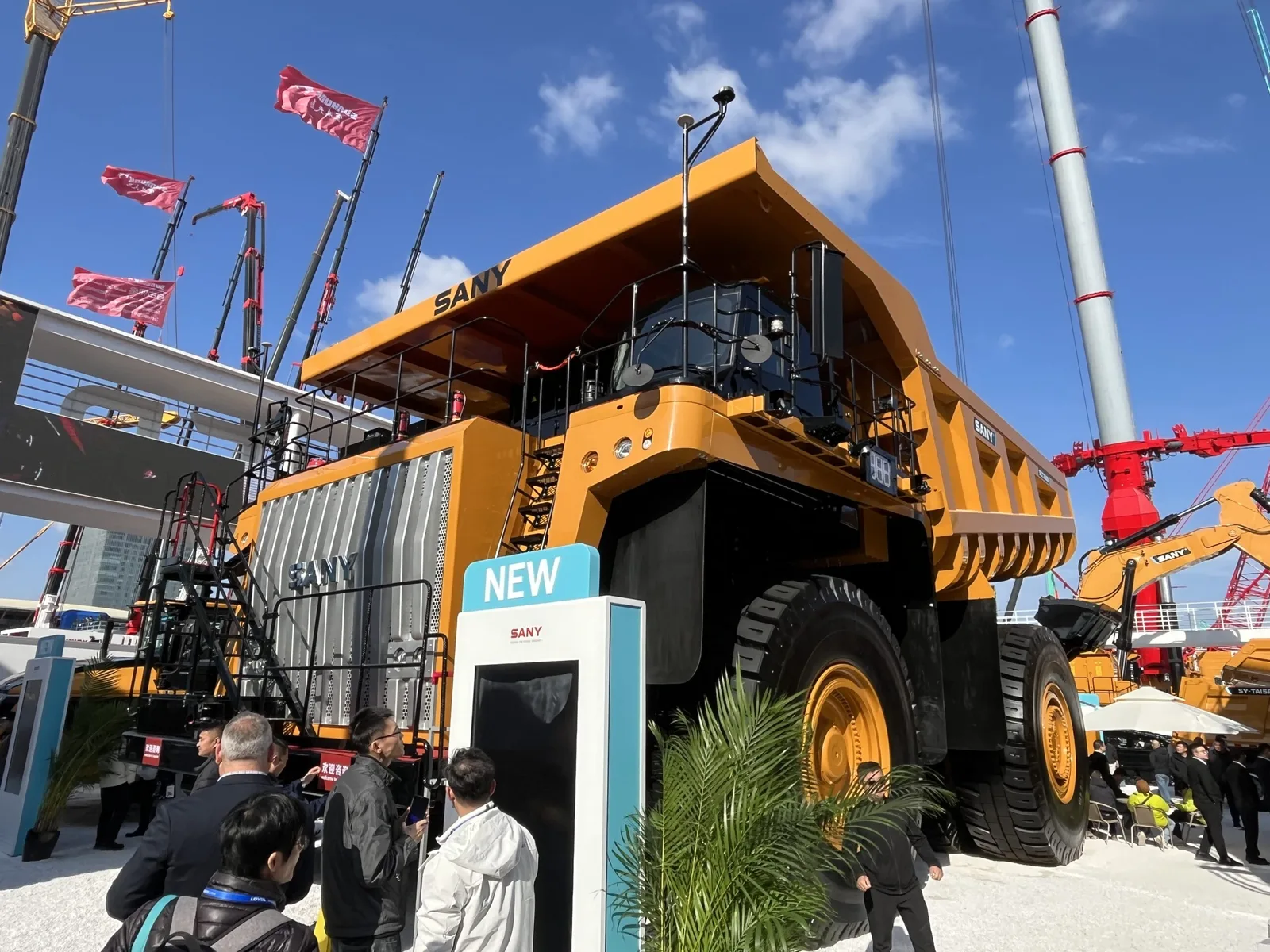
At bauma CHINA this week, SANY has a number of interesting product and technology launches but the big hitter is definitely the SET260E, a 240-tonne battery-electric mining truck on a 1,500-volt platform.
SANY has seen a lot of interest, and has quite a few operators, for its large hybrid mining trucks – notably the SET150S and SET220S – and at bauma CHINA it also has the 95 t class SRT100S hybrid rigid dump truck, it says the world’s first hybrid rigid dump truck with twin engines and direct motor drive. The SRT100S is driven by three electric motors with no gearbox. Two engines and a traction battery supply the power, with the engines held in their most efficient range and braking energy recovered by the motors. SANY puts the fuel saving at more than 20%.
But the SET260E brings it firmly into the all electric large rigid truck space; and obviously gives it a direct competitor to XCMG’s all electric XDE260E, which has also been officially launched at the event ahead of its ongoing extensive testing and eventual delivery to Fortescue and others.
SANY’s SET260E is hailed as the “world’s largest” battery electric mining truck – carrying 240 tonnes on battery power alone. It says its lithium iron phosphate battery was developed for heavy-duty mining: 4,130 kWh on a 1,500-volt platform, charging at up to 9 MW and going from 10 to 90% in 30 minutes, for more than six hours of hauling. As a comparison, Caterpillar’s 793 XE Early Learner has a 227 t payload.
Other highlights include electric braking of more than 3 MW continuous: regenerative first, with a seamless switch to resistor braking; wet brakes on the front axle, and combined service and parking wet brakes on the rear axle; a battery pack built to withstand vibration and impact in mine conditions; integrated thermal management; high-voltage direct drive of power components; plus traction control, automatic payload weighing and 360° camera view.
Next on SANY’s launch list this week is the SKT165Ei cabless autonomous electric mining truck, hailed as the industry’s first 100 t class battery-electric wide-body truck with wet brakes. The SKT165Ei is a battery-electric wide-body mining truck built for autonomous operation from the outset, with no driver’s cab. SANY says that removing the cab raises the payload ratio by 12%. It runs on an 800-volt platform with a 2C fast-charge battery and recharges in under 35 minutes. An autonomous haulage system handles loading, hauling and dumping, with dispatch and monitoring through a cloud
control platform.
Other highlights for this cabless model include a high-power powertrain with central drive; electric braking plus wet brakes for loaded downhill hauls; an autonomous haulage system with cloud dispatch and integrated monitoring; and the ability to complete the load-haul-dump cycle even with weak network coverage.
This model is complemented by the SKT115Ei autonomous electric wide-body mining truck, a 70-t class electric wide-body truck with a full autonomous driving system – noting that all these autonomous models are using SANY’s own AHS as opposed to a third party system.
SANY: “The SKT115Ei is the world’s first 70-tonne-class battery-electric wide-body truck with uninterrupted power delivery, and it is built to drive itself. Its fused sensors see more than 150 m ahead, pick out small obstacles from 40 m away and keep working in rain, snow, fog and dust. LiDAR, GNSS and inertial data are combined for continuous centimetre-level positioning, switching automatically when satellite signals are blocked. The truck is dispatched and monitored from the cloud, and completes loading, hauling and dumping even where network coverage is weak.”
It has two domain controllers bringing 400 TOPS computing-power and functional-safety requirements; fused perception vis LiDAR, cameras and radar cover 360° around the truck; fused positioning at centimetre-level, even when satellite signals are blocked; vehicle-cloud coordination and on-board intelligence with cloud dispatch and monitoring; plus redundancy via vehicle-to-vehicle links and on-board perception to cross-check each other.
In excavators, SANY has its SY4000E electric mining excavator, “China’s first” dual-motor hydraulic mining excavator driven by two 700 kW electric motors. The SY4000E is a 400-tonne-class hydraulic mining excavator with a 22 m³ bucket. The two independently driven 700 kW motors power the machine, and it can keep working if one motor is out of service. SANY supplies it together with the power infrastructure it needs, from the substation to the cable reel on the machine.
In more detail, the motors have an electronically controlled multi-pump, multi-valve hydraulic system and the machine offers fully electronically controlled hydraulics with flow of up to 6,000 L/min. It also has a3D assisted-digging system with centimetre-level accuracy, payload weighing, electronic fencing and driver monitoring, plus a 360° view with pedestrian-approach alarm, and a rear camera that monitors the trailing cable. The complete power supply package includes cable reel, junction box, cable-handling vehicle, mobile energy storage and mobile generator.
Other excavators in the larger sizes at the event include the SY1650E, a 165 t hydraulic mining excavator driven by a 630 kW electric motor and supplied from a 6 kV grid connection. It suits mines where the excavator stays in one working area for long periods. SANY also supplies the cable reels, cable-handling vehicles and mobile power units needed to run it.
Then it is also showcasing the 87 t class SY870E, also built for mining and coming in two versions: cable-fed, or dual-power with a 207 kWh battery added. A 400 kW permanent-magnet motor runs on a 1 kV electric drive system. A spring-loaded reel pays out and rewinds up to 35 m of cable automatically, and the dual-power version travels more than 2 km on battery alone to move between working areas. The machine can be fed from the grid or from a mobile power unit.
Finally in ancillary machines is the STG335E, a 34.8 t battery-electric motor grader built for mine haul roads. Its 528 kWh battery charges in about an hour and supports six to ten hours of work, enough for sites that run 16 hours or more a day. An automated manual transmission with energy recovery is matched to the electric drive.