NVIDIA without Huang: The winners and losers
NVIDIA has had a rocky few weeks.
By the time Jensen Huang resigned last Thursday, NVIDIA shares had fallen ~30% from their October peak.
Then came earnings. Revenue more than doubled to $115.8B, beating expectations, and NVIDIA projects $130B this quarter.
The business is fine, so the sell-off is really about Huang.
Under him, NVIDIA also became one of AI’s most active investors, backing 144 startup rounds this year alone. When he resigned, NVIDIA was linked to roughly $9B worth of rumored or pending rounds. Those deals may now be up in the air.
We used CB Insights data to map where the kingmaker’s exit leaves the AI landscape. Here’s who’s up and who’s in a tough spot.
This brief is adapted from our weekly newsletter. Sign up here to get it in your inbox every Thursday.
Winner: AMD
Talk about timing. The day after NVIDIA announced Huang’s exit, AMD closed its deal for NVentures-backed 3D world model startup World Labs. It’s AMD’s third acquisition this year, after AI chip startup Taalas and memory software company MEXT.ai.
AMD also sits next to NVIDIA on cap tables. More than a third of its nearly 30 deals this year included NVIDIA. If NVIDIA pulls back, AMD could be the only chipmaker left on some of them.
NVIDIA’s edge has never been just chips. It’s also CUDA, the software that makes switching costly, and the startups it backs that build on it. While AMD won’t close the software gap quickly, it can back the companies NVIDIA hasn’t.
Its biggest opening may be specialized AI model developers. We found 50+ that neither chipmaker has backed and that are due to raise soon, per our Funding Window algorithm. That includes:
- Cradle (protein design company)
- Tavus (builds AI models for real-time video conversations)
- Tennr (develops models that read medical paperwork)
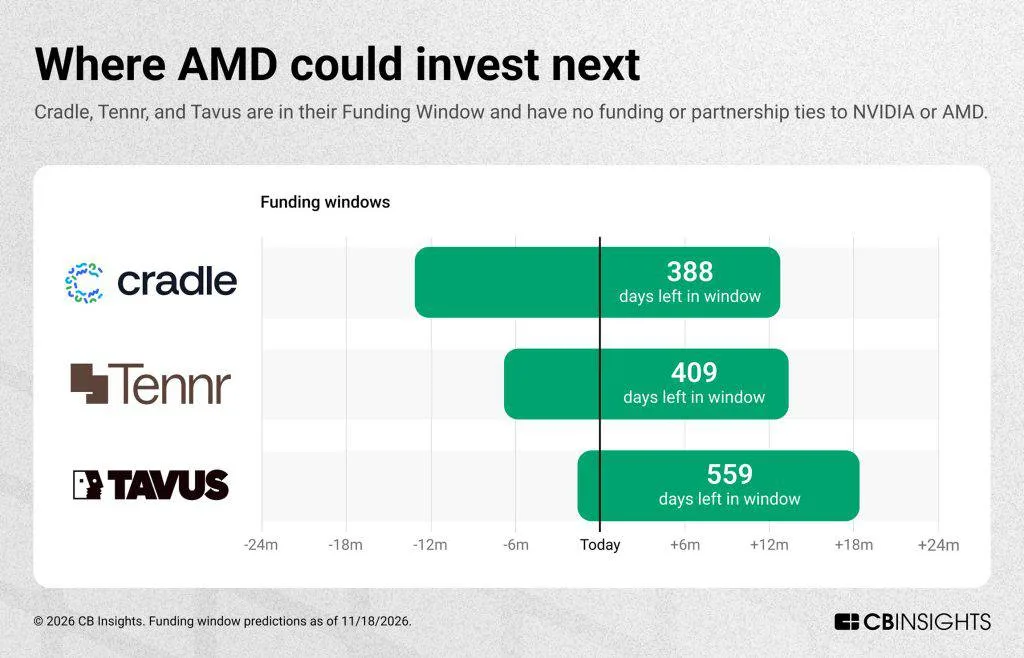
All three rent computing power from cloud providers, so AMD could steer that spending toward clouds that run on its chips.
Loser (for now): Chinese AI labs
Chinese AI labs just hit another roadblock to NVIDIA’s best chips.
After the fallout from NVIDIA’s ties to Megaspeed, the US restricted overseas data centers that let Chinese companies rent advanced computing power instead of buying restricted chips. That workaround was already happening at scale:
- Moonshot AI sought access to clusters of over 8K NVIDIA Blackwell GPUs in Europe, mainly for inference.
- ByteDance planned to tap roughly 36K NVIDIA B200 chips through Aolani Cloud in Malaysia. Banks have paused a $480M loan for the project.
- Alibaba Cloud reportedly trained Qwen models in Southeast Asian data centers.
Companies can still seek licenses, but the rules could make advanced models harder and more expensive to train and run. That opens a door for Chinese chipmakers like Huawei and Cambricon as developers look for domestic alternatives.
Winner: NVIDIA’s private challengers
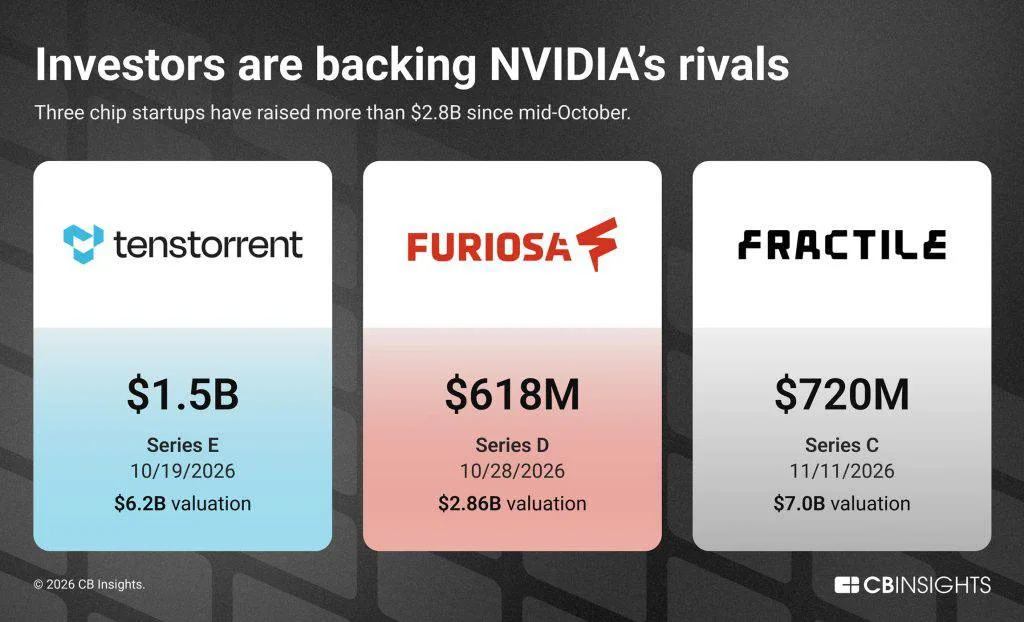
Investors were already betting on NVIDIA alternatives before Huang left. Since mid-October:
- Tenstorrent raised a $1.5B Series E at a $6.2B valuation. CEO Jim Keller designed processors for AMD, Apple, and Tesla.
- FuriosaAI raised a $618M Series D at a $2.86B valuation. LG uses its chips to power its AI models.
- Fractile raised a $720M Series C at a $7B valuation the day before Huang resigned. It builds chips that run large language models faster and cheaper.
Customer demand for alternatives was building before the recent funding wave. A year ago, CB Insights partnership and hiring data showed AI companies still choosing NVIDIA for speed and reliability but increasingly adding a second chip supplier when availability or cost mattered.
Loser: NVIDIA-backed startups that need to raise
Some of NVIDIA’s portfolio is heading to market at an awkward moment.
There are 63 private NVIDIA-backed companies in their predicted raise window right now, including:
- Thinking Machines Lab, whose last round in March was backed only by NVIDIA, and which has a reported $5B raise with NVIDIA attached still pending
- Cartesia, whose $100M round in October 2025 included NVIDIA
- Harmonic, whose $120M Series C in November 2025 included NVIDIA
They’ll be pitching while their strategic investor’s appetite is an open question. Other investors can fill the gap, but a round without NVIDIA’s name on it may price lower.
Winner: Startups founded by NVIDIA alumni
If Huang’s exit shakes loose NVIDIA talent, startups led by NVIDIA alumni are best placed to recruit their old colleagues. Some are already hiring fast:
- Blitzy (AI software development): CTO and co-founder Siddhant Pardeshi spent six years as an NVIDIA software architect. Headcount is up 462% in a year to 236, with 41 open roles.
- Flexion Robotics (humanoid robot software): CTO and co-founder David Hoeller spent seven years in NVIDIA research. Headcount has more than doubled in a year to 70.
- Dream Labs (generative AI models): CTO and co-founder Yunhao Ge left NVIDIA research in April, and the company has already raised $90M.
Loser: NVIDIA’s cloud partners
Neoclouds, the companies that rent out NVIDIA GPUs to AI developers, took some of the hardest hits.
- CoreWeave fell as much as 14% the day Huang resigned
- Nebius dropped about 20% in premarket trading (on top of its own weak guidance)
The concern is that NVIDIA is both their supplier and one of their biggest backers. That makes neoclouds a leveraged bet on NVIDIA.
And there’s a lot of money riding on this. Neocloud startups have raised $15B in equity funding so far this year, more than double what they raised in all of 2025, with NVIDIA backing 1 in 3 companies driving the boom.
Not every neocloud is tied to NVIDIA, though. TensorWave runs entirely on AMD chips, and AMD Ventures co-led its $350M Series B in June.
The question now is whether interim CEO Colette Kress keeps writing checks to NVIDIA’s customers or pulls back. That will tell us whether the kingmaker era is over, at least until NVIDIA names a new CEO.