Crypto Market Update: Second Longest Losing Streak Keeps Bitcoin on Edge

Get the latest insights on Bitcoin, Ether and altcoins, along with a round-up of key cryptocurrency market news.
Here's a quick recap of the crypto landscape for Monday (November 23) as of 10 p.m. UTC.
Bitcoin price update
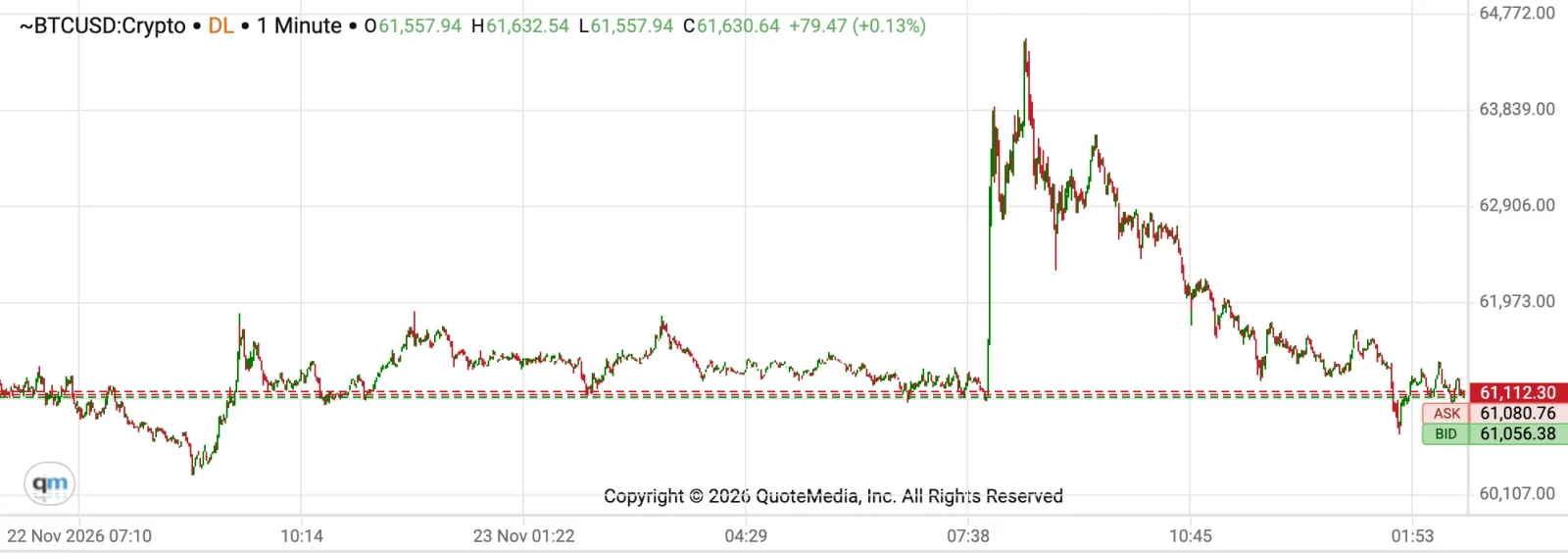
Bitcoin (BTC) was priced at US$61,070.81, trading 0.8 percent higher over the past 24 hours.
After bottoming out near US$55,500 on November 21, Bitcoin recovered back above US$61,000 over the weekend and traded higher this morning alongside gains in US stock futures.
Despite the weekend recovery, analysts at Bitfire Research caution that the relief rally is technical and that the broader downtrend in Bitcoin remains intact. The crypto sector is facing ongoing macroeconomic pressures, including expectations of tighter US Federal Reserve policy, with remarks from Fed governors Christopher Waller and Lisa Cook keeping market odds of a 25 basis point rate hike at the December 8 to 9 meeting high, alongside heavy selling across artificial intelligence names and continued spot Bitcoin exchange-traded fund (ETF) net outflows.
From a technical perspective, Bitfire notes that Bitcoin remains below its seven and 20 day exponential moving averages, which are US$62,416 and US$67,886, respectively. Analysts at the firm say that while an oversold relative strength index leaves room for a potential move toward US$65,000 if US$62,416 holds, a breakdown below support between US$55,150 and US$56,100 could risk a drop toward US$50,000.
Bitcoin price chart
Ether and altcoin price update
- Ethereum (ETH) was priced at US$1,720.74, trading 0.9 percent higher over the last 24 hours.
- XRP (XRP) was priced at US$0.94, trading 1.6 percent higher over the past 24 hours.
- Solana (SOL) was trading at US$72.64, trading 3.8 percent higher over the past 24 hours.
Today's crypto news to know
Read on for a round-up of the biggest crypto market news:
- Strategy taps dividend reserve, lifts buyback cap to US$4 billion
- Cardano Foundation's 2027 events request trails five to one
- Ethereum’s Glamsterdam upgrade delayed to 2027
- South Korea moves to restrict crypto withdrawals
- Europe’s central bank opens the door to blockchain-based assets
- OKXICE launches onchain tokenized stock trading
Strategy taps dividend reserve, lifts buyback cap to US$4 billion
Michael Saylor's Strategy (NASDAQ:MSTR) has freed up US$1 billion from the pool it keeps for preferred dividends and debt interest, giving management more room for Bitcoin purchases and other capital management.
The move comes a week before MSCI drops the company's stock from its flagship US index.
The board announced on Monday that it has approved moving up to US$1 billion from its USD Reserve into USD Cash, an account management can spend from more freely.
The reserve now stands at US$3.73 billion, down from US$4.77 billion on November 8, and the cash account holds US$1.09 billion. Preferred dividends took another US$17.6 million out of the reserve last week.
Strategy spent US$211.8 million in the same week buying back 2,183,747 shares of STRC, its variable-rate preferred stock, after spending US$228 million the week before. To pay for it, the company sold 1,925,676 MSTR shares for US$176.7 million. Of that, US$147 million went to the buyback; the remainding US$64.8 million came out of USD Cash.
Those two weeks of STRC purchases, roughly US$440 million in total, left only about US$120 million in the preferred buyback program. The board has now raised the program's cap to US$4 billion from US$3 billion, its second increase since October, putting US$1.12 billion back on the table.
A separate program for MSTR stock still has US$1 billion available.
The MSTR sale also funded the purchase of 457 BTC, which Strategy bought for US$29.6 million at roughly US$64,898 per coin, marking its fourth weekly purchase in a row. The company's Bitcoin stack now totals 851,305 BTC, which cost US$64.23 billion, or about US$75,446 per coin on average.
Bitcoin touched US$55,298 over the weekend, its weakest point since September 2024.
MSCI will remove Strategy from its MSCI USA Index after the close on November 30, a change that will also pull the stock out of wider benchmarks, including the MSCI World index.
Strategy estimates that MSCI-tracking funds own about 13 million of its shares.
Cardano Foundation's 2027 events request trails five to one
A Cardano Foundation request for nearly 25 million ADA to fund next year's conference is trailing by more than five to one in the network's onchain vote, as delegates press for evidence that past event spending paid off.
As of Monday morning in Asia, representatives holding about 741.7 million ADA had voted against it, compared with 140.8 million ADA in support. One delegate, YUTA, accounts for about 482.5 million ADA of the opposition, roughly 65 percent. The proposal lapses on December 20 unless it wins the required approvals.
YUTA's written explanation questions whether earlier conference spending delivered more transactions, more fees or developers who stayed, and asks for customers or partnerships traceable to event introductions. Some argued that contacts, collaboration talks and wallet signups fall short of proving lasting demand.
"I need verifiable evidence connecting previous spending to adoption and real-world usage," the delegate wrote.
Others object to who pays and how, adding conference promotion already falls within the foundation's remit while calling on the foundation to cover the roughly US$2 million in sponsorship costs from its own budget or justify why it can't, and to commission an independent review of its last program.
The foundation filed the request, titled "Cardano Global Events 2027," on November 16. It covers booths and sponsorships at 12 conferences, plus side events, four hackathons and travel for Cardano projects that join.
At current prices the request is worth about US$3.6 million. The foundation built its roughly US$5 million budget on ADA trading at 20 cents and says it would cut or cancel events if the payout comes in short.
Ethereum’s Glamsterdam upgrade delayed to 2027
Ethereum core developers have confirmed that the network’s Glamsterdam upgrade, originally scheduled for December, has been delayed to 2027 to resolve a smart contract compatibility issue.
The delay stems from two gas-repricing proposals (EIP-8037 and EIP-8038) designed to separate long-term data storage costs from transaction fees. Under EIP-8037, the base cost to deploy a new smart contract jumps nearly sixfold from 32,000 to 183,600 gas. Audits by ChainSecurity and Dedaub uncovered 200 distinct vulnerability patterns across older smart contracts that rely on hardcoded gas limits; under the new pricing, sub-transactions within these contracts could silently run out of gas and fail while the main transaction keeps running, creating potential security exploits.
Ethereum Foundation developer Marius van der Wijden estimates that 10,000 to 15,000 live contracts could be affected.
During a core developer call on November 19, teams split over whether to make apps patch their code or rewrite Ethereum’s upgrade rules, leaving three launch windows:
- Late January to February 2027: This path keeps the current upgrade rules intact while giving high-risk apps until mid-December, and medium-risk apps until January 10 to patch their contracts.
- Late February to March 2027: If developers wait until January to assess whether apps patched in time before making minor rule adjustments.
- April to May 2027: This path immediately rewrites or drops EIP-8037 to protect legacy contracts, forcing a full reset of engineering and testing cycles.
The setback has renewed scrutiny over Ethereum’s upgrade process after Glamsterdam underwent 10 specification changes in six weeks. Meanwhile, developers are already debating scaling back the scope of Ethereum’s subsequent hard fork, Hegotá, to ensure post-quantum security upgrades stay on schedule.
South Korea moves to restrict crypto withdrawals
South Korean crypto users sending coins to a private wallet will generally have to own that wallet themselves, under tighter transfer rules regulators reported on Monday. Regulators could block transfers to overseas exchanges they consider high-risk outright, while withdrawals to other foreign platforms would face closer scrutiny. Local crypto firms will need systems that flag suspicious transactions of 10 million won or more.
Financial Services Commission Chairman Lee Eog-won set out the measures in Seoul at an event marking the Korea Financial Intelligence Unit's 25th anniversary and the 20th Anti-Money Laundering Day. He said the government will "significantly strengthen reporting and screening of virtual asset service providers."
The push extends August rule changes that raised standards for crypto firms and broadened anti-money laundering checks on transfers. It also follows October action against offshore platforms operating without Korean registration, when regulators moved to block the websites of 27 exchanges, including KuCoin, BitMart and MEXC. MEXC also faces a FinCEN order cutting it off from the US financial system.
Europe’s central bank opens the door to blockchain-based assets
Starting in June 2027, the European Central Bank (ECB) will permit commercial banks to use financial assets on distributed ledger technology as collateral for central bank borrowing.
Commercial banks must pledge high-quality assets such as bonds to secure ECB cash loans. Previously, eligible collateral was restricted to traditional banking databases. By accepting tokenized assets on licensed DLT platforms, the ECB bridges traditional banking with digital finance while maintaining strict safety standards.
To qualify as collateral, digital assets must meet specific safety criteria:
- Issued on platforms approved under the EU’s DLT Pilot Regime.
- Linked to a traditional Central Securities Depository and settled via TARGET2-Securities.
- Ensure legal certainty, finality of settlement, and sound operational risk management.
The ECB will publish technical and legal rules in Spring 2027 ahead of the June launch, while exploring future support for fully native blockchain assets.
OKXICE launches onchain tokenized stock trading
OKXICE, a joint venture between OKX and NYSE parent Intercontinental Exchange (NYSE:ICE), opened onchain trading on Monday at 12:00 p.m. EST under the US Securities and Exchange Commission's five year innovation exemption.
The platform launched with 113 confirmed assets and participation from firms including Fidelity, eToro (NASDAQ:ETOR), Strive (NASDAQ:ASST) and Vida Global (NYSEAMERICAN:VIDA), alongside Direxion’s plans to bring 59 ETFs. However, the rollout is facing notable corporate pushback: 56 of the 62 first selected companies have opted out, including major names like Apple (NASDAQ:AAPL), Microsoft (NASDAQ:MSFT), NVIDIA (NASDAQ:NVDA) and JPMorgan Chase (NYSE:JPM).
Don't forget to follow us @INN_Technology for real-time news updates!
Securities Disclosure: I, Giann Liguid, hold no direct investment interest in any company mentioned in this article.
Securities Disclosure: I, Meagen Seatter, hold no direct investment interest in any company mentioned in this article.