19 companies founded in 2026 are already unicorns. Here’s what investors are paying for.
AI assistant startup Town just raised a $108M Series B, hitting a billion-dollar valuation four months after its public launch. Great news for everyone worried investors were taking their time.
Nineteen companies founded in 2026 have already become unicorns, with a combined valuation of $60.5B. For context, the median time to unicorn for AI companies that hit $1B this year took 3.4 years. These 19 did it in months.
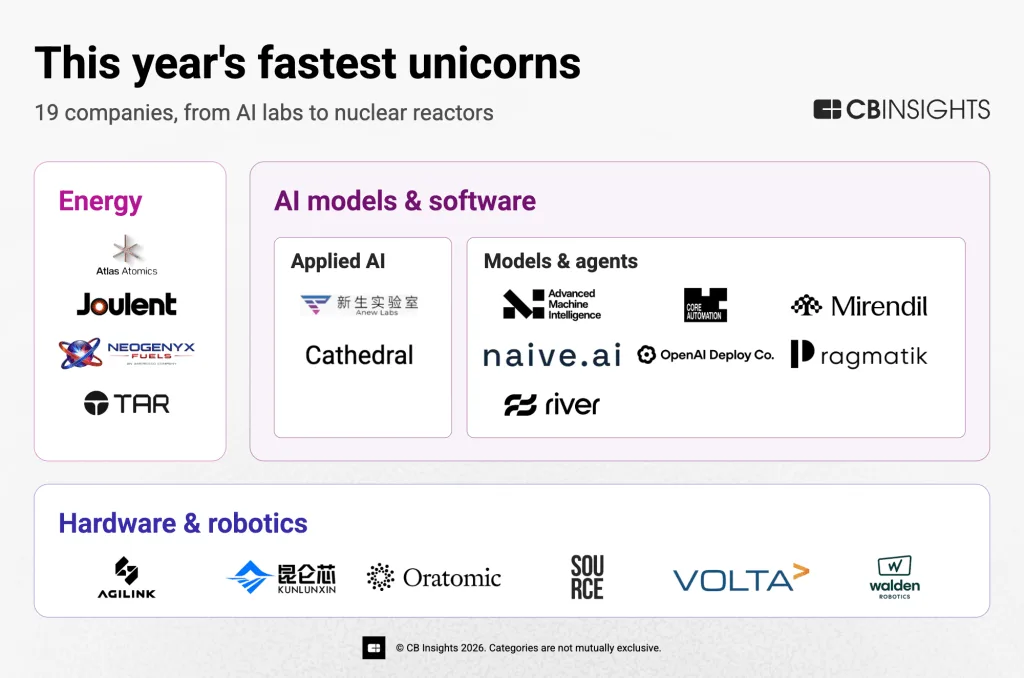
We looked at what investors are paying for, from famous AI researchers to power plants that haven’t opened yet.
This brief is adapted from our weekly newsletter. Sign up here to get it in your inbox every Thursday.
Nice resume. Here’s a billion dollars.
Four AI labs on the list are led by researchers who left OpenAI, Anthropic, Meta, or xAI:
- AMI Labs is Yann LeCun’s post-Meta lab, building AI that learns how the physical world works from video. It raised $1B at a $4.5B valuation. Its CEO says commercialization is years away.
- River AI gives developers tools to train their own models. xAI co-founder Igor Babuschkin raised $1.1B at a $5B valuation, and its API has been live since June. At least developers can actually use River’s product.
Core Automation (ex-OpenAI) and Mirendil (ex-Anthropic) are both building AI that does AI research. Core went from a $1B valuation to a reported $4B target in weeks with no product or revenue. Mirendil is reportedly in talks at $5B, three months after hitting a $1B valuation.
No power yet
A data center takes one to two years to build. Connecting it to the grid can take three to seven.
So AI companies are buying power and compute from whoever can deliver it sooner, and that’s turning brand-new suppliers into unicorns before they’ve delivered anything.
- Data center power developer Joulent has Microsoft locked in for 20 years of power from a 2.67GW gas plant with Chevron that won’t turn on until 2028. National Grid paid $1.75B for 35% of it, valuing Joulent at $5B.
- UK-based compute provider Volta signed a six-year, $10B contract with Anthropic. It raised $300M at $2.4B with NVIDIA as a co-lead, plus a $5B credit line the same day.
- Nuclear startup Atlas Atomics raised about $400M at $1.9B while still in stealth, with Vivek Ramaswamy as a backer and no disclosed customers.
Joulent is the one we’d defend: gas is proven, Chevron knows how to build it, and the buyer is locked in for two decades.
China is minting robot unicorns, minus the robot
Three of the five China-based unicorns on our list build robots or embodied AI. All three came out of big tech.
- Kunlunxing Robotics was founded in March by former Alibaba Cloud president Ren Geng and Li Auto’s former self-driving chief. Almost nothing about its product is public. Show us the robot.
- AGILINK is AgiBot’s robotic hand spinout, passed a $1B valuation in under 150 days. A billion dollars for a hand sounds absurd, and until we see those hands working full shifts at customer sites, we think it is.
- Pragmatik Labs builds AI agents for office work and for robots, and it hasn’t picked which business it’s in. Founder Junyang Lin previously ran Alibaba’s Qwen models.
The only US robotics company on our list, Walden Robotics, has humanoids working full shifts at a Toyota plant. It also spun out of Toyota Research Institute, and Toyota is its only customer. We’d like to see someone outside Toyota place an order before getting comfortable with the $1.1B price.
What does any of this mean?
These aren’t isolated incidents. The time it takes a company to reach unicorn status has been compressing for years, though nowhere near as quickly as what we’re seeing right now.
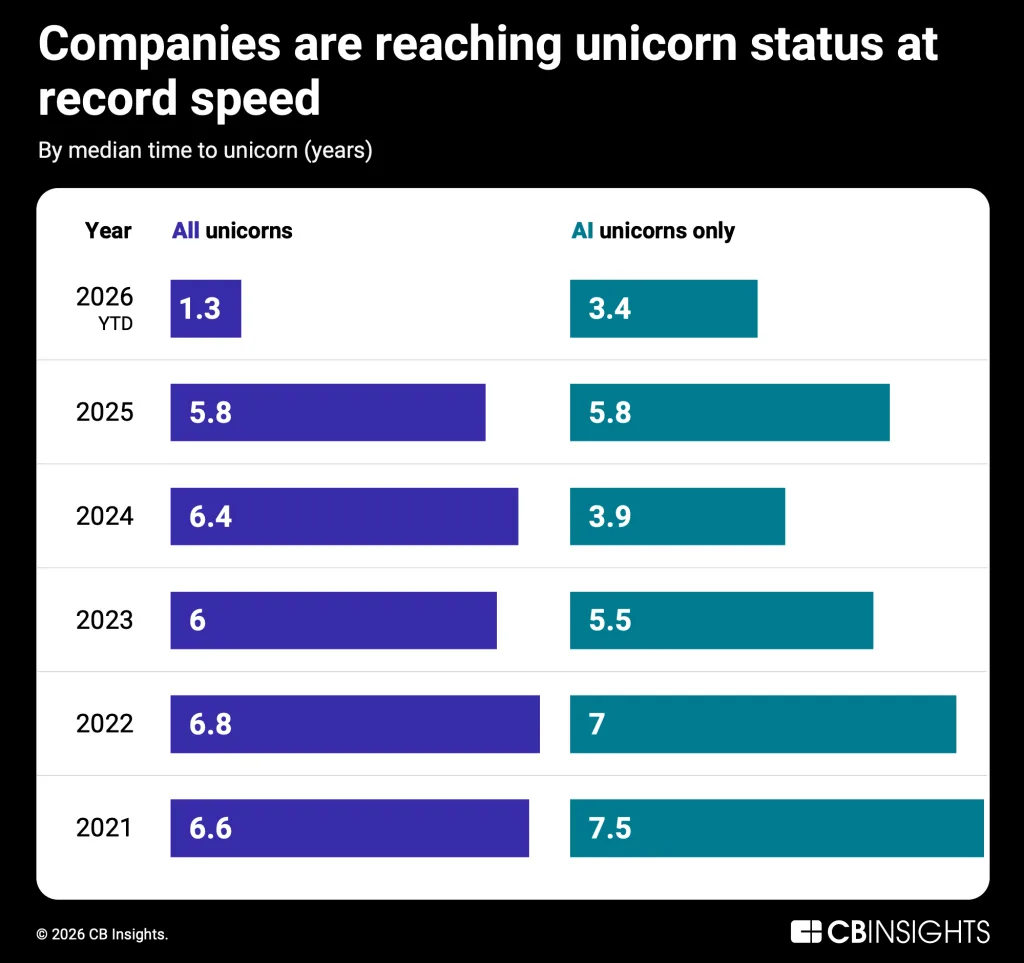
Turns out, you can now accomplish a lot before you turn 1.