Does the Stock Market Stigmatize Banks that Borrow from the Fed?
Natalia Fischl-Lanzoni, Martin Hiti, and Asani Sarkar
Banks may resist borrowing from the Federal Reserve during a panic if such borrowing is stigmatized (that is, viewed by the market as a sign of financial weakness), thus hampering the Fed’s ability to resolve the crisis. The problem may be particularly acute for publicly traded banks since their stock prices immediately reflect the market’s opinion of them. In this post, based on a recent paper, we track what happened to stock investors’ perceptions of a bank’s risk level right after it first borrowed from Fed facilities in the first month of the bank run of 2023. We find that, after a first trip to the Fed’s Discount Window (DW), investors became more sensitive to that bank’s weaknesses. In contrast, investors did not evince such concern when the bank took a first loan from a new facility, the Bank Term Funding Program (BTFP).
Two Ways to Borrow
In 2023, banks borrowing from the Fed had two places to turn: the traditional DW and the novel BTFP, announced at the start of the bank run on March 12, 2023. The DW accepts a wide range of collateral and provides short-term loans against the market value of the securities that a bank pledges. The BTFP provided loans of up to one year against the face value of high-quality securities that the Fed accepted in its open market operations—Treasuries, agency debt, and agency mortgage-backed securities.
Why Borrowing From the Fed Might Increase Risk Perceptions (or Not)
Borrowing from either facility is anonymous, with individual borrowers disclosed only after two years. Nevertheless, the problem of stigma has shadowed the Fed’s DW for decades, spiking during the 2007–08 financial crisis and resurfacing most recently around the bank run of spring 2023. If the same pattern held in 2023, a bank’s first borrowing would be bad news, and investors would grow more alert to bank risk. However, our paper shows that the announcement of the BTFP made investors less sensitized to the risks posed by the banks most likely to benefit from the BFTP. So, it’s possible that subsequent borrowing from any Fed facility would be less stigmatized.
Measuring Investor Perceptions About Bank Risk
To track investor risk perceptions, we build bank stock portfolios that isolate four balance sheet weaknesses: reliance on uninsured deposits, unrealized losses on securities, and size of cash holdings—all measured as a share of total assets—as well as the strength of banks’ capital. We then estimate a “beta” for each bank, where a higher beta means that each bank’s daily stock return moves more closely with each of those portfolios—i.e., investors become more sensitized to that particular bank risk (e.g. uninsured deposits). An earlier post describes this measure in more detail. The chart below shows that beta was statistically zero (i.e., the confidence interval straddles zero) before the bank run, implying that stock investors were relatively unconcerned about bank risk. Just before the run started (on March 7), the beta becomes positive and increases sharply – that is, investors became highly sensitized during the run.
Investor Perceptions of Bank Risk Suddenly Increased Around the 2023 Bank Run
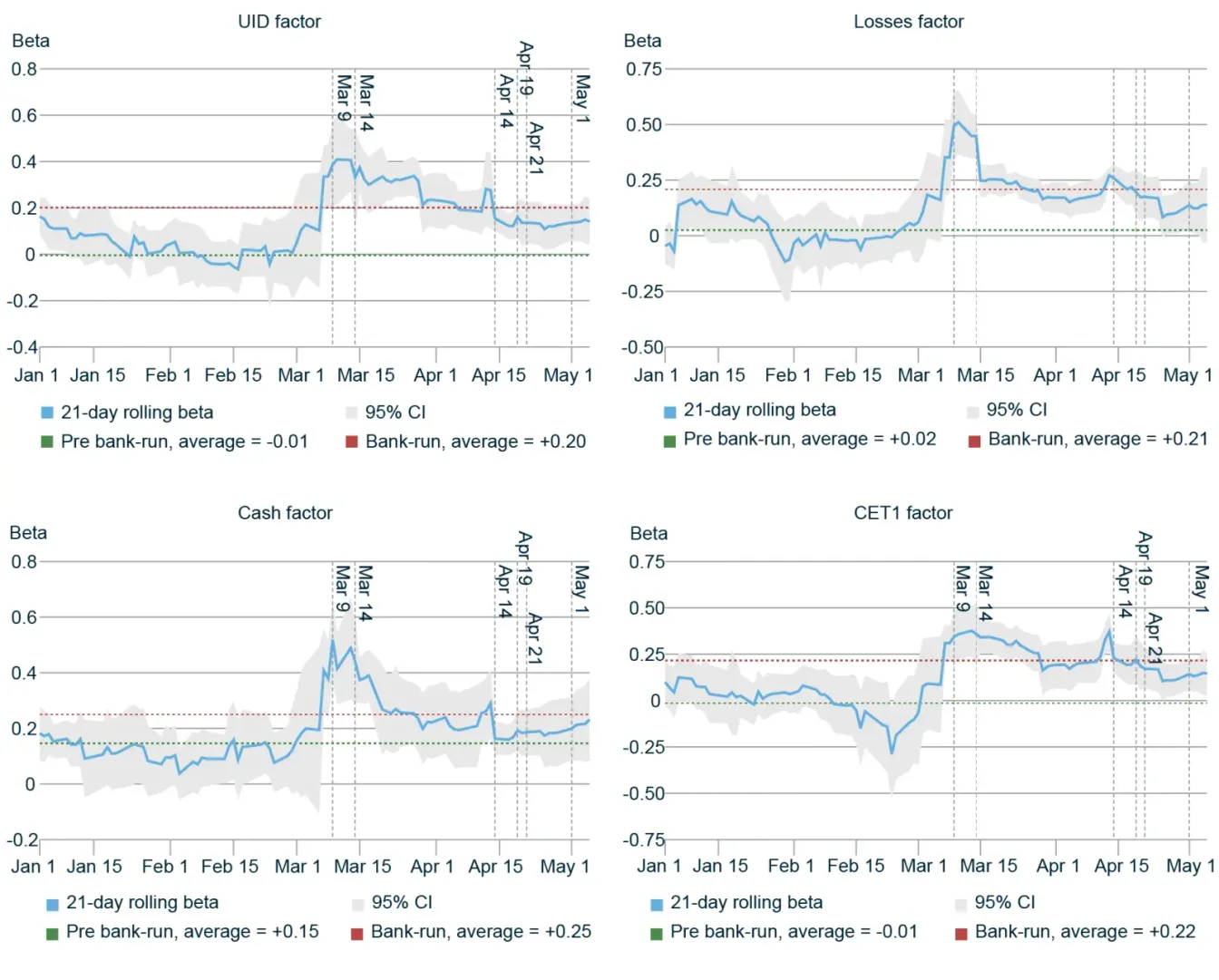
Notes: The chart shows the estimates of the UID and Losses betas (top panel) and cash and CET1 betas (bottom panel) using data from January 3 to May 5, 2023. UID is the uninsured deposit ratio; Losses is unrealized losses on securities; CET1 is the Common Equity Tier 1 ratio, a measure of the bank’s capital strength. The beta is a measure of stock investors’ perception of the bank’s exposure to a particular balance sheet risk (e.g. of high levels of UID). The line indicates the estimates, while the shaded areas indicate the 95 percent confidence interval of the estimates.
Stock Investors’ Reaction to First BTFP or DW Borrowings
For this comparison we focus on the moment a bank first borrowed, when new information is most likely to reach the market (since borrowing tends to be persistent). Between March 8 and March 31, 2023, 34 banks in our sample made a first draw on the BTFP and 33 on the DW; among these institutions, 10 used both facilities. We compare each borrower with the 207 banks that used neither facility, looking at the seven trading days on either side of that first loan. Because banks borrowed on different dates, we employ a statistical approach used for analysis where an event occurs with staggered timing.
After DW Borrowing, Investors Grew More Sensitized to Bank Risk
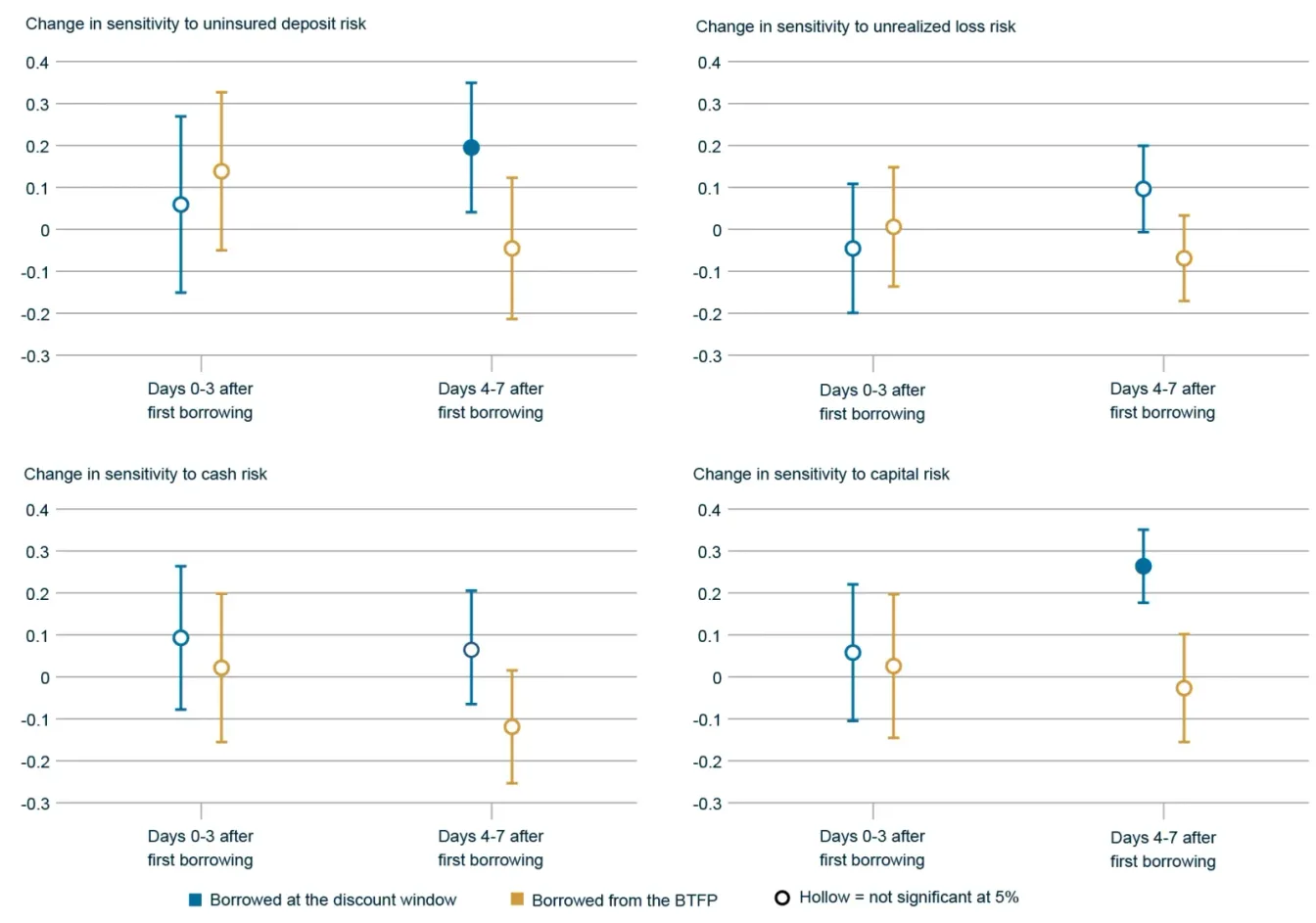
Notes: Each panel shows changes in stock investors’ perceptions of one type of bank balance-sheet risk (as measured by the bank’s beta) after the bank first borrowed from the DW (blue) or the BTFP (gold) between February 27 and April 11, 2023; banks that used both facilities are excluded from the chart. The four risks are uninsured deposits, unrealized losses on securities, cash, and capital. The change is measured relative to the bank’s own beta over the 7 trading days before borrowing and to banks that did not borrow. Vertical bars are 95 percent confidence intervals. A filled marker means the change is statistically significant at the 5 percent level, and a hollow marker means it is not. Bank stock returns and risk factor returns are standardized.
The chart above shows the change in the beta for borrowers following their first borrowings relative to non-borrowers and to the pre-borrowing period. For banks that used only the DW, investors’ sensitivity to uninsured deposits and bank capital rose (i.e., the beta increased) significantly 4-7 days after borrowing. Indeed, sensitivity to bank capital was higher over the entire 7- day period after the first DW loan. Sensitivity to bank capital also rose significantly in the days after the first DW loan (and grew larger in the second week).
For banks that used only the BTFP, there was no significant change in investor risk perceptions. Thus, investors did not penalize banks for using the BTFP.
Why the Two Facilities Might Differ
Part of the gap might simply reflect differences in the terms offered by each facility. A bank arriving at the DW with underwater bonds got market value for them; the same bonds at the BTFP got face value. Also, the borrowing rate at the BTFP was typically lower than at the DW. A bank willing to accept the worse deal may be one that had already exhausted better options, or that needed to pledge the illiquid loans only the DW would take—and investors could reasonably read the choice that way.
History probably matters, too. Shunned by banks for decades, the stigma surrounding the DW has only hardened over time, and the pattern in our data is consistent with such a reputation. Notably, DW borrowing was persistent: of the 48 banks that drew on the window during the period we study, about half borrowed more than once, and about a third of those returned repeatedly. The BTFP, by contrast, was new, carried no such history, and was aimed squarely at the specific problem banks faced in March 2023.
We caution that the head-to-head comparison between the two facilities is not statistically decisive.
Final Words
A lender-of-last-resort facility is more likely to work if banks are willing to use it. Our results suggest that banks that used the DW saw investors become more attentive to their vulnerabilities. However, seeking support from the BTFP, a newly created facility that was purpose-built for the crisis at hand and lent on more generous terms, drew no such reaction. This study examines small groups of banks observed over a handful of trading days in a single, fast-moving episode, and we cannot fully separate the signal a bank sends by borrowing from the reasons it needed to borrow. Still, the asymmetry is striking and may suggest that emergency programs designed to address a specific crisis, and not carrying the burden of history, are more likely to be successful.
Natalia Fischl-Lanzoni is a research assistant at MIT FutureTech and a masters student in computer science at NYU Courant.
Martin Hiti is a Ph.D. student at MIT Sloan School of Management.
Asani Sarkar is a financial research advisor in the Federal Reserve Bank of New York’s Research and Statistics Group.
How to cite this post:
Natalia Fischl-Lanzoni, Martin Hiti, and Asani Sarkar, “Does the Stock Market Stigmatize Banks that Borrow from the Fed?,” Federal Reserve Bank of New York Liberty Street Economics, November 17, 2026, https://doi.org/10.59576/lse.20261117 BibTeX: View | Download
 @article{Fischl-LanzoniHitiSarkar2026, author={Fischl-Lanzoni, Natalia and Hiti, Martin and Sarkar, Asani}, title={Does the Stock Market Stigmatize Banks that Borrow from the Fed?}, journal={Liberty Street Economics}, note={Liberty Street Economics Blog}, number={November 17}, year={2026}, url={https://doi.org/10.59576/lse.20261117}
}
You may also be interested in:
The Recent Rise in Discount Window Borrowing

Measuring the Ampleness of Reserves
How the Federal Reserve’s Monetary Policy Implementation Framework Has Evolved
Disclaimer
The views expressed in this post are those of the author(s) and do not necessarily reflect the position of the Federal Reserve Bank of New York or the Federal Reserve System. Any errors or omissions are the responsibility of the author(s).