Crypto Liquidations Top $628 Million in an Hour as Binance Hack Fears Sink Bitcoin

Crypto liquidations reached $627.7 million in a single hour late Thursday, $606.6 million of it on bets that prices would rise, Coinglass data shows. Bitcoin (BTC) fell below $79,000 and Ethereum (ETH) under $2,240 as traders reacted to an unexplained $2 billion outflow from Binance hot wallets.
Nobody has confirmed a hack, and Binance has not commented. The market priced the worst case anyway, and leveraged traders paid for it before any facts were established.
How Fast the Selling Hit
Bitcoin traded near $80,800 on Binance at 20:00 UTC, according to TradingView. By 20:35 UTC it had spiked down to about $78,300, a drop of around 3% in one candle, before bouncing back above $79,100.
ETH fared worse. It slid from roughly $2,335 to a low near $2,233, a fall of more than 4%, before recovering to about $2,263.
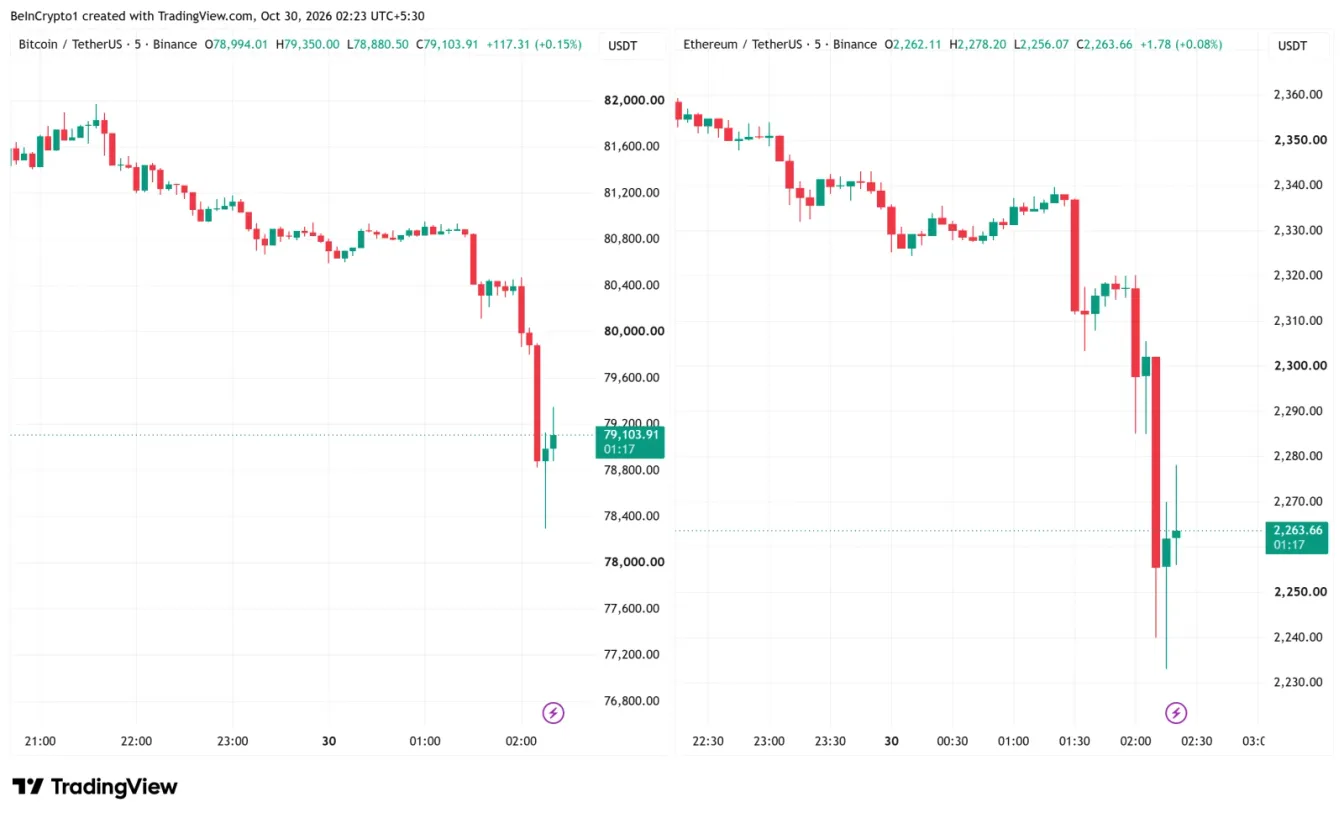
The timing lines up with the on-chain move. The first transfer out of the Binance 14 wallet landed at 20:24 UTC, and the sharpest price candles printed within the following 15 minutes.
Who Lost Money
A liquidation happens when a trader borrows to amplify a bet and the price moves far enough against them that the exchange closes the position by force.
Coinglass logged $189.1 million in Bitcoin positions and $156.8 million in ETH positions wiped out in the hour, with Solana (SOL) a distant third at $46.8 million.
Short sellers, who profit from falling prices, lost only $21.1 million. The single largest forced closure was an $11.09 million Bitcoin long on Binance at $79,254.
Binance itself carried $344.8 million of the hour’s liquidations, more than half the total. Hyperliquid followed at $97 million and Bybit at $77.3 million.
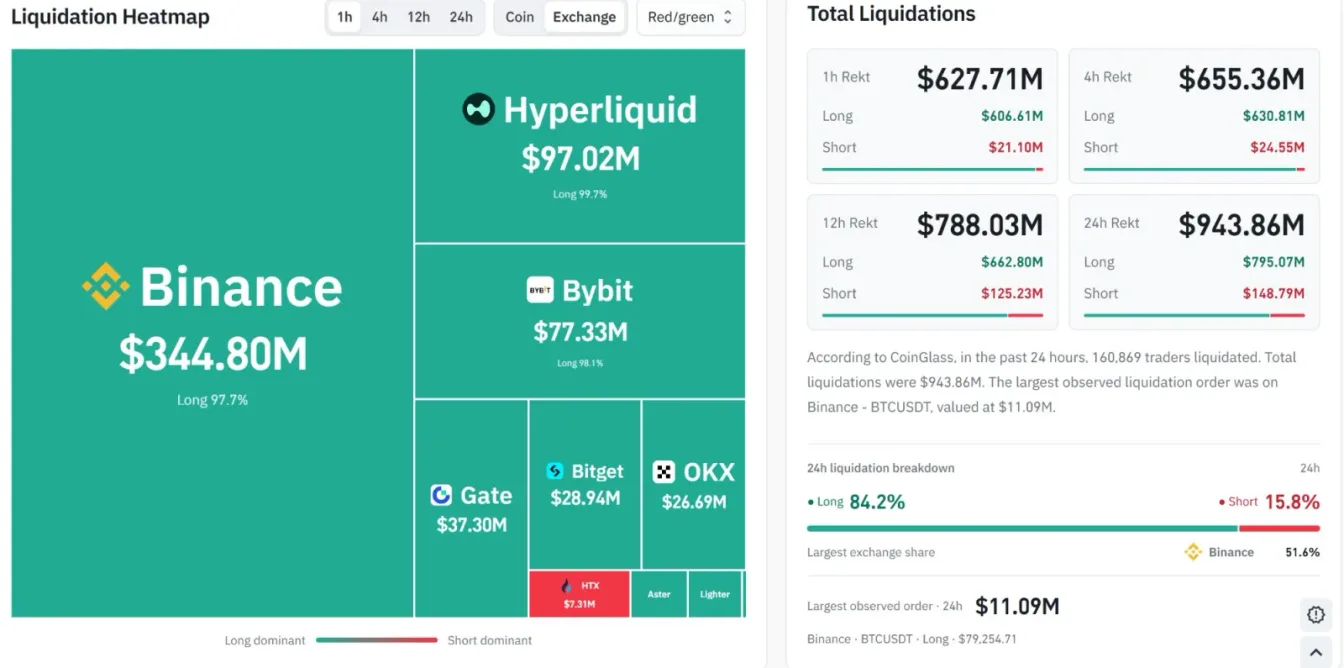
That is three times the $200 million unwind that pushed Bitcoin below $80,000 last Saturday. Over 24 hours, Coinglass counts 161,647 traders liquidated for $951.2 million, and two thirds of that damage came in the final hour.
Why the Market Sold First
Bitcoin was already fragile. It had failed to hold $83,000 last week, and analyst Benjamin Cowen’s bearish Q4 roadmap had traders watching $80,000 as the line that mattered.
A breach at Binance, the largest exchange by volume, would also carry a different risk from a DeFi exploit. Stolen exchange funds tend to get sold, and every fresh movement from the receiving addresses can move prices again until Binance explains the transfer.