Lightchain AI Sets Three-Month Plan for AI Agents and Pay-Per-Call Payments

Open models still trail the best closed systems, but they are usable for real work and far closer than they were. Lightchain AI’s next three months target what still holds open AI back: agents, payments and a network anyone can check.
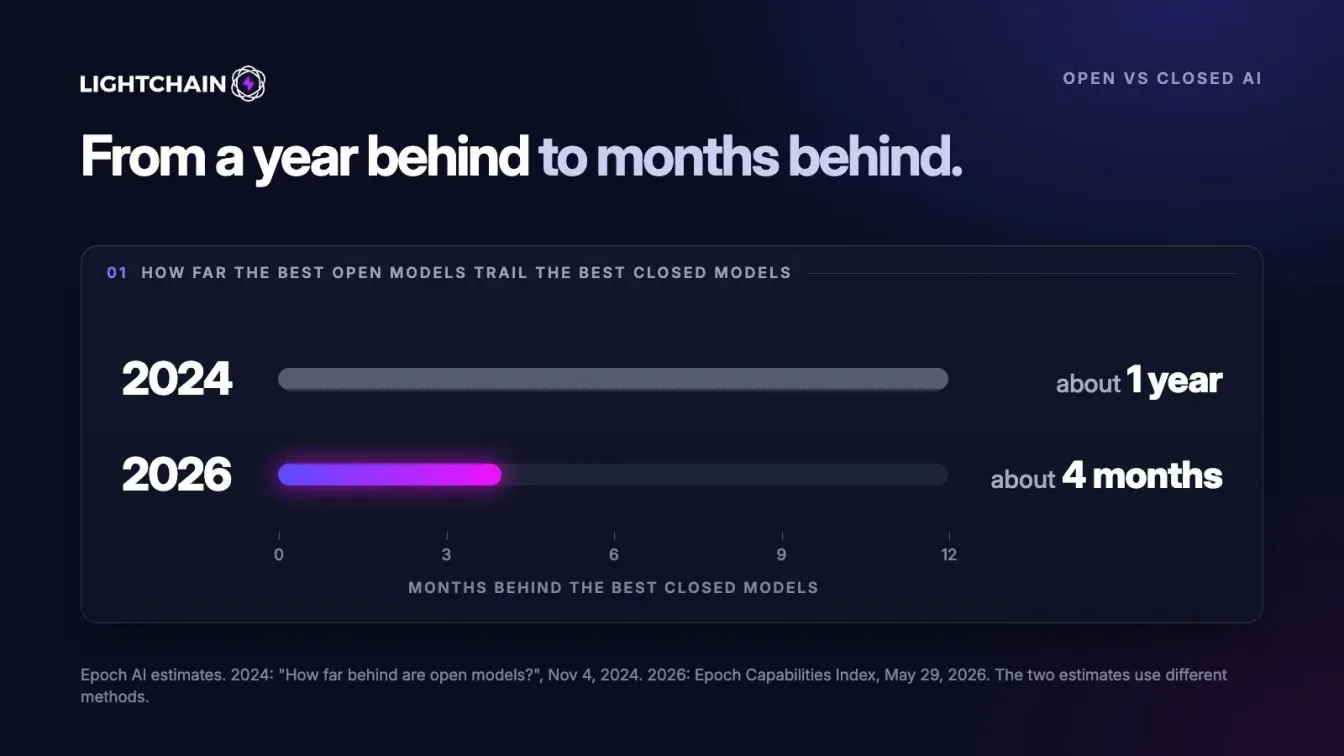
Open models are still behind the best closed systems, but the distance has changed. In 2024, the research group Epoch AI estimated that open models trailed the frontier by about a year. Its latest measure, published in May 2026, finds that since January 2026 the most capable open-weight models have trailed the best closed models by an average of four months. Open models such as OpenAI’s gpt-oss, Alibaba’s Qwen3 and Meta’s Llama are good enough to build real products on, and anyone can download, inspect and run them.
What closed AI still owns is everything around the model. One company runs the servers, takes the payment and builds the agents and tools that people use every day. Even an open model is only half open when a single company serves it, because that company can change it, reprice it or switch it off.
Lightchain AI is building the other half as an open network. Its plan for November 2026 to January 2027 brings the features closed platforms are known for, such as AI agents, pay-per-call payments and developer tools, to a blockchain where independent operators serve the models and every job leaves a public record.
An open network for open models
Lightchain AI is a layer-1 blockchain built for AI. Independent operators, called workers, serve open models from their own GPUs. The chain picks the worker for each job, holds the fee in escrow and keeps an onchain record of every job, with its job ID, its transaction and the worker that served it.
The network already serves 14 open models, from small Llama and Gemma models up to gpt-oss 120B and DeepSeek R1, each at a fixed fee per job. People use them through Lightchain Chat, the Lightchain Desktop beta and Lightchain Studio, an open-source code editor with a coding agent in which every prompt is a job on the chain.
Next: agents that anyone can call
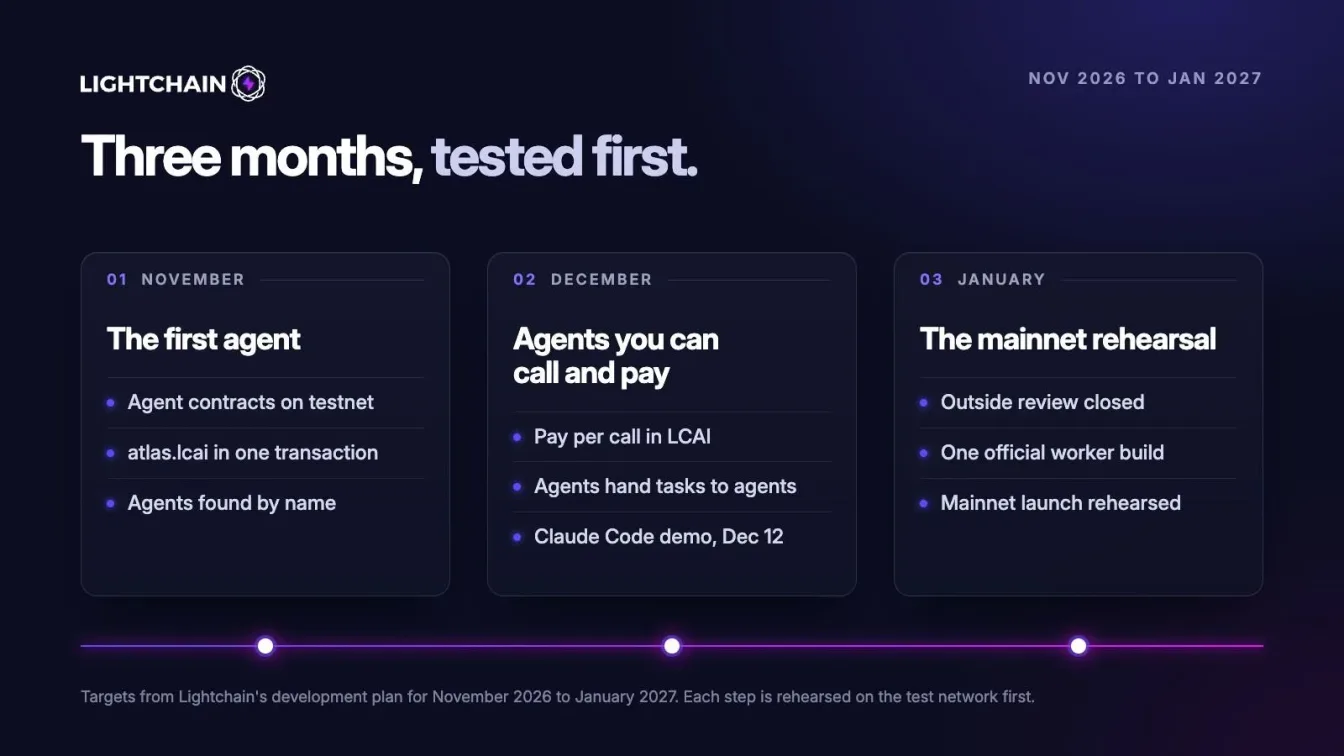
The largest AI companies are racing to build agents: AI services that take on tasks and work with other software. Lightchain’s three-month development plan brings agents to its own network, built and rehearsed on the test network first.
- November: the first agent. The agent contracts go live on the test network, and the first agent, atlas.lcai, is created in a single transaction. Each agent has its own name on the chain, so apps and other AIs can find it, call it and pay it, and a public gateway lets them look agents up by name.
- December: agents you can call and pay. Apps pay an agent in LCAI for each call, through the network’s x402-inspired pay-per-call payments, and each payment is tied to a single request. One agent can hand a task to another, and anyone can confirm that an answer came from the job it claims to come from. On December 12, a public demo calls an agent from Claude Code, Anthropic’s coding tool, and pays it from a script.
- January: the mainnet rehearsal. An outside review of the agent contracts is closed and its report published. An official worker build gives every operator the same model files and settings, and the full mainnet launch of the agents is rehearsed on the test network.
AI work that can be verified
With a closed AI provider, users have to trust that the work was done as promised. On Lightchain, every AI job leaves an onchain record of when it ran and which worker served it, the network re-runs jobs to check the answers, and any user can dispute an answer within 24 hours. The record shows that the work was done, not what was asked: prompts are encrypted before they reach the chain. The plan adds more checks:
- Every testnet job checked. From November, the disputer, the network’s checking service, re-runs every job on the test network, where on mainnet it re-runs a sample. By January it is to cover every model the network accepts.
- A network that keeps running. After a test network outage on November 8, the plan locks down public endpoints and gives every service a backup connection. In December the test network spreads its validators across seven or more servers at three or more providers, so losing two servers no longer stops the chain.
- Operator rewards anyone can verify. A grants program for the operators who run the network’s GPUs and nodes is being built in public. Uptime is logged every hour, grant tiers come from the jobs a worker actually served, and every grants run ends in a payout root, a single fingerprint of the whole payout list that anyone can recompute.
- Progress you can verify. Every deliverable is referenced by a transaction hash or address on the public testnet explorer, and the team posts a written update every week.
The dates in the plan are targets, and each step reaches mainnet only after its rehearsal on the test network.
The next gap is the platform
Open models are not level with closed AI yet, but they are close enough to build on. The gap that remains is the platform: who serves the model, who gets paid, and who can check the work. Lightchain’s next three months are its plan to close that gap in the open, with agents anyone can call, payments per call, and a public record that lets anyone verify each job.
About Lightchain AI
Lightchain AI is a layer-1 blockchain for AI. Independent operators stake LCAI and serve open models such as gpt-oss, Qwen3 and Llama from their own GPUs. The chain assigns each job, holds the fee in escrow and keeps a record of every job that anyone can look up. Products live today include Lightchain Chat, Lightchain Desktop (beta), Lightchain Studio, the Lightchain Bridge and the Lightscan explorer. The LCAI DUNA, a Wyoming association, is the project’s legal entity.
For more information, please visit: Website | X | Discord
This article is for informational purposes only and is not financial or investment advice.