BluVein entering ‘product’ territory after clocking up proving ground hours
One hundred and eleven kilometres. That’s the distance that has been travelled on BluVein Rail at the BluVein Proving Grounds to get the company’s fourth-generation dynamic charging system to Technology Readiness Level (TRL) 6.
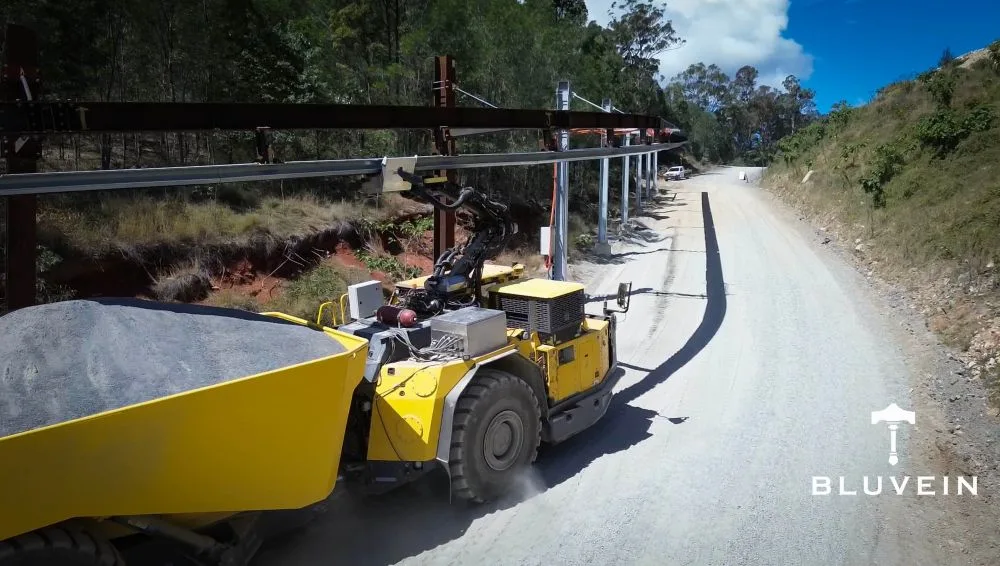
Between August 10 and September 30, there have been 2,158 test runs of the system, a combination of slotted overhead rail and the vehicle-attached hammer, at the grounds, situated just outside the southern pit of Heidelberg Materials’ Wolffdene quarry in Queensland.
Around 3 MWh of energy has been delivered over this timeframe, with almost 1 MW of power delivered to Epiroc’s battery-electric Minetruck MT42 SG at the system’s peak. Top on-ramp speed over this circa-seven-week period was 18.3 km/h.
All these stats, on top of the significant amount of ‘testing to failure’ safety trials to have taken place at KEMA Labs in Germany, has put BluVein front and centre of the dynamic charging ecosystem.
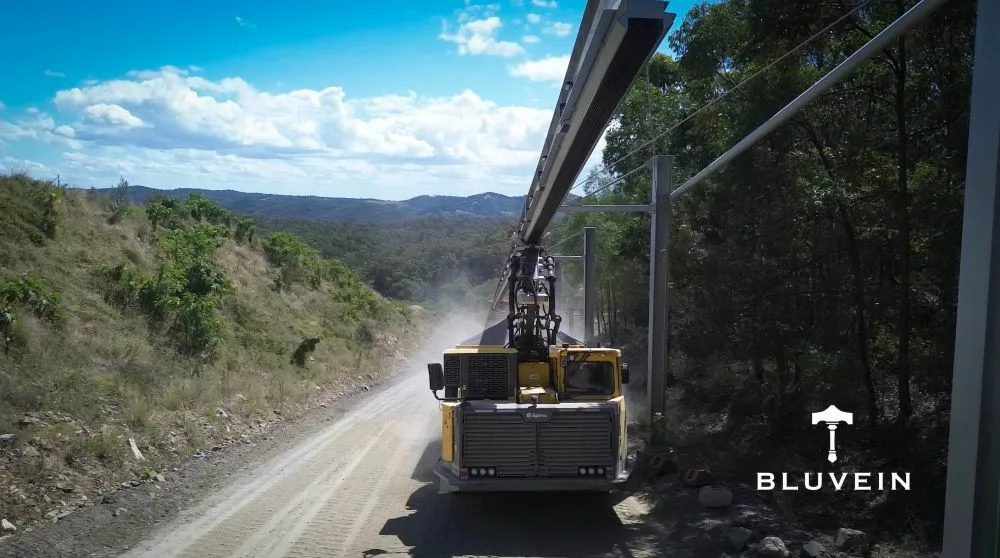
Punching way above its start-up weight, BluVein has had more than 20 mining company delegations visit its proving grounds this year, as its track has expanded – through industry and government funding – from a short, straight uphill section to a route that takes in a sharp curve and a straight uphill route on a 1:7 incline, deliberately designed to simulate your typical underground haulage ramp.
“BluVein can handle this sort of terrain because we are the genuine all-terrain connector,” BluVein CEO, James Oliver, said in a summary video on the company’s website. “The head stays rock solid against the rail, creating that reliable and smooth connection for the brushes to maintain contact with the rail and still continue to pull that full current, whilst the truck is going through and navigating terrain like this that you’d see every day on a mine site.
“What this proving ground has enabled us to do is take this technology from a concept through to a proven product.”
Agnostic advantages
And that ‘proven product’ is agnostic when it comes to both the electrical connector that joins the slotted rail system and transmits electrons onto a moving vehicle, as well as the on-board energy source, according to Oliver.
The electrical connection point has been proven already – the company has removed a traditional pantograph-type system from one Epiroc Minetruck MT42 SG and replaced it with a BluVein Hammer – and the energy source agnosticism has been receiving wider scrutiny in the last 12-24 months.
Even before this year’s diesel fuel supply shortage fears and realised fuel price escalation got miners reconsidering the mobile equipment propulsion status quo, the diesel-electric solutions coming to market were being eyed up for the potential to boost speed on ramp, reduce fuel burn and lower operating costs.
Caterpillar’s R2900 XE diesel-electric loader has found sales success wherever it has gone and is soon to be joined by the larger 22-t payload diesel-electric unit (thought to be named the R3200 XE). A diesel-electric truck from the OEM is not far behind.
Epiroc’s Minetruck MT66 S eDrive has completed its trial at Gold Fields’ Granny Smith mine in Western Australia, reportedly meeting the plus-11% ramp speed and circa-7% lower fuel use projections the OEM publicised. Epiroc is expected to go public with a matching diesel-electric loader soon, too.
And Sandvik also has diesel-electric loader and truck plans with its 600 series platform, recently showcased in Turku, Finland.
All of these could potentially be integrated with a BluVein connector and run on the slotted rail system, amplifying some of the gains that come from using these new drivelines. And, of course, further reduce fuel burn. Anyone studying the latest quarterly results from miners will have seen the impact higher fuel prices have had on production costs.
These benefits also coincide with diesel particulate matter regulation changes to be inscribed in New South Wales, Australia, later this year, which, if enacted, will likely lead other states to follow suit.
While battery-electric machines were the expected recipients of the BluVein treatment when the company was formed in 2019, it could be diesel-electric trucks that receive electrons from the system in a TRL 7 trial at an underground mine in Western Australia, set to start next year.
Safety at the core
Safety is a big reason behind the BluVein success so far.
“The rail operates at 1,500 V,” Oliver said. “And the conductor is in an IP2X slot, which means that no one physically can touch the live conductor. Each section of the rail is only energised as required.
“As a truck transitions onto that section, we have an earth and an earth continuity relay. We can sense that that truck is in position, is earthed safely, and then the isolation from the substation sends the rail live.”
If any faults are detected during this process, the system isolates the DC supply at the substation, so no voltage is supplied to the rail.
This isolation not only benefits the safety side of the business; but it also allows multiple vehicles to connect to long rail sections and be adequately powered.
“Equally important is the off-board safety side of the equation,” Oliver said, adding that the type of setup it has at Wolffdene – with a 2 MVA modular substation, built by JTMEC Pty Ltd, Powered by Epiroc – is likely to be looked on favourably by regulators.
Collaboration catalysts
At a time when so many question marks remain over new electric solutions, this factor is not to be overlooked, hence the names attached to the technology’s development since 2020 – namely Northern Star Resources, South32, Glencore, Rio Tinto, Vale, Evolution Mining, BHP, Agnico-Eagle Mines, Freeport-McMoRan, AngloGold Ashanti and Newcrest Mining (now Newmont).
One can add to this the official support of Epiroc as a key OEM partner and Hitachi Energy, which could provide advanced power electronics and digital charging technologies to augment the dynamic charging input from BluVein.
Mehrzad Ashnagaran, Global Business Development Lead – Mining and Industries, Hitachi Energy, told IM: “BluVein provides the dynamic power-transfer interface to the vehicle, while Hitachi Energy can provide the electrical backbone behind it, including grid integration, power conversion, substations, power quality and digital monitoring. Together, we can deliver an integrated grid-to-vehicle solution that is safer, more efficient and easier to scale.”
He said the BluVein system can help accelerate mining decarbonisation while also reducing operational costs: a combination that is a requirement for today’s cost-conscious miners.
Anders Hedqvist, acting Vice President, Epiroc Electrification Solutions, said: “Underground mining electrification can be seen as a set of building blocks that form one complete system and where we, as Epiroc, are contributing throughout the system: the machines (diesel or battery-electric), charging and power systems such as BluVein, rail, electrical infrastructure as well as automation. Each has a specific role, but together they deliver more than the sum of their parts.
“With our JTMEC team on site in Queensland to install, commission and support the system, miners get a complete, ready-to-install system solution rather than a collection of products.”
The consensus around this technology platform continues to build.