Researchers Fit Quantum Circuits Into a 30 Billion-Parameter AI Model
Insider Brief
- Researchers replaced eight layers of the Qwen3 language model with a module that can run on a quantum processor, cutting its parameter count by about 16% while keeping text prediction scores within about 1% of the original in simulations.
- In short tests on an IBM quantum processor, the module took roughly 90 seconds of processor time per token, the unit of text the model processes.
- A conventional neural network of similar size predicted text more accurately than the quantum module in nearly every comparison.
A quantum computer may one day serve as a computational partner to help chatbots predict what comes next, although scientists caution a lot of work remains.
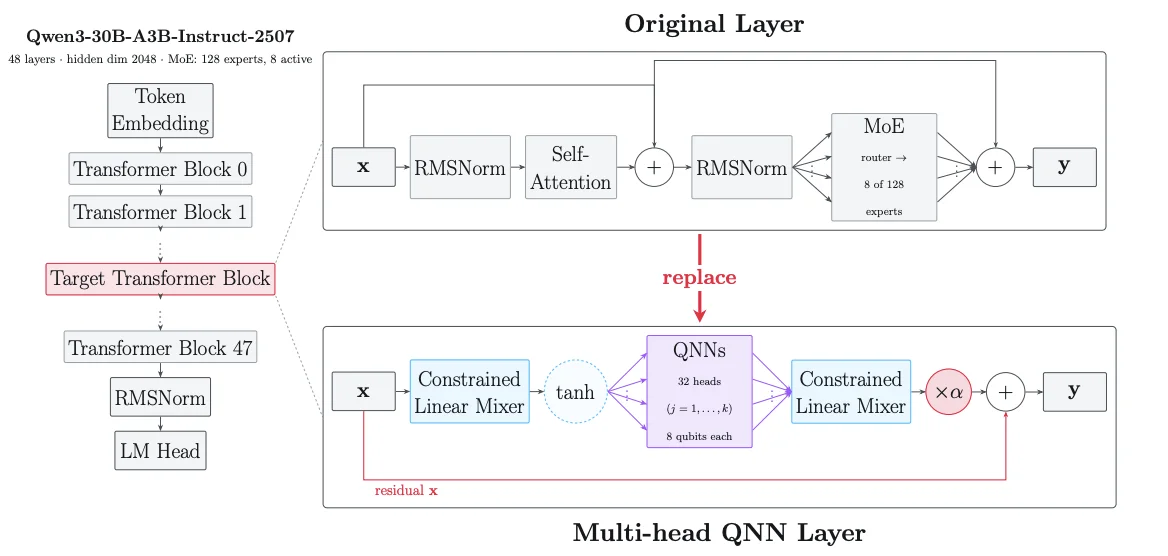
In an experiment, a team of researchers replaced eight layers of a large language model with a compact module that can run on a quantum processor, cutting the model’s parameter count by about 16% with little change in its ability to predict text in simulations.
The study, posted as a preprint on arXiv, shows how today’s quantum hardware could take over a small part of the work inside a production-scale language model. A conventional replacement of about the same size generally predicted text better, however, and the quantum processor ran its part of the calculation far more slowly than conventional hardware. In fact, the researchers reported it took roughly a minute and a half of quantum processor time to do its share of the work for a single word or piece of one.
The team, which included researchers from Multiverse Computing and the University of Toronto, modified a pretrained version of Qwen3 — a large language model developed by Alibaba Cloud — with 30.5 billion parameters. Those parameters are the numerical settings a model learns during training. The researchers removed eight consecutive blocks from the middle of the model, displacing nearly 5 billion parameters, and put a single module with 145,281 trainable parameters in their place.
In simulations, the modified model stayed within about 1% of the original on a measure of text prediction across two sets of English text. The score was 0.9% worse on WikiText-2, a collection of Wikipedia text, while the researchers could establish no clear difference on a sample from C4, a collection of web text. The measure, known as perplexity, reflects how much probability the model assigns to the text that actually follows a passage. Lower scores indicate better predictions.
The team also ran the module’s quantum circuits on a 156-qubit IBM Heron processor while graphics processors handled the rest of the model. Those hardware experiments covered short runs. The broader text prediction scores came from conventional computers simulating the quantum circuits without hardware errors.
Dividing the Work
A language model processes text in units called tokens, which can be words or pieces of words. As a token moves through the model, successive blocks update an internal representation of it using information from the surrounding text.
Think of a Wheel of Fortune contestant who sees “A SLICE OF ___” and guesses “pizza.” “Cake” would fit, too. Give the contestant a clue about a birthday, and “cake” becomes a better bet. A language model uses context in much the same way to weigh what might come next.
The Qwen3 model in the study represents each token at that point with 2,048 numbers. Loading all of them into a single quantum circuit would require either too many qubits or operational sequences that are too long for the hardware the team used, the researchers reported.
The team split the 2,048 numbers into 32 groups of 64 and assigned each group to a separate eight-qubit circuit. Each circuit took in its share of the data over four stages. Conventional calculations mixed information before it entered the circuits and recombined the results afterward. Because the circuits worked independently, the team could run several side by side on the same processor.
Holding the rest of the language model fixed, the researchers trained the module in two steps. They first taught it to reproduce the outputs of the blocks it was replacing. They then adjusted it inside the model to improve predictions of the next token. Both steps ran on conventional computers, which could simulate the small circuits exactly.
The team tested replacements spanning one, two, four, eight and 16 consecutive blocks, starting in a part of the model that early tests indicated could tolerate cuts. Eight was the widest span that stayed within about 1% of the original on both text collections. At 16 blocks, the model shed nearly a third of its parameters, but its WikiText-2 perplexity rose 14.4%. The team used WikiText-2 to choose where to make the cuts, making C4 the independent check on that choice.
the Quantum Processor’s Role
The IBM processor could run 14 of the 32 circuits at once. Processing a single token therefore took three circuit batches and occupied the processor for roughly a minute and a half under the study’s settings. The researchers repeated each circuit thousands of times to estimate its output, a step that contributed to the cost of using the device.
For each of the five replacement sizes, the researchers ran the quantum circuits for the first token of a prompt. With the eight-block replacement, they also used the processor at every step in short generations of 15 tokens for two prompts, repeating one prompt in a separate session. The hybrid model’s top prediction agreed with the original model’s at all 15 positions for one prompt and at 13 of 15 for the other. A full WikiText-2 evaluation on the device would have required on the order of a million circuit submissions, the team estimated.
Hardware errors also proved larger than the researchers’ simulations of those errors suggested. The team said a systematic study would be needed to determine how those discrepancies affect the model’s predictions across longer passages and more varied prompts.
Where Conventional Methods Lead
A conventional neural network with roughly the same number of trainable parameters beat the quantum module on text prediction in nearly every comparison of consecutive block replacements.
In separate tests on a single, more sensitive layer, switching off entanglement, which links the behavior of qubits, or leaving circuit settings fixed also produced better prediction scores than the fully trained quantum design in the runs reported. The researchers said the experiments leave open whether trained, entangling circuits offer any benefit for this task.
The parameter savings also measure how many settings the model stores. Qwen3 already uses only a fraction of its settings for each token, and the eight-block replacement reduced that active count by about 14%.
The study did not benchmark the time it took to simulate the quantum module against the time required to run the original blocks. It also did not compare the design with leading conventional compression methods, which can combine layer removal with techniques that store the remaining settings at lower precision.
A priority for future work is to preserve the model’s ability to connect words across a passage.
The quantum module processes each token independently, leaving the surrounding layers to carry out the comparisons between tokens that are central to a transformer’s attention mechanism.
The researchers proposed testing a replacement that preserves attention while shrinking the other parts of a block. They also called for comparisons with practical compression methods and further study of why replacing several layers scattered through the model can degrade performance even when individual replacements work.
For a deeper, more technical dive, please review the paper on arXiv. It’s important to note that arXiv is a pre-print server, which allows researchers to receive quick feedback on their work. However, it is not — nor is this article, itself — official peer-review publications. Peer-review is an important step in the scientific process to verify results.
The research team included Maforikan Amoussou, Borja Aizpurua, Sukhbinder Singh and Román Orús of Multiverse Computing and Hans-Arno Jacobsen of the University of Toronto.