Sonic price prediction 2026-2032: Will S reach $1 soon?

Key takeaways:
- The average Sonic price prediction for 2026 is $0.0400.
- Holders can anticipate a maximum price of $0.1574 in 2029.
- By 2032, Sonic (S) might touch $0.2967
Sonic has continued developing its blockchain infrastructure and expanding its focus on decentralized finance (DeFi). Formerly known as Fantom, the EVM-compatible Layer 1 network rebranded to Sonic in 2024, offering fast transactions and sub-second finality.
Sonic’s price reached an all-time high of $1.03 in January 2025 before falling to $0.02768 in June 2026. Its long-term outlook now depends on market conditions, network adoption, ecosystem growth, and continued development.
Can Sonic recover and reach new highs by 2032? Where could S trade over the coming years? This Sonic price prediction examines its outlook from 2026 to 2032, alongside technical analysis, fundamentals, and key market risks.
Sonic Price Prediction: An Overview
Sonic (S) price prediction: Technical analysis
Sonic price analysis: S declines by 3.01% as sellers push the price towards $0.032.
TL;DR Breakdown:
- Today, Sonic price analysis shows continued bearish momentum with S trading at $0.03256.
- The latest daily candle shows the cryptocurrency lost 3.01% of its value in the last 24 hours.
- RSI is at 34.19, and MACD is in negative territory.
On November 16, 2026, Sonic (S) continued its downward trend, trading at about $0.03256. The latest daily candle shows a 3.01% loss, as sellers continue pushing the token lower.
Sonic price analysis 1-day chart: S extends its November decline.
As seen on the daily chart, Sonic trades below $0.040 and is losing ground since early November. The token recovered briefly around November 5, before new selling pressure pushed the price lower.
Recent candles show a pattern of lower highs and lower lows. This means that although there have been some recovery efforts, sellers have remained in control.
The latest candle opened at $0.03355 and reached a low of $0.03235. It is trading near $0.03256, leaving immediate support at $0.0323. If selling pressure continues, Sonic has the opportunity to test the $0.0323 support level. Any drop to the lower side of this range could signal more weakness towards $0.0300.
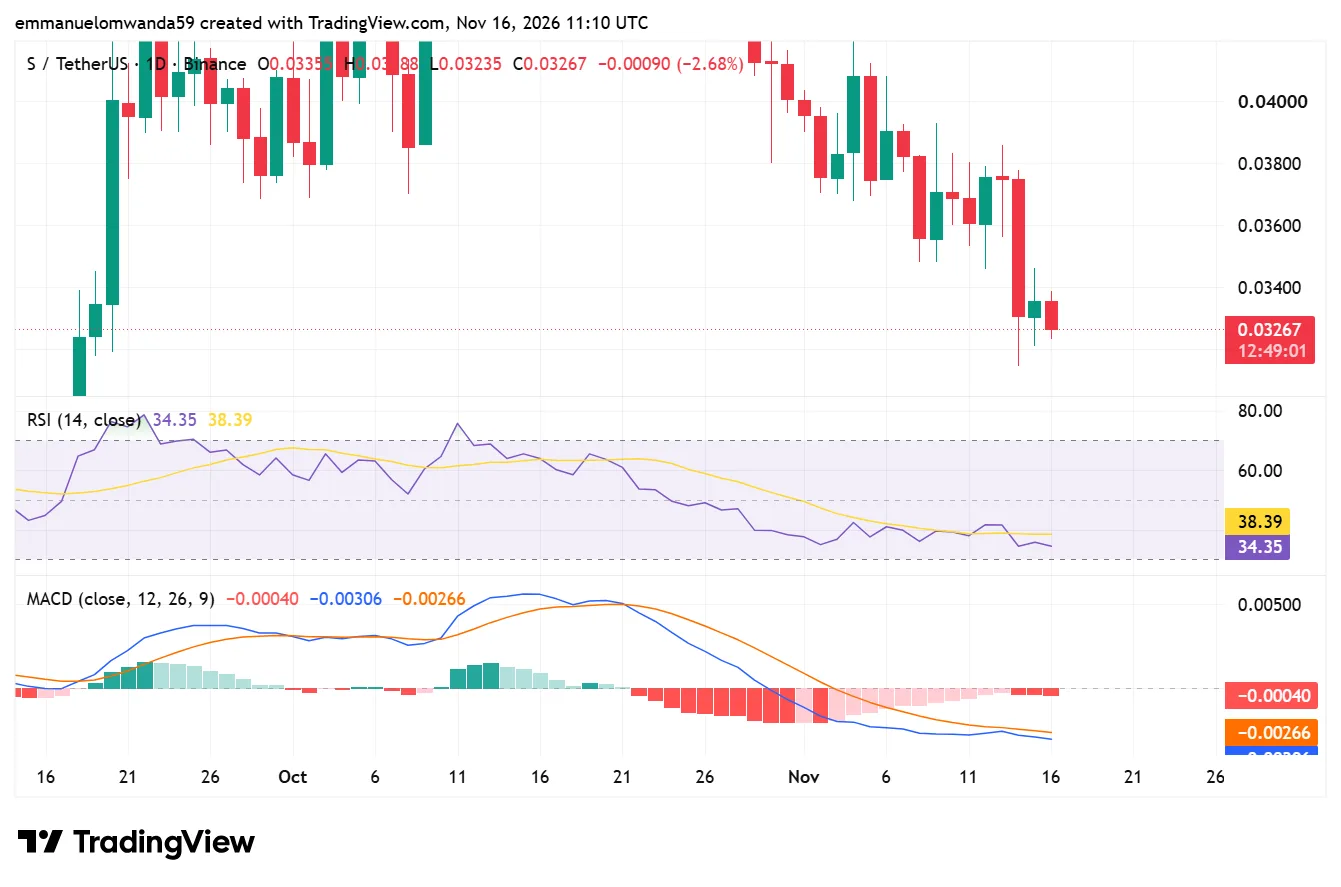
Resistance is around $0.0340; a recovery above $0.0340 could provide an initial sign of improving momentum. Buyers need to challenge the $0.0360 to strengthen the recovery.
The Relative Strength Index (RSI) is at 34.19, below its moving average of 38.38. This means that buying pressure is not yet strong enough, and there is continued bearish pressure. RSI is still above 30 and has not entered the oversold zone.
The MACD also reflects the negative trend. Its line stands at -0.00307, below the signal line at -0.00266. The histogram still shows bearish momentum at -0.00041, confirming that bearish momentum continues.
Sonic price analysis on the 4-hour chart
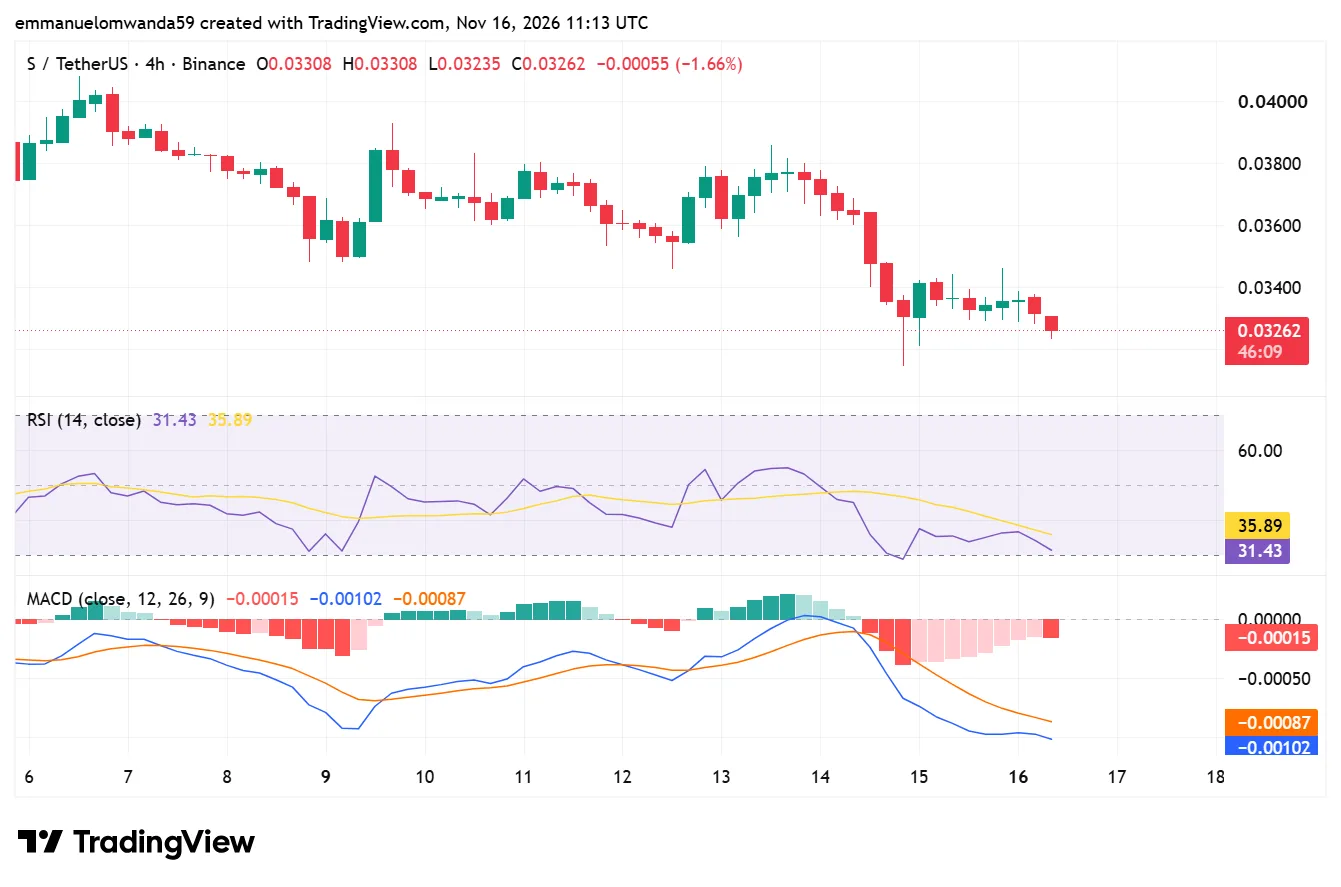
On the 4-hour chart, Sonic trades at $0.03262, down by 1.66%, with the latest candle reaching a low of $0.03235. The RSI is currently at 31.43, which is below the 35.89 moving average, suggesting ongoing selling pressure. The MACD remains bearish, with its line at -0.00102 below the signal line at -0.00087 and a negative histogram of -0.00015.
Sellers are holding S just below the $0.0323 support level. If it drops below this level, it could drop a little further down to $0.0300; $0.0340 is still the immediate resistance
Sonic technical indicators: Levels and action
Daily Simple Moving Average (SMA)
Daily Exponential Moving Average (EMA)
What can you expect from the Sonic price analysis next?
Sonic could test the $0.0323 support level if selling pressure continues. A break below this area could expose further downside toward $0.0300. However, a recovery above $0.0340 could provide an initial sign of improving momentum. Buyers would then need to challenge $0.0360 to strengthen the recovery.
Why is Sonic down today?
Sonic is down mainly because of weakening DeFi activity and liquidity concerns after Silo Finance announced plans to wind down its Sonic markets. Broader crypto weakness is adding pressure, while S has fallen 3.79% in 24 hours to $0.032509 amid declining market capitalization.
Is Sonic a good investment?
For crypto investors, traders, and enthusiasts assessing whether S looks like a good buy, the key is to predict moves using a combination of technical indicators and fundamental factors, while remembering that macroeconomic trends such as inflation and regulatory developments can quickly change Sonic’s price.
Sonic is a high-speed, scalable blockchain platform that competes with established chains such as Solana and Ethereum L2s, positioning itself as a performance-focused chain within the blockchain ecosystem. This analysis looks at Sonic’s price outlook from 2026 to 2032, technical signals, historical sentiment, ecosystem and blockchain fundamentals, recent news, and the main investment risks that shape market direction.
While Sonic does not currently lead the market, it maintains a credible, stable mid-tier position, volatile Total Value Locked metrics, and weak user retention, despite recent price rebounds, which are an indication that execution risk remains. The Sonic (S) network is also transitioning from a community-driven layer-1 to a more structured corporate model, which investors should factor in before they invest. Own research and assessing personal risk tolerance are essential for anyone considering S as a potential investment opportunity.
Will Sonic reach $5?
The price of Sonic could reach $0.1215 by 2030, with price predictions suggesting a high of $0.1678. The base case scenario for Sonic’s price by 2030 is projected to be around $0.1215, with potential highs depending on market conditions. However, achieving this depends on market conditions, overall technical factors, and fundamental factors.
Will Sonic reach $10?
Based on our technical analysis of multiple technical quantitative indicators, S’s price projections for 2032 estimate a range, with Sonic expected to reach about $0.2967 but not approach double-digit prices within the next 6 years. A move to $10 is not guaranteed; even by 2046, Sonic is expected to reach $0.8797, still far below $10 and requiring over 25,386% upside to hit that mark.
Is Sonic a safe network?
Sonic is regarded as a secure blockchain platform whose architecture differs from traditional blockchains, using its unique Lachesis consensus mechanism to enable high-speed, scalable transactions. The Sonic Gateway is its native Ethereum bridge for cross-chain transfers.
Its directed acyclic graph approach helps deliver theoretical throughput of up to 10,000 transactions per second with finality in less than 500 milliseconds. The gateway includes a fail-safe mechanism so assets can be recovered on Ethereum if heartbeat confirmations stop for a set period. However, as with any blockchain network, users should exercise caution, use official channels, and follow best security practices to protect their assets, while this asset-recovery design reduces reliance on bridge infrastructure during downtime.
Does Sonic have a good, long-term future?
Sonic shows potential for a strong long-term future, with a long-term forecast framing price predictions for 2030 and beyond as scenario-based projections rather than guarantees. Analysts forecast that prices could reach between $0.1215 and the highest price of $0.1678, driven by its unique blockchain technology, increasing adoption in decentralized applications, support for app builders, and robust ecosystem growth. A 5% annual growth rate predicts Sonic Solana at $0.03 in 5 years.
Ecosystem growth, fueled by increased developer activity and more developers joining the platform, is crucial for Sonic’s long-term success. Total Value Locked (TVL) in dApps is a critical metric for long-term growth, reflecting real-world usage and platform strength, while on-chain activity is another key signal of fundamental health. Many traders also watch user growth, TVL, and on-chain activity because sustained participation supports the long-term case. Sonic’s ability to attract and retain users also matters for long-term growth. Sonic also continues airdrop campaigns and support for liquid staking tokens to help boost TVL and revenue generation.
Additionally, the Sonic ecosystem has established a $25 million fund to attract builders and improve user metrics, further supporting future expansion. Future ecosystem expansion may also benefit from plans to pursue a spot ETF and private investment vehicles on Nasdaq, though the long-term impact remains uncertain. However, market volatility remains a concern.
Recent news/opinion on Sonic (prev. FTM)
Sonic Labs said it planned to move about 13 million S within 24 to 48 hours under an agreement with a long-term partner. The tokens represent roughly 0.33% of circulating supply.
Over the next 24 to 48 hours, approximately 13M S will move under a strategic OTC agreement.
— Sonic (@SonicLabs) October 22, 2026
The counterparty is a long-term partner who will be working with us to grow Sonic's reach and engagement across their network.
We're sharing this in advance so the community is aware of…
Sonic price prediction for November 2026
The Sonic price prediction for November 2026 suggests the token could attempt a modest recovery if buying pressure improves. S is expected to trade between $0.0325 and $0.04000, with an average price of around $0.04000.
Market sentiment, trading volume, and broader crypto market conditions are expected to remain the main drivers of price action. While a gradual recovery is possible, a drop below $0.03700 could signal renewed selling pressure.
Sonic price prediction 2026
In 2026, Sonic (S) is expected to trade between $0.0320 and $0.0459, with an average price of around $0.0400. The forecast suggests Sonic could remain volatile throughout the year, with gradual recovery potential if ecosystem development and broader market sentiment improve.
Sonic Price Forecast 2027–2032
Sonic (S) price prediction 2027
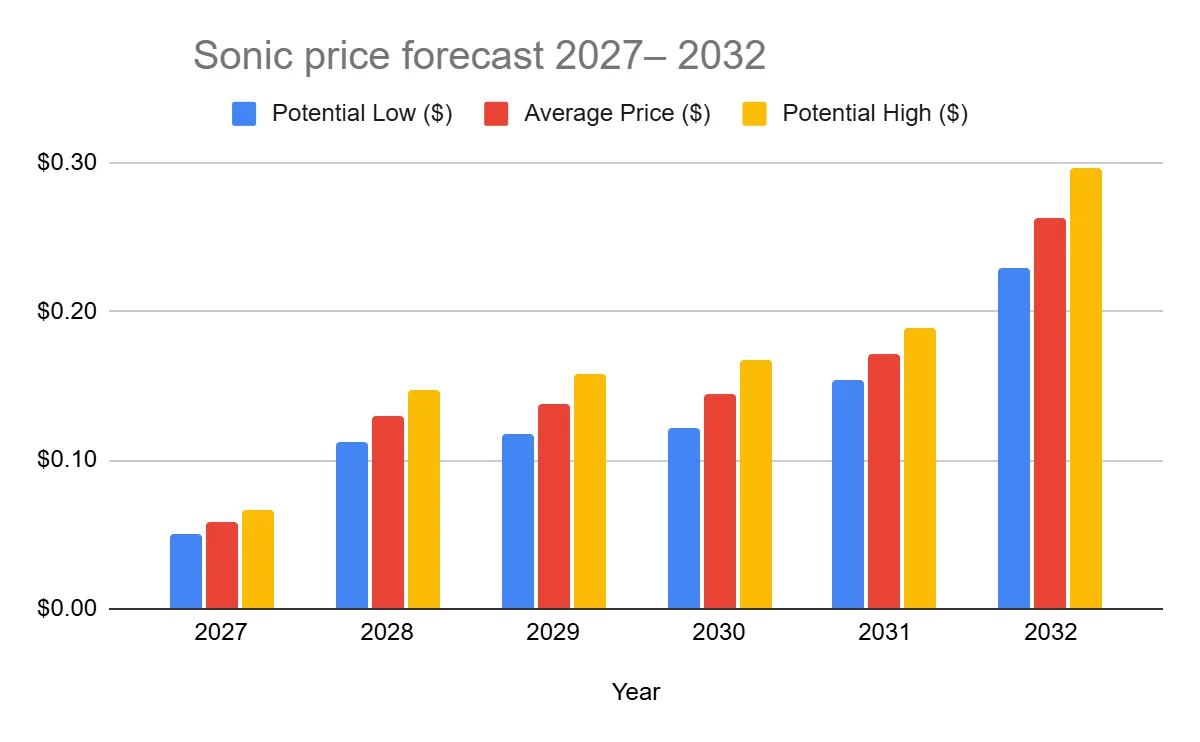
The Sonic forecast for 2027 speculates that the price might reach a maximum of $0.0662 by 2027. On the lower end, corrections may pull the price to $0.0499, with an expected average trading price of around $0.0581. As an alternate modeled scenario, the predicted price for 2027 could be around $0.03998, representing a potential 1.90% increase.
Sonic (S) price prediction 2028
Sonic’s (prev. FTM) 2028 forecast of $0.1128–$0.1465, averaging $0.1296, is linked to growing adoption of its rebranded ecosystem. By then, expanded DeFi, NFT, and gaming use cases are expected to strengthen utility and demand. The projected rise in Sonic’s price by 2028 is supported by its fee monetization model and transaction fees, which can reward developers, while the fee-burning mechanism helps support network sustainability by reducing token supply. Network scalability upgrades and rising developer engagement support gradual appreciation, while market cycles keep growth within range.
Sonic (S) price prediction 2029
In 2029, Sonic’s market price might stabilize at $0.3238 while attaining an average trading price of around $0.2698 and a minimum price of around $0.2158. The broader outlook points to $0.03250 by the end of 2026, $0.1464 by 2030, and $0.2327 by 2040, based on combined technical and fundamental factors.
Sonic (S) price prediction 2030
Sonic is expected to reach a maximum of $0.1678 by 2030. A more conservative long-range model calculated from historical trends puts Sonic near $0.09969 by 2030 as an alternate scenario. However, it could fall to $0.1215 with an average price of $0.1446.
Sonic (S) price prediction 2031
Sonic is projected to hit a high of $0.1889 in 2031. An alternate model suggests Sonic could gain 146.97% to $0.05425 by 2031, a percentage move that adds a more conservative upside case. Another projection places its 2031 range between $0.03445 and $0.1014. In the event of a price correction, it could drop to $0.1545 with an average of $0.1717, and reaching $0.1014 would imply a potential profit of about 291.26% from Sonic today.
Sonic (S) price prediction 2032
Sonic is expected to reach a high of $0.2967 in 2032. The average trading price is expected to be $0.2626, and the minimum price is projected to be $0.2285. However, this projected future performance is speculative, and actual future prices may differ significantly from these estimates.
Sonic market price prediction: Analysts’ FTM price forecast
Cryptopolitan’s Sonic (S) price prediction
Our predictions for 2026: Sonic (S) is expected to trade between $0.0350 and $0.0489, with an average price of around $0.04300. The forecast suggests Sonic could remain volatile throughout the year, with gradual recovery potential if ecosystem development and broader market sentiment improve.. The forecast suggests Sonic could remain volatile throughout the year, with gradual recovery potential if ecosystem development and broader market sentiment improve. Investor confidence, along with supply and demand dynamics, plays a key role in Sonic’s price action, and macro conditions, regulatory changes, and investor decisions about whether to purchase or buy Sonic can also affect pricing. Governance and execution risks are essential to investor confidence in cryptocurrency projects.
Fundamental events such as hacks and other real-world occurrences can significantly impact price movements. Please note that the information provided on this page is for general informational purposes only and is not intended to be financial, legal, or other professional advice. No model can fully predict short-term moves tomorrow or next month. Do not rely on this content alone when making investment decisions; completeness and reliability are not guaranteed, and you should seek independent professional advice.
Sonic’s (S) historic price sentiment
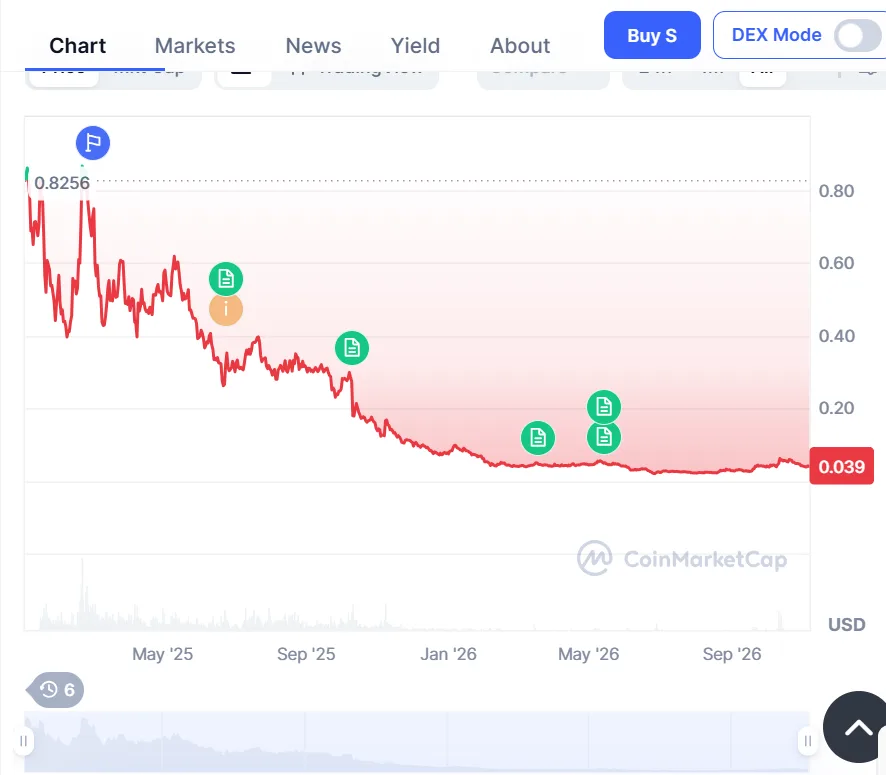
- Fantom (FTM) launched in 2018 at $0.0182, hit a low of $0.00229 in 2020, and peaked at $3.24 in 2021 during the DeFi boom.
- Following the 2022 bear market, FTM recovered to $0.55 by early 2024 before rebranding to Sonic Labs in August 2024.
- The 1:1 FTM-to-Sonic (S) token swap began in December 2024, with Binance completing it by January 2025, as Sonic Labs focused on creating a stronger post-rebrand ecosystem around S tokens.
- Sonic hit a new ATH of $1.029 in January 2025 but steadily declined to around $0.33 by late August.
- By early September 2025, Sonic traded stably between $0.3092 and $0.3126.
- In early September, Sonic traded around $0.309–$0.313, showing relative stability compared to its August lows.
- Mid-September – Price remained in the ~$0.30–$0.33 band, with minor upward drift toward ~$0.32.
- Sonic SVM traders often watch short-term support and resistance levels on the chart for potential short setups after sharp rebounds.
- Late September—The token approached $0.26, as reported by markets, showing a decline and increased volatility.
- Early October – Trading price dropped further into the ~$0.23–$0.26 range, indicating a weakening trend.
- By November 3, Sonic had fallen to approximately $0.122, marking a substantial decline from early September levels.
- At the beginning of November 2025, Sonic (S) traded around $0.12–$0.14, occasionally spiking to roughly $0.17 before retreating.
- Through mid-November, the price generally drifted downward, reaching a low near $0.10–$0.11 around November 21.
- From late November to December 3, S recovered slightly—trading in a narrow band around $0.10–$0.11, suggesting consolidation and stabilization after the mid-month slump.
- From early December, Sonic traded around $0.071–$0.075 on Dec 3–Dec 6, then moved higher through mid-December as the price climbed into the $0.085–$0.095 zone by Dec 14–Dec 17, reflecting increasing buying interest late in the year.
- Into late December and early January, S stabilized in the $0.07–$0.08 range before rising above $0.08, closing around $0.082–$0.086 by Jan 4, 2026, showing a modest recovery into the new year.
- On January 4, 2026, Sonic was trading near $0.086–$0.090 after stabilizing from December weakness, with modest rebounds in the first week of January as buyers emerged off key support levels.
- By February 3, 2026, Sonic had drifted lower toward roughly $0.065–$0.070, reflecting continued selling pressure and failed rallies, with price consolidating near the low end of its recent range.
- Sonic (S) traded around $0.052 to $0.048 between Feb 3 and Feb 10, 2026, before declining toward the $0.041 to $0.039 range by late February amid steady selling pressure.
- From early March to Mar 14, 2026, Sonic moved between $0.038 and $0.044 with a gradual rebound attempt as the price stabilized near the $0.040 support zone.
- From March 14 to late March, Sonic drifted lower from $0.0514 toward $0.040–$0.042, unable to sustain any meaningful bounces amid broad market weakness.
- By April 7, its price pressed critical $0.040 support at $0.0396–$0.0414—dangerously close to its all-time low of $0.0368 set on February 28.
- Sonic is trading at around $0.04951 at the start of May 2026.
- By the end of May 2026, Sonic had retreated to around $0.040, erasing much of its early-May gains after a failed rally above $0.055 and stabilizing near a key support zone amid continued selling pressure.
- By the last week of June, Sonic had recovered by 24.36% from its recent all-time low of $0.01915 on Jun. 25, 2026, marking a percentage recovery from that low.
- From August through September 2026, Sonic (S) traded mainly between $0.02 and $0.03, reaching around $0.02814 in September before gradually recovering to its current price of approximately $0.03912 in November.