SEI price prediction 2026-2032: Time to buy SEI?

Key takeaways:
- Our SEI price prediction anticipates a high of $0.14 by the end of 2026.
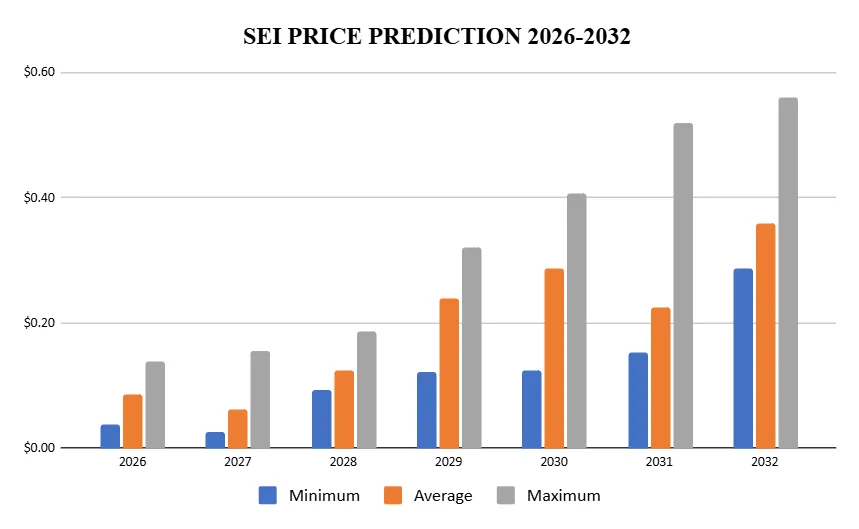
- In 2028, it will range between $0.09 and $0.19, with an average price of $0.12.
- In 2030, it will range between $0.12 and $0.41, with an average price of $0.29.
Our SEI price prediction sees SEI reaching as high as $0.14 by the end of 2026, potentially climbing to $0.52 by 2031 and into a $0.29-$0.56 range by 2032. For crypto investors, traders, and enthusiasts evaluating SEI’s upside and risk, that outlook matters because the project remains active on both the development and market fronts.
The Parallel Stack, a robust, open-source framework for building rollups and Layer 2s that leverage parallel processing, is now on SEI V2. The stack enhances Ethereum’s performance by addressing the most common bottlenecks Layer 2 blockchains face, and such developments could support SEI’s long-term value.
Regarding price performance, SEI shows signs of trading higher; however, it remains influenced by broader market sentiment. Below, we break down SEI’s current market position, technical analysis, price predictions from 2026 to 2032, recent developments, investment potential, and how this forecast compares with other expert outlooks so you can judge how high SEI could go and whether it fits your strategy.
Overview
SEI price prediction: Technical analysis
SEI price analysis
On November 19, SEI’s price rose 0.02% over 24 hours, fell 9.86% over the last 7 days, and 35.58% over the last 30 days. Its 24-hour trading volume fell 14.98% to $21 million, signaling weak conviction in the market trend and a possible shift in momentum.
We use technical analysis of historical price action and chart patterns, and monitor technical resistance levels as reference points for potential price movement.
SEI 1-day chart analysis
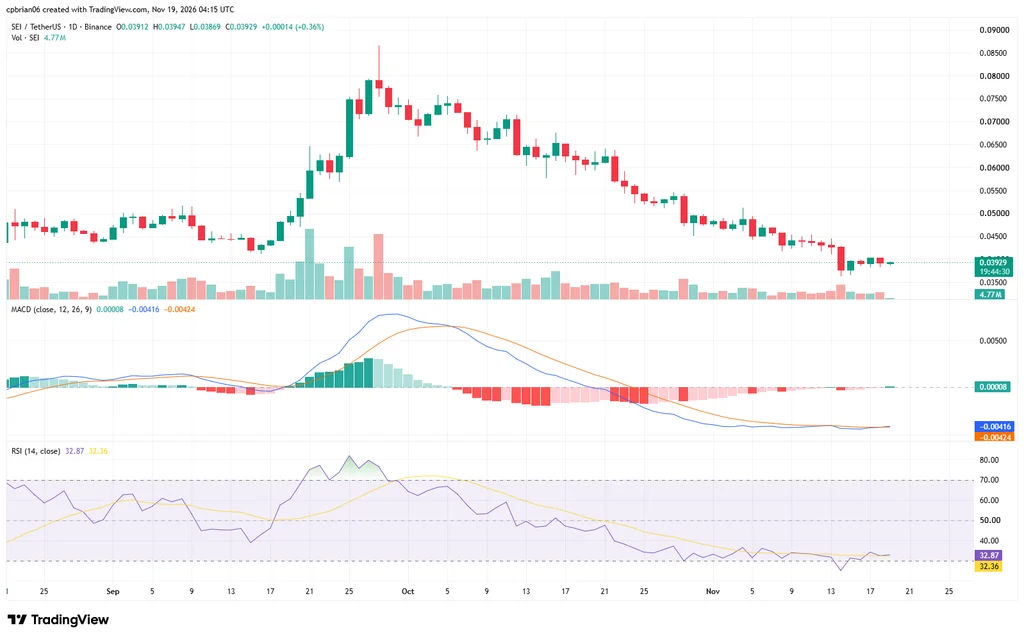
The 1-day chart’s price action shows SEI broke below major moving averages after bouncing off the $0.08 peak in September. Its MACD histogram shows little market momentum, reflecting bearish pressure, though a crossover would signal a shift in momentum. The RSI is at 32.87, suggestive of a neutral market. It is oversold when the value drops below 30.
SEI price 4-hour chart analysis
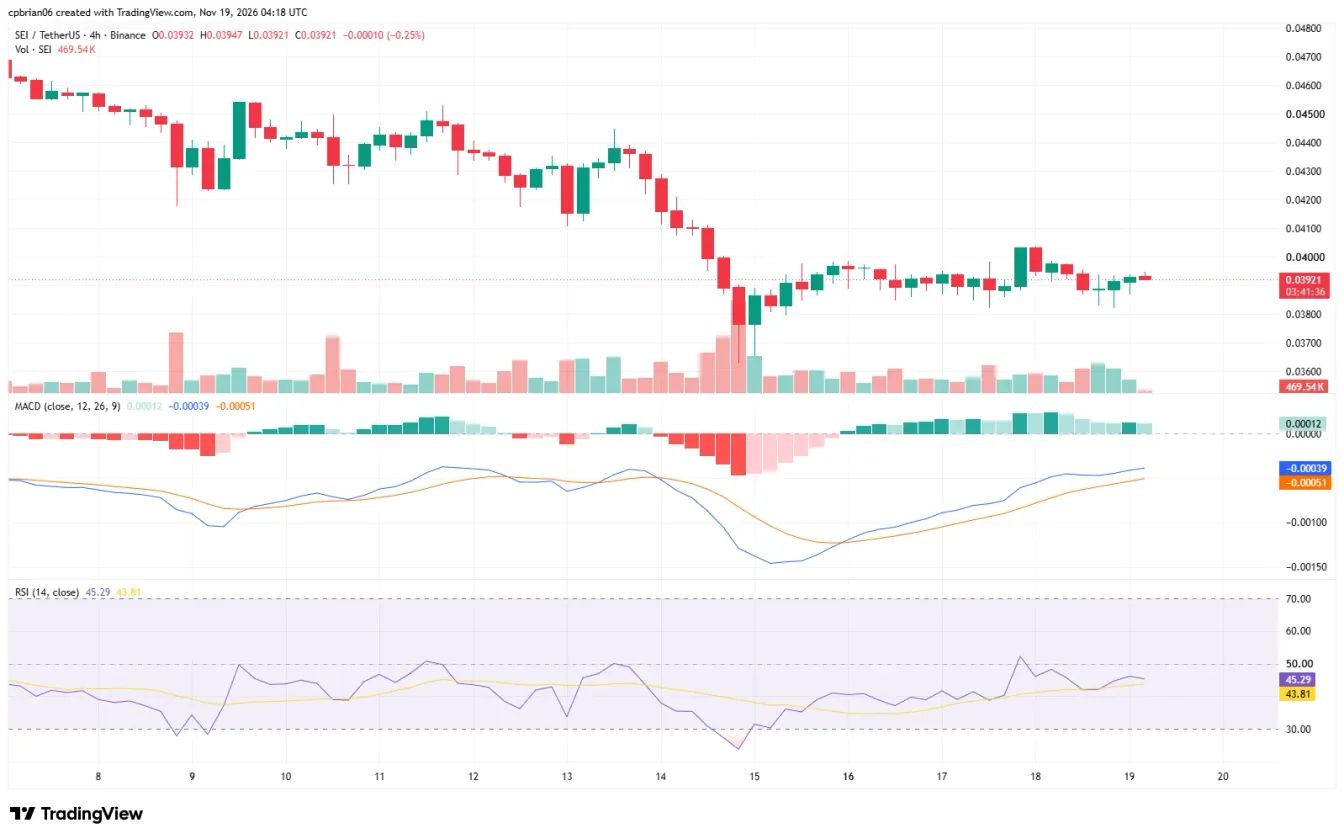
The 4-hour chart highlights SEI’s run this month. The trend is characterized by a bearish slant, reflecting a failure to reclaim near-term resistance on this timeframe. SEI’s momentum is positive in this timeframe, slowing the drop.
SEI technical indicators: Levels and action
Daily simple moving average (SMA)
Daily exponential moving average (EMA)
What to expect from the SEI price analysis next?
SEI is bearish, with short-term market conditions shaped by waning trading volumes and negative momentum; bearish pressure remains in place until price breaks above nearby resistance. Technical indicators now place key support levels at $0.035, with the 0.03-0.04 zone still important for near-term valuation. A move above resistance would shift focus toward the next recovery zone.
Why is SEI down?
Overview: The total crypto market cap fell about 2.2% in 24 hours, while Bitcoin dropped 2.96%; Sei’s decline is directionally consistent, though milder. Market sentiment was at “Extreme fear,” an indicator of caution rather than proof of the cause.
Will SEI reach $1?
According to Cryptopolitan’s price prediction, SEI is unlikely to reach $1 before 2031.
Can Sei Coin reach $10?
According to Cryptopolitan’s price prediction, SEI is unlikely to reach $10 before 2031. With a maximum token supply of 10 billion, SEI would need enormous market cap growth to support a $10 price. Its total supply is also a major valuation constraint when judging whether that target is realistic.
Will SEI reach $100?
According to Cryptopolitan’s price prediction, SEI is unlikely to reach $100 before 2031.
Does SEI have a good long-term future?
According to Cryptopolitan’s price predictions, SEI will trade higher in the years to come. Analysts track on-chain metrics to gauge the Sei network’s health and utilization, including TVL as a signal of utility and active decentralized application usage. They monitor both network activity and broader fundamental developments when building price predictions for users.
Improved scalability and developer tooling could attract more projects and liquidity to this layer 1, especially as Sei aims for 200,000 TPS, a target that would appeal to more developers. Technical upgrades, such as the Sei Giga upgrade, can also materially affect market sentiment; they aim to optimize Ethereum Virtual Machine execution and are expected to increase throughput by 50x.
SEI also faces competition from high-speed networks such as Solana and Aptos, while scheduled token unlock events can add circulating supply and create selling pressure if demand does not keep pace. Long-term projections also depend heavily on ecosystem growth and adoption.
SEI recent news
Sei is now integrated with Binance Pay, Binance’s contactless, borderless crypto payment technology. SEI can be sent, received, and spent directly in the Binance app. The integration expands practical use cases for developers and users across the Sei ecosystem.
Is SEI a good investment?
SEI is a high-performance Layer 1 platform for trading applications with growing utility, and its EVM compatibility helps it steal market share from Ethereum. While the technical analysis is bearish, price predictions paint a different picture. The outlook for this asset also depends on overall market sentiment, institutional crypto adoption, and macroeconomic trends.
Potential ETF developments could boost institutional interest in SEI, and broader institutional adoption can improve market dynamics by expanding access, especially since SEI’s infrastructure is designed for institutional-grade security and reliability. The network also uses Twin-Turbo consensus and has transaction finality of around 380 milliseconds, which can strengthen its utility case against Ethereum. Improved scalability and developer tooling, along with native frontrunning protection and multi-level transaction bundling, could bring more projects and liquidity to the network, while ongoing developer adoption could also drive short-term price surges.
Token vesting schedules can also create short-term sell pressure through supply dilution. Momentum also relies on fundamental growth metrics such as developer activity, TVL, user growth, ecosystem activity, and security, so investors should conduct thorough research before making investment decisions in this asset.
SEI price prediction November 2026
SEI’s current value suggests it will average at $0.07 in November. The price will range between $0.04 and $0.08.
SEI price prediction 2026
This year, SEI will trade between $0.04 and $0.14, with an average of $0.09. Late-2026 projections still vary widely, and this SEI crypto price prediction also reflects short-term swings in the coming days and next week. The average price target for November 2026 is $0.0738. Some models place SEI in a 2026 trading channel between $0.05128 and $0.07323, with an end-of-2026 forecast near $0.05589. The broader 2026 outlook implies roughly -15% ROI for the year despite expected volatility.
SEI price prediction 2027 – 2032
External forecasts also note potential upside in profit, including a 169.78% gain to $1,697.76 by July 16, 2027, and a 2030 target of $0.1495.
Cryptopolitan’s prediction 2027
The SEI forecast climbs higher into 2027. It will range between $0.0259 and $0.1546, with an average price of $0.0629.
SEI coin price prediction 2028
The analysis suggests a further acceleration in SEI’s growth in 2028. According to the Cryptopolitan price forecast, it will trade between $0.0939 and $0.1861, with a year-round average of $0.1240.
SEI token price prediction 2029
Based on SEI’s price movements in 2029, the maximum price is $0.3199, the minimum is $0.1212, and the average is $0.2392.
SEI price prediction 2030
The SEI coin price prediction for 2030 suggests a price range of $0.1249 to $0.4054 and an expected average trading price of $0.2865. Some longer-term projections put the minimum SEI prices and recovery range at about $0.82 to $1.26 by 2030.
SEI prediction 2031
SEI forecast for 2031 sets the high at $0.52. On the downside, it will drop to $0.15, with an average price of $0.22.
SEI price prediction 2032
According to expert predictions, the price of SEI will range from $0.29 to $0.56, with an average of $0.36.
Some post-2032 forecasts extend beyond this article’s horizon and suggest SEI could reach 4.00-8.00 by 2035.
SEI market price prediction: Analysts’ SEI price forecast
Cryptopolitan SEI price prediction
SEI key price levels are expected to evolve over the coming years, according to price prediction tools. The coin will reach a high of $0.1378 before the end of 2026. In 2028, it will range between $0.09 and $0.19, with an average of $0.12.
SEI is highly volatile. Negative market sentiment, such as market crashes, could derail the predictions. Always seek independent professional consultation for investment advice. The information provided is for general informational purposes only and should not be treated as financial advice.
SEI historic price sentiment
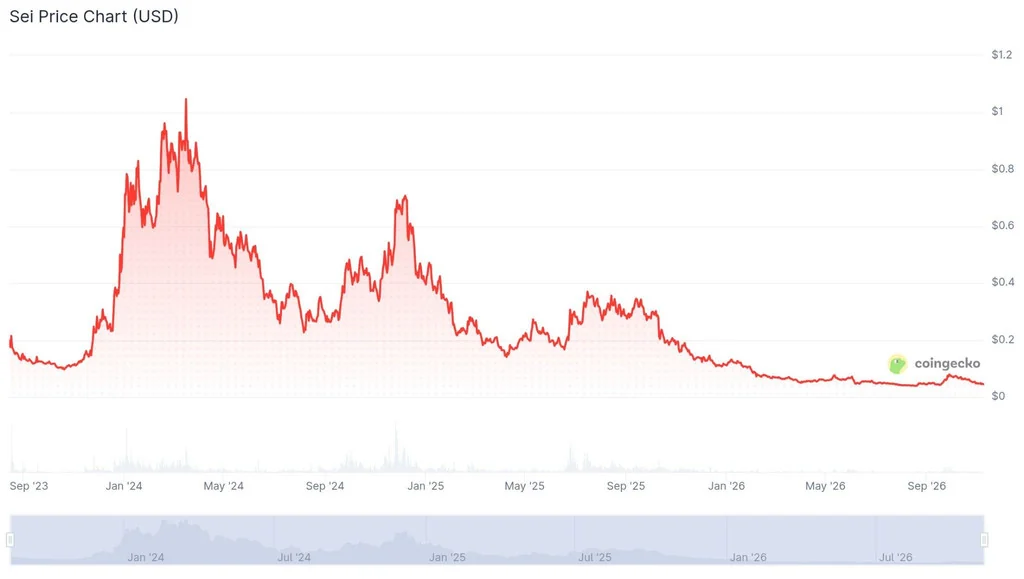
SEI price history. Image by CoinGecko
- SEI was established in 2022 and launched in August 2023 with the mainnet rollout, making SEI its native token following the public beta’s launch. A community airdrop accompanied the launch.
- The token also supports transaction fee payments.
- Sei was built as a layer 1 blockchain for decentralized finance applications in the broader crypto space, with a focus on exchange-oriented infrastructure.
- Decentralized exchanges are a core target use case, and the chain was designed to optimize trading on such platforms, including derivatives platforms and other trading applications.
- Sei emphasizes a secure, reliable, and robust infrastructure that provides a solid foundation for developers and users, while making scalability a core design goal across the platform.
- Carbon neutrality is also among Sei Network’s stated ecosystem goals.
- Governance decisions can involve token holders through the network’s community processes.
- SEI news and broader ecosystem developments can also influence sentiment around the token over time as SEI expands its DeFi ecosystem.
- As per CoinMarketCap data, it started trading at $0.1808.
- Since listing, it has experienced significant fluctuations, reaching an all-time low of $0.007989 on August 15, 2023.
- The coin later reached an all-time high of $1.14 on March 16, 2024.
- Since March, it has been in a bear market, falling to $0.27 in September. It then began to recover, trading at $0.45 in October, a time when long-term holders may accumulate if bullish sentiment improves.
- It then began to recover in November; by December, it had risen above $0.68.
- It was later corrected and crossed into 2025, trading at $0.40, dropping to $0.32 in February. By March, it had fallen below $0.27, reflecting historical patterns in crypto where profit-taking often drives a correction before recovery.
- In June, it fell below $0.20. In December, it reached $0.13.
- External crypto correlations, including narratives around the artificial superintelligence alliance and other cryptocurrencies such as Immutable X and Bitcoin, can also affect broader risk appetite and Sei price movements.
- Rapid changes in market capitalization have also contributed to sharp price swings in Sei over time, as with many crypto coins.
- In February 2026, it fell below the $0.10 support level. By April and May, it had fallen below the $0.06 support level. Between June and September, it traded at $0.05.
- In the third week of September, it broke higher, and by October, it had reached $0.07. It later reversed to $0.40 in November.