The founders behind 2026’s top new aerospace companies
The founders of aerospace’s newest startups aren’t all coming from aerospace.
They’re building across the sector, from autonomous aircraft and drone defenses to satellite antennas and data centers in space. Their backgrounds range from university research to scaling micromobility fleets, gaming studios, crypto marketplaces, and AI software.
Using CB Insights People data, we profiled 12 founders across 7 high-potential aerospace companies founded in 2026. Here’s what stands out about the companies they’re building:
- Drones dominate the cohort. 5 of the 7 companies build drones, drone software, or drone defenses. Vernius Systems and Stendr target counter-drone applications, while Aviern, Degla, and Meteoric work on autonomous aircraft, multi-drone fleet coordination, and atmospheric modification.
- Y Combinator is the main on-ramp. 4 of the 7 companies are in current YC batches (F26 and S26). A fifth company’s founder, Euwyn Poon, went through YC in 2010 before building scooter-sharing company Spin, which Ford acquired in 2018.
- Half the founders are fresh out of school. 6 of the 12 left a university degree or PhD program in 2026 and built directly on their coursework or research. This includes founders from MIT, Cambridge, Aalto, and UCLA.
- Two founders who scaled businesses elsewhere crossed over to aerospace. Poon built and scaled Spin to 250K+ units across 100+ markets before pivoting to space infrastructure. Aleksander Leonard Larsen co-founded Sky Mavis, the gaming studio behind Axie Infinity, and ran business operations as COO until launching Stendr in February 2026.
- University research is turning into hardware. Metaktik is commercializing thin, flexible antennas for satellites and drones based on Aalto University research. Meteoric is adapting Mete Karslioglu’s Cambridge research on making clouds reflect more sunlight to do the reverse: make them less reflective so more sunlight reaches solar panels below.
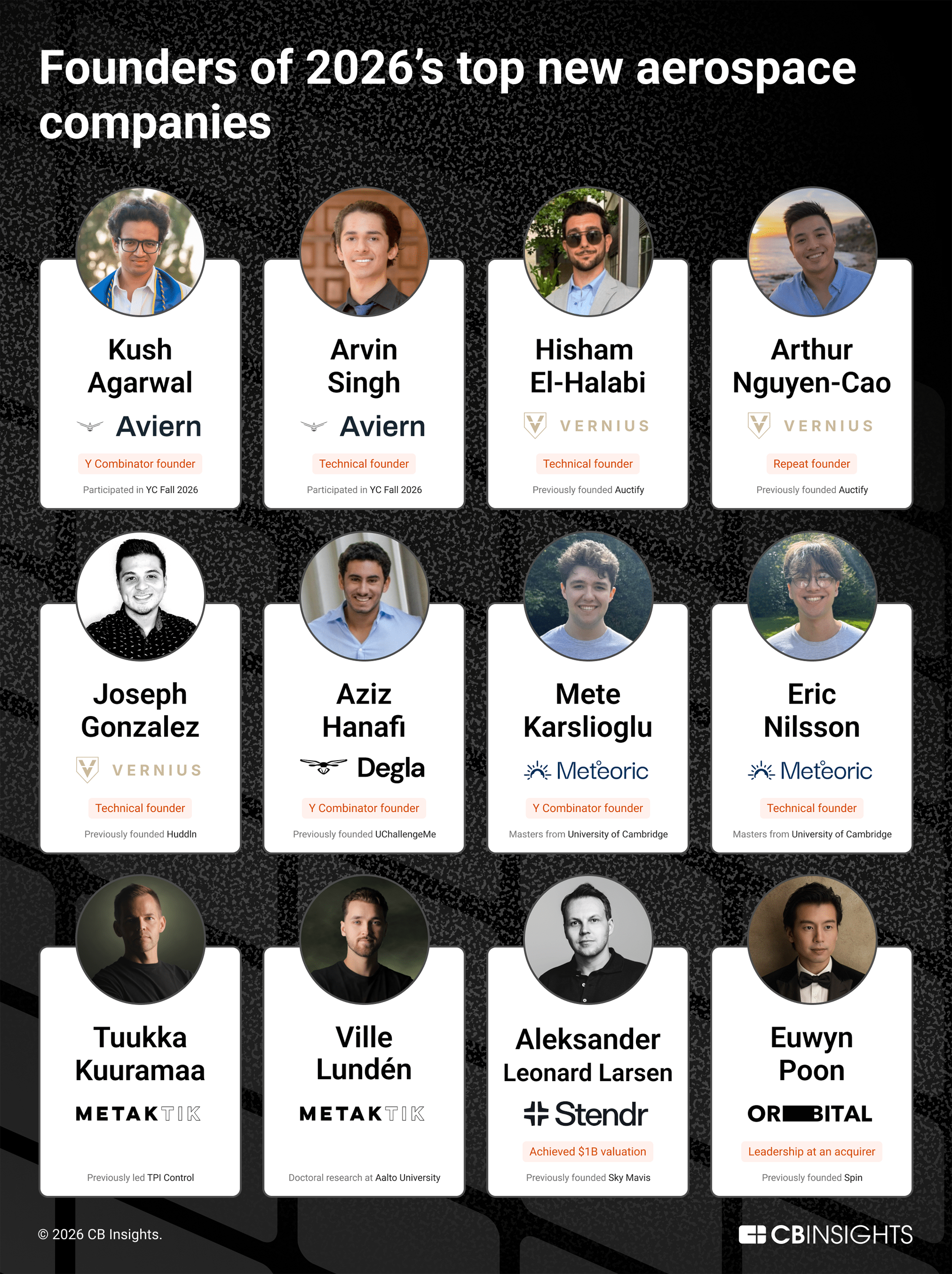
CB Insights customers can see 60+ founders of new aerospace companies here.
What makes these founders stand out
The two UCLA engineers swapping helicopter pipeline patrols for autonomous drones
Kush Agarwal & Arvin Singh — Aviern
Agarwal is a UCLA aerospace engineering grad who ran UCLA’s Uncrewed Aerial Systems club and designed an introductory UAV course for the School of Engineering. He also flew drone missions using specialized imaging and thermal sensors at Matter Intelligence. His co-founder Singh studied mechanical engineering at UCLA, competed on its Design Build Fly team, and spent two summers in manufacturing engineering at Cepheid.
In September 2026, they co-founded Aviern, part of Y Combinator’s Fall 2026 batch. The company builds fixed-wing drones that patrol pipelines, taking off and landing at docks without staff on-site. It aims to replace helicopter patrols, which operators pay for up to 26 times a year, and charges per mile flown.
The MIT grad letting search and rescue teams command drone fleets in plain English
Aziz Hanafi — Degla
Hanafi is an MIT computer science graduate who worked on AI for coordinating autonomous systems at InstaDeep. His first startup, a gamified social platform named UChallengeMe, reached 10K+ users organically before he shut it down and sold the codebase.
Degla AI (Y Combinator Fall 2026 batch), founded earlier this year, builds software that lets search and rescue teams direct a fleet of drones using plain-English commands. The system plans the mission and splits tasks across the drones, with all processing running onboard. Degla is currently in its funding window (3 to 17 months from latest seed round) according to CB Insights’ benchmarking analysis.
The Aalto pair taking ultrathin antennas from satellite research to drones and defense
Tuukka Kuuramaa & Ville Lundén — Metaktik
Kuuramaa led commercialization for Aalto University’s DIAMANT project, which developed lightweight, fold-out antennas for small satellites. He previously served as acting CEO of building-automation company TPI Control. Lundén researched small-satellite antennas during his doctoral work at Aalto.
In March 2026, they co-founded Metaktik to turn Aalto’s antenna research into products. The company develops ultrathin, flexible antennas for radar and communications on satellites, drones, and defense equipment. Based in Espoo, Finland, Metaktik has raised $1.1M in pre-seed funding.
The Cambridge duo flying drones into clouds to send more sunlight to solar farms
Mete Karslioglu & Eric Nilsson — Meteoric
Karslioglu earned a masters in aerospace and aerothermal engineering at Cambridge, where he researched spray nozzles for marine cloud brightening at Cambridge’s Centre for Climate Repair. That work provided the scientific foundation for Meteoric, his first venture. Nilsson, Meteoric’s co-founder and CTO, is also a Cambridge MEng graduate with a background in atmospheric measurement, cloud-related hardware, and liquid-handling systems.
Launched in August 2026, Meteoric (Y Combinator Summer 2026 batch) builds drones that fly into low- and mid-altitude clouds over solar farms and make them less reflective without chemicals, so more sunlight reaches the panels. The company is targeting its first large-scale cloud-clearing field demonstration in 2027.
The Spin founder trading scooters for AI data centers in space
Euwyn Poon — Orbital
Poon, a Y Combinator 2010 alumnus, co-founded micromobility company Spin in 2017 and led its growth before Ford acquired the company in November 2018 (reported at ~$100M). Under Ford’s backing, he scaled Spin to 250K+ units deployed across 100+ markets. Spin was subsequently acquired by Tier in 2022 and then by Bird in 2023.
Founded in February 2026, Orbital is building AI data centers in space. It plans to launch its first data-processing satellite, carrying Nvidia Space-1 Vera Rubin-class GPUs, in 2028 and eventually scale to a constellation of up to 100K satellites. The company raised $5M led by a16z’s Speedrun accelerator in April 2026. Poon’s bet is that solar power and the ability to release heat into space can help overcome the power and cooling constraints facing data centers on Earth. He says reaching full scale depends on SpaceX’s Starship entering commercial service.
The Axie Infinity co-founder building homegrown drone defenses for Europe
Aleksander Leonard Larsen — Stendr
Larsen co-founded Sky Mavis, the gaming studio behind Axie Infinity (virtual world that peaked at 3M monthly active players), and scaled the business operations side as COO until January 2026.
The following month, he founded Oslo-based Stendr to build drone defense hardware and software. Its AI combines readings from multiple sensors to help defense teams track aerial threats in real time. Stendr targets European governments seeking air defense technology developed within Europe. The company raised a $5.4M pre-seed round in April 2026, led by Rainfall Ventures, ACME Capital, and Skyfall.
The three repeat founders helping interceptor drones hunt Shaheds beyond visual range
Hisham El-Halabi, Arthur Nguyen-Cao, & Joseph Gonzalez — Vernius Systems
El-Halabi and Nguyen-Cao previously co-founded smart glasses developer Auctify. El-Halabi also built fitness startup Moredovate and AI calorie tracker Sano. Nguyen-Cao, now Vernius’s CEO, led a volunteer engineering team building drones for Ukrainian units. Gonzalez worked as a solutions architect at Sandia National Laboratories and founded rewards platform Huddln and AI chatbot developer PluckyLabs.
They co-founded Vernius Systems in May 2026 and joined Y Combinator’s Summer 2026 batch. Vernius builds low-cost radar guidance systems designed to help interceptor drones find and track Shahed-class drones beyond visual range, including in poor weather. The company reports testing in Ukraine within eight weeks of launch, selling 45 units to a special forces unit, and receiving roughly $500M in letters of intent for 2027.
For information on reprint rights or other inquiries, please contact reprints@cbinsights.com.