From manual CAD to engineering orchestration: Closing mining’s study bottleneck
Moving a mineral deposit from discovery to commercial production averages 16 to 18 years globally and nearly 30 years in the US, with roughly 30% to 40% of that timeline consumed by scoping, prefeasibility and feasibility studies, Dr. Ari Rostami, Founder & CEO of AiMinr, writes.
At the exact moment electrification, defence supply chains and AI data centres are compounding critical mineral demand, experienced mining engineers, geologists and metallurgists are retiring faster than universities can replace them. Yet scarce senior talent still spends months on manual drudgery: CAD drafting, spreadsheet stitching, and pointing and clicking across disconnected legacy software.
Because geology, mine planning, processing and finance sit in isolated siloes that do not talk to one another, there is no automated backwards-and-forwards reconciliation. Changing a single metal price, cut-off grade, or geotechnical assumption can trigger weeks or months of manual rework from scratch, trapping teams in “study fatigue” and forcing projects to evaluate only one or two mine plans before locking in billions of dollars.
52 domain agents, deterministic math and human sign-off
AiMinr was built to eliminate that manual bottleneck without eliminating engineering rigour or the human engineer. Delivered as a 12-module SaaS platform inside dedicated, tenant-isolated cloud environments backed by SOC 2 security controls, the system follows a strict hybrid philosophy: 30% agentic orchestration and 70% deterministic engineering calculation.
A central orchestrator coordinates 52 domain-specialised subject matter expert (SME) agents trained on roughly 120,000 publicly available technical reports (mostly NI 43-101 and JORC filings) and refined through working directly with mining clients and processing real-world project data within their dedicated cloud environments, alongside regional unit-cost templates (covering power, fuel, labour, consumables, and shaft or shop construction across North America, South America and other major jurisdictions) and equipment cycle-time benchmarks from jumbos and LHDs to haul trucks.
Crucially, the agents never use generative AI to guess at numbers. Each SME agent knows which deterministic physics, 3D CAD geometry, mass-balance, or cash-flow algorithm to execute, and continuously cross-validates forwards and backwards with peer agents. For example, an open-pit or underground design agent runs a deterministic solver and hands the geometry to downstream scheduling, ventilation and financial agents; if operational targets or economic expectations are missed, downstream agents automatically send the design back upstream to re-optimise under adjusted parameters.
That architecture fits cleanly within JORC 2012 and NI 43-101 requirements. Statutory reporting requires Qualified Persons (QPs) and Competent Persons (CPs) to verify and sign off on every material assumption. AiMinr enforces hard human validation gates across modules before compiling audited outputs into structured NI 43-101 and JORC technical report sections, allowing senior engineers to audit every Basis of Estimate formula and source cell rather than trusting a black box.
From brownfield optionality to greenfield audits
Running disciplines in parallel at machine speed changes what is possible across both brownfield and greenfield studies, cutting mining side prefeasibility timelines from roughly eight months down to eight weeks:
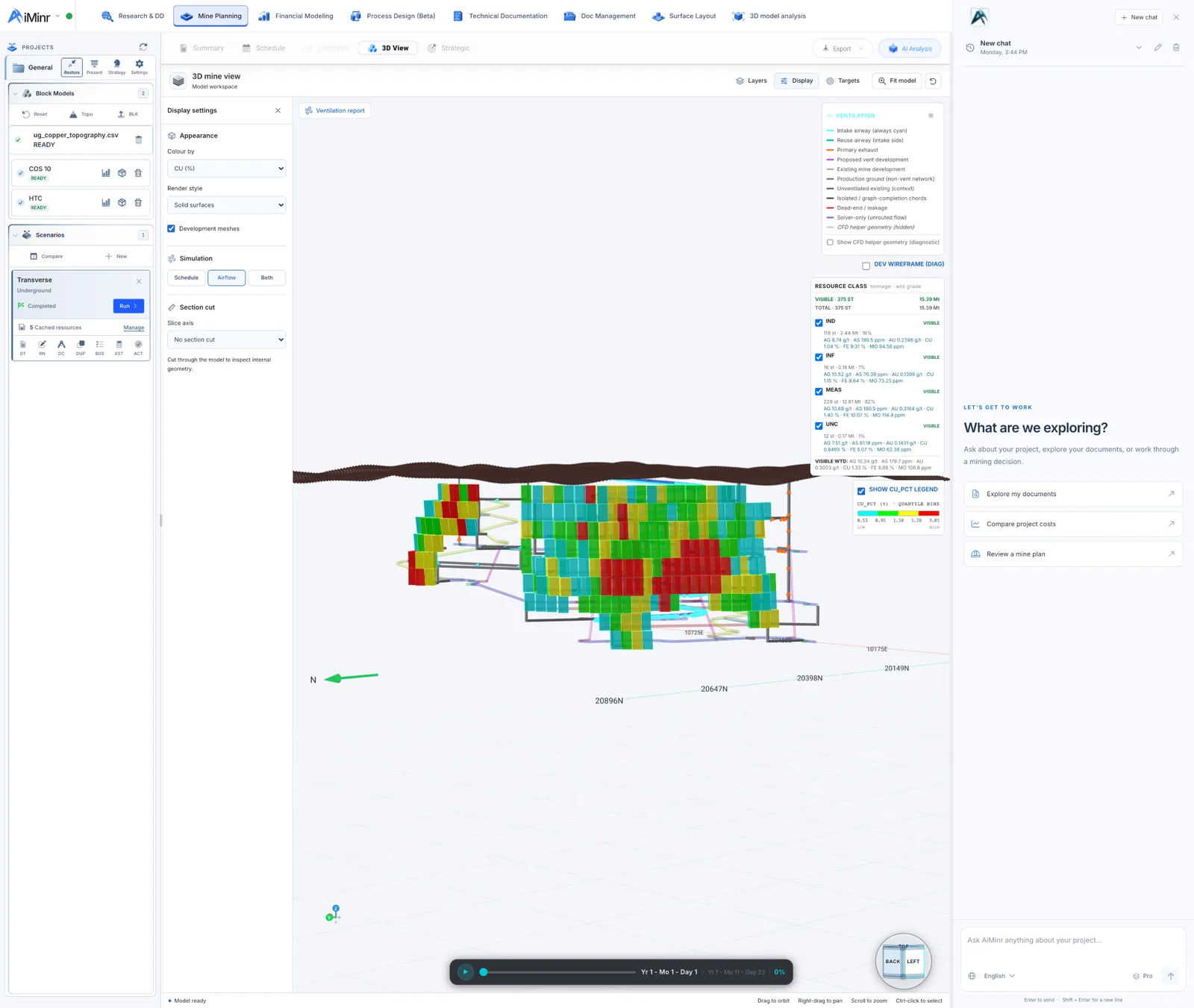
- Brownfield transitions and adaptive mixed mining: Starting from uploaded block models and existing as-built CAD or DXF files, engineers define design criteria and production targets, click run and in 35 to 40 minutes receive a scheduled 3D CAD mine plan complete with stopes, sublevels, ramps or shafts, ventilation and construction staging. On complex open-pit-to-underground transitions or variable orebodies, the platform supports adaptive mixed mining, evaluating local deposit dip, thickness, orientation and grade to combine methods such as longhole stoping and drift-and-fill automatically. Instead of testing two manual cases over months, teams can run 100 to 200 deterministic scenarios across pit shells, 3D crown-pillar boundaries and process-flow diagrams, plotting every iteration onto a 3D decision graph to pinpoint the true value frontier.
- $1 billion-plus greenfield capital and operating cost audit: On a billion-dollar greenfield project spanning dozens of disconnected EPCM contractor and owner workbooks with tens of thousands of CAPEX and OPEX lines, estimation and financial SME agents audited work based schedule structures, mobile fleet schedules and regional unit-cost assumptions in under a day rather than weeks of manual cell checking. The system surfaced over $190 million in conflicting initial-versus-sustaining CAPEX classifications (including nearly $40 million in unallocated lines) and wired every approved cost driver directly into live NPV, IRR and AISC models with 100% cell-level provenance.
Every stakeholder benefits from this shift. Mine owners eliminate blind spots across hundreds of scenarios before committing capital. EPCMs and independent consultants offload repetitive CAD drafting and spreadsheet reconciliation, freeing senior specialists to focus on defining parameters, Basis of Estimate criteria and high-value optionality, while project financiers and investors gain a transparent, cell-traceable audit trail rather than static summary tables.
Where AI takes mine studies next
AI will not replace geologists, mining engineers, or metallurgists because capital projects require accountable human judgement. What is ending is the era where highly trained engineers spend months manually drafting stopes and reconciling disconnected spreadsheets for a single static PDF study that goes stale the moment markets move.
Over the next decade, mine studies will operate as living, continuously reconciled engineering systems: as new infill drill holes, metallurgical test work, tariff shifts, or commodity prices arrive updates will propagate across mine design, plant sizing and project economics in hours rather than years. In that future, the engineer’s role shifts from manual drafter to supervisor and orchestrator, setting the engineering rules, evaluating hundreds of deterministic scenarios in parallel and guiding better mines into production years faster.
The post From manual CAD to engineering orchestration: Closing mining’s study bottleneck appeared first on International Mining.