14 robotics founders who’ve already built a $1B company
Founders behind billion-dollar companies in e-commerce, smart locks, batteries, and lidar are now starting over with robots.
Using CB Insights People data, we profiled 14 founders of robotics companies started in 2024 or later who held a founder or C-level role at a previous company when it first hit a $1B valuation. Their track records include taking QuantumScape public through a $3.3B SPAC, leading Hesai to listings in New York and Hong Kong, and serving as Figure’s CTO.
Now they’re building everything from humanoids to the data and models robots learn from.
A closer look at the list:
- Two of these startups are already unicorns: Rhoda AI raised $450M at a $1.7B valuation in March 2026, about 18 months after it was founded. Sharpa raised about $669M in August at a valuation of roughly $3B.
- Most come from outside robotics: 10 of the 14 founders built their previous unicorns in other sectors, including resale marketplace Vestiaire Collective, smart lock maker Latch, and household goods brand Grove Collaborative. The exceptions are former Figure CTO Jerome Pratt and Hesai’s three co-founders, whose lidar sensors are used in robots.
- Several are betting on robot training data: 4 of the 9 companies focus on the data and models robots learn from. Poseidon and Cortex AI collect real-world training data, SpAItial generates 3D environments, and Rhoda pre-trains robots on internet video.
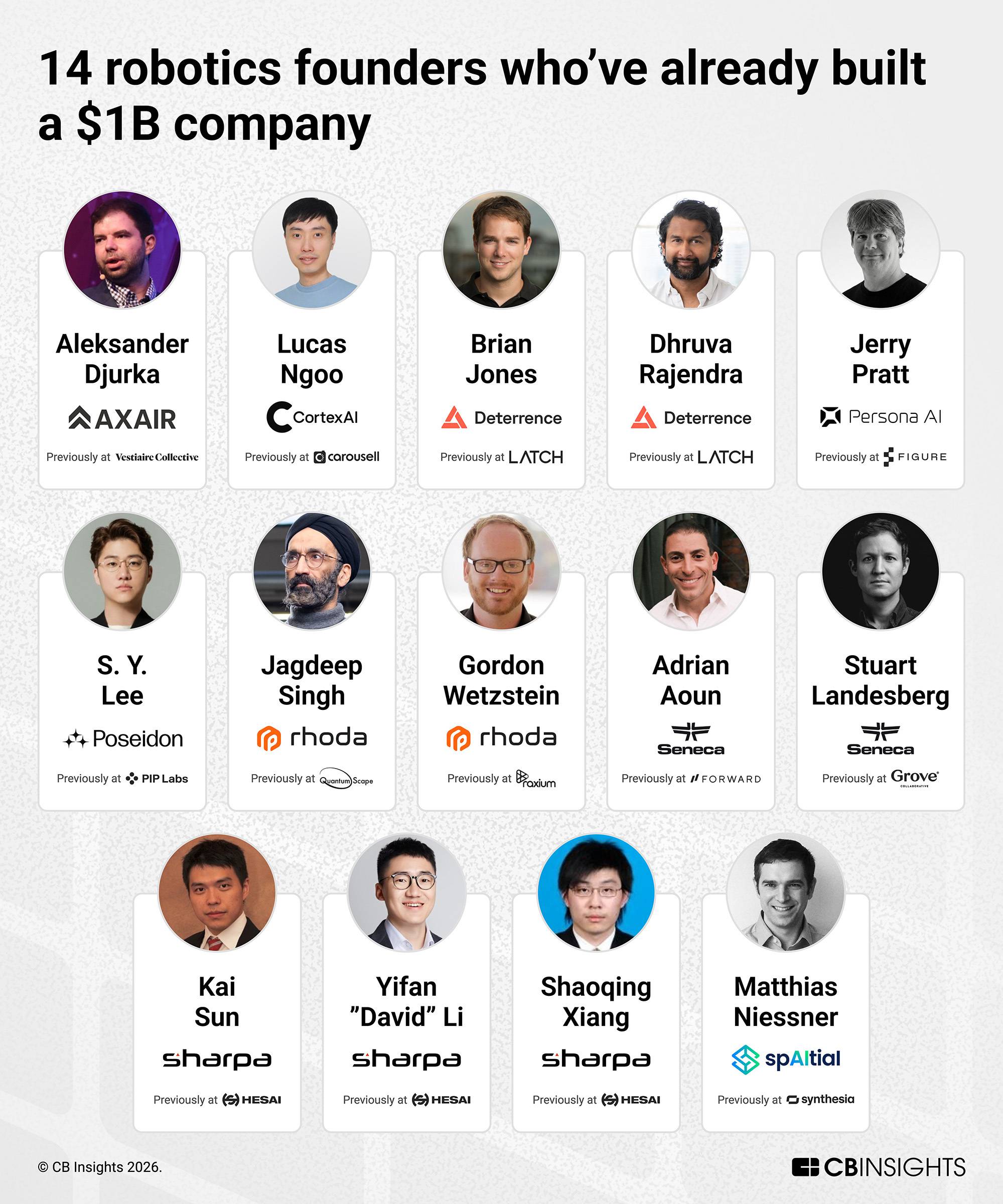
CB Insights customers can see 2,000+ founders of new robotics startups here.
Meet the startups and their founders
Rhoda AI
Rhoda AI builds FutureVision, a foundation model that pre-trains robots on hundreds of millions of internet videos so they learn how objects move before they ever touch one. The company says the model already runs robots autonomously in production environments, including a test with an automotive company, and it works with industrial partners in manufacturing and logistics.
Rhoda, which states robots using it can learn a new task with as little as 10 hours of teleoperation data, came out of stealth in March 2026 with a $450M Series A at a $1.7B valuation led by Premji Invest, with Khosla Ventures, Temasek, and John Doerr participating. It has since grown to more than 100 employees.
Jagdeep Singh
Singh founded solid-state battery maker QuantumScape in 2010 and led it as CEO through its $3.3B SPAC listing in 2020 and until 2024. Before that, he founded optical networking company Infinera, which went public in 2007, as well as optical switching company Lightera Networks.
Gordon Wetzstein
Wetzstein is a Stanford professor who leads its Computational Imaging Lab. He co-founded microLED display maker Raxium, which Google acquired in 2022 in a deal reportedly worth about $1B, and eye-tracking company Zinn Labs.
Sharpa
Singapore-based Sharpa makes dexterous robot hands and humanoid robots, with manufacturing and R&D in Shanghai. Its SharpaWave hand won a CES 2026 Innovation Award and has been in mass production since October 2025.
In August, Sharpa opened a fully automated Dairy Queen restaurant in Shanghai run by its robots and most recently raised about $669M from Alibaba, Tencent, Meituan, and JD.com.
Yifan “David” Li
Li co-founded lidar maker Hesai Technology in 2014 and has been its CEO since. Hesai raised more than $700M in private funding, reaching a valuation of $2.2B before listing on Nasdaq in 2023 (and in Hong Kong in 2025). Li earned a PhD in motion control and previously worked on robotics motion control at Western Digital.
Shaoqing Xiang
Xiang also co-founded Hesai and has been its CTO since 2014. Before Hesai, he was an iPhone hardware engineer at Apple.
Kai Sun
Sun was the third co-founder of Hesai and serves as its board chairman and chief scientist. He earned his PhD and did postdoctoral work at Stanford, developing laser-based sensors.
Persona AI
Houston-based Persona AI builds humanoid robots for heavy industry, using robotic hand technology derived from NASA.
Its first big customer push is shipbuilding: Persona signed a joint development agreement with HD Hyundai in March 2026 to build welding humanoids for its shipyards, with a prototype targeted for late 2026 and field testing in 2027. Persona raised a $65M Series A in October and has grown to 90 employees.
Jerome Pratt
Pratt co-founded Persona and serves as its CTO. Previously, he was Figure’s CTO from 2022 to 2024, a stretch that included its $2.7B-valued Series B round. Before that, he spent 20 years as a research scientist at the Florida Institute for Human and Machine Cognition, where he worked on humanoid robots, and co-founded humanoid startup Boardwalk Robotics in 2017. He studied at MIT.
Seneca
San Francisco-based Seneca builds autonomous drones that attack wildfires.
Each drone carries enough water and foam concentrate to make about 100 gallons of finished foam, and a single pilot can direct a five-drone strike team. The Aspen Fire Protection District became its first customer in February 2026, and in October, San Bernardino County Fire signed on to deploy five aircraft ahead of the 2027 fire season.
Stuart Landesberg
Landesberg founded sustainable household goods brand Grove Collaborative in 2012 and ran it as CEO until 2023, taking it past a $1B valuation in 2019 and onto the NYSE. Under him, Grove became the world’s first plastic-neutral retailer and expanded into Target stores nationwide. He remains Grove’s chairman and is Seneca’s CEO.
Adrian Aoun
Aoun founded primary care company Forward and ran it as CEO until 2024. Forward topped a $1B valuation in 2021 and raised over $350M from backers including Thrive Capital, Marc Benioff, and Khosla Ventures.
Earlier, he sold natural language processing startup Wavii to Google in 2013, helped build Google’s AI division, and ran special projects for Larry Page, where he helped found Alphabet’s Sidewalk Labs. He has invested in more than 300 startups.
Deterrence
Deterrence uses robotics and computer vision to automate the production of energetics, the explosive materials inside ammunition and weapons.
In 2026, Deterrence partnered with General Dynamics’ ammunition business and raised a $10.1M seed round in 2024 led by Riot Ventures.
Dhruva Rajendra
Rajendra co-founded smart lock maker Latch (now Door) in 2013 as its first president. During his time, the company achieved a $1.6B SPAC listing in 2021. By then, Latch’s smart access system had been booked into more than 300K homes across 35 states, according to the company. He now serves as Deterrence’s CEO.
Brian Jones
Deterrence’s COO Jones also co-founded Latch and served as its CTO from 2013 to 2023, including its SPAC listing. Earlier, he was a quality engineer at Brinkman Precision, a maker of precision-machined aerospace components.
Poseidon
Poseidon collects hard-to-get, IP-cleared training data for AI and robotics developers, such as first-person video of people doing physical tasks, and pays contributors through licensing tools. It raised a $15M seed round in July 2025 led by A16z Frontier.
Seung Yoon Lee
Lee founded PIP Labs, developer of web3 creator technology Story Protocol, in 2022 and led it as CEO through a $2.25B valuation in 2024 and until June 2026.
PIP Labs raised $164M in total funding from investors like Andreessen Horowitz and launched its public network in February 2025. Before that, he founded serial fiction app Radish, which South Korean media company Kakao Entertainment acquired for $440M.
Cortex AI
Cortex AI records annotated first-person video of people working with their hands, collects robot movement data, and runs human-in-the-loop evaluations for robotics companies and frontier AI labs. It most recently raised a $6M seed round in 2025 from investors like Y Combinator and Matrix Partners, and its team has grown 5x over the past year to 20 people.
Lucas Ngoo
Ngoo co-founded Southeast Asian marketplace Carousell in 2012 and stayed until 2024, including when it reached a $1B valuation in 2021. He wrote Carousell’s first lines of code, built its technology team as CTO until 2019, and later helped build its Malaysia car resale business as the company expanded to eight markets. Ngoo also co-founded AI health coaching company CareSense.ai.
SpAItial
SpAItial builds AI models that generate and reconstruct 3D environments, which robotics developers can use as training grounds for robots. Its latest model, Echo-3, launched in October and turns a short iPhone video into a realistic, true-to-scale 3D copy of a room or building.
Matthias Niessner
Niessner co-founded AI video company Synthesia in 2017, which reached a $1B valuation in 2023. He co-developed the deep learning research behind Synthesia’s AI avatars, and the company has since reached a $4B valuation, with more than 90% of the Fortune 100 as customers.
He has also been a professor at the Technical University of Munich since 2017, after four years as a visiting assistant professor at Stanford, and is SpAItial’s CEO.
Axair Systems
Berlin-based Axair Systems, founded in May 2025, builds autonomous drones and the software behind them for defense and civilian use. Its first focus is low-cost AI interceptors that use computer vision to take down fiber-optic-guided drones, which can evade radar and jamming and have spread quickly since their use in Ukraine.
Aleksander Djurka
Djurka was chief information officer at resale marketplace Vestiaire Collective from 2020 to 2022, including when it reached a $1B valuation in 2021. He then led data engineering and infrastructure for automaker Stellantis‘ software organization, including its connected-vehicle data platform. Earlier, he headed data engineering at Southeast Asian e-commerce company Lazada.