9 Big Tech engineers building the next wave of fintech
Big Tech engineers are turning to fintech in 2026, targeting workflows like investment research, trading, accounts receivable, and financial data.
Using CB Insights People data, we profiled 9 technical founders who came from Google, Meta, Microsoft, AWS, TikTok, and IBM and founded fintech startups this year. Several have also spent time inside finance or fintech at firms including Goldman Sachs, Nomura, and Varo, seeing both the engineering and the workflows they’re now rebuilding.
Here’s what stands out about the companies they’re building:
- These founders are prioritizing operator workflows. V2O helps assess a company’s earnings during M&A due diligence, Itoflow helps investment teams test and track investment ideas, and Segmental AI handles accounting and reporting.
- Big Tech isn’t the whole resume. Simone Qu moved from Meta to Goldman Sachs and Nomura before founding V2O. Skylar Chen jumped between TikTok Shop, AWS, and Goldman Sachs. Alexander Vasilevskiy led engineering across Zuora, Varo, and IBM. Several have worked on both sides: at Big Tech building modern infrastructure, then inside finance or fintech dealing with actual workflows and constraints.
- Several are targeting specific customer groups. Alpha Investing focuses on Shariah-compliant investing, VolumeLens serves Indian retail traders, JoyWork targets multi-location service businesses such as cleaning, landscaping, and HVAC companies, and Knowable Labs builds for prediction market traders.
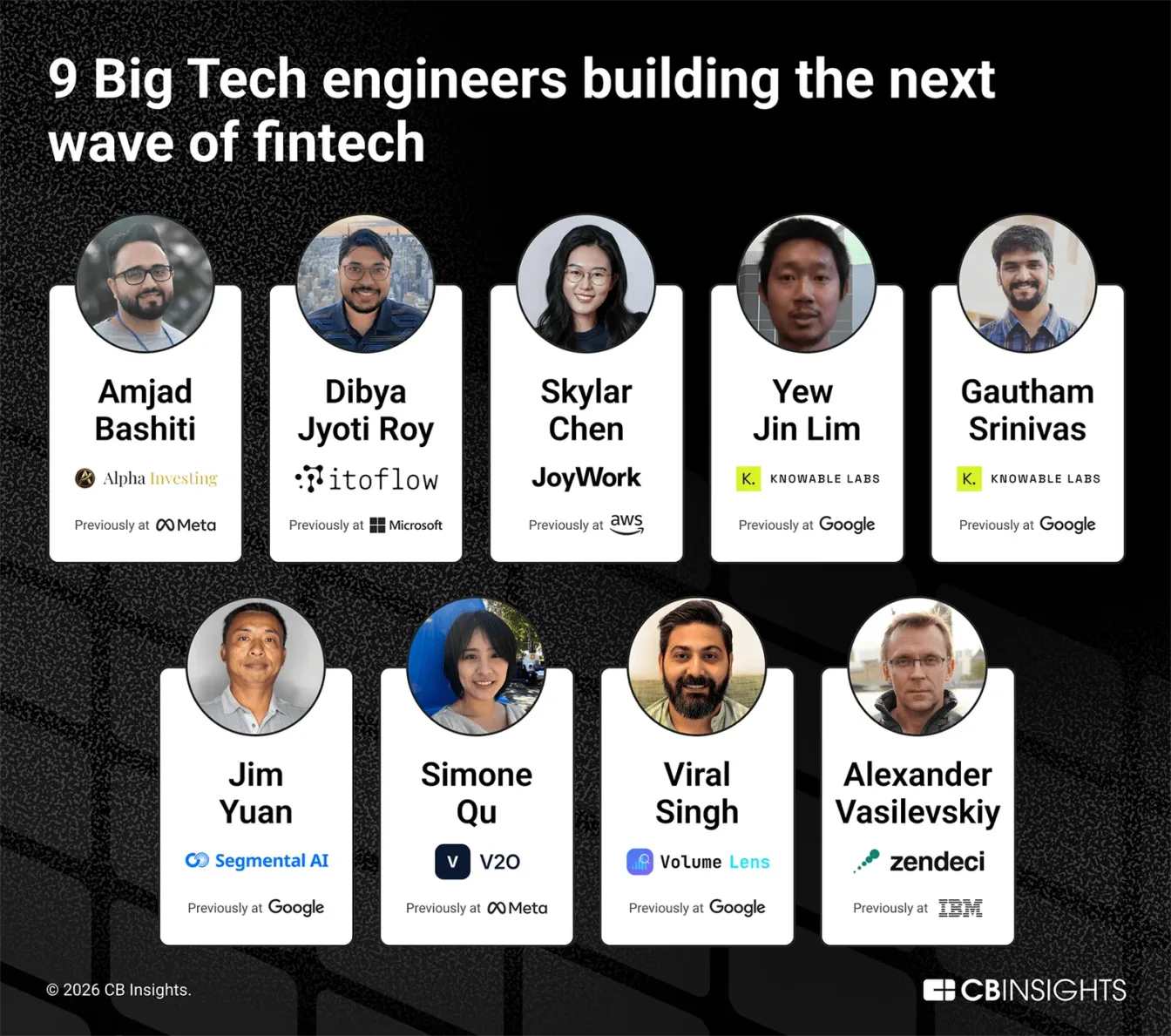
CB Insights customers can see 140+ technical founders of new fintech companies here.
What makes these founders stand out
The former Meta payments engineer bringing AI agents to Shariah-compliant investing
Amjad Bashiti — Alpha Investing
Bashiti spent roughly 4 years as a software engineer at Meta, working on payment and checkout tools across its apps and fraud prevention systems protecting customer accounts and financial data.
His Los Angeles-based startup, Alpha Investing, builds an AI-powered investing platform for Shariah-compliant equities. Its agents analyze company financials, trading patterns, market sentiment, economic conditions, and earnings to identify investment opportunities.
The Microsoft cloud architect helping European funds test and document their investment ideas
Dibya Jyoti Roy — Itoflow
Roy spent roughly 9 years at Microsoft progressing from software engineer to senior architect, focusing on Azure infrastructure, distributed systems, and cloud reliability.
Itoflow, based in London, helps hedge funds, asset managers, wealth advisors, and family offices across Europe research and test investment ideas. Teams can test strategies against historical data, monitor results, and keep a record of their hypotheses, tests, and decisions for internal review and regulatory purposes. Itoflow raised $2.5M in pre-seed funding in August 2026, led by Balderton Capital. CB Insights predicts its next funding window will open in mid-2027.
The TikTok Shop and AWS engineer automating collections for cleaning and HVAC companies
Skylar Chen — JoyWork
Chen’s career threaded through engineering roles at TikTok Shop (where she worked on Seller AI tools), AWS (Cloudformation), and Goldman Sachs.
Her startup JoyWork, where she serves as CTO, automates accounts receivable for multi-location service operators in sectors like commercial cleaning, landscaping, and HVAC. The startup is forecast to open its next funding window starting November 2026.
The Google X engineering director rebuilding back-office accounting for fund administrators
Jim Yuan — Segmental AI
Yuan spent more than a decade at Google in engineering leadership roles: tech lead for Google Cloud Storage, engineering lead for Google Express’s payment and transaction platform, and director of engineering at Google X (Alphabet’s moonshot lab). He then served as CTO of Mineral, an Alphabet company building AI for agricultural perception, where he led a team shipping AI into the field.
His Mountain View-based startup, Segmental AI, builds enterprise resource planning (ERP) software with AI for fund administrators, asset managers, and financial institutions. It handles financial tasks including recording accounting entries, reconciling accounts, and preparing reports.
The quant turned serial founder automating the earnings reviews behind M&A deals
Simone Qu — V2O
Qu is a serial fintech founder. She co-founded Nauma, an AI financial advisor for tech workers (3K+ users, 80+ paying customers), then Fineras AI, automating cash flow forecasting for turnaround advisors. Before founding, she was an ML engineer at Meta and spent years in quantitative research roles at Goldman Sachs and Nomura, modeling credit and building pricing systems.
V2O, based in Irvine, California, automates quality-of-earnings (QoE) analysis for M&A due diligence. It produces financial workbooks combining historical results, analysis of changes in performance, and adjustments to EBITDA to help buyers assess the earnings behind a deal. Its customers include financial advisory firms, investment banks, and private equity operations. The company is currently in the pre-revenue to <$1M ARR stage.
The QoE market spans $500M to $1B annually, with 5,000-10,000 deals yearly across the mid-market and lower-market segments. Qu describes the recent policy shift reshaping demand:
“ There’s been a policy change recently, starting October 1st. For any small business, if there’s a change of ownership involved and there’s a need for a loan, the lender would require a quality of earnings report. That actually makes the market bigger. Since it’s required, more lenders, more quality of earnings reports are needed.Read our full interview with V2O CEO Simone Qu here.
The Google engineering lead giving India’s retail traders AI market commentary
Viral Singh — VolumeLens
Singh built products across LinkedIn, Myntra, and Google, spending more than a decade in engineering roles and most recently, leading engineering teams at Google.
His startup, Bengaluru-based VolumeLens, is a trading and analysis platform focused on the Indian retail trading market. It combines data on buying and selling activity with AI-generated market commentary and pattern detection. The platform integrates with Zerodha, India’s largest retail broker by market share, allowing traders to research and place trades within the same ecosystem.
The IBM and Varo engineering veteran rolling loan underwriting into one AI system
Alexander Vasilevskiy — Zendeci
Vasilevskiy spent more than a decade at IBM working on compilers, software that translates code into instructions computers can run. He later held engineering leadership roles at subscription billing company Zuora and neobank Varo, where he oversaw fraud, risk, and lending technology.
His San Jose-based startup, Zendeci, builds AI software for processing and approving consumer loans. It brings lending rules, real-time loan decisions, and credit risk monitoring into one system, aiming to replace the separate underwriting tools many lenders use. Its target customers include online lenders, credit unions, and fintech lending platforms.
The Google Search alumni building an AI agent that trades on its own forecasts
Yew Jin Lim & Gautham Srinivas — Knowable Labs
Lim spent nearly two decades at Google, joining in 2007 and rising to Director of Engineering in Search, where he worked on proactive AI and notifications. Srinivas started as a software engineer at Microsoft before moving to Google Search, where he most recently grew AI Mode and helped make the iOS Search app one of the 10 most downloaded apps worldwide.
Knowable Labs uses AI to forecast outcomes in news, politics, and finance, then trades on those forecasts in prediction and capital markets within set limits on capital and position size. It raised a $310K seed round this month. In early live trading on Kalshi with thousands of dollars, Lim stated the company’s agent was up 7%, while the same underlying model using standard prompts was down 58% over the same period.