Nithya Raman prevails over her former ally to lead Los Angeles
LOS ANGELES — Nithya Raman is projected to become Los Angeles’ first Asian-American mayor and the second woman elected to the highest citywide office. After entering the race last minute to challenge incumbent Karen Bass, Raman ran a campaign following the playbook of other democratic socialist-aligned candidates.
Raman galvanized young voters with policy proposals grounded in affordability and improvements to municipal utilities.
Her campaign received an early boost when Controller Kenneth Mejia, the first Asian American to be elected to citywide office in Los Angeles, endorsed her. The two frequently campaigned together, attacking Bass’ signature homelessness program, Inside Safe, which has cost the city over $300 million to house 6,000 Angelenos, 40 percent of whom returned to the streets.
Raman’s background as an urban planner earned her trust with voters concerned about housing policy and utility costs. She touted her ability to reduce homelessness in her district by nearly 50 percent, even as rates rose across the city overall.
Bass, once a young radical, had the Los Angeles Police Department’s union on her side: Campaign finance records show it poured in over $5 million to oppose Raman. Like other candidates affiliated with the Democratic Socialists of America (DSA), Raman had called for defunding the police during the 2020 nationwide uprisings following the killing of George Floyd in Minneapolis.
The next mayor will lead the city through the final years of the Trump administration and take charge of the 2028 Olympics. The short-term rental company Airbnb spent millions in the race to support Bass.
At the Crenshaw High School voting location Tuesday, people waited in line for about an hour to cast their vote. Those who voted for Bass expressed confidence in the current mayor’s ability to lead Los Angeles during a second term.
“Everybody needs a second chance,” Crenshaw native Irene Randall said, in reference to Bass’ handling of the Palisades Fire. “They’ve all done something underneath the covers where we cannot see, and hers just so happened to be a little open. I believe in second chances.”
Those who voted for Raman emphasized the need for new leadership.
Brandon Ramirez, 20, voted for Raman in his second ever election. “With everything going on with how Karen Bass has been running the city, I’d rather have someone else do it than her.”
Ramirez believes that Republican spending on the Bass campaign was a sign Raman is the better option. In October, the Los Angeles Police Department union, which has endorsed Bass and spent millions to oppose Raman, donated $200,000 to the Republican Central Committee of LA County. That group later sent out anti-Raman mailers, according to state campaign filings.
“Being an LA native, a lot of our money doesn’t go [to] what it should be going to. [You] see apartments and housing get set up, but what’s the point of it if people can’t even afford it? And then, crime rates don’t decrease, rent gets higher, and stuff like that needs to change.” Ramirez said.
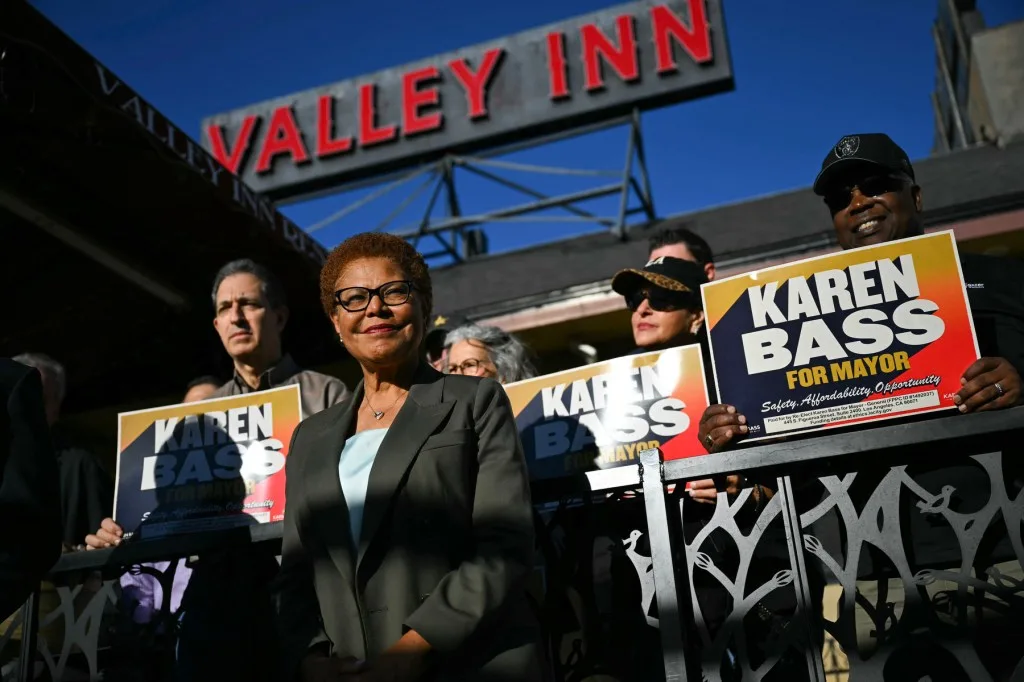
Nestled in the Loews Hotel off Hollywood Boulevard, a DJ played upbeat tunes spanning from R&B to Latin music at the Bass watch party on Tuesday night. Bass’ various endorsers took to the stage ahead of her speech to praise her first term as mayor.
Yvonne Wheeler, the executive vice president of the Los Angeles County Federation of Labor, referred to Bass’ political experience and her being an L.A. native as an upside.
“So who do you believe understands the importance of working people and organized labor?” Wheeler said. “This election was an opportunity to hold our leaders accountable, examine their records, and decide which visions best reflect our values and our priorities. Who has experience, leadership, and vision that reflects our priorities? So I think you understand why organized labor put all of our muscle and machine behind Karen Bass.”
Two large projector screens showcased the other elections of the night. Cheers rang out whenever a Democratic victory was secured.
Bass was introduced to the stage by her stepdaughter and stood among her family.
“Four years ago, you gave me the honor of a lifetime to serve as the mayor of the city that raised me. The city my parents chose to build a life in, and the city I have spent my entire life fighting for. We have taken on some of the most difficult challenges facing any major city,” Bass said in a 10-minute speech, recounting the wildfires, Trump’s National Guard deployment, and the ramping up of ICE activity that marked her first term.
“I love Los Angeles. I believe in this city, and I will always fight for the city that we deserve,” Bass said. “I am proud to say Los Angeles is the best city in the United States of America.”
A few miles away at Griffith Park, hundreds of Raman supporters gathered to celebrate the councilmember at a party that went on past midnight.
A DJ spun nostalgic millennial hits and screens were tuned to local station KTLA for election updates. When Bass’ party was shown, the crowd booed.
Abby Offenhauser, a first year law student at UCLA, was one of the young people in attendance. “I would love to see more transparency in where LA residents’ tax dollars are going, and I would love to see police reform in the LAPD, if at all possible,” she said.
Tara Singh, also a 21-year-old law student, said she had never been to an election party before — but that Raman stood out to her as a South Asian woman. “I think it’s so inspiring to watch someone like me stand up on a stage and move people towards issues that affect all of us. And I think she’s done a really beautiful job of threading the needle and resonating with every single type of person, so I’m excited. I’m cautiously optimistic for tonight.”
The speaker lineup included union leaders, the two local politicians who have endorsed Raman, her younger brother and a tabletop dungeon master with one million Instagram followers.
Raman closed out the program with a 30-minute speech shouting out the organizations and individuals who came together to help her campaign. “This city’s government has made solving problems look impossible for so long that I heard from people across this city who started to believe that it was impossible,” she said. “Hopelessness can be fatal for a city, but this campaign refused to accept that. You refused to accept that.”
“How lucky are we to be in this fight together?” Raman asked the hundreds assembled before her. “Thank you, Los Angeles. I love you.”