A fake Einstein quote actually explains the affordability crisis
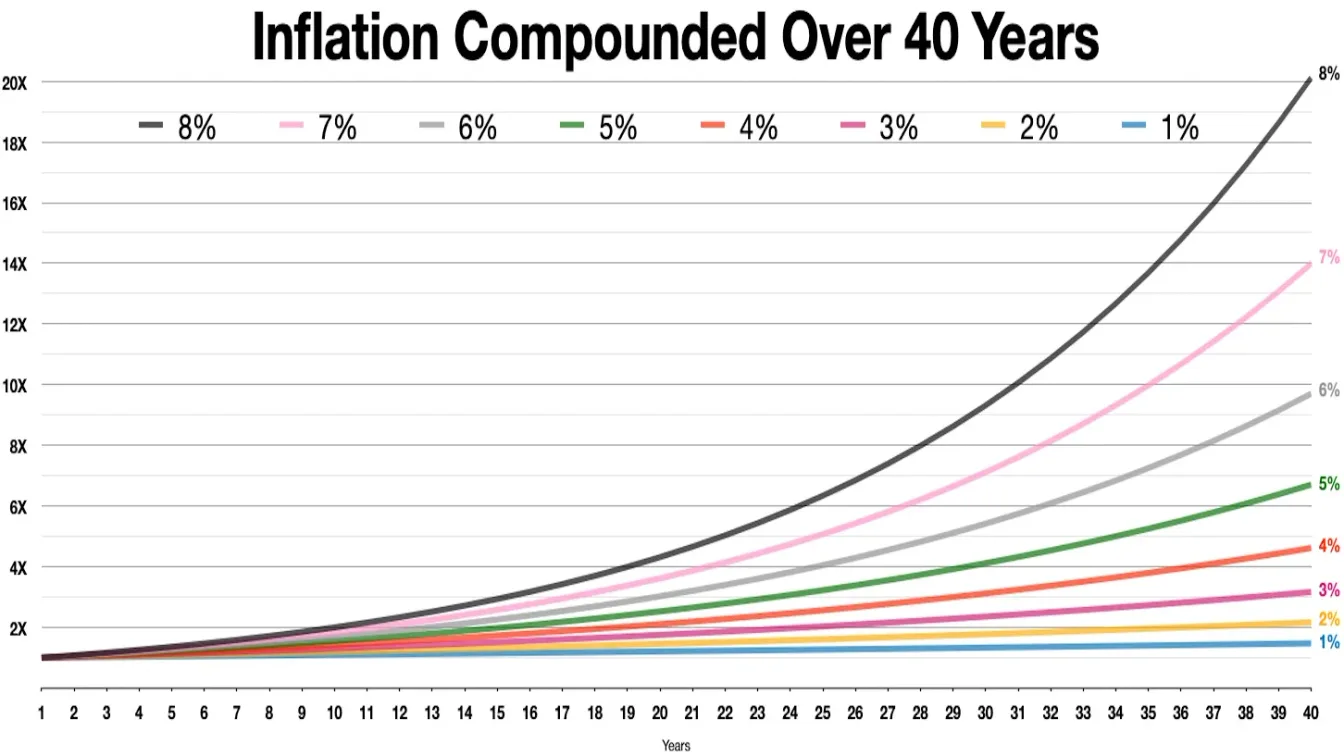
One of the most famous quotes commonly attributed to Einstein was something that he himself never actually said: “Compound interest is the eighth wonder of the world. He who understands it, earns it; he who doesn’t, pays it.” While the quote is not from Einstein at all, the math behind the concept of compound interest is incredibly profound, playing a role in any system — physical, mathematical, or financial — that accumulates based on how much of a base amount is present. When the base amount increases, it isn’t just the original amount (the principal) that continues to accumulate, but the additional amount (the interest) that adds to the accumulation as well.
While investors most often use this to explain the growth of wealth in an interest-bearing account, it can be applied not just to wealth, but to the cost and price of goods and commodities that continue to increase over time as well. When wealth increases, we call it compound interest, but when prices increase, we call it inflation: not the cosmic kind, but the economic kind. The Einstein quote may be a fake, or at least grossly misattributed, but if you want to understand the current affordability crisis, the mathematics and the concept behind the quote is exactly what everyone should understand. Here’s how it works.
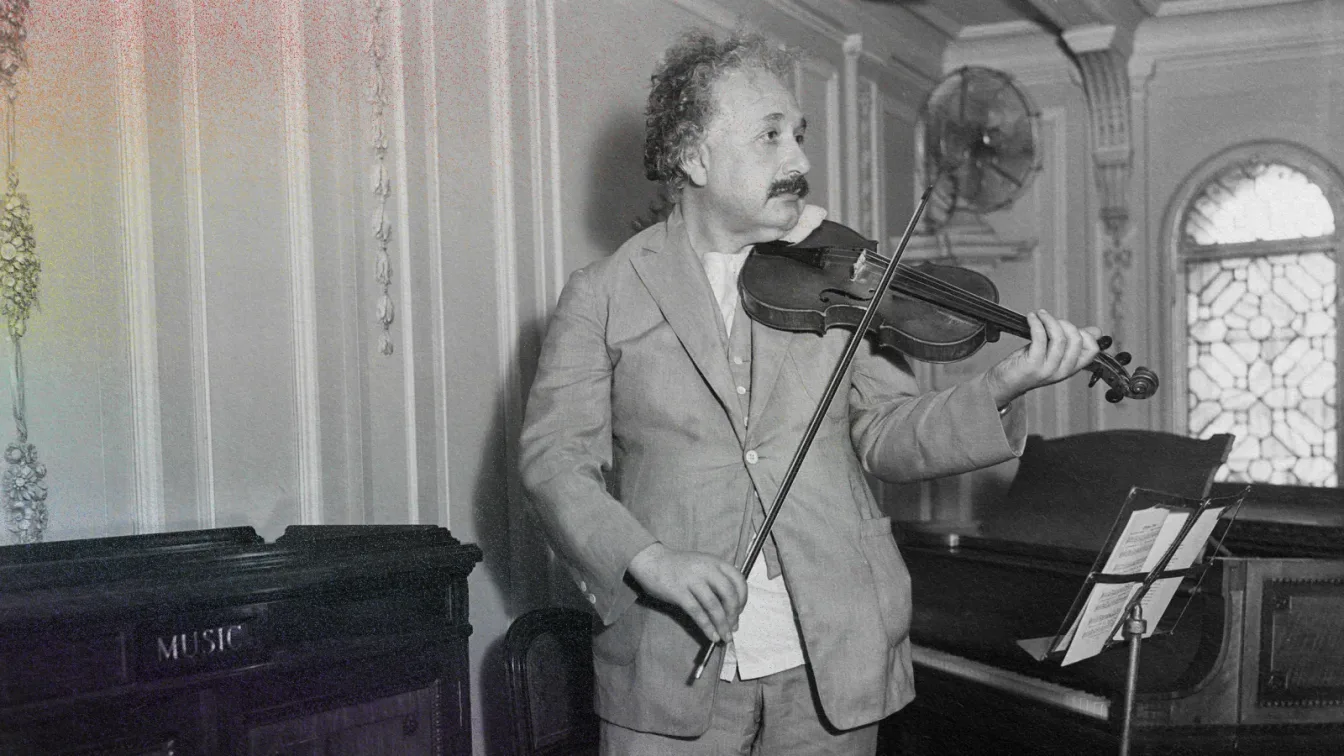 This image shows Albert Einstein playing his violin in 1932. While Einstein had a great many famous quotes and sayings over his life, there is no evidence he ever remarked anything about compound interest, or called it “the greatest invention” or the “eighth wonder of the world” or anything of that ilk. It appears that was an invention of a New York Times writer from 1983.
Credit: Bettmann Collection / Getty Images
The story behind the quote
Einstein grew to fame in the early 20th century, and died in 1955. While an enormous amount of his writings, speeches, and interviews survive, nothing that he ever said or wrote relating to compound interest survives. The earliest assertion that the quote was said by Einstein can be traced back to a 1983 New York Times column, which mentions the quote as a popular saying that’s attributed to him. But it’s likely that the attribution was made up entirely, as there is no print record of the quote — or any saying linking Einstein to the concept of compound interest — prior to that.
An investigation into the quote’s origins unearthed two very similar statements that may provide the ultimate inspiration for the eventual saying that became linked with Einstein’s name. In 1916, a newspaper advertisement in California described compound interest as “the greatest invention the world has ever produced.” A little bit later, in 1925, the phrase “the eighth wonder of the world is compound interest” was used by a Cleveland savings and loan company. It is unknown what sort of intersection of:
- fabrication,
- marketing by financial firms looking for investment,
- and antisemitic thoughts (about the link between Einstein, Jews, and banks),
played a role in conferring an Einsteinian attribution to the actual quote itself.
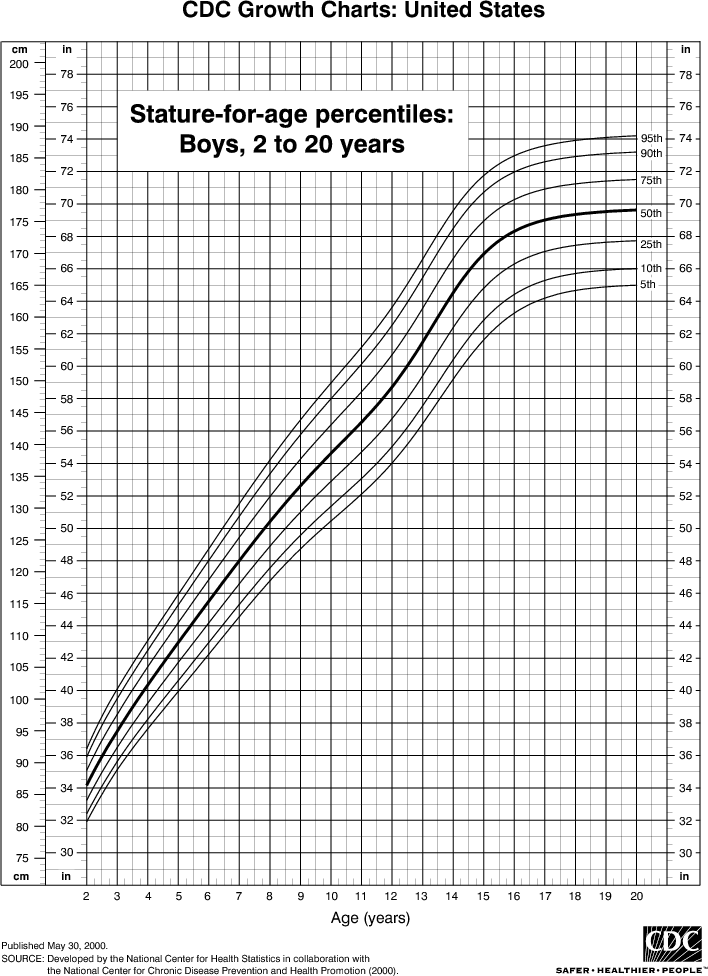 This height by age chart, published in 2000 by the CDC, shows a roughly linear growth in height in boys from the age of 2 until adulthood. There is no compounding in humans when it comes to increases in height; the increase comes instead in a linear fashion.
The math of compound interest
When most of us think of growth, we think of what’s known as linear growth: where things grow by a given amount over a given interval. If you have a child and the child grows by 7.6 centimeters (3 inches) per year, then a baby who’s initially born at 51 centimeters (20 inches) will, after 17 years, have grown to a height of 180 centimeters (5 feet 11 inches). In linear growth, the amount that you gain does not depend on the amount that you already have. Instead, the growth is by a fixed amount over a given time. Financially, it would be like getting $100 every year on your birthday: after 17 years, you would have $1700.
On the other hand, compound interest accumulates based on the base amount that you already have. If you accumulate interest at a 4% rate annually, then if you start with $100, how much will you have after 17 years? You might think — and this is incorrect, linear thinking — that you should just multiply that 4% by 17 years, giving you 68%, growing your $100 to $168. But the way compound interest works is different.
- For the first year, you earn 4% interest on $100, giving you $104.
- For the second year, you earn 4% interest on $104, giving you $108.16.
- For the third year, you earn 4% interest on $108.16, giving you $112.49.
- For the fourth year, you earn 4% interest on $112.49, giving you $116.99.
And so on. Note that for each year beyond the first, you don’t just gain $4 a year (the 4% of the initial $100), but more than $4, as you get 4% interest on the full amount of your balance. By the time a full 17 years have elapsed, your initial $100 will have grown to $194.79: a significant increase over the $168 you’d expect with linear growth.
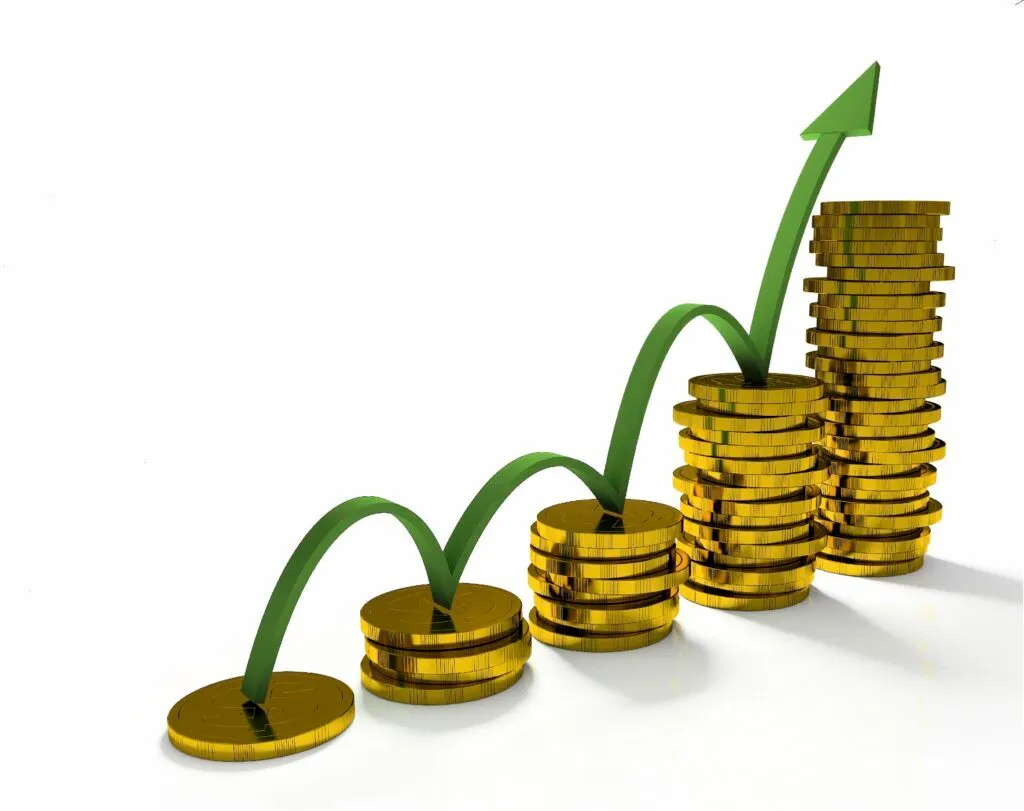 The idea of compound interest is that instead of just gaining the same amount year-after-year on your initial investment, the interest that you earn gets re-invested alongside the principal, where they both earn interest together. Over long periods of time, this can add up to a tremendous advantage over “linear” interest and growth alone.
There are three factors that matter when it comes to compound interest.
- The first is simple: the rate of growth, known as the interest rate. If we took that same analysis — starting with $100 and growing it for 17 years — but upped the interest rate to 5%, 7%, or 9%, that initial investment would instead have grown to $229.20, $315.88, or $432.76, respectively after those 17 years elapsed.
- The second is also simple: the duration of time of the investment. If we go back to that original 4% interest rate, but consider longer-term investments, we can see how continued growth helps increase the amount that you gain. If you wait 30 years, 50 years, or (generationally) 250 years, your initial $100 would grow to $324.34, $710.67, or $1,812,737.11, respectively, at that same 4% rate. Time makes an enormous difference when it comes to compound interest, especially over the long run.
- The third is a little more complicated: how often the interest is compounded. In the prior examples, we compounded the interest annually: we calculated the interest based on how much we had as the principal amount at the start of the year, and then added the interest to the balance at the end of the year, where it becomes part of the new principal. After 17 years, if we compounded the interest quarterly, monthly, or daily, then instead of $194.79, we’d have $196.72, $197.16, or $197.38.
All three of these factors matter for the same underlying reason: interest gives you growth, and the amount of growth you get is determined by both the interest rate and the principal amount. When you grow the principal, you get interest not just on the original balance, but on the “amount of growth” too, and this accumulates over time.
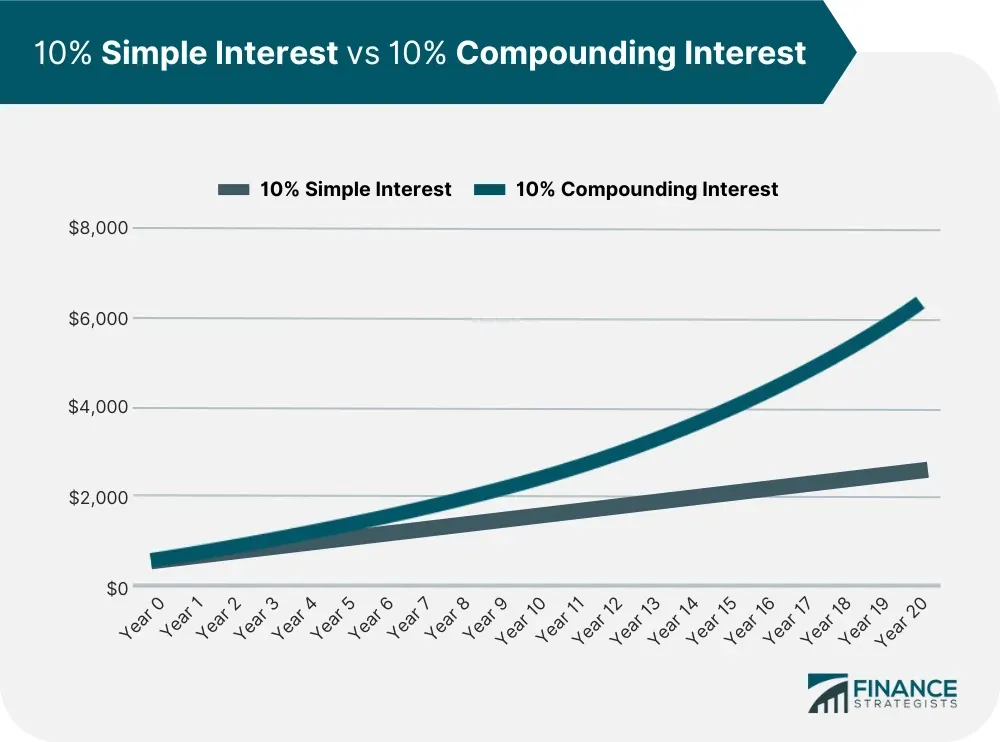 This graph shows the difference of a 20 year investment that accrues 10% in simple interest per year (gaining 10% of the original principal value, annually) versus 10% compounding interest, where after each year, the interest is added back into the principal and begins accruing interest as well. The greater the amount of time that passes, the more the two curves depart from one another.
Growing wealth from an investment
If you want to grow wealth via compound interest, the key is to maximize the value of your principal balance for as long as you can: during the maximal interest-earning times. In most instances, this means your best strategy is as follows.
- Make the largest initial investment that you can. This, of course, is only doable with any starting assets that you have, as well as your “extra” income: your income minus taxes minus necessities. The more of an up-front investment you make, the more interest you earn right at the beginning of your investment: interest that keeps on earning more interest as time goes on.
- Add to your principal balance when you can. Rather than just starting with an initial investment and earning interest on that, the more you continue to add to your investment, the more additional income you generate. Again: the earlier the better.
- Go after the highest interest rate that you can. In general, not everyone gets the same interest rate for their investment: people who have more to invest get higher interest rates on their investments. Try to achieve the highest percentage that you can.
- And maximize the frequency at which your interest is compounded. Continuously is the best, followed by daily, weekly, monthly, quarterly, semiannually, and annually.
The idea is that the more you invest, the more your investments earn for you. Then, those earnings get reinvested, and that makes it possible for you to grow wealth. Of course, this method is only accessible to people who both are on the positive side of the balance ledger, and whose incomes are greater than their tax burdens plus their expenses.
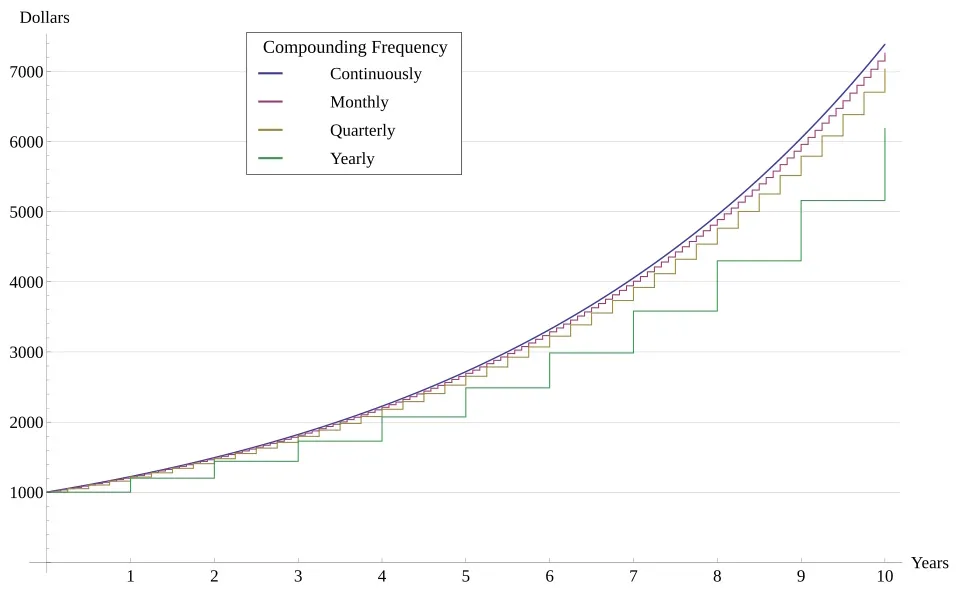 Given a $1000 initial investment and an annual rate of return of 20%, this graph shows the total balance for interest that is (color-coded) compounded at different frequencies: annually, quarterly, monthly, and continuously. The greater the frequency of compounding, the closer you’ll earn to the ideal (continuously compounded) value of your investment.
Inflation: applying the same concept to prices
The flipside of compound interest, which grows your wealth, is inflation: the “compound interest” of the cost of goods. In the United States, they call this the CPI: Consumer Price Index, which is tracked monthly: an annual rate scaled by month-over-month cost increases (or decreases) of a variety of goods.
It’s a simple concept: if you earn a certain amount of (after-tax) income, that’s the amount you have available to spend on everything else. Since the inflation rate is calculated monthly, it’s straightforward to cumulatively calculate how much prices have gone up since a certain time period began: by calculating the monthly rate of inflation and then “compounding” the cost-of-living (or the prices of goods) with each new month that elapses.
If you look at the data from the U.S. Bureau of Labor Statistics, you’ll find that deflation — or periods where things actually get less expensive — happened only in one year out of this entire century: during the financial crisis year (and the year of the Great Recession) of 2009. If you want to get things right, you’ll remember not just to look at the annual inflation rate, but rather to look at the monthly rate and compound the cost-of-living with each month that passes.
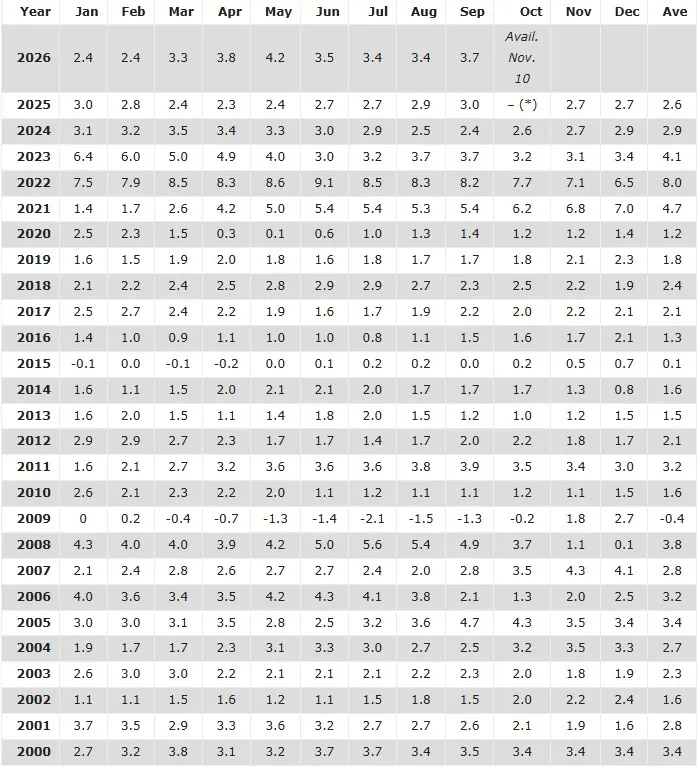 This monthly chart shows the equivalent annual rate of inflation in the United States for that month. As you can calculate for yourself, the rate of inflation here in the 2020s is, on average, more than double what the rate of inflation was throughout the 2010s. Although the COVID-19 pandemic played a major role, the rate remains significantly above the rest of the 21st century average here in 2026.
An example of the affordability crisis: Inflation in the United States in the 2020s
Let’s take a simple starting point as an illustration: how much money it requires, at a later time, to buy goods that would have cost $100 on January 1, 2020.
- On January 1, 2021, you would have needed $101.24.
- On January 1, 2022, you would have needed $106.10.
- On January 1, 2023, you would have needed $114.93.
- On January 1, 2024, you would have needed $119.77.
- On January 1, 2025, you would have needed $123.36.
- On January 1, 2026, you would have needed $126.75.
- And on October 1, 2026, which is the most current data that’s presently available, you would have needed $129.96.
Over the span of 6 years and 9 months, what used to cost you $100 to buy now requires $130 to purchase. That’s a net increase in prices of 30%, which means that $100 today has only the same amount of purchasing power that $77 had in January of 2020.
If you feel that things cost more than they used to, and that the same amount of money doesn’t go as far as it used to, that is not your imagination: that is a consequence of inflation. For a year-over-year inflationary rate, there’s a tremendous difference between what’s been happening here in the 2020s and what happened previously in the 2000s and the 2010s. The average (annual) inflationary rate for the 2000s was 2.56%. The average (annual) inflationary rate for the 2010s was 1.77%. But here in the 2020s (so far), the average (annual) inflationary rate is 3.85%, or more than double what it was during the prior decade. Things aren’t just getting more expensive; they’re getting more expensive and staying more expensive than at any other time this century.
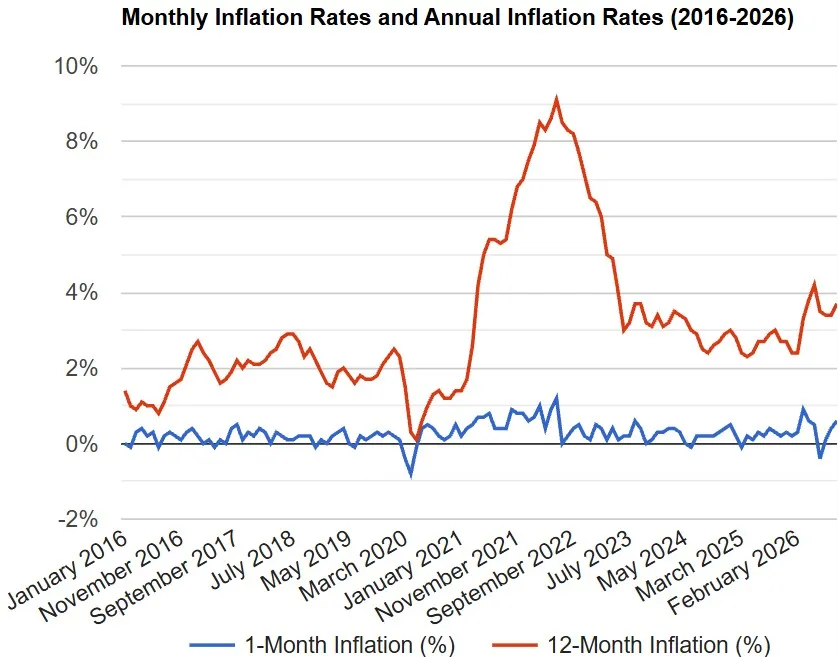 The red line in this chart shows the annual 12 month inflation rate from 2016 through 2026. The inflation rate spiked during the COVID-19 pandemic, but has remained high even in its aftermath. The 2020s annual average for the rate of inflation is more than double the rate from the 2010s.
The increased effect of overinflated necessities and stagnated wage increases
Not everything, of course, has increased equally in cost over time. While the average cost of goods has increased 30% from the start of January, 2020, to the present day, the cost of certain commodities has gone up by much, much greater amounts than that average. For example:
- Lumber, which affects the cost of housing and construction, has increased by 34%.
- Crude oil, which affects the cost of fuels, plastics, and road materials, has increased by 65.6%.
- Gasoline, which affects both the consumer retail price of gas and also shipping and transportation costs of all materials, including food, has increased by 75%.
- Beef, a vital food staple in the United States, has increased by 94%.
- Copper, which affects the prices of electrical, plumbing, and electronics equipment, as well as the cost of cars (especially electric vehicles), is up an astounding 125%.
- And coal, which affects the cost of electricity and household utility bills, is up 111%.
If you’re interested in buying a home, you can expect to pay over 50% more, today, than you would have paid for the same home at the start of 2020. If you’re looking at what your monthly mortgage payment would be for buying that home today, it’s approximately double what it would have been at the start of 2020, as elevated interest rates combined with the extra expense of the house hit homebuyers with a double-whammy.
Wages have gone up in that time as well, but have not kept pace with the level of inflation that we’ve seen. Nominal wage earning growth from early 2020 is at 21%, the median earnings growth is up 23%, and the federal minimum wage has not increased at all: it has grown by 0%.
Meanwhile, the average cost of goods is up 30% over that same interval, and the cost of many necessities is up by greater amounts than that. Health insurance costs, for example, have risen by 5-7% per year from 2020 until today, far outpacing not only wage increases but also inflation.
If you want to keep pace with inflation, then that means your wages should be increasing not by a certain amount each year (or month, or whatever time period is chosen), but by the necessary percentage to keep pace with the cost of living. From January 2020 to the present day, the average cost of consumer goods has gone up by 30%. Can you say the same about your wages?
Although it’s still often attributed to Einstein, there is no record of him ever stating that, “Compound interest is the eighth wonder of the world. He who understands it, earns it; he who doesn’t, pays it.” However, whether you understand or earn compound interest or not, everyone pays the cost of inflation: the compounding, rising prices of consumer goods and commodities. You pay it everywhere you go, from the gas pump to the grocery store to your health insurer, and you pay it unevenly: where your dollar only has 77% of the purchasing power it had at the start of 2020.
If you were struggling to make ends meet back in 2020, there’s an excellent chance that — if you’re like most American workers — you’re falling further behind now than you were back then. Inflation is compound interest for the cost of goods and commodities, and it’s something that everyone who makes purchases must reckon with. Understanding inflation is the key to understanding the affordability crisis, and it explains how the cost of living has gotten so high. The specifics that you face will vary from country-to-country, but affordability is a concern around the world, and understanding the two sides of compound interest is the key to solving this problem.
This article A fake Einstein quote actually explains the affordability crisis is featured on Big Think.