Baylor, BYU presidents share a unique focus on student faith formation
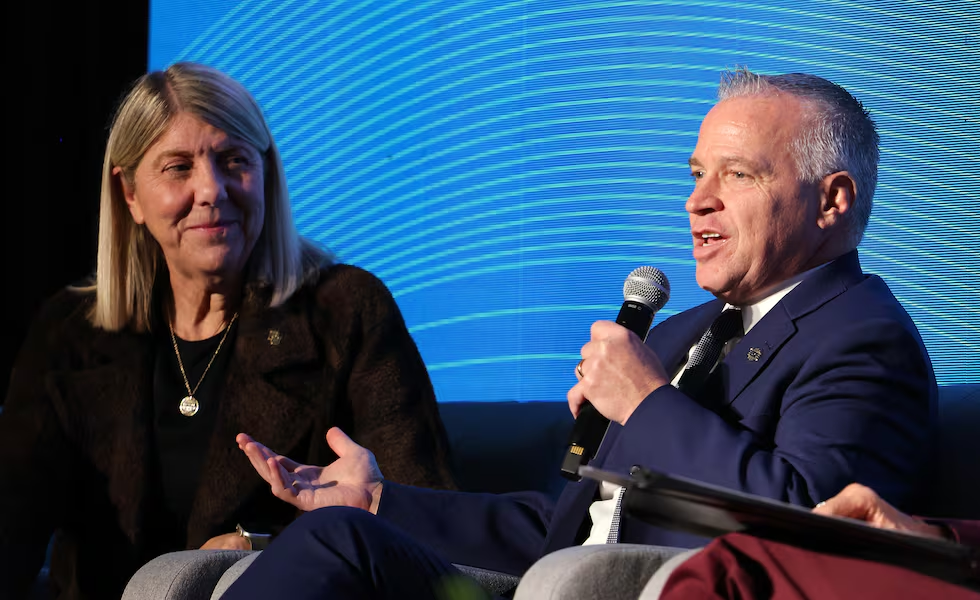
Shane Reese knows he only has so many years to influence the campus culture as BYU’s president.
Now in his fourth year in a job that nationwide averages five to 10 years, he devotes an unusual amount of attention to one major priority.
Hiring.
Reese or his academic vice president interviews every prospective faculty member.
‘Hear God more and your earbuds less,’ BYU president tells students
“Faculty will shape the culture for 30 years,” Reese said Friday night during a panel discussion with Baylor President Linda Livingstone at the G20 Interfaith Forum in Salt Lake City.
“The most important decisions that will be made during my tenure as president of the university are the faculty that will be hired,” he said at the Institute of Religion operated by The Church of Jesus Christ of Latter-day Saints on the campus of the University of Utah.
Baylor also asks its faculty to focus on student faith formation right alongside rigorous intellectual pursuits and professional and social development, Livingstone said.
Latter-day Saint leader, world-famous choir host opening ceremony for global faith summit
“We’re a Christian university of the Baptist tradition and we hire faculty from the Christian faith tradition and from the Jewish tradition,” she said. “We expect our faculty and our staff to care deeply about our students becoming people of deep faith engaged in their church community.
“We ask our faculty to think deeply about how that informs what they’re teaching in the classroom, how they’re advising students, and so on.”
That amount of emphasis on student faith is fairly unique at the highest-profile American universities. Baylor and BYU are two of six universities in power athletic conferences that maintain active religious identities.
And each is actively increasing its emphasis.
The number of BYU graduates who report that their faith in Jesus Christ was strengthened during their time on campus has risen from 78% to 91% during Reese’s tenure.
Livingstone, who is in her 10th year, has reshaped Baylor to improve faith formation outcomes through its Faith and Character Study, which assesses students at the start, middle and end of their time on campus and 10 years afterward.
The new measurements show that by the time they are seniors, Baylor students have grown in resilience and humility, she said.
“We’ve learned that church attendance for students while they’re at college was one of the best predictors of retention, graduation and grade-point average, far beyond even the spiritual formation, it gets them to a place of belonging and connectedness.”
Baylor transformed its campus chapel experience, based on what it learned, and restructured its Christian scriptures classes because students were arriving on campus with less depth and breadth in understanding the scriptures than they did 10-15 years ago.
Faculty at both schools embrace the opportunity to integrate their faith with their research, the two presidents said.
“It’s really allowed schools like ours to hire some really amazing faculty, where they can bring those two together,” Livingstone said.
Livingstone and Reese said faith-based education is resonating with American youth today because they are purpose-driven.
“These students walk through our doors now motivated by something bigger than their next job,” Reese said. “They are motivated to make a difference in the world. They may choose to study finance or statistics or computer science or engineering, but they have a pure and beautiful motivation for doing those things, because they see it as a means to make a difference in the world.”
Livingstone said faith-based education serves students well.
“I think it gives them a much broader perspective on the world,” she said. “I think it makes them care much more deeply for those around them. And I think the other piece that is really important is I think it gives them an eternal perspective.”
The world of academics is a place of collaboration, Livingstone said, so it should be natural for faith-based schools to be collaborative, too.
Doing so is healthy, she argued.
“In the world we’re in today, whether it’s in the United States or globally, many of the really significant conflicts and challenges are around religion and differences in religious belief,” she said.
“I think we have an opportunity in faith-based higher education to show that we can work together, we can learn to understand each other’s faith traditions and their value and build on those things that we can agree on to bridge those areas where there have been differences that caused conflict in the world.”
Ibrahim Saleh Al-Naimi, an under secretary in Qatar’s Ministry of Education, was unable to attend the session but sent remarks.
“Knowledge is a profound good, but knowledge also raises questions of purpose, responsibility and the use of human power,” he stated. “A university must therefore do more than prepare people for employment. It must also help them develop sound judgment, intellectual humility, moral courage and a sense of responsibility toward others.”
He said the university should prepare students to take responsibility for the world as it could be.
“Faith-based universities can make a distinctive contribution when they bring serious scholarship into meaningful conversations with questions of purpose, human dignity, ethical responsibility and service,” he stated.