They couldn’t bring Landon back. But they could show how much he mattered
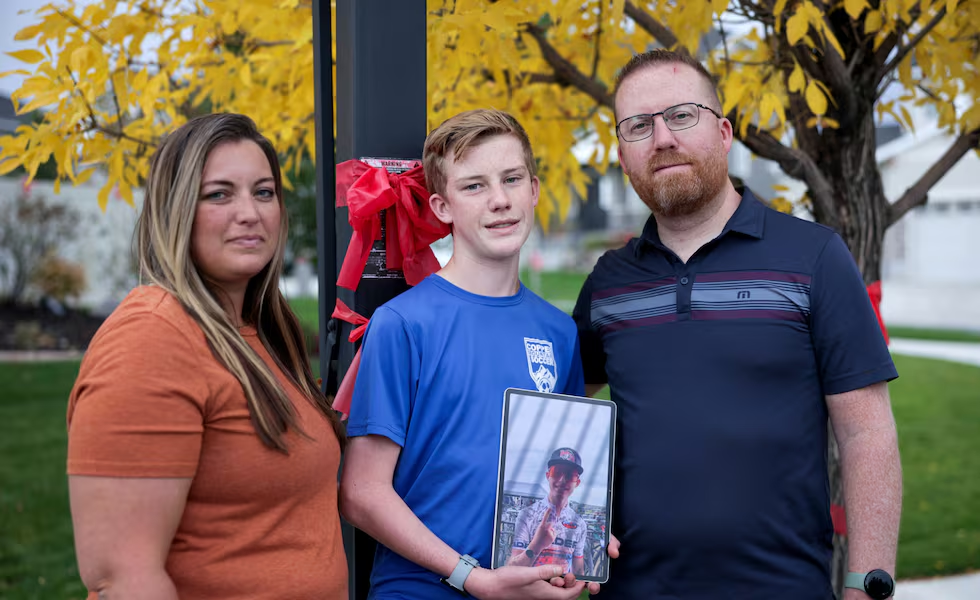
For Nick and Jodie Dutson and their son Camden, what was to be a family vacation in Arkansas, surrounded by loved ones, turned into a nightmare. Their oldest son, Landon, just 16, was killed in an accident Oct. 20 while helping clean up downed trees damaged by a storm.
But as they returned to Utah and their Herriman neighborhood, they found themselves surrounded by support and comfort in the form of red ribbon after red ribbon, tied to fence posts and trees and even mailboxes — hundreds and hundreds of them, everywhere they looked. Red was Landon’s favorite color. A broad community had come together to honor him and comfort the Dutson family in their grief.
“I don’t know if I’ll ever experience hardship in my life like I am now, but the only reason we are getting through it and we can laugh about certain things is how our neighbors, our community has just showed up, or messaged or brought something by,” Nick Dutson said, wonder in his voice.
The ribbons weren’t a total surprise. The Dutsons were still in Arkansas when their outdoor camera showed dozens of people in their yard back home, decorating and crying and telling Landon stories. Still, already knowing their community had shown up did nothing to lessen their emotions as they drove down streets lined with love.
“We just lost it because we knew that those were for Landon. Wow. I’ve always loved my neighbors and my community, but they showed it back to me. I’ll drop everything and serve anyone however they need me to; it’s how I was raised. But to have it done back to you in a manner that is a hundredfold is just so humbling and empowering,” he said.
Friends couldn’t bring Landon back. But they could show how much he mattered to them.
So they did.
An old soul
Nick Dutson describes Landon as an “old soul” who got along great with his peers but was just as comfortable hanging with adults, chatting and learning from them. He was an avid outdoorsman and a dedicated rider on the Mountain Ridge High School mountain bike team and was supposed to go to the state championship the weekend after he died. His biking buddies were largely responsible for the incredible ribbon effort throughout the neighborhood.
Landon was honored and remembered at the championship race in St. George, where riders were given stickers that said “Ride for Landon.”
The teen especially loved hiking and mountain biking, finding peace and comfort in the solitude, his dad said. Sometimes, he’d tell his folks he was going for a hike late at night. He loved venturing into the mountains near their home and often photographed the stars.
He was also a prankster. Landon’s dad said perhaps the thing he will miss most is the “little mischievous smirk” that tipped off those who loved him that he was up to something. He especially liked to get a rise out of his mom, sometimes calling her to say he was blowing past his curfew when he was actually chuckling in the other room. His friends, his coach, his family describe a teen who was equal parts fun and smart. He got straight A’s and had been in a Chinese language immersion class since first grade and had hoped to share his love of God as a missionary in Taiwan.
“He has a deadpan sense of humor,” his dad told Deseret News, speaking in the present tense. “When he was with friends, he had a huge belly laugh.”
The day he died, Landon, his dad, and brother Camden, 14, were helping his great-uncle clear trees on his property. The teenager was in his happy place, surrounded by bike trails and nature, outdoors with people he cherished, doing something physically challenging. Though he was taken to the hospital, the traumatic brain injury from the falling tree was lethal. His family is comforted by the belief it happened so fast he didn’t suffer.
The pain would be his family’s burden. But friends and family were willing to share it.
“I think it’s easier to grieve together as a community,” Nick Dutson said. “Otherwise, I think we would just be in our home and time passes so slowly. When you have people that are just constantly coming to your door and sharing memories about him, it makes our load much lighter. People can help us carry that.”
Lining the street with love
After Landon died, his parents messaged Jodie’s family. Then their bishop in The Church of Jesus Christ of Latter-day Saints, a very close friend. Next, Nick reached out to his son’s mountain bike coach, Rich Riddle, “who has just been there for Landon for years, training him.” Riddle is head coach of the Mountain Ridge High School mountain bike team. He’s also involved with a youth mountain bike club called Aspire and worked with Landon there, too.
That club’s coach, Tracy Fonger, knew exactly how to rally the troops, Dutson said.
Rainbow babies: Birth of a miracle after a loss
Riddle described Landon as “great for the team. He was always happy, always working hard. He had grit, passion.”
Besides riding, Landon, a high school junior, was part of a remote cheering zone on the course that’s unique to the team, where he played music and hyped up other riders. “He asked everybody, ‘Hey, what hype song do you want me to play when I see you?’” Riddle said. “He had a whole playlist for all of the team.”
So it’s not surprising that when the team was notified, it jumped into action.
Riddle said it felt unreal when Nick Dutson broke the news and he “literally looked at it for 10 to 15 minutes in disbelief. I’d just seen him a few days before at practice. He was just doing some vacationing before the state race this weekend.”
Even notifying other coaches and team members, it felt unreal. He asked Nick what they could do to help and “of course, at that time, he doesn’t know either.” So Riddle and the other coaches — like him, all volunteers — told their large team what had happened “and every one of them jumped into action.” They began brainstorming how to support the family and memorialize the boy. He also notified the Aspire team. Two of the coaches suggested red ribbons and a crowd to tie them. They sent a message out and a huge group showed up, he said, probably 60 strong.
They were joined by parents and people in the neighborhood and they didn’t waste time.
“The family was coming home and we wanted to make sure that they had the warmest welcome we could give them,” Riddle said. They were also pondering how to honor Landon at the state championship.
Jodie Dutson sent Riddle an uplifting note to read to the team in St. George at the meet. Landon wouldn’t want the riders to be sad, she said. He would want them to work hard. To race your race and do the best you can.
Riddle recounted the meet in a text the next day. Landon’s ride leader rode with the teen’s race plate — No. 5363 — in the junior varsity A race from start to finish. The crowd had a moment of silence in his honor at the beginning of his race category and the announcer read the note Jodie Dutson had written to the team.
The team rode with “Ride for Landon” stickers on their helmets and set up a cheer section on the course with Landon’s jersey and race plate, and decked out their pit zone with red ribbons and posters for athletes to leave messages.
“Overall, it was an amazing response and a great way to honor him,” Riddle said.
The mountain bikers also hoped to raise some money. Flying Landon home from Arkansas, the hospital and other expenses will pile up, said Riddle. “It’s just awful.”
He added that tears have flowed freely, the loss devastating. He admits he’s a little afraid of the quiet time to come when the flurry of activity ends. Trying to help the family has helped other mourners, he said.
Why showing up matters
“In the first days after a sudden death, a family may feel as though the rest of the world is continuing while their own world has stopped,” said Ajita Robinson, author of “The Gift of Grief.” Visible community gestures communicate something powerful: “Your child mattered, your loss matters, and you are not carrying this alone.”
“These acts cannot lessen the magnitude of the loss, but they can reduce the profound isolation that often accompanies traumatic grief,” said Robinson, a licensed clinical professional counselor specializing in grief and trauma in Bethesda, Maryland.
She said that “collective rituals also give a community a way to bear witness when words feel inadequate. Bringing food, tying ribbons, helping with household responsibilities or simply remaining present can create a layer of practical and emotional support around a family whose capacity for decision-making may be overwhelmed.”
Laura Vargas, a grief therapist and licensed clinical social worker in Denver, said there’s healing power when friends, family and community members reach out.
“Grief is not something to fix. For most people, grief is something to be witnessed. So when there’s a large community demonstration like (for Landon), that tells the family that their grief is being witnessed. It validates their pain, recognizes what they’ve been through and shows people care and are willing to be supportive.”
Even small acts convey that, she said, noting the bereaved are often reluctant to ask for support. So proactive support is powerful.
According to Robinson, the most meaningful support is “specific, gentle and sustained.”
Vargas agrees. “It doesn’t always have to be as grandiose as it was early on, people showing up with casseroles and all that stuff, but still checking in. We’re pretty good as a society at holding people up in those first few weeks of their loss and then everyone goes back to their regular lives.”
Remembering an anniversary or birthday or milestone and checking in — even a simple text — can make people feel validated that their pain exists and that others know that they’re hurting, she said.
According to Robinson, support often peaks immediately after a death and fades just as the reality of the loss begins to settle in for the loved ones. Continuing to check in weeks and months later, remembering important dates, and making space for the family to speak about their child can be among the most meaningful forms of care.
What doesn’t help
But not all reactions promote healing, Vargas warned. In the depths of sorrow, it’s not helpful to hear about someone else’s similar experience. Pain and loss are unique and individual, so “I know what you’re going through because ...” is not comforting.
Said Robinson, “Even well-intended support can become burdensome when it requires the grieving family to manage other people’s emotions, answer repeated questions, retell the details of the death or make decisions about what help is needed.” She said statements like “Everything happens for a reason,”“At least you still have your other children,” or “They are in a better place” may reflect the speaker’s beliefs, but minimize the magnitude of the loss and unintentionally hurt the bereaved.
She also warned against sharing information, photographs, memorial details or the family’s story publicly without permission. “Support should never become performative or place expectations on the family to respond, participate, express gratitude or grieve in a particular way.”
Unsolicited advice is also bad, Vargas said. “People are hurting, and really what they’re looking for is just to be validated, to be seen, to have their pain be seen. When people give advice or make those comparisons, it often invalidates their pain because it turns into someone just trying to fix it because they’re uncomfortable holding space for that pain.”
The most helpful approach is to follow the family’s cues and offer specific assistance that does not create another task, per Robinson. For example: “I am leaving dinner on your porch at 5 o’clock. You do not need to answer the door,” or “I can handle school pickup this week if that would be helpful.”
The most important thing is acknowledging their loss. It’s a myth that saying something will remind them. It’s already there, Vargas said, noting that her experience as a therapist suggests those who are grieving “really appreciate when people do address it” rather than everyone skirting around the loss.
It is far scarier, she said, to think that a loved one’s name will never be said out loud again or that their legacy will be forgotten because no one’s talking about them.