What Vera Rubin observatory’s first new dwarf planet means
Back in 2006, the International Astronomical Union controversially demoted Pluto.
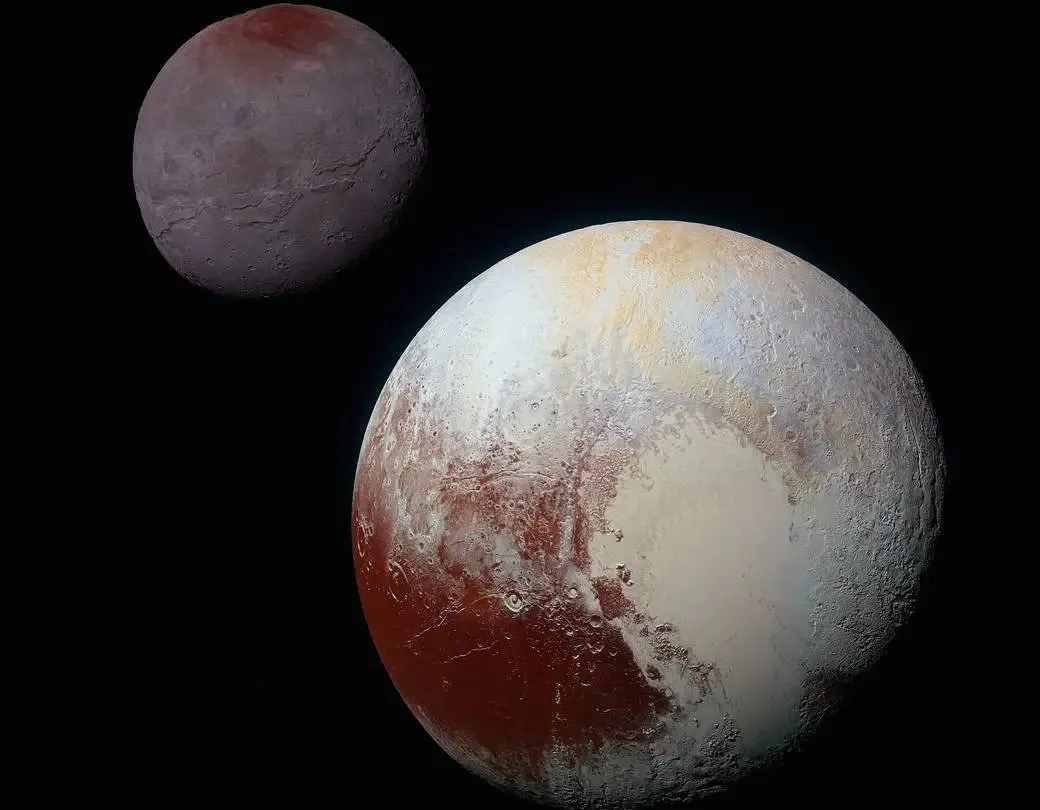 This composite image of Pluto and its largest moon, Charon, was based on photographs taken by the New Horizons mission as it flew by the Plutonian planetary system back in 2015. Charon’s appearance is vastly different from Pluto’s, but both bodies are shown with the correct relative size and albedo. The surface features on Pluto show evidence of recent changes, indicating that the next time we visit Pluto to image it at this level of precision, it may exhibit a remarkably different appearance.
As part of that process, they officially defined “planet” and “dwarf planet” for the first time.
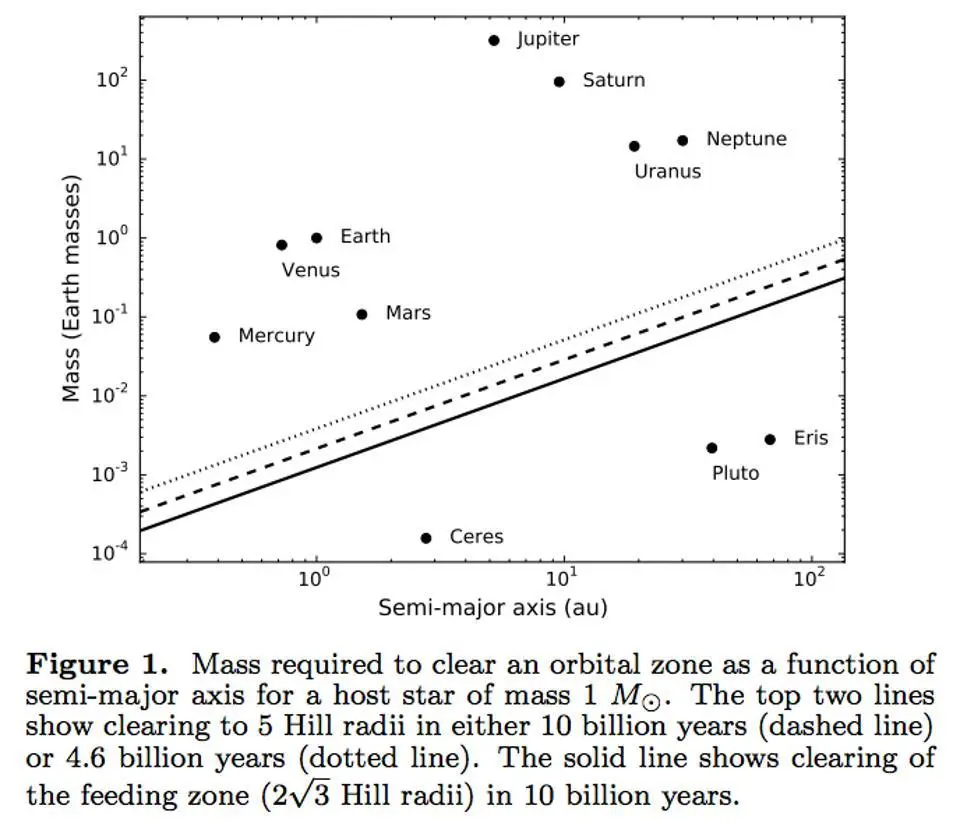 The scientific line between planetary (above) and non-planetary (below) status, for three potential definitions of an orbit-clearing phenomenon and a star equal to the mass of our Sun. This definition could be extended to every exoplanetary system we can imagine to determine whether a candidate body meets the criteria, as we’ve defined them, for being classified as a true planet or not.
Dwarf planets all:
- orbit the Sun,
- aren’t moons,
- achieve hydrostatic equilibrium,
- but don’t clear their orbits.
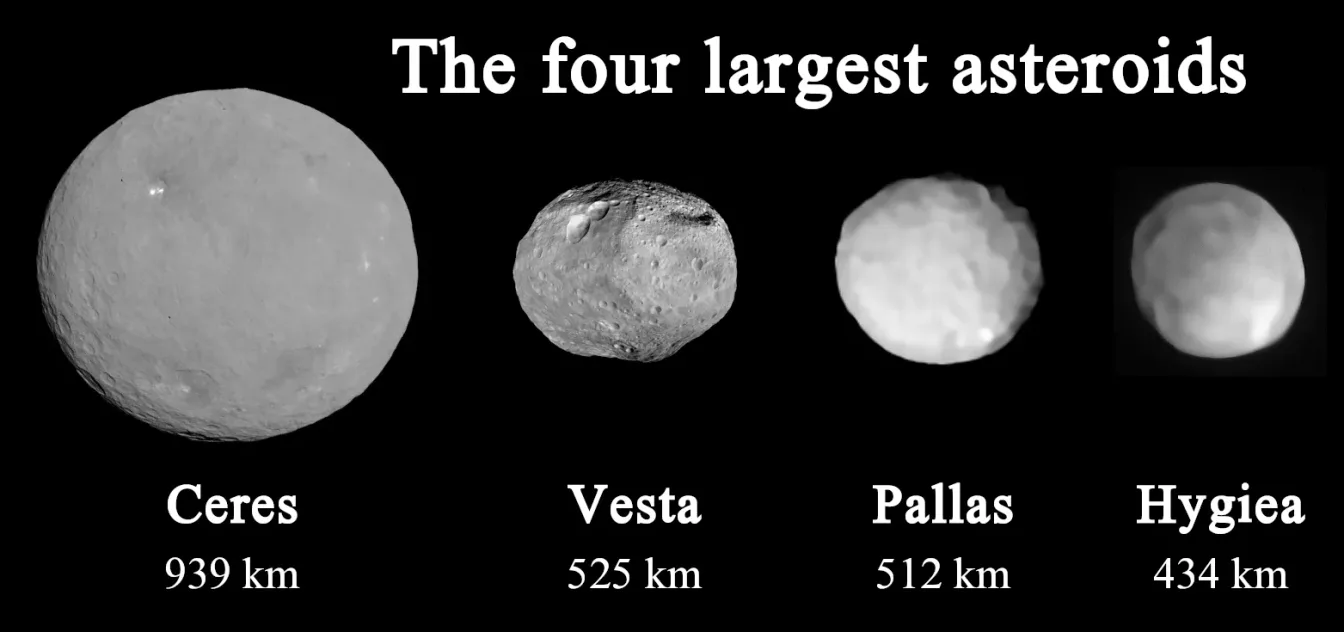 The four largest asteroids, all shown here, have been imaged with NASA’s Dawn mission and the ESO’s SPHERE instrument. Ceres, the largest asteroid, is the smallest known body definitively in hydrostatic equilibrium. Vesta and Pallas are not, but Hygeia, with a smaller mass but a much lower density, may yet be; its status is indeterminate.
Therefore, sufficiently massive asteroids like Ceres,
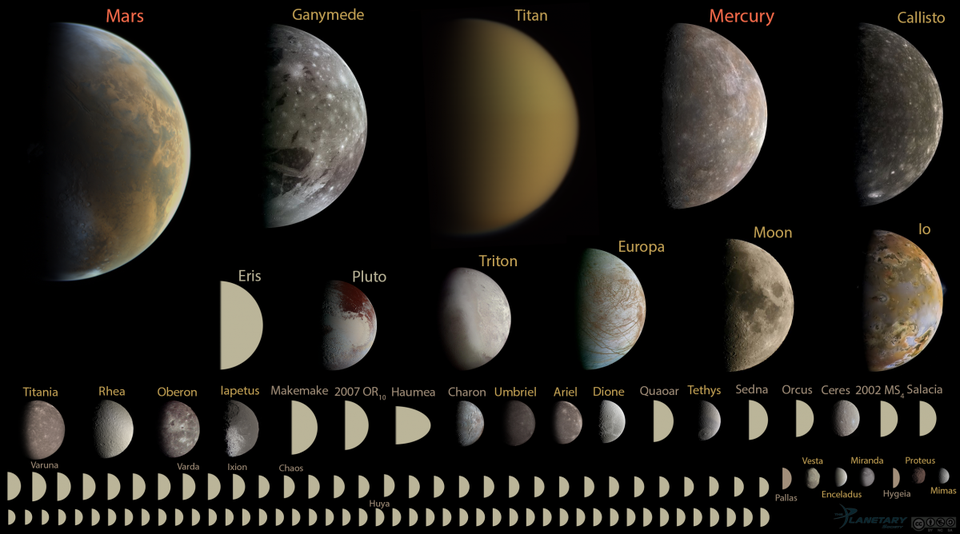 Under a size cutoff of 10,000 kilometers, objects within our solar system appear to be round, pulled into hydrostatic equilibrium via their gravity and rotation, combined. However, once you go to planetary radii below ~800 kilometers, hydrostatic equilibrium, or even roundness, are no longer certainties, but composition dependent. There are over 100 objects in hydrostatic equilibrium in our solar system, including asteroids, moons, planets, dwarf planets, and Kuiper belt and Oort cloud objects, but only 5 official dwarf planets as of 2026.
Credit: Emily Lakdawalla; data from NASA/JPL, JHUAPL/SwRI, SSI, and UCLA/MPS/DLR/IDA
Kuiper belt objects like Pluto, Eris, Makemake, and Haumea,
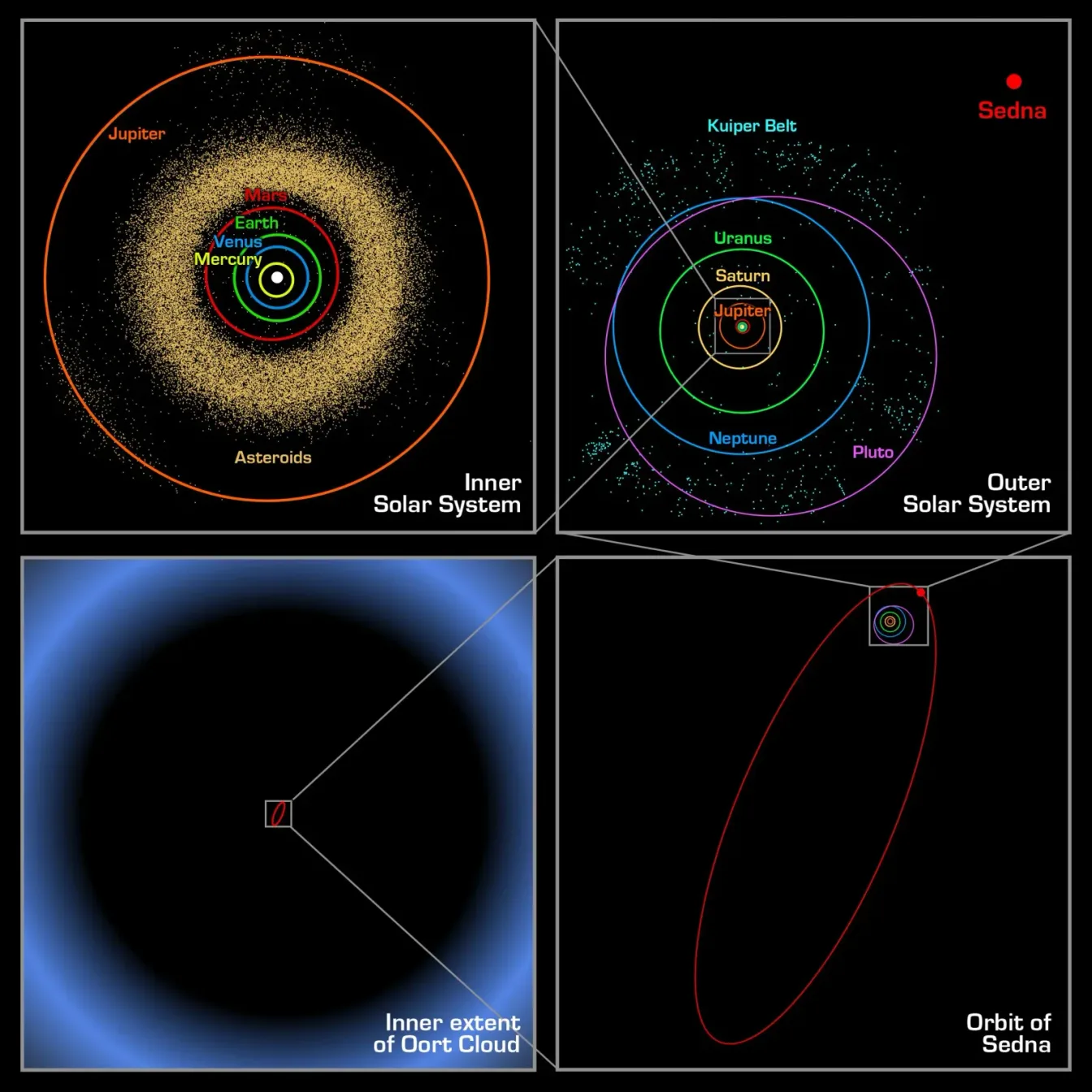 The inner Solar System, including the planets, asteroids, gas giants, Kuiper belt, and more, is minuscule in scale when compared to the extent of the Oort Cloud. Sedna, the only large object with a very distant aphelion, may be part of the innermost portion of the inner Oort Cloud, but even that is disputed. On a linear scale, depicting the entire Solar System in a single image is incredibly limiting; to characterize the orbit of a faraway bound object requires years or even centuries of data.
and Oort cloud objects can achieve dwarf planethood.
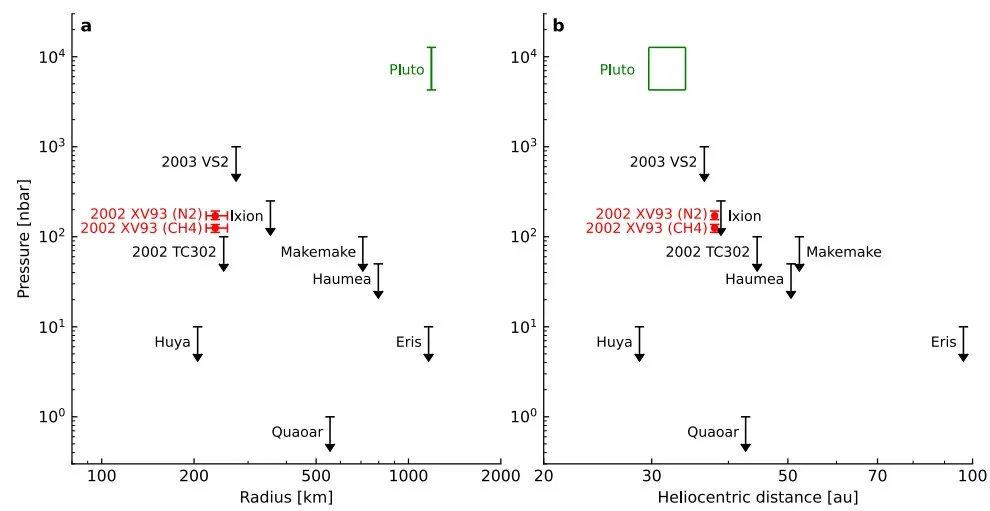 This chart shows the measured pressures (or constraints on pressure) around a variety of trans-Neptunian objects. Of all the objects ever measured through stellar occultations, only Pluto and 2002 XV93 were found to actually have non-zero atmospheres, with all other plutinos, including plutinos much larger than 2002 XV93, exhibiting no signature of an atmosphere at all.
Trans-Neptunian objects, ice-rich in composition, require estimated diameters of 400 km to likely achieve hydrostatic equilibrium.
 This image shows the Vera C. Rubin Observatory atop Cerro Pachón in Chile, with fairly typical cloud-free conditions accompanying it. When complete, Rubin Observatory will use its 8.4-meter telescope and 3200-megapixel camera to conduct an unprecedented, multi-color, decade-long survey of the optical sky called the Legacy Survey of Space and Time (LSST). The camera will be the largest ever constructed for astronomy, weighing an incredible 2.8 tonnes.
Currently, the Vera C. Rubin Observatory surveys the visible southern skies every 3-4 nights.
Through successive imagery, it uncovers faint, distant, migrating Solar System objects.
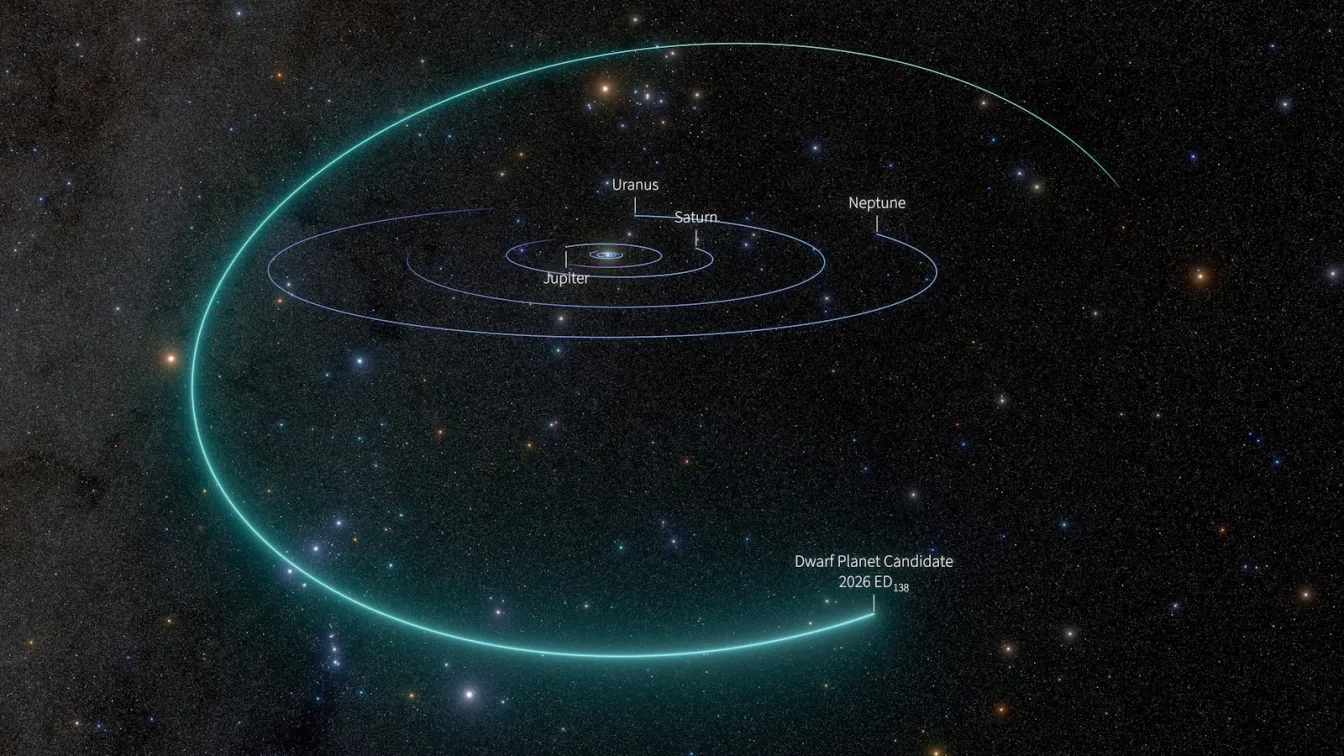
Helped by automated code, Rubin scientists identified a remarkable object 2026 ED138.
“Precovery” images were spotted going back 10 years, enabling an orbital determination.
Based on its distance, brightness, and estimated reflectivity, it’s definitely a Trans-Neptunian object.
Its estimated size — between 600 km and 1500 km — places it firmly in dwarf planet territory.
However, no new dwarf planets have been officially recognized by the IAU since 2006.
2026 ED138, nicknamed “Ed“, becomes the 103rd known Trans-Neptunian object 400+ km in diameter.
The 14th brightest Trans-Neptunian object, future occultations should reveal its size.
Credit: Bob King/Stellarium/Sky & Telescope
Mostly Mute Monday tells an astronomical story in images, visuals, and no more than 200 words.
This article What Vera Rubin observatory’s first new dwarf planet means is featured on Big Think.