A mass march, a burning city hall and a country on edge
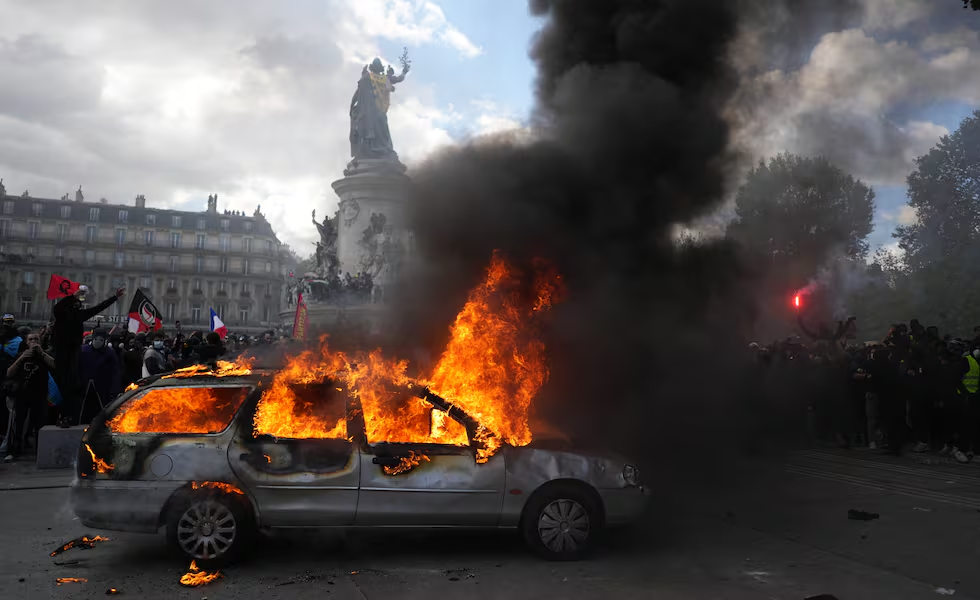
French officials said they were instituting curfews in some locations after a weekend where protesters damaged or destroyed thousands of businesses and a fire nearly consumed a historic city hall in Limoges.
Over half a million people marched in protests across France on Saturday. The demonstrations grew out of high school protests that began in late September over staff shortages and spread to complaints about overcrowded classrooms, deteriorating facilities and long school days. Saturday’s marches drew students, labor unions, advocacy groups and socialist and communist organizations, with violent groups using the huge crowd as cover.
As of Sunday evening, the Interior Ministry reported 2,397 arrests, 997 police and gendarmes injured with seven in critical condition, and one protester dead. Commerce Minister Serge Papin said at least 3,000 businesses were affected by the looting and riots.
On Monday, Paris police officials said in a statement that they had issued an overnight curfew in areas of the French capital “to protect people and property from the violence and looting,” according to The Associated Press.
“Manifesting is a fundamental right. Sowing disorder with violence and in a concerted manner is not,” Interior Minister Laurent Nunez stated Sunday in a post that was translated to English. “Attacking our law enforcement forces, targeting our institutions, degrading public buildings, breaking into prefectures or town halls, looting businesses: nothing can justify it.”
Manifester est un droit fondamental. Semer le désordre avec violence et de manière concertée n’en est pas un.
— Laurent Nuñez (@NunezLaurent) October 18, 2026
Attaquer nos forces de l’ordre, s’en prendre à nos institutions, dégrader des bâtiments publics, s’introduire dans des préfectures ou des mairies, piller des commerces :…
On Monday, Prime Minister Sebastien Lecornu called for limited, local curfews, while President Emmanuel Macron rejected Nunez’s offer to resign and ordered a review of security planning and intelligence features.
The damage done
By Monday, the damage stretched from smashed windows at luxury boutiques in central Paris to public buildings and businesses burning down across the country.
In Paris, about 50 shops were looted on Sunday alone. By Monday morning, 36 more were damaged, 33 of which were looted, and there were 176 street fires throughout the city. Other cities across the country suffered similar damages.
How student protests grew into a nationwide crisis in France
The worst single loss was the Limoges town hall, which opened in 1883 and is a listed historic monument. Rioters set it on fire on Saturday after the city’s protest, and the blaze destroyed the roof and upper floors and brought down the bell tower. Mayor Guillaume Guérin blamed “the ultra-left,” telling French radio station RMC that they came “to destroy symbols and weaken the authority of the state.”
Town halls in Marseille, Lille, Grenoble and Angers were also invaded or damaged, and a tourist office in Lyon and two banks in Rouen were set on fire. In Bordeaux, the official residence of the top official in the region was ransacked, and a police station in Marseille was vandalized.
Cars were burned along the Canal Saint-Martin and on Rue Yves Toudic in Paris, and bus shelters were smashed in Nice.
At the Louvre, Paris’s national art museum and the most visited museum in the world, protesters blocked the entrances and prevented the museum from opening on schedule. Management said students from the Ecole du Louvre, an art history school based in the museum, led the protest. According to Newsweek, students held up banners in front of the glass pyramid reading “French public services are falling apart.”
🇫🇷 Chers visiteurs, en raison d’un mouvement social étudiant, le musée est fermé pour le moment. Nous vous prions de nous excuser de la gêne occasionnée.
— Musée du Louvre (@MuseeLouvre) October 19, 2026
🌍Dear visitors, due to student strikes the museum is currently closed. We apologise for the inconvenience. pic.twitter.com/tNKFk3B9aj
The total cost of damage done to shops, buildings, and government sites is estimated at hundreds of millions of euros. On Monday the prime minister held a crisis meeting on the economy, insurance and prosecutions.
The groups behind the riots
French officials have blamed far-left activists and criminal groups for the violence, with Lecornu accusing a far-left movement of seeking to foment unrest ahead of next year’s presidential election.
“Today, ultraleft groups have orchestrated violence in several French cities; delinquents have joined in to pillage and destroy,” Lecornu posted Saturday in a message that was translated to English.
Les manifestations pacifiques ont toute leur place dans notre République. Les incendies, les pillages et les attaques n’en ont aucune.
— Sébastien Lecornu (@SebLecornu) October 17, 2026
Aujourd’hui, des groupes d’ultragauche ont organisé la violence dans plusieurs villes de France ; des délinquants s’y sont mêlés pour piller et…
Fox News’ “Who’s Who” report identifies 54 organizations in the wider protest network, from student groups and unions to advocacy groups and media outlets to socialist and communist parties. The groups’ reported roles range from organizing and joining protests to expressing support or amplifying coverage, so the list alone doesn’t establish which groups were responsible for the violence.
According to the report, only 16 of the 54 identified organizations are student or youth organizations. The rest are adult-led and include communist groups, political parties, revolutionary-left organizations and propaganda outlets.
Opinion: Demonstrations in France could have international impact
According to Fox News, these groups “include Gilet jaunes, or ‘Yellow Vests,’ a radical far-left group that led protests with other groups this weekend, and far-left socialist political party La France Insoumise (LFI), or France Unbowed.”
Vijay Prashad, a communist leader and academic, celebrated the unrest online and connected protests happening in France, India, and Argentina.
“Paris-New Delhi-Buenos Aires,” Prashad posted Saturday. “Let fury have the hour, anger can be power.”
Paris-New Delhi-Buenos Aires
— Vijay Prashad (@vijayprashad) October 18, 2026
Let fury have the hour, anger can be power.
(The Clash, Clampdown, London Calling, 1979). pic.twitter.com/UC3KyYDY8n
Jean-Luc Melenchon, LFI leader and presidential candidate, blamed the French prime minister for the violence in a post online.
“What a lamentable politician,” Melenchon wrote. “He is responsible for the chaos that he methodically prepared through incompetence or a worst-case strategy to provoke an order party that would make people forget his failure in public finances.”
While reports from both sides of the aisle map a broad protest network, Nunez said investigations are underway to identify those responsible for attacks on police, public buildings and businesses, while distinguishing those acts from the right to protest peacefully.
“The Republic will yield nothing to those who seek to impose disorder and violence,” Nunez said.