Opinion: Great Salt Lake is the bipartisan win Washington needs
With Democrats taking control of Congress in January, the nation will once again have a divided government. With the recent election results, a Democrat will now join Republicans representing Utah in Congress. Partisanship has shaped nearly everything about Washington in recent years. What the country needs now are leaders willing to work together to solve big problems.
The Great Salt Lake offers a perfect opportunity for bipartisan collaboration.
The needs of Great Salt Lake
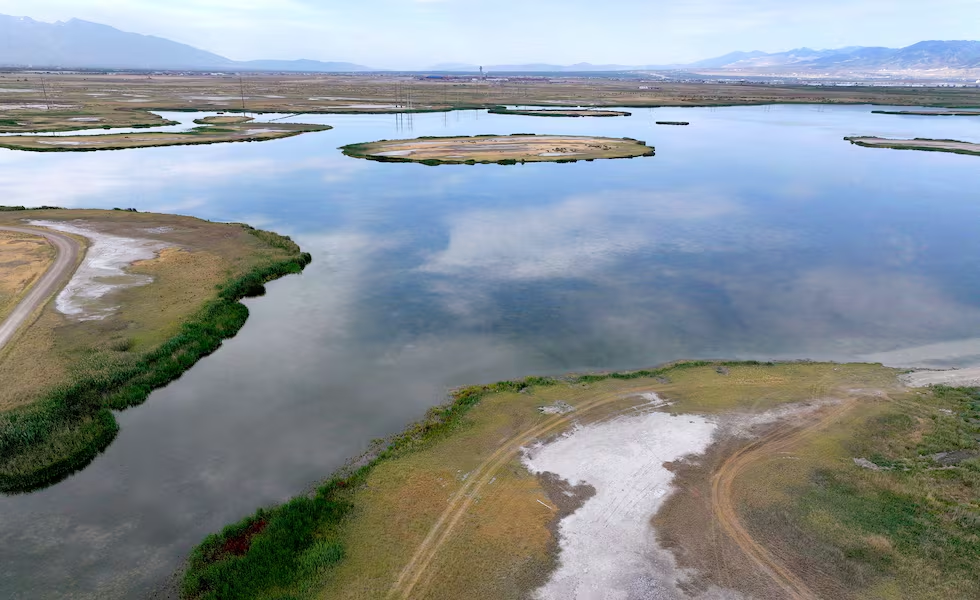
For decades, water that once flowed into the lake has been diverted to farms, cities and industry. In 2022, Great Salt Lake fell to the lowest level ever recorded, shrinking to roughly half of its historical average size. Today, the lake is once again approaching that mark.
Great Salt Lake dust: A problem Utah can’t afford to fix or ignore
The lake’s decline does not sort neatly into any one political party, which is exactly why Utah’s delegation should treat it as a shared assignment. A shrinking Great Salt Lake poses a fundamental threat to Utah in multiple ways across the political spectrum: public health, the economy, wildlife, private property, ecosystem services and recreation. It is a crisis that touches every part of the region, and it should be a cause around which Washington can unite.
Each side should come to the table
A federal proposal is already on the table. President Donald Trump raised the lake’s plight publicly last February, and his budget request for fiscal year 2027 included $1 billion for a Great Salt Lake Watershed Recovery Program. That proposal gives Congress a practical starting point to fund and shape a plan the executive branch has already put forward.
Each side has its own reason to come to the table. For the President, restoring Great Salt Lake offers a chance to build a lasting legacy during the final two years of his presidency — one that survives the next election cycle. For members of Congress in both parties, it offers a chance to work together on a problem with clear, measurable results at a moment when the connection between legislation and real-world outcomes can feel remote.
Opinion: Saving the Great Salt Lake is about saving Utah
The price of restoration is significant in the abstract, but modest given what’s at stake. Saving the lake is estimated to cost somewhere between $3 and $4 billion. For comparison, a declining lake threatens trillions of dollars of regional infrastructure and millions of homes and businesses, plus $2.1 billion to $2.8 billion every year in losses to industry, recreation, health, and mitigation. Given these numbers, restoration is less an expense than a worthwhile investment.
Restoring Great Salt Lake also provides a chance to do something no one has done. No saline lake has been fully restored after a serious decline. The Aral Sea, California’s Owens Lake, and Iran’s Lake Urmia are cautionary tales, not success stories. Great Salt Lake could be the first.
There is no excuse to delay
None of this erases the hard questions. Reasonable people will disagree over the right federal role, the best water-management policies, and how costs should be shared among local, state, and national governments. Those debates are worth having. But they cannot become an excuse for delay or inaction.
Opinion: The paradigm shift that could help save the Great Salt Lake
Great Salt Lake offers Washington a simple test: can it still recognize a clear danger to its citizens, find common ground, and follow through? Letting Great Salt Lake disappear would be a historic failure, one that would result in devastating impacts for Utahns and a region far less livable for future generations. Preventing that outcome requires Congress and the President to work together to bring federal resources to the lake’s rescue.
Utah’s delegation — returning members and new ones alike — should arrive in Washington this January with the lake as a top priority and work together until the lake is restored.