Answering the Fairford Wake-Up Call
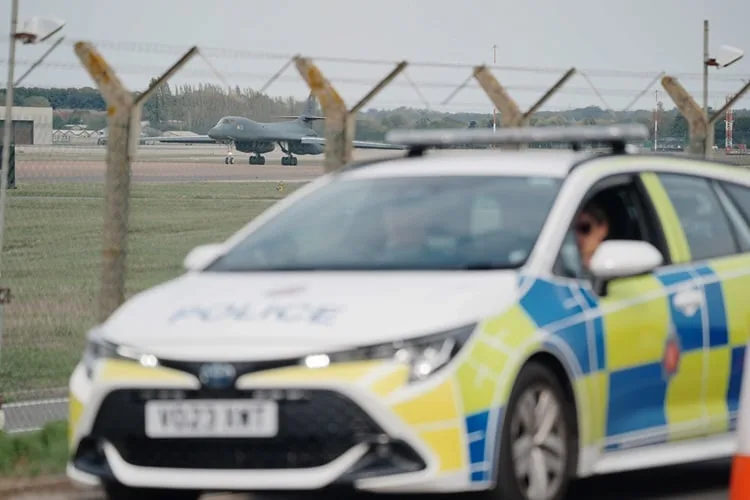
When police arrested masked men with vans outside a British air base in Fairford, national security experts feared an imitation of Ukraine’s Operation Spiderweb unfolding on UK soil. The operation pulled off by Kyiv last year launched armed drones from trucks to target bombers deep inside Russia, destroyed or damaged dozens of aircraft, and created a template for others to copy. Outside Fairford, police reportedly found no explosive devices inside the vans, but the uncertainty over the threat these men posed is the latest reminder that distance from a front line offers our bases less safety than ever. The faster the UK and US adapt to this reality, the more secure our nations will be. And right now, we still have lessons to learn.
The Fairford base, until recently, hosted American long-range bombers, which have launched strikes in the war with Iran. Iran has threatened the base by name, along with other locations across Europe hosting US military equipment and personnel. US and UK bases are far from defenseless, but the threats facing them have changed dramatically in recent years. After American bombers arrived at Fairford in March, authorities closed nearby roads and affixed screens to the base’s fencing to block plane spotters from filming. The base was already on alert before the recent incident, and its security perimeter, police force, and other access controls are real barriers to many attackers. But fences don’t block satellites, and drones can fly over them. A few drones may be shot down, but waves of them can saturate or evade inadequate defenses. And the proliferation of both drones and satellite imagery means that adversaries can often know where aircraft are parked in the open. Militaries should operate in recognition of these new threats, even far from the front lines.
It is a challenging problem, with satellite imagery sources like Europe’s Copernicus program offering a free look at where these bombers parked, in addition to the high-resolution view our adversaries have from commercial or state-owned satellites. Satellite technology can even send radar waves through clouds to produce images, meaning overcast skies don’t always guard against views from space. The proliferation of consumer drones magnifies this problem further, with unauthorized flyovers of UK bases in 2024 demonstrating how close platforms like these can get to our bases without adequate defenses.
When it comes to protecting platforms essential to national security, like long-range bombers, we should adapt to this new era of visibility. Russia has already drawn on the lesson from Ukraine’s Operation Spiderweb, building new hardened shelters to protect aircraft at bases across the country. For the UK, US, and our allies, modern warfare calls for dramatically expanding our active and passive defenses, like counter-drone equipment and hardened aircraft shelters, to stymie adversaries’ attack plans. It also calls for expanding deception and concealment tactics, like the use of decoys, to mislead anyone watching from above. These investments are worth it when a small, relatively inexpensive drone can destroy in seconds aircraft that take years and hundreds of millions of dollars to produce. The UK and US should no longer operate as if remote locations, screen-covered fences, and expensive interceptors are enough to counter the versatile and affordable threats adversaries can field today.
Following situations like Fairford, we should not respond by banning plane spotting or stopping Copernicus from collecting satellite imagery. The spread of satellite imagery and drone technology means the view from above is impossible to shutter entirely, and attempts to do so limit the legitimate and beneficial uses of these technologies by law-abiding citizens. Instead, we should make what is seen less useful and prepare for threats at our bases, regardless of their distance from any front lines. Our allies and partners can help with developing these measures through shared training and intelligence cooperation, especially in the case of Ukrainian military experts who have seen both sides of this equation. For now, US bombers have been forced to depart the Fairford base. But by expanding on-the-ground protection for platforms like long-range bombers, bolstering air defense against drones, and ramping up concealment and deception efforts, we can make vulnerable bases more resilient to today’s evolving threats.
Brady Africk is the author of Views from Above, a satellite imagery–driven newsletter, and a research analyst specializing in open-source intelligence and satellite imagery analysis at the American Enterprise Institute.