‘Deseret Voices’ Episode 59: Is American democracy slipping? A global ranking says yes
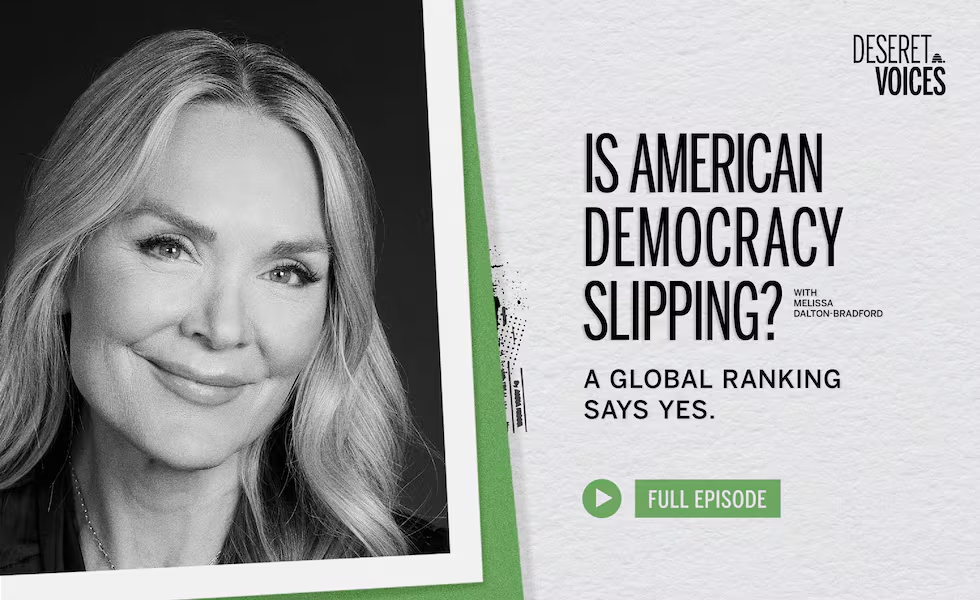
Author Melissa Dalton-Bradford has roots in Provo and currently lives in Germany, a nation which succumbed to authoritarian rule under the Nazi regime.
“Deseret Voices” host Jane Clayson Johnson invites Dalton-Bradford on the podcast to talk about her new book, “How to Save Democracy: The Anti-Authoritarian Playbook,” which covers the hallmarks of authoritarianism.
Dalton-Bradford shares her concerns about the rise of the Alternative für Deutschland party. Does she also see democracy crumbling in America?
Subscribe to “Deseret Voices” on YouTube, Apple Podcasts or Spotify.
Note: Transcript edited by Steven Watkins.
Jane Clayson Johnson: In just 18 months, the United States plunged from 20th place to 51st in global democracy rankings — marking the steepest drop ever recorded.
Democracies almost never fall overnight in a sudden coup. They crumble quietly, step by step, using a predictable playbook that leaders across history have used to turn free citizens into passive subjects.
Today, international author Melissa Dalton-Bradford breaks down the 11 hallmarks of the authoritarian playbook, how our public trust is being manufactured and the exact steps everyday citizens must take before it’s too late.
Melissa Dalton-Bradford, it’s so nice to have you with us. Thank you for coming.
Melissa Dalton-Bradford: Thank you for having me, Jane.
JCJ: All the way from Germany.
MDB: All the way from Frankfurt.
JCJ: You grew up in a very conservative community.
MDB: Yes.
JCJ: And now you have this sort of global vision of the world. How did your upbringing shape kind of who you are now and the way you live now?
MDB: I was raised in the Deep South for a period, and then in the Midwest, and then junior high and high school was in Provo — Provo, Utah. And then I went on to do undergraduate work and graduate work at BYU. That’s where my roots are, my deep roots are. But my parents had studied in Austria and in Germany, and they were determined to feed us everything German. And so when I was 14, I stepped on to German-speaking European soil for the first time, and I knew this was my place.
‘Deseret Voices’ Episode 58: The pendulum keeps swinging. Will Democrats waste their turn?
JCJ: And you were sort of a nomad for many years. You lived in many different countries —
MDB: Thirty-five years, we’ve been in eight different countries. That’s where I started understanding things that — big blind spots that I had about my own beautiful, beloved America. And people who had different views of our policies that perhaps had affected their lives, that was a wake-up call for me. And I also learned that, by and large — and this isn’t everyone — but by and large, other people understood world history better than I had been taught world history, so I didn’t just understand my national history, but my nation’s history in the context of the entire world. That’s what I’m talking about, how we fit with all of these different countries.
JCJ: And so that has led you to this incredible online presence with a very large following where you teach history and civics and current events. What’s your goal in the midst of that? What are you trying to do?
MDB: I’ve been researching these sorts of things on my own as a civic observer for decades. How can I help other people understand what seems so clear to me and so clear to my German neighbors?
So I said, “I’ll just start telling the stories.” And my — sort of my trifecta or the three things that I try to focus on are educating, motivating and activating. Let’s understand what our history teaches us, let’s be motivated by the stories of how other people reacted to delicate times in their own political systems, in their own countries, and then let’s be activated to do something.
And I was hoping that that was what my little online following would do for just a little group of people. I had no goals, no ambitions, certainly didn’t think I was going to write another book of a political nature. And then it just skyrocketed, and I was chasing after it all of the time.
JCJ: So this is your new book: “How to Save Democracy: The Anti-Authoritarian Playbook.” What led you to study authoritarianism? Why this book now?
MDB: I was ready to write my historical fiction. I was ready to write my novel. I had all of the characters and all of the timelines literally laid out in butcher paper on my big writing desk, and then historical fiction became less pressing for me than the present reality.
The present reality was, first of all, in 2015, we had just moved from Switzerland to Frankfurt, center of Germany, and there was civil unrest, there was civil war in Syria, and there was this influx of forcibly displaced people that landed right on my doorstep, literally in our town. And I engaged in that. I’ve been deeply engaged in the lives of forcibly displaced people.
They drove me. They drove me to understand better and to understand that it was politics that landed them in the most destitute circumstances in my town, and I started teaching them German. That was my goal.
JCJ: What did you learn from these refugees about authoritarianism?
MDB: That power that is unchecked destroys people, destroys cultures. Democracy is designed so that the citizens, the participants in that system, are agents. Agents are the groundwork, they’re the bedrock of democracy. It works from the bottom up. Authoritarianism works the other way around.
People in an authoritarian regime are subjects. They don’t have power. They can’t choose. They’re held under a heavy thumb, and they become victims of these regimes, as I know so well in Germany, and the most terrible scourges that we can see in history come from the sort of system.
So why authoritarianism? Because the people that I’ve been reading for decades, particularly in the last decade, have been warning that authoritarianism is on the rise around the globe in countries that are fledgling democracies, countries where we have elected leaders.
JCJ: You say that authoritarian movements exhibit recognizable patterns, 11 hallmarks that you’ve identified in your book, from assaulting truth, the politicization of independent institutions, corrupting elections, stoking chaos. If you were to describe the authoritarian playbook, what is it?
‘Deseret Voices’ Episode 57: Kalshi bet this state wouldn’t enforce its gambling laws. It lost
MDB: It’s a pattern of tactics, characteristics, and moves, legal or otherwise, that take power from a democracy and shift it so that it’s held in very, very few hands.
And the reason why I begin my list of hallmarks with assaulting truth is because that’s the first place where authoritarian-leaning leaders begin: they tell lies, they make up facts, they weaponize vagueness. It’s not just to teach or to convince people of any alternative truth, it’s to just leave us confused, to leave us believing that truth can’t be known, that everyone lies equally, all the sources are deceitful, and so I’m just going to give up. And there’s no better victim of authoritarianism or totalitarianism or whatever you want to call it than someone who just can’t tell the difference between fact and fiction.
JCJ: And so what have you learned about these movements in other countries — in Russia, in Poland, in Brazil, in Hungary?
MDB: They all follow similar hallmarks, and they do it in a different sequence. It kind of happens more in a network, in a spring motion, not happening in an exact chronological order.
JCJ: So it’s not sequential, necessarily. One is not based on another.
MDB: No, no, it’s not sequential.
JCJ: One is not based on another.
MDB: No, some of them are very closely connected. For instance, silencing dissent, that’s one of the key hallmarks of authoritarianism. In other words, an authoritarian leader does not like anybody to tell them that they are wrong, or to check their version of a story, or to say, “Mmm, our facts differ from you,” or “We have found out something that you aren’t sharing with the public.” Authoritarian leaders hate that. So they will silence them.
Now, in an extreme case, you have someone like the leader of Russia, who was seated in power through a democratic election, so ostensibly a democracy, but he will kill people who discover his secrets. People fall off of 21st-floor balconies somehow, they’re poisoned, they’re sent to Siberia. There are numerous stories. It connects also to silencing the press.
In Turkey, for instance, that has slid well into authoritarianism under Recep Tayyip Erdoğan, there have been so many journalists — journalists like you, good, trained, respectable journalists — who have been jailed or they have been exiled. More journalists in Turkey in the last few years than in any other country. That’s silencing dissent.
JCJ: Is there a tipping point where you can’t really see it coming? It’s not a tidal wave; it’s more of the proverbial frog in the pot.
MDB: It differs from many scholars’ points of view. When the courts are completely politicized, when the independent institutions are gutted and replaced with loyalists, when the three branches of government are no longer functioning as three equal, co-equal branches of government, when, for instance, the judiciary or the legislature — let’s say Congress — says, “We can’t push back against the desires of the executive,” then you’re right on the tipping point.
JCJ: So the globally recognized V-Dem —
MDB: Yeah.
JCJ: — Varieties of Democracy, it’s based in Sweden —
MDB: Yes.
JCJ: — has been tracking democracies for years. Tell us what they’re finding and how they’ve characterized the United States.
MDB: The United States, over the last few years, has hovered somewhere around 20th place. But in the last year and a half alone, it has plummeted from 20th place to 51st place. It is the steepest, most precipitous drop of any rated country that V-Dem has ever tracked. Ever.
That, for me, who follows V-Dem and a number of other democracy watchdogs, that’s a huge alarm ringing for me. And the scholars that I’ve been reading whose entire life has been devoted to studying democracy and political systems, they’re saying the same things. It’s a chorus of people that are saying, “We’re in a place where we need to decide if we want democracy to continue and be healthy, or not.”
JCJ: Talk about the polarization in our country and in democracies that are in decline around the world. Is that a hallmark of authoritarianism?
MDB: It’s an undercurrent throughout all of the 11 hallmarks that I note. One of the hallmarks that maybe this fits under is scapegoating. So what we saw in Germany was the scapegoating of certain ethnicities, minorities. But scapegoating can also be scapegoating the other party. You can blame the other party for everything, or you can blame an entire gender for everything, or you can blame whatever group you want. You can pin all of the grievances that you might have about the current situation on one group of people.
Scapegoating gives us a convenient villain, it distracts us from the real issues that might really be a threat to our democracy, but it pits us against one another. It makes brothers “others.” Those are the other.
It’s a very dangerous place to be in, because what an authoritarian wants more than anything is for us to be weakened, to be unable to find any common ground, and to be ready to just lunge at one another. It stokes violence and chaos, and there’s kind of this fomenting sense of being at war with one another that is very, very precarious.
There’s also an enormous amount — this is the message and the feeling that I keep getting — a lot of fear.
JCJ: Well, that’s another hallmark of the authoritarianism is fear.
MDB: Yeah, that’s right. That’s right, stoking fear. You want to create fear.
Life is a scary — it’s a scary undertaking. Things are going to be uncertain. But there’s a difference between normal fear that’s rooted in truth and manufactured fear, which is rooted in lies, and it has a motivation to rob you of your agency.
Authoritarians weaponize fear so that we will be small, we will be scared, we will be afraid to speak because we might be cast out of our community, we might lose a relationship. We’re — I mean, I’m talking with people who are afraid for their family members because they have Latino backgrounds, and they’ve had the talk with their kids about what happens if Dad gets detained — Dad who’s a U.S. citizen, who’s paid his taxes for 40 years. Because these stories are happening.
So that kind of fear, that kind of ambient — I’ll call it ambient fear — that does a lot of things to us, Jane. It makes us quiet, it affects our entire nervous system, and it makes us look at one another with different eyes: “Is that person my enemy? Can I trust them? Can I talk with them?” It changes everything in our most intimate interactions. That’s a dangerous place to be, and we have to recognize when we are being goaded, when we are being played, when someone wants us to be afraid.
Authoritarians will also use language — and again, this comes from years and years of studying this, and it’s in my book as well — they’ll use language that will tell you that you need to be afraid. You need to be afraid of anybody of that ethnicity, you need to be afraid of people who cross the border, they’re going to do this and that, and you need to be afraid of people who, according to all of the research and statistics, really aren’t people that we need to be afraid of.
‘Deseret Voices’ Episode 56: Trump can sign an order, but can he make it last?
JCJ: You talked about assaulting truth. Politicization of the independent institutions, consolidating executive power, silencing dissent. Hijacking faith, tell me about that one.
MDB: We know what happened in Germany. We know that those good, faithful Germans, they wanted to be obedient, and what the authoritarians of that age understood is if you could somehow harness the incredible power of religious identity and religious symbols, and use those priests and those pastors, and use that good, faithful, obedient churchgoer, if you could do that, you pretty much had the people in your hands.
And remember that Germany was at a time that was extremely fragile at the time. They had just come out of World War I, they were economically devastated, their identity had been absolutely just crushed. It was a terrible time for Germany. And they needed somebody that would give them hope and give them something to hold on to, and they needed a sense of unity: “We are the German people. Here is who we are.” And, you know, in truth, there was a slogan: they were going to make Germany great again.
JCJ: Make Germany great again.
MDB: Right, make Germany great again, make Germany great again. And one of the things that was going to drive Germans to this was going to be this organization, and they were going to believe that they were going to expunge Germany of anything that was not ethnically German.
Hijacking faith plays into this, because we are going to make our country pure, and anything else is a threat, and anything else is a degradation, and we are intended to be white and Christian. It’s happening in many countries right now.
JCJ: Do you see it happening in the United States?
MDB: There are many, many top scholars whose whole life has been devoted to studying this who say, “Yes, that’s happening.” We see it in immigration policy, we see it in the introduction of religious iconography and practices right in the center of our political system. And I can understand so well — I can understand so, so well why that’s pleasing for people, because they want their religion, their Christianity, to be the religion that supersedes all of other religions everywhere else. I can understand part of that, but that’s never what our country was designed to be.
JCJ: What happens when your political identity is so enmeshed with your religious identity? What’s the danger in that?
MDB: Great danger. The scholars say you weaken both: you weaken your political strength and you weaken your religious strength. As soon as religion becomes enmeshed, like you said so well, wrapped around politics, you lose that independent spirit, you lose the ability to do what religion does best.
What does it do to the state? It weakens the state’s ability to be democratic and pluralistic. We want many different religions to be at home here, we want many different ethnicities to be at home here. As soon as there is one religious norm that imposes itself on politics, then you weaken what makes democracy so vibrant, so beautiful, so messy, but so powerful.
And this is what our Founding Fathers designed. And yes, we need a moral foundation, there’s no question about that, but to impose a specific religion on that is a threat to our religious freedom.
JCJ: Your whole life has been dedicated to sort of understanding democracies. When you see your America from across the pond over in Germany, you look over and you see what’s happening in this country, what crosses your mind? What do you think?
MDB: What I’m watching from abroad is an opportunity for us to put principle above party, to put precedent above party. And what do I mean by that? I mean that whatever happens right now in our democratic system, whether we like the administration or not, those precedents are going to shape whatever comes next. So let’s just imagine that 10 years from now, or even five years from now, let’s imagine that another administration is sitting in the White House right now, and let’s say that it’s someone that you loathe. You can’t stand anything about their party or what they stand for, but the precedent has been changed, because right now democratic norms are shifting. How we treat the press is shifting. How we use that office is shifting, and that precedent opens up the field for the next administration and the next and the next and the next to maybe abuse it in a way that you wouldn’t be very happy.
So principle over party, precedent over party. I think of that all of the time. And I also want to say this as someone who’s coming from the outside looking inside: the entire globe is watching. That’s no exaggeration. It’s in the news. People are literally on the edge of their seats.
Because we’re also seeing — again, I’m coming from Germany, if anybody’s watching the news, there have been some major shifts in Germany just in the last month as well. So a far-right extremist party with very close ties to the Kremlin —
JCJ: AfD.
MDB: AfD, Alternative für Deutschland, the Alternative for Germany, which was pretty much radioactive 10 years ago, nobody wanted to touch them or deal with them, they now have scaled to great power in Germany. Openly, they’re on record saying, “We’re taking all of our cues from the current U.S. administration.”
When they talk about their immigration — their intended immigration policies, they cite what the current immigration policies are in our country by name, and they say, “When we get in power, we will do precisely the same thing.” They mimic the language, they actually use the language from our rallies, from our press conferences, and they say them, and they say them in English even in Germany.
So authoritarian-leaning leaders look to one another, and they feed one another’s rise. And it’s happening in many, many places.
JCJ: Power.
MDB: They feed their power, they show up at one another’s rallies, they stump for one another. So maybe it’s helpful for us to just see who are the best friends of the current U.S. administration, where are those strong ties, who or what administrations are they supporting, and then find out about those administrations.
JCJ: Finish us off with your democracy defense pod.
MDB: Oh, wow. OK.
JCJ: You meet every week with a group of women, and what do you do?
MDB: They’re just the people that understand you and are concerned like you are, and you keep each other accountable, and you keep each other going.
Two nights ago, I was in Logan at a book event, and these people had already done it. It was this room full of really scrappy, smart, active, creative women and a couple of men that just come together every week, and they say, “What is the local concern? Is it protecting our immigrant neighbors? Is it showing up at the school board? Is it preparing to talk at the town hall?”
And that’s what they do with one another. And I envision these DDPs, these democracy defense pods. All of these nodes, these bright nodes connected with one another all across the nation, taking action, protecting one another, and keeping each other going, because the thing that an authoritarian wants is for us to get deflated and despondent and exhausted, we’ll just give up.
And if you’re concerned at all about democracy, don’t be isolated and don’t try to do it all alone. Get in a group of people. There are so many good organizations that are doing things right now. They’ve already laid the groundwork, and you can gain energy from one another.
JCJ: Read us from your book to carry us out.
MDB: I just want my readers to know, I want to end with hope. Will we let fear and division suffocate the flame of democracy, or will we walk together toward something better?
‘Deseret Voices’ Episode 55: No country has ever saved a dying saline lake
Every person counts. Every effort counts. Every tool matters: every email, every meeting, every hard conversation, every vote. Every weary step toward justice is another mile on the long walk from Roxbury — that’s where Dr. King began that first march — to the Common — Boston Common, that’s where he ended and thousands thronged around him — from the Revolution to a more perfect union.
This book is your summons to link arms and to join that beat. So take notes and take a breath. Lift your sign, lift your pen, your voice, enlist in the fight for the anti-authoritarian movement, not with weapons — because I write a whole chapter here on nonviolent resistance — not with weapons, but with the unassailable power of nonviolent protest, civil disobedience, and borderless love for humanity — the only arsenal that matters. It’s love that drives, not fear. It’s love for democracy and for one another that drives us.
Interrupt every single one of the small obediences: the overlooked lie, the tolerated fraud, the shrugged cruelty, the numbed conscience, before these compound into catastrophe, rise. As the Boston Tea Party did. As March’s ghosts demand.
I have watched this nation from across an ocean. I have sat with people who fled war with nothing but their stories, their scars, and their hope. I have seen what it costs when decent neighbors wait too long to get political — which, put simply, is the moment democracy waits too long. And I am telling you: The moment is now, and you are enough. March.
JCJ: Thank you. Thank you so much.
MDB: Thank you, Jane. Thank you so much for this time.