‘Brother Pat’ wondered what the Book of Mormon says about second chances. We’ve got receipts
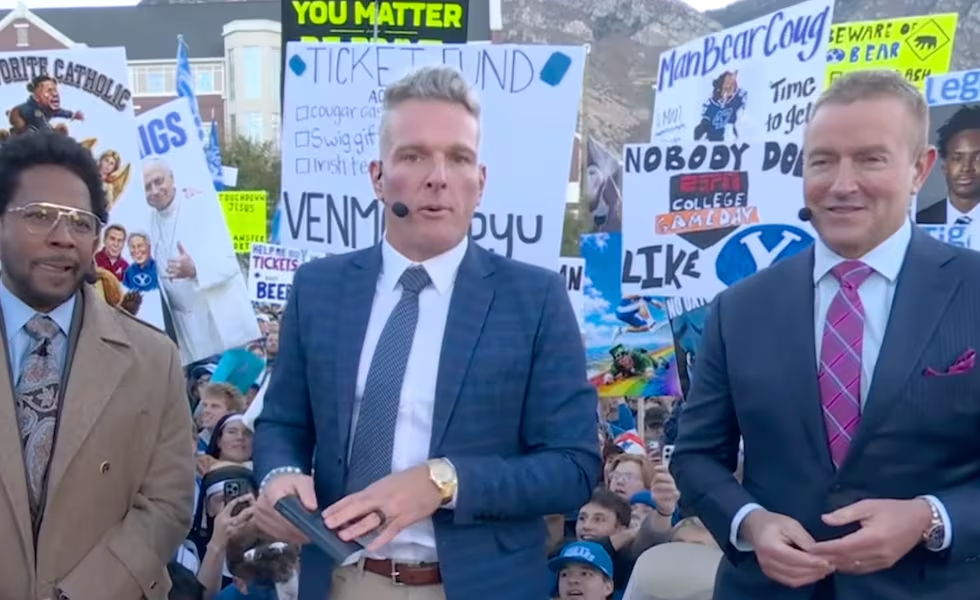
To: “Brother” Pat McAfee
Regarding: The Book of Mormon
Dear “Brother Pat,”
We know you usually get your Latter-day Saint intel from your boy, Austin Collie. Or Ryan Smith.
But we thought maybe you’d dig a little download that would let you get the drop on them the next time you send a DM or have them on your show.
We sure hope the bruise on your leg has healed after the fan struck it with that thrown Book of Mormon on the “College GameDay” stage at BYU last month.
Analysis: ‘College GameDay’ got really religious in Provo. Was it respectful?
You read a couple of passages of scripture during the show, but later you raised a killer question.
“I don’t know what the Book of Mormon has to say about second chances,” you said after Spider-Man BYU student Carter Smith missed his first $3 million field goal attempt. “I have no idea.”
Taysom Hill gave you the perfect short answer — “A lot!” — but we think you’d get a kick out of dropping a Book of Mormon reference on Taysom or Austin or Ryan next time around.
We’d bet a cup of Coach Sitake Road ice cream on it.
Here are our three options for Book of Mormon stories you can tell to surprise them:
- The church antagonist
- The deceptive lawyer
- The fallen missionary
The miracles that led BYU student Carter Smith to his $3 million ‘College GameDay’ kick
The rule on second chances is explicit
The Book of Mormon is all about second chances. It doesn’t treat a person’s worst moment as the inevitable end of their story.
It describes people who change, the people who help them change and the communities that make room for their return.
At one key point, the church’s leader is asked to judge people who had committed serious sins. That man, Alma, asked the king to judge the sinner, but the king said it was a church matter.
Alma prayed for guidance, and God’s response is the strongest verse about second chances in the entire book:
“Yea, and as often as my people repent will I forgive them their trespasses against me” (Mosiah 26:30).
But let’s get to those three stories!
Receipt No. 1: A church antagonist turns around
Alma’s son was a rebel who aggressively undermined his father. He led an apostasy that divided the kingdom. He said he “murdered” the spiritual beliefs of others.
When Alma prayed for his son, God sent an angel who commanded him to stop trying to destroy the church. It was such a powerful intervention that the son fell into a three-day coma.
When he woke up, Alma the Younger had accepted his second chance. He turned from destruction to peacemaking, and he spent the rest of his life righting his wrongs.
“From that time even until now, I have labored without ceasing, that I might bring souls unto repentance,” he said, “that I might bring them to taste of the exceeding joy of which I did taste; that they might also be born of God” (Mosiah 27 and Alma 36).
The rebellious antagonist found joy, not because his history never happened, but because it no longer determined his future.
Receipt No. 2: The deceptive lawyer becomes a preacher
Zeezrom was a lawyer described as “a child of hell,” an “expert in the devices of the devil.”
He led another successful apostasy, despite his later admission that he had known the truth. He even turned his devilish skills on a confrontation with two church leaders who were former rebels themselves — Alma the Younger and Amulek.
Zeezrom failed to bribe Amulek or to discredit either of them. In fact, they spoke so powerfully that he was converted. That angered most of the people he had led astray. They burned many of the faithful. Then they bound Alma and Amulek and mocked, imprisoned, starved and beat them.
Zeezrom stood up to the mob to try to save the two missionaries.
“I am guilty,” he said, “and these men are spotless before God.”
Zeezrom fell ill while the missionaries were in prison, wracked by the torment of what he had caused. After God delivered Alma and Amulek from prison, they healed Zeezrom, and he joined them as part of a missionary dream team (Alma 11-15).
The men Zeezrom sought to destroy helped him redeem himself. Second chances depend partly on what other people do.
Receipt No. 3: A missionary who sinned receives another assignment
A member of the missionary dream team, Corianton, abandoned his ministry and pursued “the harlot Isabel.”
The hypocrisy of his sexual sins damaged the mission. Those who saw or learned of his conduct would not believe what the missionaries taught.
His father, Alma the Younger, held Corianton accountable, but he also taught him that God had provided “space for repentance” through the Atonement of Jesus Christ.
“The remarkable and celestial blessing of the Savior’s Atonement is that through repentance, sinful conduct is blotted out,” a Latter-day Saint apostle taught.
Corianton accepted the rebuke instead of becoming defensive. He repented of this serious sin, turned around his behavior and rejoined the mission and its dream team of repentant souls.
He recognized that correction was his second chance, and it was a renewed opportunity to share with others the glad tidings that Christ had established mercy.
Accountability does not wipe out a future (Alma 39-42, 49).
What Jesus himself says in the Book of Mormon about second chances
The appearance of Jesus Christ in the Americas is the centerpiece of the Book of Mormon, and he instructed the people to give people second chances, too.
Talking to a people who remembered Alma the Younger, Zeezrom and Corianton, he said that people who were trying to destroy the church should not be numbered among his people.
But he would not give up even on someone like that.
“Nevertheless, ye shall not cast him out of your synagogues, or your places of worship, for unto such shall ye continue to minister,” Christ said, “for ye know not but what they will return and repent, and come unto me with full purpose of heart, and I shall heal them” (3 Nephi 18:32).
Takeaways for ‘Brother Pat’
There’s a lot more about second chances in the pages of those scriptures that hit you in the leg.
To put some of it in sports terms, a coach should at times forgive a player’s mistake and keep or return him to the starting lineup or roster. Other times, the coach may forgive the person but decide the player must be benched, demoted, traded or cut.
Modern apostles continue to teach that Christ will forgive as often as a person will repent.
“You don’t have to be who you’ve been before. Embrace your fresh start, your second or third or fourth — or 100th — chance, offered to you through the atoning blood of Jesus Christ,” Elder Patrick Kearon of the Quorum of the Twelve Apostles taught last year.
Brother Pat, you wondered if the Book of Mormon said anything about second chances. Like Taysom said, it sure does.
The harder question is whether the rest of us will make the room for someone to take one.