Progressives confront their limited leverage as they take on Democratic leaders
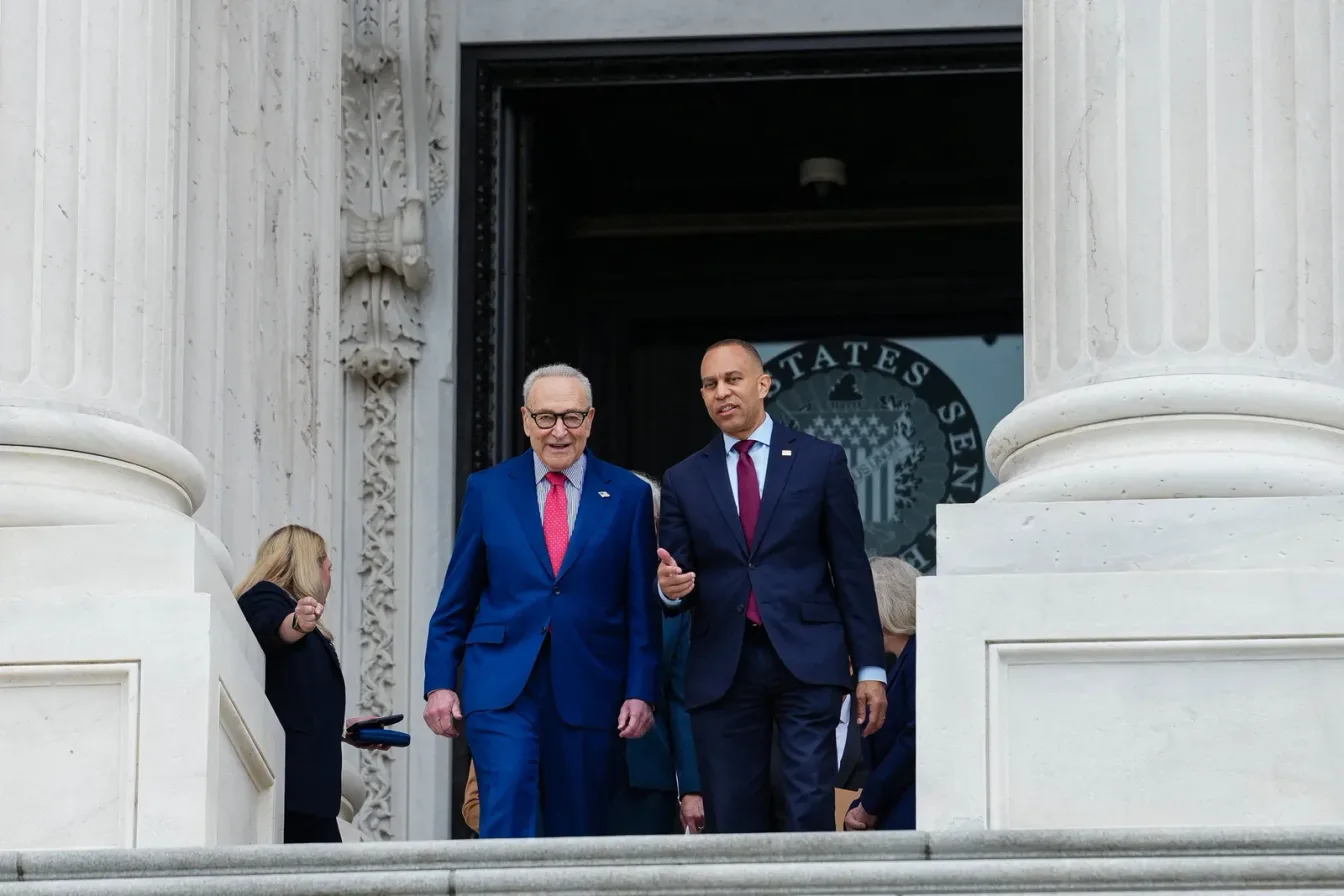
The News
By Corbin Trent’s estimate, he’s spending 15 hours a day on a cause that has animated the left ever since Democrats won huge majorities in the House and Senate: urging them to dump their leaders.
Trent, a former spokesman for Rep. Alexandria Ocasio-Cortez, has some well-known allies in his long-shot campaign to oust Senate Minority Leader Chuck Schumer and House Minority Leader Hakeem Jeffries. They include actor Mark Ruffalo, former Ocasio-Cortez chief of staff Saikat Chakrabarti, and countless progressive influencers.
But they don’t include Ocasio-Cortez, who underscored on Tuesday that she’s backing Jeffries. Even Trent acknowledged that what legions of online progressives are asking for — the rejection of leaders who just presided over Democratic landslides — is unlikely to happen.
“I reckon it’s about a 10% chance on Schumer and a 3% chance on Jeffries,” Trent told Semafor. “What matters, and matters a lot, is making it loud and clear that voters asked for something else. That it is being denied to them. If you’ve ever got a chance to beat these folks, you need votes.”
Theoretically, the votes to shake up leadership are at least within reach. Informal whip counts and hallway interviews confirm that dozens of newly elected Democrats are interested in challengers to the two New Yorkers who occasionally break from the left. But realistically, the battle to replace Jeffries and Schumer was built for a disappointing election, not a landslide.
And the obstacles of the anti-leadership campaign are revealing the limited reach of a progressive movement that wants to pick the next presidential nominee. Critics of Schumer haven’t given up on enlisting Maryland Sen. Chris Van Hollen to challenge him, but no Democrat has stepped up to take on Jeffries.
Even if Van Hollen mounts a campaign, it will be a massive uphill climb for progressives to deny Schumer the votes in next month’s closed-door vote. The left’s chances of defeating Jeffries are even lower.
But by forcing the question, progressives hope to either pull off a miracle — or at least, keep an argument going. Activists believe that they, not Schumer and Jeffries, put in the work to win the biggest Democratic victories in decades. The progressive media outlets that exploded after the party’s 2024 loss to Trump are now watching the leaders take credit for what they think their movement built.
Their message is consistent: That voters who want “change” and support progressive ideas will stay engaged only if the leadership changes and President Donald Trump is forced to veto big progressive bills.
At last week’s post-election Crooked Con, a gathering of progressive activists, strategists, influencers, and podcast addicts, the demand for new leaders hung in the air. Attendees walking up to the Washington Convention Center on Saturday were offered leaflets about stopping bipartisan permitting reform moving through the Senate, warning that it would speed up the building of “immigrant detention centers.” (The bill advanced two days later.)
Inside, there were excited murmurs whenever a Democrat was asked about replacing Schumer or Jeffries.
Pressed by Pod Save America co-host Jon Favreau on whether she would challenge Schumer, Michigan Sen. Elissa Slotkin gave a winding answer that didn’t rule it out — but suggested that Schumer could win her over.
“Look, if he wants to be majority leader, what is your plan for the first 100 days?” she said. “How are you going to do things differently so that Democrats get their sh*t together?”
That got muted applause from an audience ready to join an insurgency. There was much more excitement when Rep.-elect Milat Kiros of Colorado said there had been a “mandate” for change, not for current leadership; Kiros unseated Rep. Diana DeGette in one of the left’s biggest primary wins.
Everywhere he went, Van Hollen was asked if he would challenge Schumer. In a short interview with Semafor, he disputed the idea that the leader had earned the job already by electing between seven and nine new Democratic senators.
“I’m glad that the DSCC and Senate Majority PAC raised a lot of money,” Van Hollen told Semafor. “I mean, their Republican counterparts raised even more money. I think the lesson from this election was, this was people power over money.”
The scale of the Democratic wins has made the entire push trickier.
“Look, we had a wonderful, wonderful outcome,” said Maurice Mitchell, the president of the Working Families Party, which clashed with DC Democrats over primaries in the Midwest and California. “It’s almost like it would be greedy of me to want better outcomes. But I know there were elections that could have been won if we were able to move as a united front.”
David’s view
The modern left is at its most powerful inside the Democratic Party after the party screws things up.
Hillary Clinton’s defeat convinced many Democrats, even his Senate colleagues, that Sanders would have won the presidency, and his populist ideas were more popular than whatever it was she ran on. Kamala Harris’ defeat was even more empowering for Sanders, whose “Fight Oligarchy” rallies brought out hundreds of thousands of people.
After victory, the left’s challenge is twofold. One: Schumer and Jeffries didn’t blow it. They are no longer the brittle wimps who were protesting outside of federal buildings last year and insisting they’d “fight” Trump. They beat him.
Two: Democrats really did listen to them. Last year’s government shutdown fight, while it did not end as progressives wanted it to, was about healthcare funding — the sort of life-or-death economic issue the left wanted to focus on. The eventual Democratic themes of the election were “costs, chaos, and corruption” and “fighting for an affordable America.”
What’s worth watching most closely right now is how upstart progressive media — Hasan Piker, Drop Site, Lever, Majority Report, and other influencers — approach all this. Left-leaning media has a much larger reach than it did eight years ago, when Democrats last assembled for an open presidential primary.
They have willed a “leadership challenge” story into existence when most of DC thinks they’re bound to fail. They aren’t done.
Room for Disagreement
The challenge of actually replacing leaders who just won is already weighing on progressives, who are already asking themselves whether they’re undercutting their own allies.
“People are doing what they should be doing, which is swing for the fences. Go after leadership, if that’s what people want to do. But if we don’t get that, we can’t just let it destroy us emotionally,” former New York Rep. Jamaal Bowman told Don Lemon on Monday.
Or as Trent put it: “I think it’ll be a great thing to highlight when Democrats fail miserably to meet the moment.”
Notable
- In pre-election reporting on Democratic infighting, Axios previewed how the left could lose its leverage: “Anything short of a landslide victory for House Democrats next Tuesday will open the door” to crisis.