‘Deseret Voices’ Episode 60: Why the fight over Sharia law could affect every faith
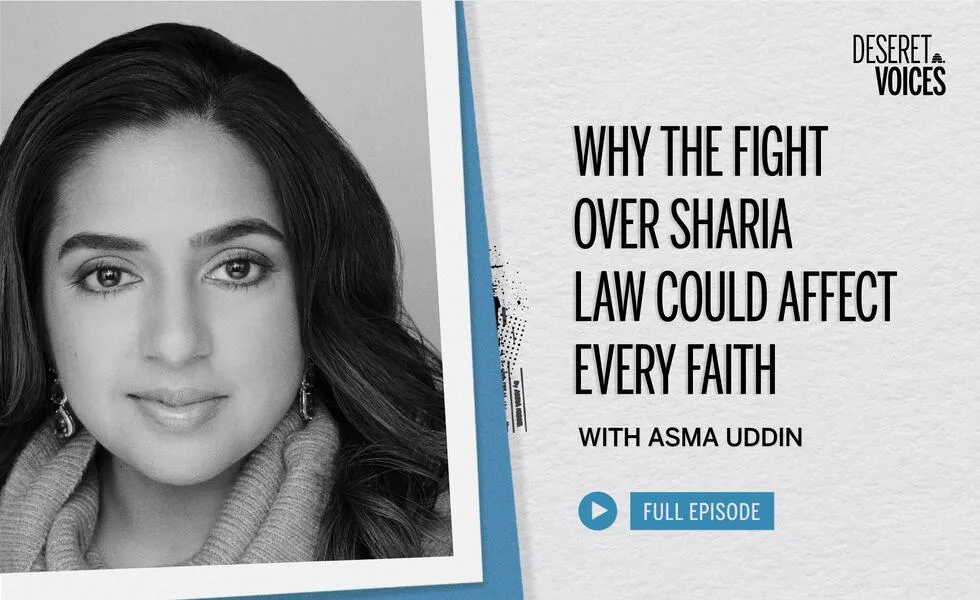
Legal scholar Asma Uddin applauds the work the Supreme Court has done to protect religious liberty, saying, “If you protect religious liberty for one group, you protect it for every group.”
Uddin is troubled by anti-Sharia legislation and other efforts to limit the scope of religious freedom.
On this episode of “Deseret Voices,” McKay Coppins asks her what religious people in America should be paying attention to if First Amendment protections become selective in enforcement.
Subscribe to “Deseret Voices” on YouTube, Apple Podcasts or Spotify.
Note: Transcript edited by Steven Watkins.
McKay Coppins: Asma Uddin, thank you for coming on “Deseret Voices.”
Asma Uddin: Thank you for having me.
MC: So, Asma, you wrote a book a few years ago called “When Islam Is Not a Religion: Inside America’s Fight for Religious Freedom.” And this is a subject you’ve been writing about a lot and has become kind of newly relevant this year. We have seen just in this past year, the House Judiciary Committee has held two different hearings titled “Sharia-Free America.” We had a Republican congressman who proposed the Preserving a Sharia-Free America Act.
There’s this big kind of conversation, especially on the political right right now in America, that appears to frame much of Islam as a religion, not as a religion, but as a political ideology. So I want to start by just asking you, what does it mean when politicians call Islam a political ideology? What legal work is that distinction doing?
AU: It’s actually just really kind of unsettling in some ways, maybe not entirely surprising. But having explored this topic in my 2019 book, to see it kind of come back in an even clearer form than what I documented in the book has been really disheartening and kind of just shows how just the same tactics are used over and over again. When I traced this before, I was thinking about this — I mean, my background is in religious liberty, first as a litigator in the space and now as an academic.
‘Deseret Voices’ Episode 58: The pendulum keeps swinging. Will Democrats waste their turn?
In the context of that, just kind of, like, thinking about the politics of religious liberty in this country as well and what’s happening at the Supreme Court, which I think even casual observers of the court have noticed that the court has become increasingly protective of religious liberty. And a lot of those protections are expressed in cases where the claimant is a conservative Christian. And for me, as an advocate of religious liberty, I’ve never really had a problem with that because the nature of the law is that if you protect religious liberty for one group, you protect it for every group. And so it doesn’t really matter who’s involved in a particular case, it really just — it’s like a precedent is set, and then every subsequent claimant can take advantage of that.
But what happens when there is an increasingly powerful sort of contingent in this country that doesn’t want those religious liberty protections to extend to certain groups? And increasingly, it’s always American Muslims are one of, you know, primary groups that there’s a lot of sort of fear and fear-mongering around. And based on my analysis, it seems like the defining of Islam as something that’s not religion is a way to prevent the extension of ever-increasing sort of broadening religious liberty protections to American Muslims, because if you’re not a religion, then you don’t really qualify for religious liberty.
MC: Right. So it’s basically a way to preserve the gains for Christians in the religious liberty space, while excluding minority religions like Islam that, you know, a lot of people on the religious right might not be quite as supportive of. Is that fair to say?
AU: Yeah, 100%, and thereby attacking the sort of very basis of religious liberty, right? To protect like this quest for the divine that each human has, and to understand like the core role that faith plays in people’s lives and it’s just to do away with all of that, and sort of the space, even the marketplace of religious ideas that religious liberty protects, it’s a way of just kind of erasing all that and saying religious liberty is really just for some. Not realizing that when you do begin to be this selective, you essentially also weaken religious liberty for everyone else.
MC: There’s a bill before Congress that, if passed, would essentially say that an immigrant who adheres to Sharia law should be deportable. If such a bill were to pass, what would the government actually have to ask a person to determine whether they adhere to Sharia?
AU: I mean, this is something that has, again, precedent. The thing I was tracking in my 2019 book are measures starting around 2010, where a series of state legislatures were trying to pass what they called anti-Sharia legislation. And at the time, a lot of this was really — and a lot of the proponents admitted that they didn’t think that there was a problem of people following Sharia in this sort of way that’s like somehow subverting American policy and constitutional law, right? That was like the rhetoric in the public space. And they were like, “We don’t actually think that’s a problem.”
And we actually acknowledge that that’s probably not even possible, and we can get into that, but we’re still going to have these attempts to pass this legislation, because that in itself serves a political purpose. And so we’ve seen this before. Most of them were not enacted. When they were, it was just often used in ways that you would find surprising, because Islamic law, in many cases, does, for example, protect the rights of Muslim women. And so the way this would play out is if there’s a private arbitration that one voluntarily sort of brings a dispute — and it’s a very limited set of disputes that a person can bring for arbitration. And so if it’s a personal issue kind of in the aftermath of divorce, trying to figure out, like, the settlement of assets afterwards, then once you have that the award from arbitration, then you have to take it to an American civil court and make sure secular court, and they would check for various things to make sure you weren’t coerced into participating in this process, that there’s fairness. And once all these different sort of procedural and substantive checks have been met, only then would a civil, again, civil, secular court enforce the award.
And so in a lot of these cases, again, Islamic law is very favorable to women’s rights, and there were cases in which that precise award would be overturned just because there was this attempt by a judge to try to understand how to apply an anti-Sharia law, right? That if this was somehow arrived at through the interpretation of Islamic law, that that by itself made it impermissible. So, again, seeing this at the federal level, it’s just a continuation of that.
‘Deseret Voices’ Episode 57: Kalshi bet this state wouldn’t enforce its gambling laws. It lost
MC: I think it might be helpful for you to kind of define briefly Sharia law for our listeners. Because it is one of those terms that gets tossed around in a political context often. And I think that, you know, a lot of people look at theocratic Islamic governments in places like Saudi Arabia, and they would push back on you saying that Islamic law is favorable to women, because they’d say, “Look at all these countries where women don’t have the same rights as men.” But, you know, Saudi Arabia, Iran, the way those governments are structured is not the same thing as Sharia law or Islamic law, is that right? Could you kind of explain what Sharia law actually is?
AU: Yeah, I mean Sharia laws are broadly — “Sharia,” the word, it denotes sort of a way, a way to the water, a path to the water, right? So these big sort of idea of like what it is that God wants for humans. And so you have these general principles, and then you have a very human project of deriving actual rules from that, right? From this body of knowledge that includes the Quran, includes, like, the way of the Prophet Muhammad, the Muslim Prophet Muhammad. And, you know, various other mechanisms that jurists used in order to take something very broad and open to interpretation, and then derive very specific rules. And even then, there’s a multitude of of schools of thought in Islam. So you have jurists who are disputing with one another.
It’s very similar in that way, I think, to Judaism, where there’s just a lot of space for dissent and disagreement and different forms of interpretations. And so out of that is really just then you have a set of rules. And again, most of those rules are internally contested. You can probably find a school of thought that has a different take on whatever that issue is. And so it’s that messy process of finding rules, often ones that determine, like, how you’re going to purify yourself before you pray, or what the precise form of the prayer is and what’s required in order for a prayer to be acceptable. It’s the minutiae of religious life.
MC: You mentioned state legislatures who are trying to create laws around this. Obviously, Texas is one of the states where a lot of this political work is being done and these debates are being had. Texas Republicans have argued that advocacy of Sharia is seditious. But, you know, as you say, Sharia can tell a Muslim how to pray, or eat, or give charity, or a structure of financial transaction. How does the state distinguish the religious parts from the supposedly political parts? Is that even possible?
AU: There’s different aspects of Islamic law, right? So when I’m talking about, like, how do you pray and how do you purify yourself, that is going to be different from, for example, what does Sharia say about how to run a state. When it’s in the context of American law, again, we’re talking about arbitration and your private very sort of limited scope of disputes that you can take to this arbitration, for private arbitration, right? So there’s a series of things. If it’s something that’s involving, for example, the rights of children, that would not be something that you could take to arbitration. Like, that would be something that you would need to refer to the American legal system for resolution. Similarly, anything dealing with criminal laws, it’s not something that you’re going to have being arbitrated instead of being handled in the civil court system, in the criminal court system.
So I think the first step there is just to understand, like, the narrow kind of scope of issues that are even subject to this, because American law already does an incredible job of making space for diversity. And it’s not, by the way, something that only Muslims take advantage of. There are Jewish rabbinical courts. There are Christian panels as well where they handle dispute resolution about very specific things that the community has decided is better handled internally. And those things are allowed. And then there’s a whole bunch of other stuff that isn’t allowed. And I think what these various attempts at, you know, fear-mongering around Sharia do is they put forth a false premise that somehow our legal system doesn’t distinguish between these different types of things.
MC: The thing that worries me about the U.S. government trying to wade into these theological questions and classify certain denominations as religious and others as political, is that it gives the government a power that, once it starts to wield it, can go in a lot of dangerous places, right?
Now, we saw a small kind of low-stakes version of this earlier this year when the Pentagon released a list classifying a bunch of different denominations as Christian, but not Latter-day Saints, right? Latter-day Saints were listed as a separate denomination. And there was kind of a public outcry by a lot of Latter-day Saints, including Latter-day Saint senators and members of Congress, and the Pentagon actually backed away from it. But it was a small example of kind of what can happen when the government is kind of entrusted with deciding which religions are real, and which religions are what they say they are, as opposed to, you know, kind of pretending to be something that the government disagrees with.
And I guess I wonder if you think that members of other minority religions in America should be paying closer attention to some of this legislation and litigation around Islam as a political ideology, because most likely it will not stop with Islam, right?
AU: A hundred percent. And in many ways, it hasn’t even started with Islam. I think it’s taking its crudest form in just in recent years when it comes to Islam, but it’s certainly come up in other ways throughout American history, when there’s been other religious groups that have faced persecution that I would say is far greater and more extreme than what American Muslims are facing today. And it’s really connected to this idea of, again, the religious liberty for just some is religious liberty for none. Like, we’re all in it together. And so when you start to have these carve-outs, you cannot possibly think that this is not going to come back and affect your own community, because it absolutely creates that possibility.
The entire premise behind religious liberty is that government cannot be trusted, right? Like, this is just, like, free speech and other other freedoms, that there’s this idea that there has to be a boundary on what the government is permitted to do. And because there’s, you know, this fundamental distrust of government power, like, once you give it power, what can it do, who, and the people who are in power also change, right? So it becomes very dependent on what their particular preferences and biases are.
You know, it’s interesting when I speak in, you know, publicly about these things, others will come up to me afterwards and just be like, “This is how we feel it manifests against our particular religion.” You know, I’ve had Jewish people tell me that they feel that increasingly today Judaism, an acceptable Judaism in the public square, is one thing, right? And, you know, and so that’s a question of more of a public square issue, but how but of course, the concerning part of it is when it becomes government action.
And so in a totally different type of version of this is, like, you see minority religious women who are currently, like, sort of raising, you know, seeking a religious exemption against, for example, abortion bans. And there’s litigation pending in Indiana right now, and there’s a pretty robust discussion going on there, especially in scholarly circles, as to how to think about religious exemption when it’s pro-abortion, not anti-abortion. Like, is this something that is protected by religious liberty? Does this constitute religion? So there’s such a wide variety of ways that this is coming up that people are already feeling it.
MC: I remember a conversation I had a few years ago with a very prominent Republican political leader who was retired. It was not Mitt Romney. People always assume when I tell stories like that that it was Mitt Romney. It wasn’t Mitt Romney. He was actually a Protestant Christian, and he was talking about the rise of Christian nationalism on the right. And, you know, Christian nationalism can mean a lot of different things. In its most benign manifestation, it’s people who say that they just want to recognize America’s kind of Christian roots and character. In more kind of dangerous manifestations, you have people who are calling for basically a Christian theocracy in America. And then there’s a lot of space in between those two positions.
‘Deseret Voices’ Episode 56: Trump can sign an order, but can he make it last?
But what this Republican political leader told me was, you know, the thing you have to realize is that if the most kind of radical Christian nationalists get their way, Mormons are not included in that group, right? Latter-day Saints obviously profess Christianity, but if you get a Christian nationalist government run by, you know, a certain kind of sect of Christians, they might decide to exclude whoever they want to. And that’s where you really have to kind of give serious thought to how much power we want the government to have to make these decisions. And it seems like kind of the where this battle is happening right now is over Islam, but we’ll have the battle in a lot of other places as well.
AU: A hundred percent. And I think there’s — I mean, in the context of this conversation, I think it’s important to make the distinction between sort of private, social conversations around, like, where the boundaries of a religious community, you know, are. And so Christians can have these intra-Christian debates, right, and dissension around what is Christianity and what isn’t, just like every other group can. And in terms of like how private, you know, religious organizations that sort of define the boundaries of their membership, that’s totally all fine. And I think it’s important, because I think a lot of people tend to conflate those two. But this is really what we’re talking about is, again, government action and fundamental distrust of government power.
MC: So here’s where to me this conversation becomes more complicated, because if we live in a country, as we do, where religious belief receives special legal protection, somebody does have to determine what qualifies for that protection, right? And we have seen over the years, you know, a number of groups try to, you know, kind of make a point by forming what are obviously kind of performatively fake religions to to get special protection.
So you had something called Pastafarianism, which was deliberately created as a satire during the intelligent design fight, where these people said that if the schools were going to teach, you know, supernatural intelligent design alongside evolution, why not teach that the universe was also created by a Flying Spaghetti Monster, right? You had something called the Church of Marijuana, where they tried to get special protections to partake of a drug under religious liberty protections. You’ve had all kinds of groups like this.
And then there are other more serious movements and groups like Scientology, which are constantly being debated in terms of whether they should receive all the same protections as older religious groups. And so I guess I’m curious as an expert in religious liberty law, as a litigator yourself, doesn’t the government at some point have some role to play in deciding who gets these protections?
AU: So oftentimes people assume that just because we have religious liberty, that somehow religious liberty for all means a kind of a free-for-all, right? That someone can just claim that they have a religious claim that has to be accommodated and that our law is going to protect that. But in fact, there are a number of different stages of inquiry that a court engages in. One, I mean, often conceded because many religious claims are coming — claimants are coming from religious communities that are understood to be religious.
And so the first question would be, is it religious? Once you pass that threshold, the second question is, is it sincere, or is it merely pretextual? Is there some other aim here, or is an actual sort of religious impulse or religious duty that has to be accommodated? Then the third step is, is this something that the law actually accommodates? And it could be in the subset, again, of things that the law thinks that these are things that are designed to prevent these particular incursions on religious exercise. And then the last, and I think the most important, because I think there’s so much confusion around this idea of just, like, this fear that that is often generated, not just with Islam, but with lots of other religious communities that people just have a concern about their practices or their beliefs, is the question of whether or not there’s a compelling government interest, right?
So that there’s a very strict standard, again, goes with the fact that religious liberty has such robust protection. And so, only when the government can meet this very strict standard — and there’s all these, like, sort of finer legal points there as to when the standard is triggered, etc. — but assuming you have this strict standard, it’s literally called strict scrutiny. If the government has a compelling interest, things like safety or security, then the government can actually, if it shows that there is no better way to serve that interest other than to limit your religious exercise, then the government wins. So even in a country like the United States where we have such robust religious liberty protections, it doesn’t mean that the religious claimant always wins. The government still has fundamental interest in protecting the polity, and it will win in those cases.
‘Deseret Voices’ Episode 55: No country has ever saved a dying saline lake
MC: So the real principle is not that government can decide what religion is, but rather government may judge the sincerity and conduct of people claiming a religious belief. Is that right?
AU: That’s correct. I mean, a lot of times religious exemptions, which a lot religious claimants seek, are essentially saying that this particular law shouldn’t apply to us. We should be exempt from that. Right? And so you can imagine the context of drug laws and a variety of other laws. There could be an attempt to kind of use religion as merely a pretext, right? A front for some other motive. And so the court can engage in various sort of mechanisms to determine that you’re actually sincere in this belief that is religious, right?
So, again, the first inquiry is this a religious belief or is it something else, right? Is it philosophical? Is it secular? And there’s very specific protections for beliefs that are religious, right? The First Amendment is very clear about that and specifically singles out religious beliefs. So is it religious? OK. If it is, then you move on to the question of sincerity. And then, of course, the next part of the analysis would be: is this something that our laws can, you know, say it deserves an accommodation, right? Is there some sort of burden, and does it meet the legal standard? And then, if it doesn’t meet the legal standard — then, and only then, does it actually — is it something that the religious claimant can be accommodated with, right?
So there’s a space for the government to articulate a compelling government interest, which can easily quash a religious claimant’s claim, right? So if it’s something that the government is saying that we need to protect the security or the life of Americans or safety and security, then that would be something that would override a religious claimant’s claim.
MC: So I couldn’t create a Church of Tax Avoidance tomorrow and say that I, you know, sincerely believe that I’m spiritually commanded not to pay an income tax. Like, the government would clearly see that as not deserving of an accommodation.
AU: That’s that’s correct.
MC: As you’re kind of looking at the religious liberty landscape, like you said, over the last decade or so, there have been pretty significant gains for the religious liberty movement. And we have a conservative Supreme Court that has been, you know, found, has made decisions that side with religious liberty advocates. I wonder, though, where you see this battle going. You know, it seems like the concern among the people I talk to in this world is not that the precedents being set by the Supreme Court right now will be overturned anytime soon, but more that there will be political efforts to narrow who gets to take advantage of those precedents. Is that kind of where you are?
AU: We certainly see that in the abortion litigation or the conversations around that. That’s, I mean, the most sort of robust debate is around this idea of, like, is the religious liberty that is being protected one that is in a sense, you know, fundamentally traditional or conservative, or does it make space for these more sort of progressive interpretations of religion?
And then, of course, there’s the political project that we’ve been talking about, of just saying that there are certain disfavored communities that we’re going to cut out from protection. And I don’t think it’s so much the law that’s doing that. I think that the Supreme Court’s law is actually very much, you know, conducive to broad protections for a variety of religious groups, but there’s a continued attempt in the political space to try to articulate and apply those more narrowly.
MC: For those who sincerely believe in religious freedom as an ideal that should extend to everyone, what do you think they should be aware of? What should they be doing to support — whether it’s Muslims or groups of other religious minorities — that might be targeted by these political efforts? What should, you know, Latter-day Saints or Jews or Hindus or other, you know, religious people in America be paying attention to? What should they be doing in your view?
AU: I think a huge part of it is legal literacy, just sort of the basics of, like, what are the standards? What are the various, you know, steps that a court takes? How does this actually work in the American legal system? I mean, just as a very sort of baseline literacy about how that works, because there’s so much fear that really kind of festers in a space where there’s confusion, where a lot of these things are kind of shrouded in technicalities. And so the things that various politicians are saying seems intuitively to make sense.
Again, we see these things on TV that look scary, and when a politician says that there’s a risk of this happening in the U.S., and we don’t have the tools to really push back against that, then it allows that rhetoric to continue to spread and to continue to generate fear, and then people begin to sort of again repeat those things. And so that’s how it’s spreading and compounding. And I think that basic ideas of, like, how the legal world works, how the standards work, what religious liberty is exactly, and how best to protect religious liberty for everyone, including one’s own community and one’s own self, I think is paramount to making sure that we continue to protect religion and religious exercise in the way that is conducive to the flourishing of individual Americans and for American society more broadly.
MC: My last question is a more personal one. I hope you’ll forgive that. But, you know, we’ve talked about all of these issues from a legal and political and constitutional standpoint. What has it been like for you and people in your community to watch these kind of political efforts to redefine religious beliefs as a political ideology that doesn’t require First Amendment protections?
AU: The effects on the ground, right? So this manifests not just when it comes to anti-Sharia legislation, but also with, you know, almost every project to expand or to build a mosque or an Islamic center. And in fact, what’s happening in Texas is, I think, partly responses to the fact that there is this growing community there. There’s more and more sort of, like, Muslim organizations and there’s entire, like, housing developments, etc. And it’s a space that’s very much thriving. But a lot of those individuals who have moved from elsewhere in the country to go to parts of Texas to be part of this community, they’re experiencing what American Muslims across the country are experiencing, which is when you have this rhetoric, when you have these hurdles, right? So the rhetoric results in lots of obstacles and sometimes, like, violence. And so when you have just, like, administrative hurdles, when you have processes that where just to get a permit to build or expand your facility takes now a decade because there is ongoing protests and this type of political efforts that you have to constantly push back against, that really just creates, you know, disincentive.
‘Deseret Voices’ Episode 54: What sports betting does to your soul
It just makes people kind of lose hope. It slows down the growth of the community in a way — where the community’s really kind of focused on creating uniquely American institutions to to sort of chart the next chapter of American Muslim identity and experience in this country. But how do they really establish these institutions if they’re facing decades, more than decades worth of obstacles?
MC: Asma, thank you for coming on, talking about all of this. I hope we can bring you on again soon. I appreciate it.
AU: Thank you. Thank you for having me.