Odyssey Slop
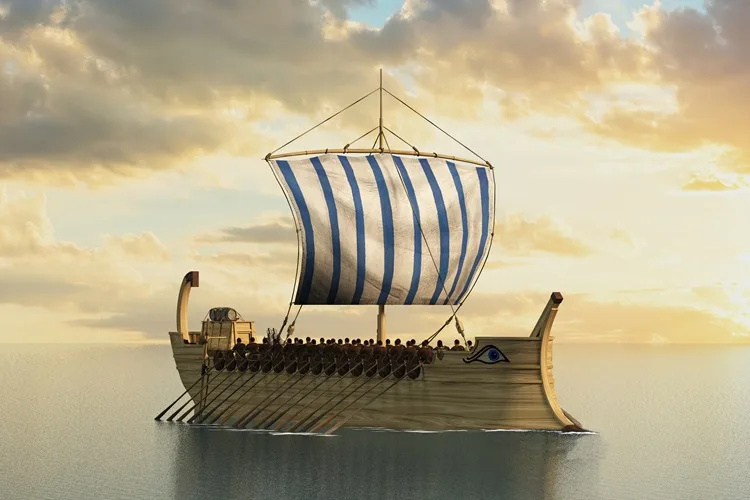
If you are currently teaching a class on the Odyssey and have written public-facing pieces about Homer and the considerable influence he still has on us today, then you have a professional obligation to spend seven minutes and 12 seconds watching the first episode of Grok Imagine’s “Odyssey series.” In fact, I have spent 21 minutes and 36 seconds watching it. That is quite enough.
As everyone knows, Elon Musk did not like Christopher Nolan’s latest film even before he saw it. Then, a few days after its release, he wrote on X that “before this year ends, Grok Imagine will make a full-length movie of The Odyssey that is historically accurate and true to the art of Homer.” So here we go.
Hundreds of people have been weighing in, and the general view, with which I agree, is that this “Creative collaboration with @WonderStudiosX and director Dev Walker @glumlot_” is AI slop. The uncanny valley effect is real and off-putting. The bearded men, one of them Odysseus, can be difficult to tell apart. The dialogue is stilted. Shots of the flotilla of Greek ships look especially artificial.
In any case, no one can reasonably claim that what Musk has given us is either historically accurate or truly Homeric. As to the first, I am particularly amused by the large church bell that the watchman at Troy rings when he and his son spot the enemy ships: The ancient Greeks and Anatolians did not have such swung bells. Still, worrying too much about anachronisms seems misguided when what is at issue is (to quote Kevin D. Williamson) “a story about men and women who never actually lived and the war they never actually fought as related by an ancient oral tradition attributed to Homer, a poet who (probably) did not exist.”
It would be unreasonable to object that a 21st-century English-language cinematic version of the Odyssey is a failure simply because it is not wholly faithful to the story of Odysseus’s return to Ithaca from Troy as sung in an artificial form of Greek, somewhere between orality and literacy, by a shadowy eighth-century bard called “Homer” (whoever he may have been). After all, the history of the reception of this poem is a history of tweaks, some of them considerable, from Vergil’s Aeneid to Madeline Miller’s Circe. That said, someone who complains that Nolan has violated Homer’s art should not begin the first episode of his Odyssey, as Musk does, with an extended scene of Odysseus’s thwarted attempt to avoid going to Troy by pretending to be out of his mind—because this aspect of the story is nowhere to be found in the Odyssey or, for that matter, its companion poem, the Iliad.
An important lesson to be learned from this is that there is much more to the Trojan War, and to the tale of Odysseus, than Homer. As it happens, Odysseus’s feigned madness is part of the deep poetic tradition, just not the familiar parts associated with the Iliad and the Odyssey. According to other sources, Odysseus donned a lowly felt cap and yoked two different animals to a plow (and/or attempted to sow salt rather than seeds) but was forced to abandon his ruse when a fellow named Palamedes placed Odysseus’s baby son, Telemachus, in front of the plow—thereby ensuring that he would reveal his sanity and end up joining his fellow warriors on the voyage to Troy, where, among other things, he came up with the idea of the Trojan Horse.
The earliest version of the story of Odysseus and Palamedes probably appeared in the Cypria, the first—but, alas, almost entirely lost—part of the so-called Epic Cycle, a collection of eight archaic poems, including the two great ones associated with Homer, that tell of the Trojan War from its background to the aftermath. (The Trojan Horse is also largely absent from Homer but played a significant role in lost parts of the Epic Cycle.) We know that the fifth-century tragedians wrote about Odysseus’s insanity, too, and we have surviving texts such as a Latin fable (#95) by Hyginus (ca. 64 BC–AD 17), as well as a number of visual representations from ancient to modern times.
The Odyssey did not come about, and does not now exist, in a vacuum, but it is our greatest source of the story of one of the most interesting, and most palpably human, of heroes. Homer’s bop is anything but slop, and its timeless magic is attributable in part to the intensely human nature of this hero. Perhaps AI will be able one day to produce good films that successfully mimic humanness. But what Grok Imagine has given us shows that we are not yet close.