Will the Hubble “constant” ever become an actual constant?
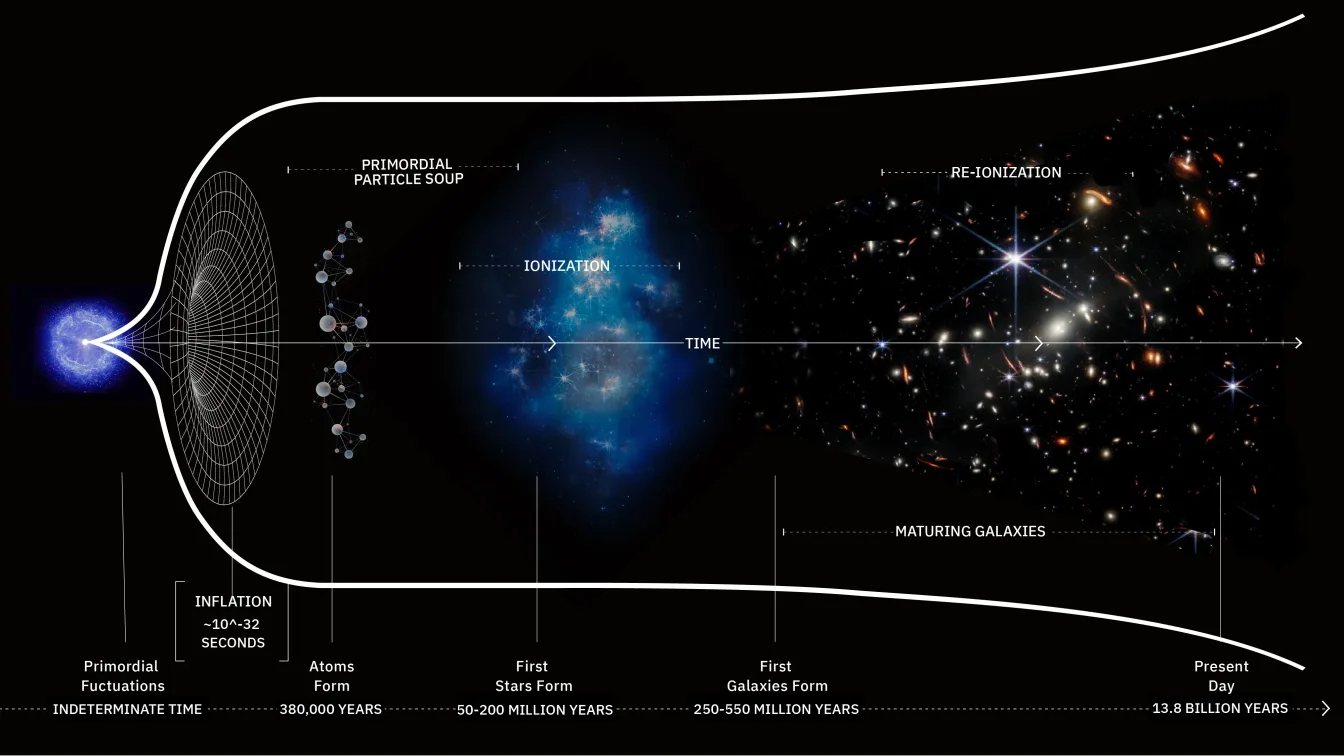
It was nearly a full century ago that enough data came in to map out both the distance to a significant number of extragalactic objects and also measure the amount that their light was redshifted: interpreted as an apparent recession speed away from us. When the distance and recession velocity of those objects were plotted against one another, an intriguing relationship emerged: the farther away we looked, the faster an object seemed to be moving away from us. Twice as far meant twice as fast; ten times as far meant ten times as fast. This linear relationship became known as Hubble’s Law (or more recently, the Hubble-Lemaître Law, since Georges Lemaître derived it first), with the slope of that line known as the Hubble constant.
However, it turns out that this is a complete misnomer: not only does the expansion rate of the Universe change with time, but it isn’t even constant across all of space right at this very moment. In other words, there’s nothing constant about the Hubble “constant” at all! The variation of the expansion rate with time was predicted from the star, but the variation in space came as a surprise: only with the discovery of dark energy did we realize this was the case. And yet, dark energy may turn out to be the Hubble constant’s ultimate savior, as if it truly is a cosmological constant, then one day, the Hubble parameter will, far into the future, actually become a constant after all. Here’s the science of what’s really going on.
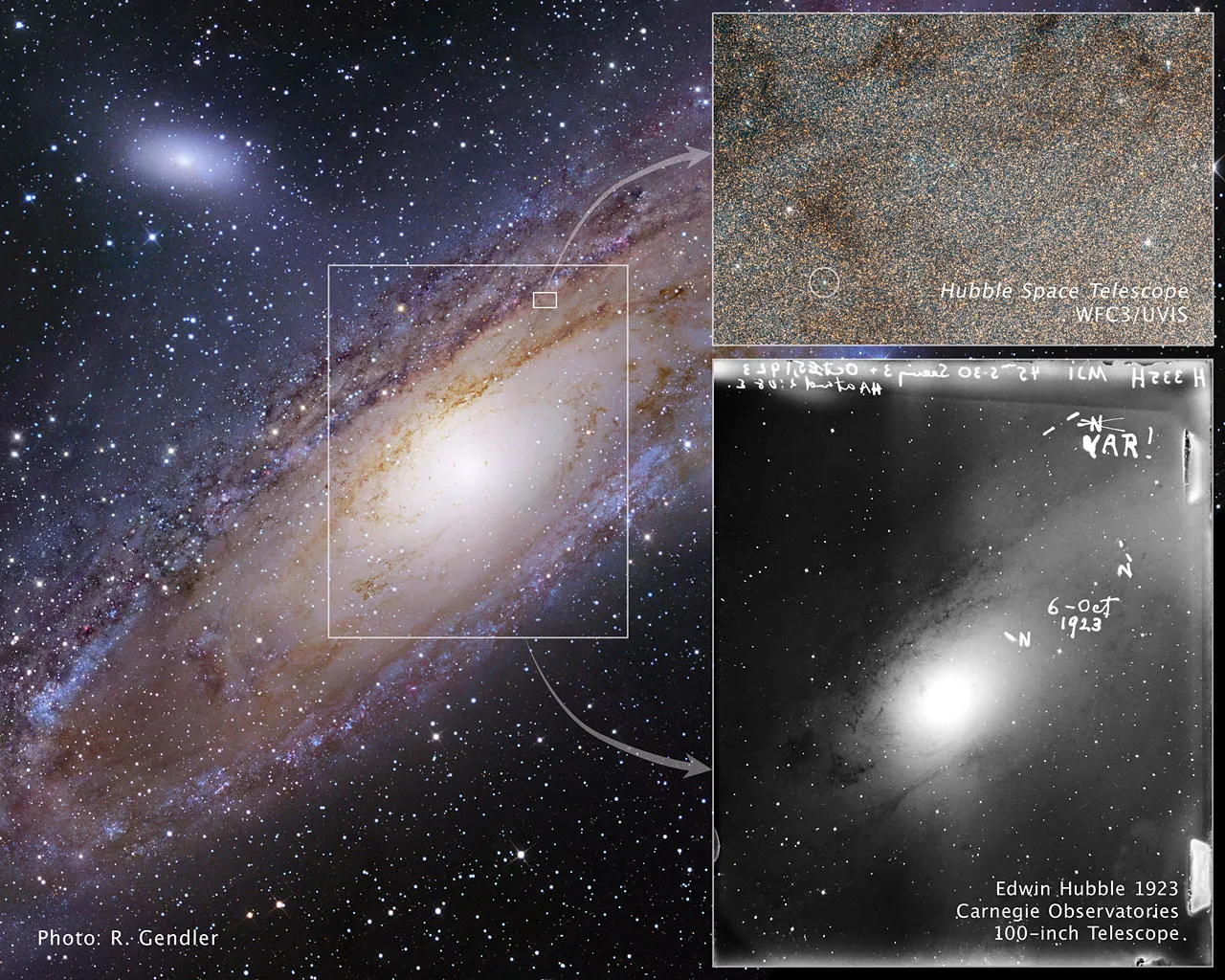 Hubble’s discovery of a Cepheid variable in the Andromeda galaxy, M31, opened up the Universe to us, giving us the observational evidence we needed for galaxies beyond the Milky Way and leading us, in short order, to the discovery of the expanding Universe.
Observationally, the story is seemingly straightforward. Beginning in the 1920s, our telescope technology became advanced enough — with large-enough aperture telescopes and the development of photographic plates — that we could start to resolve and identify individual stars in objects (i.e., galaxies) that were outside of our own Milky Way. The first such star was identified by Edwin Hubble in 1923: a Cepheid variable star, or a special class of star where, if you could measure the amount of time it took
- to brighten to its maximum,
- fainten to a minimum,
- and re-brighten back to its maximum again,
you could know how intrinsically bright it was.
Then, you could compare the observed brightness of that star (which you measured) with the intrinsic brightness that you just figured out, and that allows you to figure out the distance to it: the same way that, if you had a light bulb or candle with a known intrinsic brightness, then seeing how bright it appears would allow you to figure out how far away it is. This method for figuring out a distance in astronomy — the standard candle method — has since been extended to far more classes of objects than just Cepheid variable stars, and is one of the most useful tools in an observational astronomer’s arsenal.
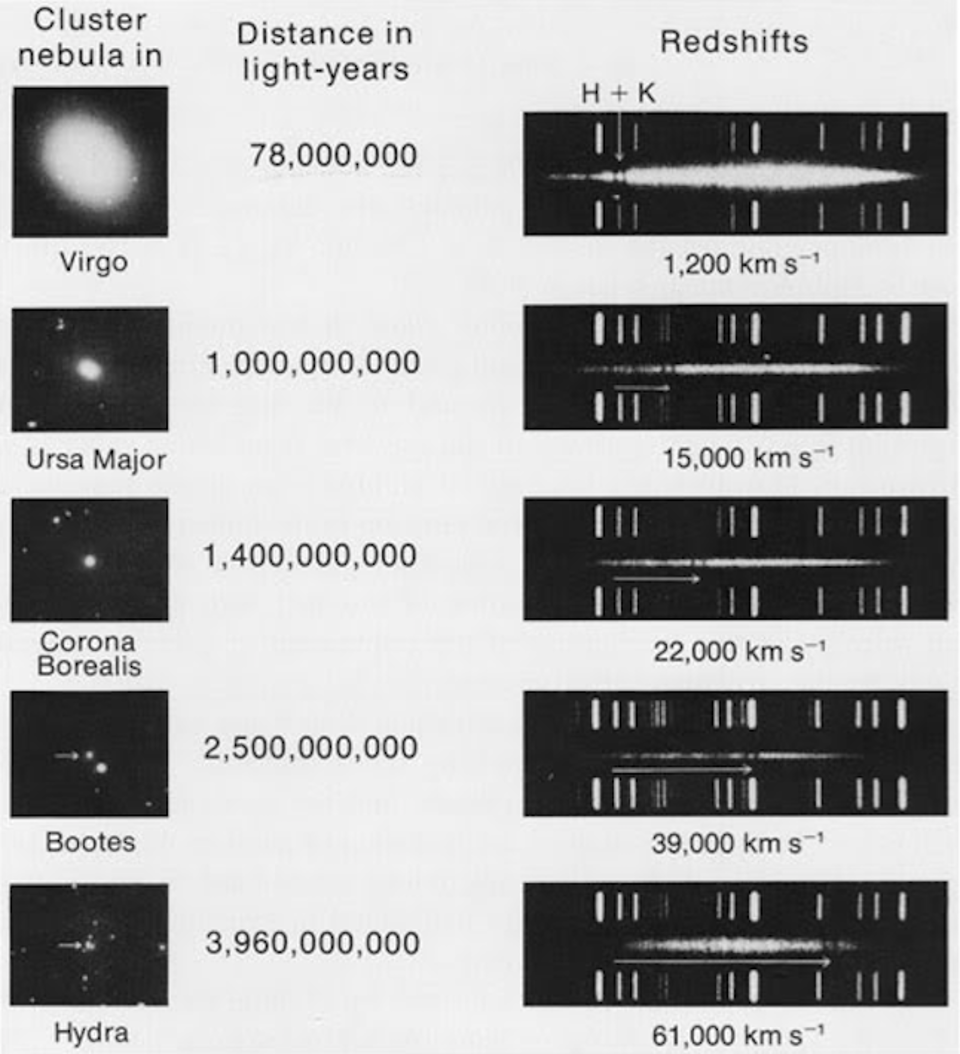 As was first noted by Vesto Slipher back in the 1910s, some of the objects we observe show the spectral signatures of absorption or emission of particular atoms, ions, or molecules, but with a systematic shift toward either the red or blue end of the light spectrum. When combined with distance measurements for those objects, this data gave rise to the initial idea of the expanding Universe: the farther away a galaxy is, the greater its light will appear redshifted to our eyes and instruments.
Then, in addition to figuring out the distance to that object, you can measure the light coming from that object as well. Rather than simply accumulating all the light of all different wavelengths together (a bolometric measurement), or even by measuring the light across a variety of differently colored filters (a photometric measurement), you could break that light up into all of its different component wavelengths, and measure the amount of light emitted at each specific wavelength along the way: a spectroscopic measurement. This technique, of spectroscopy, was the other key ingredient to uncovering the expanding Universe, and in turn, Hubble’s Law.
When you break light up into its component wavelengths, you get to see an enormous number of features about it, including lines of two varieties:
- dark lines, known as absorption features, that occur at specific wavelengths and with specific intensities depending on the amount and density of any species of molecule, atom, or ion present,
- and bright lines, known as emission features, that occur at those same specific wavelengths that emerge from electrons transitioning between an excited state and a lower-energy state in molecules, atoms, or ions, at those same specific wavelengths.
By comparing the observed wavelengths of (usually) absorption or (sometimes) emission features, we can determine an object’s redshift, and calculate the equivalent recession speed that corresponds to that redshift.
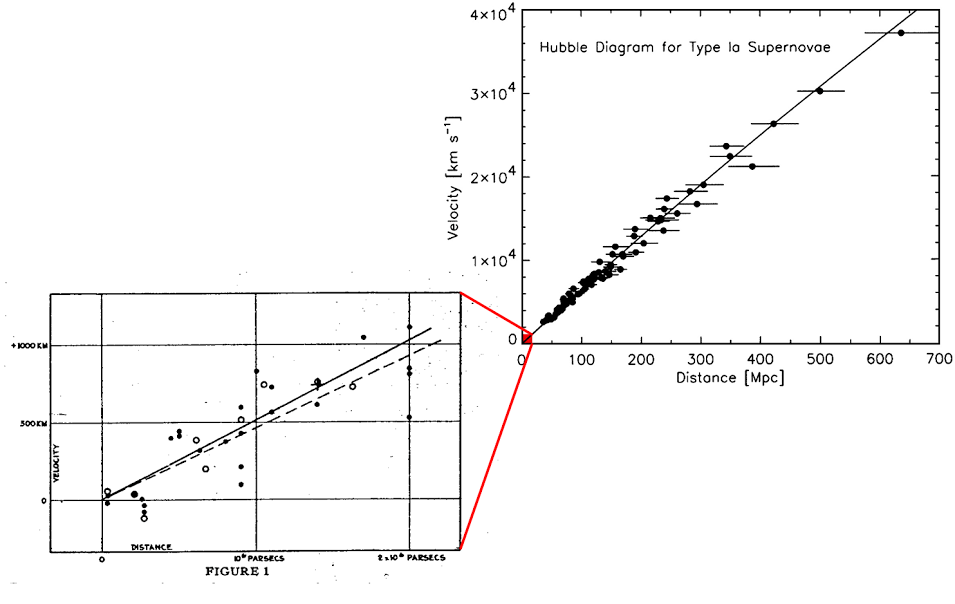 Edwin Hubble’s original plot of galaxy distances, from 1929, versus redshift (left), establishing the expanding Universe, versus a more modern counterpart from approximately 70 years later (right). Many different classes of objects and measurements are used to determine the relationship between distance to an object and its apparent speed of recession that we infer from its light’s relative redshift with respect to us. As you can see, from the very nearby Universe (lower left) to distant locations over a billion light-years away (upper right), this very consistent redshift-distance relation continues to hold. Earlier versions of Hubble’s graph were composed by Georges Lemaître (1927) and Howard Robertson (1928), using Hubble’s preliminary data.
Then, by plotting distance and redshift for the same sets of objects, together, we can make a graph for all sorts of extragalactic objects. This was done first by Georges Lemaître in an obscure 1927 paper (using much of Edwin Hubble’s data), then by Howard Robertson, independently, in 1928, and finally — and much more comprehensively — by Edwin Hubble himself in 1929. Although the points didn’t all lie exactly on a straight line, the overall trend was clear: the farther away an object was from us, on average, the greater its observed redshift, and hence, the greater its inferred recession velocity was.
In all the time since those early measurements from the 1920s, throughout the early, mid, and late 20th century and even into the 1990s, we extended those measurements of distance and redshift to larger numbers of objects and evermore distant objects. Still, the slope of that best-fit line remained constant, and was named the Hubble constant. (In fact, the famed Hubble Space Telescope got its name because its primary mission was to pin down the measurement of that constant: the expansion rate of the Universe today.)
Starting in the late 1990s, however, astronomers and astrophysicists made a shocking discovery. At the greatest of distances, the observed redshift-distance relation no longer followed a straight line, but instead departed from it. The theoretical implications of this — interpreted as evidence for the existence of dark energy — were astounding.
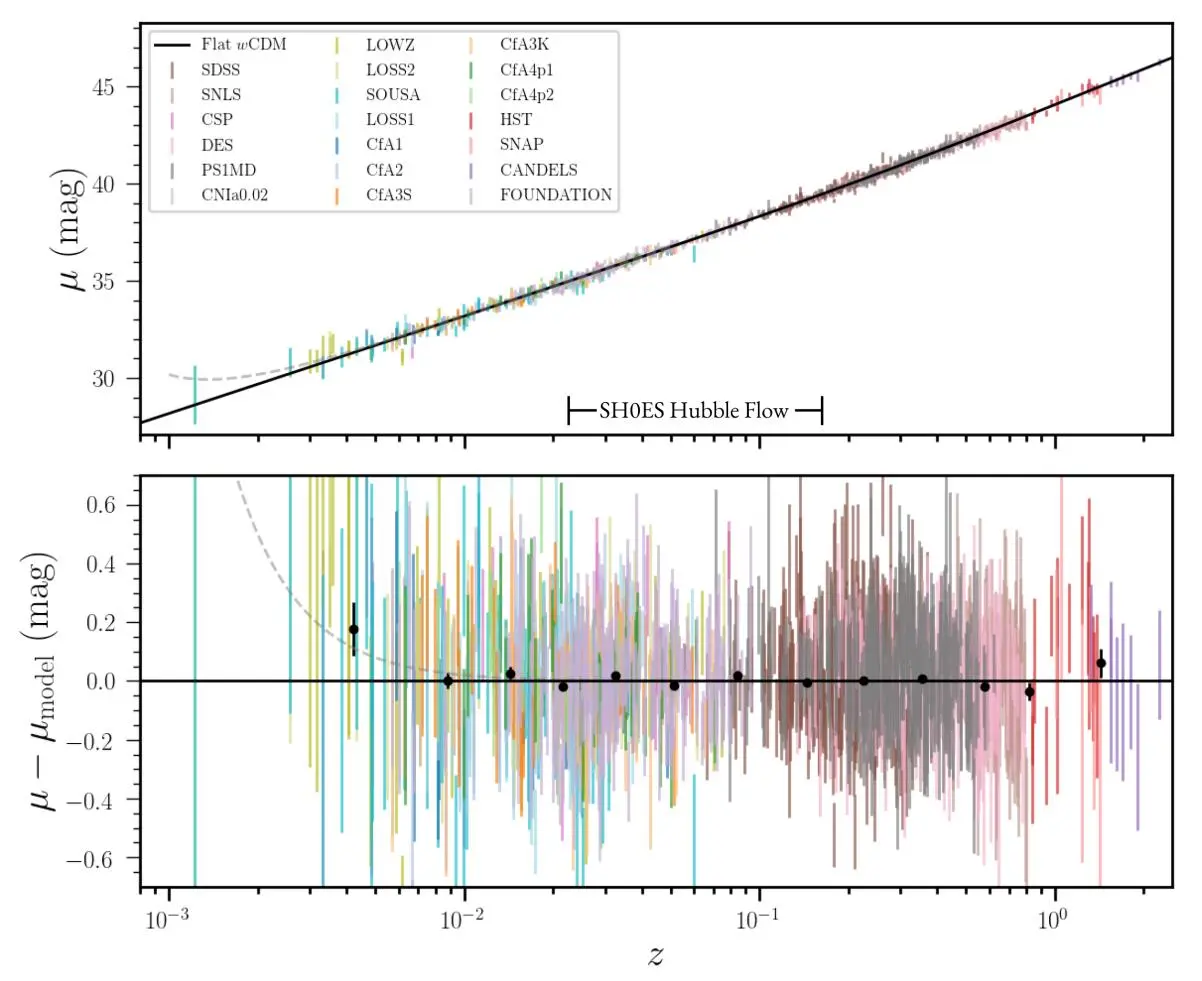 This graph shows the 1550 supernovae that are a part of the Pantheon+ analysis, plotted as a function of magnitude versus redshift. The supernova data, for many decades now (ever since 1998), has pointed toward a Universe that expands in a particular fashion that requires something beyond matter, radiation, and/or spatial curvature: a new form of energy that drives the expansion, known as dark energy. The supernovae all fall along the line that our standard cosmological model predicts, with even the highest-redshift, most far-flung Type Ia supernovae adhering to this simple relation. Calibrating the relation without substantial error is of paramount importance.
You have to understand that there was no guarantee that the relationship between redshift and distance in the expanding Universe would turn out to be a constant. On theoretical grounds, it perhaps shouldn’t have been the case. You see, the core rules that the expanding Universe obeys are governed by the law of gravitation: Einstein’s general relativity, which relates the curvature and evolution of spacetime with the presence and distribution of matter and energy in the Universe. That relationship occurs through a coupled set of equations: the Einstein field equations.
There is no general solution to the Einstein field equations; you have to specify the matter-and-energy distribution — a set of initial conditions — and only then can those equations yield possible solutions that you can discover, either analytically (for certain special cases) or numerically (for all other cases). The special case that describes the expanding Universe is for a Universe that’s both:
- isotropic, or the same in all directions on the large-scale average, and
- homogeneous, or the same in all locations on the large-scale average.
That exact solution was derived even before the expanding Universe was observationally discovered: by Alexander Friedmann, back in 1922. The resulting equations that emerge from Friedmann’s work are often called the most important equations in all of cosmology, and dictate how, based on what’s in the Universe, it has expanded over its history and will continue to expand, even arbitrarily far into the future.
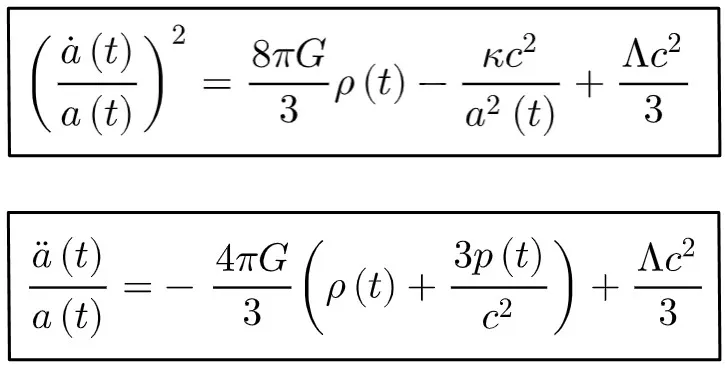 These two equations, known as the Friedmann equations, describe how an isotropic and homogeneous Universe evolves by expanding or contracting (the left-hand side) dependent on the energy density as a function of time (ρ on the right-hand side) as well as other parameters like curvature, pressure, and the cosmological constant. If you know everything about energy density as a function of time, you can figure out how the Universe will expand, contract, or otherwise evolve to arbitrary precision.
There are many interesting things that you learn by solving these equations for different special cases of what makes up your Universe. Mathematically, the Friedmann equations define the distance between any two points in the expanding Universe by the parameter a, where a is known as the scale factor. If you take the time derivative of the scale factor, ȧ (or how a changes over time), then you can define the expansion rate of the Universe at any given time by what we call the Hubble parameter, H, which is defined as H ≡ ȧ/a.
For a certain variety of special cases, we can learn that, as a function of time, the Hubble parameter H(t) evolves as follows.
- For a radiation (e.g., photon/light) dominated Universe, H(t) ~ 1/t, and a ~ t½.
- For a matter (e.g., atoms and/or dark matter) dominated Universe, H(t) ~ 1/t, and a ~ t⅔.
- And for a cosmological constant (Λ, which is the simplest form of dark energy) dominated Universe, H(t) ~ √(Λ), and a ~ eHt.
In all three cases, the scale factor — or separation between any two points in the expanding Universe — grows with time, albeit at different rates. Whether your Universe has radiation, matter, or a cosmological constant in it (or a combination of any two or even all three of them), it’s completely compatible with an expanding Universe.
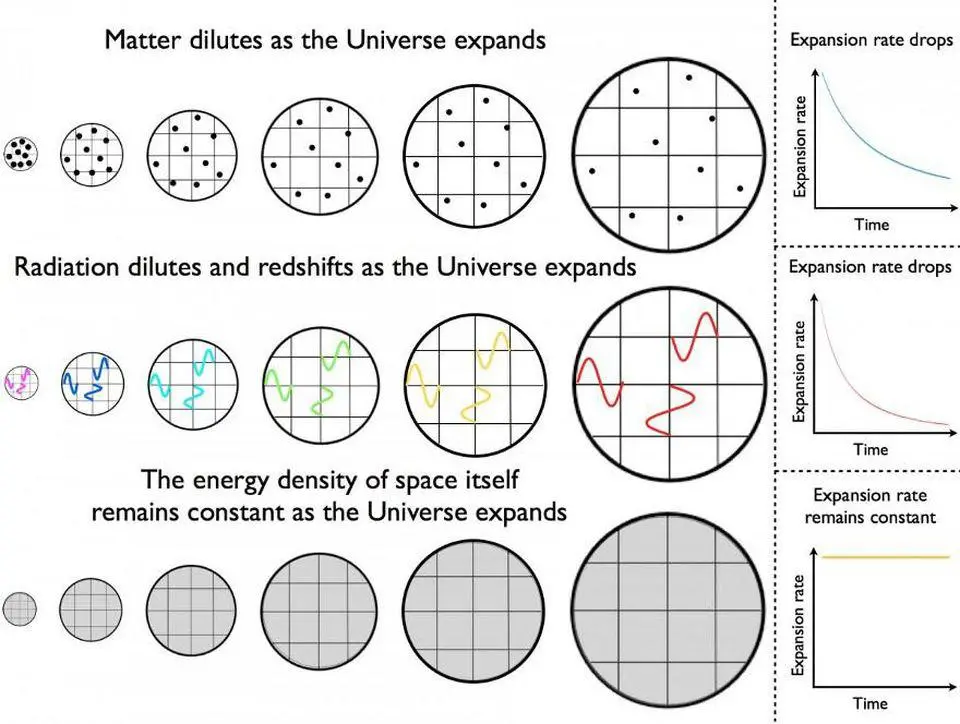 How matter (top), radiation (middle), and dark energy/inflationary energy (bottom) all evolve with time in an expanding Universe. As the Universe expands, the matter density dilutes, but the radiation also becomes cooler as its wavelengths get stretched to longer, less energetic states. Dark energy’s (or inflationary energy’s) density, on the other hand, will truly remain constant if it behaves as is currently thought: as a form of energy intrinsic to space itself. These three components, together, dictate how the Universe expands at all times from the Big Bang until the present day and beyond.
Meanwhile, in the first two cases, the Hubble parameter, which is what the expansion rate is at any moment in time, decreases with time: because the Universe is getting less dense. As the volume increases but the number of quanta (either radiation quanta, like photons, or matter quanta, like atoms and their constituents) stays the same, the overall density goes down. Since — according to the Friedmann equations — the total energy density determines the expansion rate, the expansion rate has to decrease over time. And since we’re made of matter, we must be at least part of the cosmic story, so it makes sense that the expansion rate was faster in the past, and has been slowing down ever since.
Only in the case of a cosmological constant-dominated Universe, where the energy density remains constant, does the Hubble parameter not change with time: become constant. If dark energy is anything other than a cosmological constant, which means it evolves in some way with time, then the Hubble parameter again isn’t a constant, and won’t be at any moment in time. Although the idea that dark energy could be evolving has made headlines recently, the case for it being so is actually not particularly strong. Large-scale structure data from Euclid, the Vera Rubin Observatory, and the newly-launched Nancy Grace Roman Telescope, in particular, should soon provide much more significant evidence either supporting or refuting the notion of evolving dark energy.
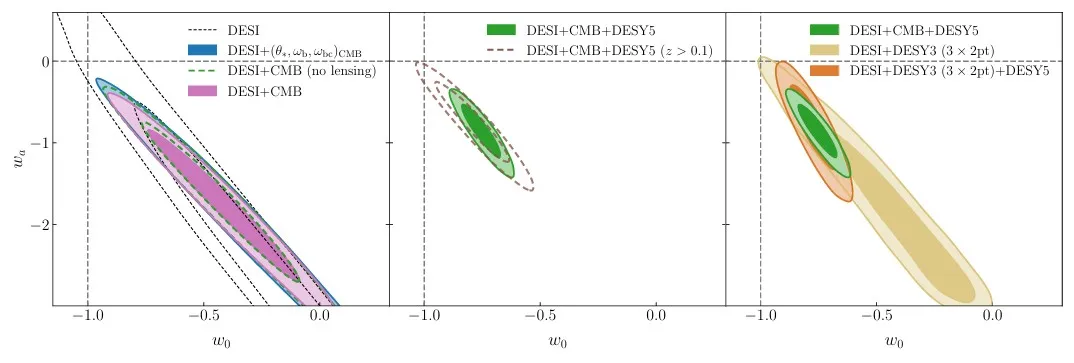 These graphs show the fit for evolving dark energy, in terms of the parameters w_0 and w_a, where a constant cosmological constant for dark energy corresponds to w_a = 0 and w_0 = -1, exactly. Note that the DESI data on its own is consistent with constant dark energy, but when you combine CMB and supernova (for example, DESY5, as shown in the middle panel) data with it, it favors evolving dark energy instead.
The idea that the Hubble constant is a “constant” happens only in a set of special cases:
- where we’re considering the expansion rate that we measure right now, at this one particular moment in time, which we call H₀, or the Hubble constant at the current time (t₀),
- and when there’s only one particular species of energy, like matter or radiation, that’s ever populated the Universe.
That special case — back in the early part of the 20th century and for many decades thereafter — was actually the default assumption of cosmology: that we lived in a universe that was 100% composed of matter. We even gave it a special name after two of cosmology’s earliest pioneers who proposed it way back in 1932: the Einstein-de Sitter universe.
The fact that our Universe has all three of those species of energy within it, and that each species dominated the Universe at a different time, ensures that even at the present moment in time, as we look out, we won’t see a uniform, straight-line relationship between distance and redshift when we measure the actual objects within our Universe. Our Universe grew at different rates at different times, depending on what species of energy dominated it at that particular epoch, and hence the Hubble expansion rate isn’t actually a constant: not even in space, not even if we restrict ourselves to what we measure right at this very moment.
In fact, what we can do is the reverse of the logic we just developed. Observationally, we can measure the redshift and distance of a whole plethora of objects, close by, at intermediate distances, and at the farthest recesses of our observational limits. We can construct a redshift-distance diagram by plotting distance on one axis and redshift on the other, and draw a curve that serves as the best-fit curve to the actual data that we have.
And then, on the other hand, we can go back to our theoretical models, and input:
- the close-by measured expansion rate today, what we might call H₀,
- a variety of different radiation densities,
- a variety of different matter densities,
- a variety of different spatial curvatures (even though our Universe is measured to be consistent with perfect flatness, or zero curvature),
- and a variety of dark energy densities and dark energy equations-of-state,
and see which of the options are compatible with the actual data.
What we find, based on the distance ladder/standard candle method we described here (and ignoring the other data sets like the cosmic microwave background or the large-scale structure clustering data) is that the expansion rate today, H₀, must be between about 71 and 76 km/s/Mpc, the matter density must be around 24-35% of the total energy density, the dark energy density must be around 65-76% of the total energy density, radiation is negligible (at the <0.1% level), spatial curvature is negligible (at the <0.3% level), and the dark energy equation-of-state must be close to a cosmological constant: to a tolerance of about ±20% or so.
Credit: Geek3/Wikimedia Commons
If — and only if — dark energy does turn out to be a cosmological constant, then at some point in the far distant future, what we call “the Hubble constant” will actually become a constant in time. The value for the local expansion rate today, H₀, will drop toward a finite, positive, non-zero value that’s around 80-85% of its present value: somewhere around 55-60 km/s/Mpc. As matter becomes less and less important to the story of the expanding Universe, dark energy becomes more and more dominant, until eventually the cosmological constant, Λ, makes up 100% of the cosmic energy density.
However, there’s kind of a Catch-22 that arises in this instance: by the time the Universe has the right conditions so that what we call “the Hubble constant” actually becomes a constant, there won’t be any way to measure it! The only way we can trace out our expanding Universe directly is by measuring the matter within it: material that’s located a certain distance away that either emits or absorbs light. But if we require that the matter density drop to zero in order to achieve a state where the cosmic expansion rate is a constant, there can’t be any matter left within it!
So even though a scenario where dark energy is a cosmological constant leads, ultimately, to a “constant” Hubble constant far enough into the future, there won’t be anything present that allows us to detect it. By that point, the only galaxy left in the observable Universe will be whatever becomes of our Local Group: a supergalaxy that forms long after all the galaxies within our bound structure merge to become one. Only in our fortunate location — in the here and now — can we gather enough information to reconstruct the Big Bang and our cosmic expansion history, detect and measure the presence and properties of dark energy, and know what our ultimate cosmic fate, far into the future, will actually be: long after the signals that allow us to determine it have ceased.
This article Will the Hubble “constant” ever become an actual constant? is featured on Big Think.