How Asian Americans helped swing the South
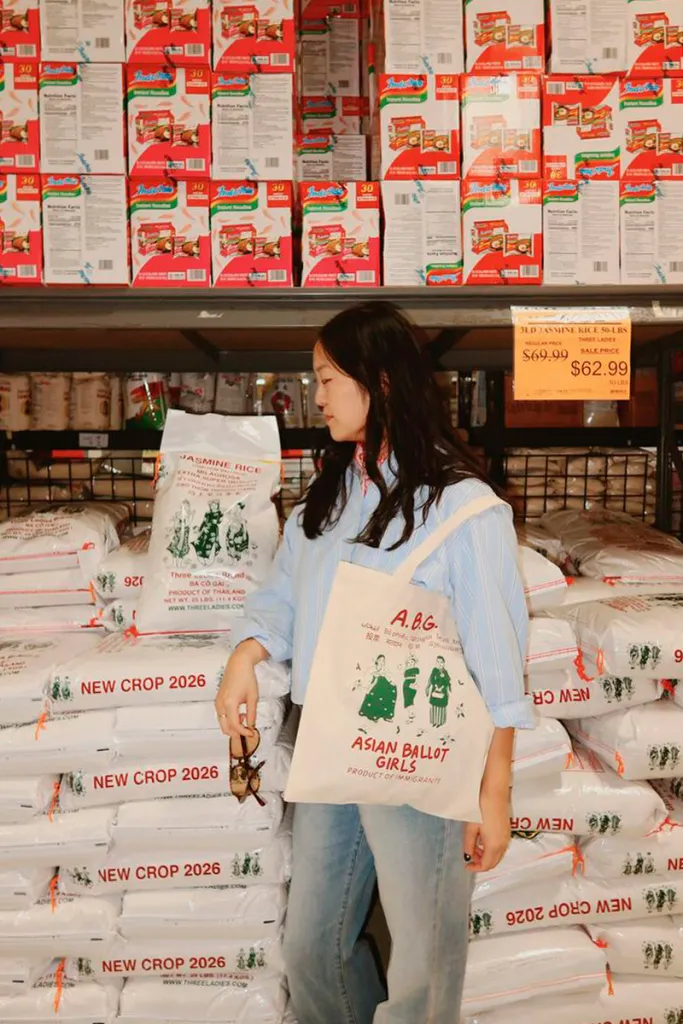
The tote bags were designed with three women printed on one side, dressed to represent East Asian, Southeast Asian and South Asian women. Above them, the letters “A.B.G” were printed in red and below them the words, “Asian Ballot Girl” — a play on the Three Ladies brand of rice and the “Asian Baby Girl” aesthetic familiar in Asian-American spaces online. Nicole Kang, the creative communications manager at the (AAAF) and a Georgia-based visual artist, created the bags to be distributed at designated meet-up points throughout metro Atlanta in the run-up to Election Day this year.
The bags were popular; batches quickly depleted at each meet-up.
“The ABG totes came out as a way to engage people, to get them excited and to see their identities expressed on these fun illustrations,” Kang said. “We were a little surprised and overwhelmed with the response.”
Kang began focusing on politics after Asian-American women became the primary targets in the deadly 2021 Atlanta spa shootings. It was a tragedy that “woke me up and ignited me to get engaged civically,” she said.
Something Kang has seen is how often Asian-American and Pacific Islander (AAPI) voters get “lost in the conversation” when it comes to election work, especially in Georgia. There, she said, “there’s a lot of very binary language when we talk about races — that there’s Black people and then there’s White people.”
More often than not, AAPI voters are wholly left out of the conversation about the electorate altogether. Once concentrated on the coasts, they are a rapidly growing political force and voter base, with 1 in 4 now living in the South, according to U.S. Census data. They were part of the swing margin that propelled Democratic women to the top in the South — most notably Keisha Lance Bottoms, the first Black woman governor of Georgia, and Gina Hinojosa, the first Latina governor of Texas. And AAPI women were more likely to vote for Democrats in Southern states than AAPI men in the midterms, according to Taeku Lee, a Harvard University professor and the director of AAPI Research at BSP Research.
Christine Chen, the co-founder and executive director of Asian Pacific Islander American Vote, said the big takeaway from this election is that AAPIs are the “movable middle.”
“After Latino voters, AAPIs are the largest partisan swing: 9 points from Republican to Democrat from 2024 to 2026,” Chen said in a post-election news briefing. “We know based on our Asian American voter survey since 2012 that AAPI voters are not committed to party loyalty but are motivated by what the governing party is able to deliver on the issues that matter to them the most.”
Demographic shifts in Georgia
In Georgia’s AAPI communities, where first-generation immigrants tend to be more religious and more conservative and following generations tend to lean more progressive, this meant there was a real opportunity to engage.
Immigration was an issue that resonated with many, Kang said: “We’re seeing that ICE was targeting people that look like our parents and how could you not take that personally?”
This was all the more true after the Hyundai ICE raids in September 2025, which particularly impacted Korean communities in the state. Even among older AAPI voters, she said, what happened at the Hyundai battery plant felt like a kind of tipping point, a sign that the Trump administration’s immigration policies were “out of control.”
Kang said she sees among her own friends the way that younger AAPI women were particularly engaged this election cycle, tuned into what’s happening and especially staying connected about political issues via social media.
“I am seeing that a lot of AAPI women are excited about change,” she said. “A lot of women also tend to think about their roles as daughters, as immigrant daughters. They think about their identity as mothers or future moms. And these are things that incorporate the values and lessons that we have inherited and we are eager to act on. I think Asian women are really excited about building power.”
‘The way racism works’
In Texas, Stephanie Cho worked alongside hundreds of volunteers to engage voters in Texas — which has about 2 million AAPI residents, the highest population size among Southern states. The state’s AAPI communities are concentrated in the major cities, with Asian Indians making up the largest ethnic group, followed by Vietnamese, then Chinese, Taiwanese, Filipino, Korean and Pakistani.
Cho, the executive director of the Asian American Texas Action Fund, said each city had its own unique vibe. Most of the volunteers knocking on doors, distributing literature and making calls in Houston, for example, were young Asian men in their 20s. In Dallas, the volunteers were primarily women. And in Austin, they were mostly older women.
Cho said voters in the AAPI community are not a monolith, but as she knocked on doors this year, she noticed a common dislike of Ken Paxton, the Republican Senate candidate, and the Republican Party’s overall combative messaging toward immigrants and Islam, especially after another state candidate posted racist remarks on X about South Asian-American students celebrating at a University of Texas football game.
“The anti-immigrant sentiment was really at a high peak,” Cho said. “Right before the election, the anti-Muslim sentiment was also really strong. And the way racism works is that people who are racist don’t know the difference between somebody who is Muslim Indian versus somebody who’s Hindu. And same if you’re targeting China, people don’t know the difference between a Chinese person and a Korean person. So all the communities were feeling it.”
Cho said many of the campaigns failed to translate their platforms and ads, so the Asian American Texas Action Fund made its own multilingual material and helped people connect the dots between politicians, policies and the power of making change with a vote.
“Sometimes in the Asian community, people don’t want to be as open or talk about politics,” Cho said. “But the people were definitely more excited to talk about it this year in a way that I hadn’t felt in Texas before.”
Years of organizing and community building
In Georgia, Victoria Huynh, founder of the Georgia Asian American Pacific Islander Hub, helped organize more than 60 volunteers — the majority of whom were women — in the lead-up to the midterm. Alongside community partners, they hosted six early voting parties targeting Asian-American communities across the metropolitan area in late October.
Korean-American volunteers helped more than 600 people look up their voter status, find their voting locations and provide translated resources. Another group of volunteers set up outside a supermarket frequented by the Burmese community. Huynh herself was with a group along Buford Highway, a corridor known for its ethnically diverse shops and restaurants. Organizers made hundreds of phone calls, distributed resources in multiple languages and offered translators who could speak Mandarin, Cantonese, Korean, Burmese, Thai, Taiwanese and Vietnamese.
Huynh said she was standing near a tent, decorated with balloons and signs encouraging people to vote when she noticed a passing vehicle pull a U-turn. An older couple with limited English proficiency emerged and said they needed help figuring out where to vote. The woman said it was her second time voting, but it would be her husband’s first time.
“I was there to help usher them into a car to go down the street to vote,” Huynh said. Afterward, she said, “they took stacks of our multilingual materials to bring back to their neighborhood. They promised to make sure that their neighbors went out to vote because they said it was so easy.”
By the end of the weekend, Huynh said the volunteers at all of the early voting parties across the city had reached more than 1,160 people.
“We hear local groups are losing funding, so this year definitely looked different,” Huynh said. “And that’s why it was really empowering to see these volunteer groups fill in the gaps and work through their networks to mobilize the communities.”
For years, organizers like Kang, Cho and Huynh led efforts to mobilize the growing AAPI population in the South and help them participate in elections as voters — but there was also a grassroots movement to support them as candidates.
A new generation of AAPI leaders
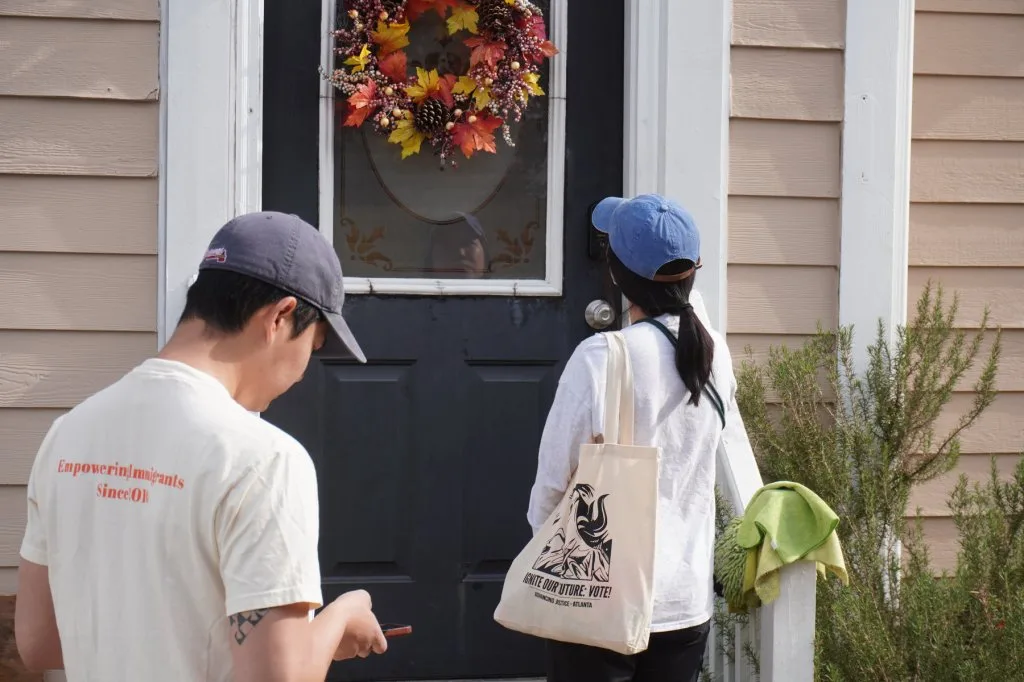
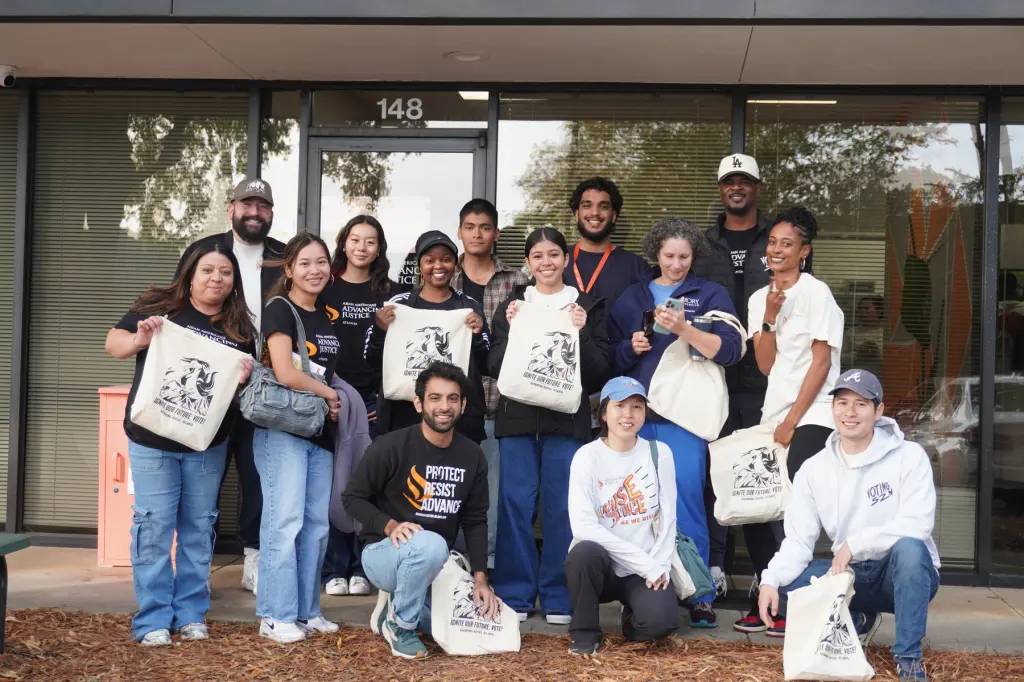
Murtaza Khwaja, the executive director of Asian Americans Advancing Justice Atlanta, said his organization has been around for 15 years, all year round and across election cycles. They canvas door-to-door and target people who haven’t historically voted.
“Half of the communities we talk to have never heard from any candidates or parties,” Khwaja said. “So really we are their first and only contact in knowing about an election, knowing how to vote and having the information they need to go cast their ballot successfully.”
Khwaja said door-to-door canvassing is especially important because a lot of the people they want to reach don’t feel safe right now leaving their homes or having political conversations.
After the 2024 election, Khwaja said AAPI people repeatedly told them the same thing: They did not see themselves on the ballot, reflected in any of the candidates or policies. So Khwaja decided to hold a nonpartisan candidate training in 2025.
“We organized, and this year we saw historic voter turnout and the most diverse ballot in Georgia history,” Khwaja said. “Across all communities, we elected the most amount of AAPI members to the Georgia House, and we also elected the most amount of Muslim members to the Georgia Legislature.”
And it’s not just Georgia: Several Asian Americans and at least one Pacific Islander were newly elected to U.S. Congress. Many will be setting historic firsts when they are sworn in. At least 22 AAPI members are poised to join the Congressional Asian Pacific American Caucus next year — the largest number in history.
Georgia State Rep. Michelle Au has been trying to call attention to what she’s seen the past few elections: the AAPI population is evolving faster than many national operatives and political pundits can follow. It’s the people on the ground, local advocates and volunteers that truly understand how voters will act.
Au, who is Chinese American, lives in Johns Creek, an Atlanta suburb that is 33 percent Asian. In the Atlanta suburbs, she saw many AAPI voters who were motivated to vote this cycle in response to the Trump administration’s immigration policies, a shift from where many of these voters stood in 2024. Especially among older immigrants and first-generation Americans, she said she often heard about them feeling that Trump’s promises about undocumented immigrants didn’t apply to them based on their own immigration experience. But by 2026, there was a real mood shift, as more and more people saw more and more legal immigrants and legal residents detained and threatened with deportation. The crackdowns on H1B, J1 and student visas has also hit these communities hard — and in some cases, has cost Republicans these votes.
Au argued that AAPI voters are persuadable, “an increasingly rare thing” in American politics — and younger AAPI women are particularly persuadable. Au said she would like to see even more efforts reaching these voters specifically.
What she saw first-hand this cycle was voters uninterested in partisan talking points and looking for candidates offering substantive policy solutions. She pointed to what that means looking ahead: a real opportunity for candidates to truly reach and win new votes — especially in the suburbs and exurbs where these communities are growing.
“The margins are getting so small,” Au said. “AAPI voters in Georgia are about 5 percent — that’s the margin of victory,” Au said.