Opinion: Forget the next election. Focus on your neighbor down the street
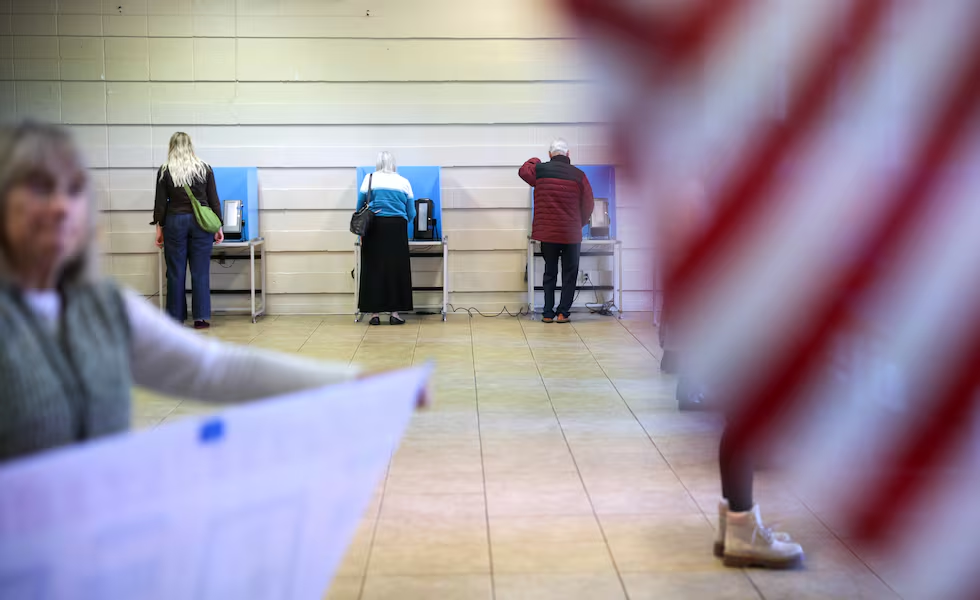
In case you’ve had your head in the sand or been on a meditation retreat, the Republicans just got nuked in the midterms. And, if I might be candid, deservedly so. As “The Wall Street Journal” noted, “the president’s erratic and self-indulgent second-term governance has alienated much of the coalition he assembled in 2024.”
The GOP followed Trump down this bitter path, resulting in the kind of shellacking they received on Election Day. (My home state of Texas went blue, for heaven’s sake!)
But now the midterms are over. Votes have been cast. Stickers have been applied. Social media updates made. So … now what? If politics has been the center of our universe, what are we to do with ourselves now?
Utah saw the biggest shift toward Democrats in the nation. Now Republicans are rethinking everything
Don’t fixate on the next election
The presidential election is only two years away, so I suppose we could get a jump on that: start investing emotionally early, increase the frequency of our political social media posts, attend more protests or call our representatives to complain.
That way, the emotional payoff could be greater if things go our way in two years. (Of course, the risk of crashing out if things go south increases as well.)
As you’ve likely picked up from my tone, I think this is a pretty terrible idea. In fact, I think we’re expending far too much emotional and mental energy on a vote we cast every couple of years.
The math behind your single vote
Consider this: by its very nature, democracy diffuses political power across large masses of people. While this is a good thing, it nonetheless dilutes the power and influence of a single vote.
Now, let’s put some numbers to this claim. The American voter on average has something like a one-in-60 million chance of changing the outcome of a presidential election. The odds are higher in congressional elections (one-in-89,000) or state legislator elections (one-in-15,000), but still incredibly low.
This is not to say that decisive single votes never happen, only that they are extremely rare.
Of course, elections can have enormous consequences. But a single vote has very little influence over who wins. So why do we give it so much moral weight? Why do we determine each other’s moral standing by political preferences and cut ties over political disagreements?
Opinion: Could stronger civics education boost Utah’s low voter turnout?
How partisanship makes us meaner and dumber
What’s worse, our obsession with politics makes us mean and dumb. Our political beliefs tend to bias the way we process information. We seek out data and arguments that confirm our priors, thus warping the way we understand the world.
Furthermore, as our political ideologies become entrenched as social identities, we become more hostile toward opposing party members.
Politics really can distort the way we perceive the other side. And these distortions and hostility lead many partisans to rationalize harm — even violence — toward their political opponents.
Almost half of college students say violence can be used to stop speech
Unlike our single vote, these attitudes and behaviors do have a direct impact on those around us.
When everything becomes a power struggle
You’ve maybe heard the phrase “everything is political,” often employed to justify the politicization of everyday life. But when we see everything through the lens of politics, we increasingly see everything in terms of power.
As sociologist Max Weber famously observed, the government claims a monopoly on the legitimate use of physical force.
Political power therefore carries the capacity to coerce. And when everything becomes political, everything becomes a power struggle. Our neighbors cease to be people with whom we must learn to live well and instead become obstacles to overcome. Opposing partisans are not merely mistaken: They are stupid and evil and must be stopped.
Choosing real neighbors over abstract politics
These antisocial tendencies can take a toll on our well-being and relationships. Economist Thomas Sowell has warned against the confusion between abstract categories and flesh-and-blood human beings. Yet politics often causes this exact confusion: We become so preoccupied with humanity in the abstract that we sometimes justify mistreating the actual human beings around us over their political differences.
Public policy is complicated, and few of us have the necessary know-how to get the intended results. Even if we did, our single vote still doesn’t carry enough weight to guarantee their implementation.
Opinion: Civil discourse means disagreeing without contempt
So perhaps it’s time to redirect some of that political energy toward rebuilding civil society: our neighborhoods, charities, churches and other voluntary associations that occupy the space between the individual and the state.
These are places where we can truly make a difference, where cooperation matters more than political affiliation.
Doing so does not require us to abandon politics altogether or pretend that public policy doesn’t matter. But it does require us to recognize that good societies and good character are built through daily interactions and choices, not simply by voting every couple of years.
The next election is two years away. But there’s meaningful work to do today with the people around you.