The final pilgrimage
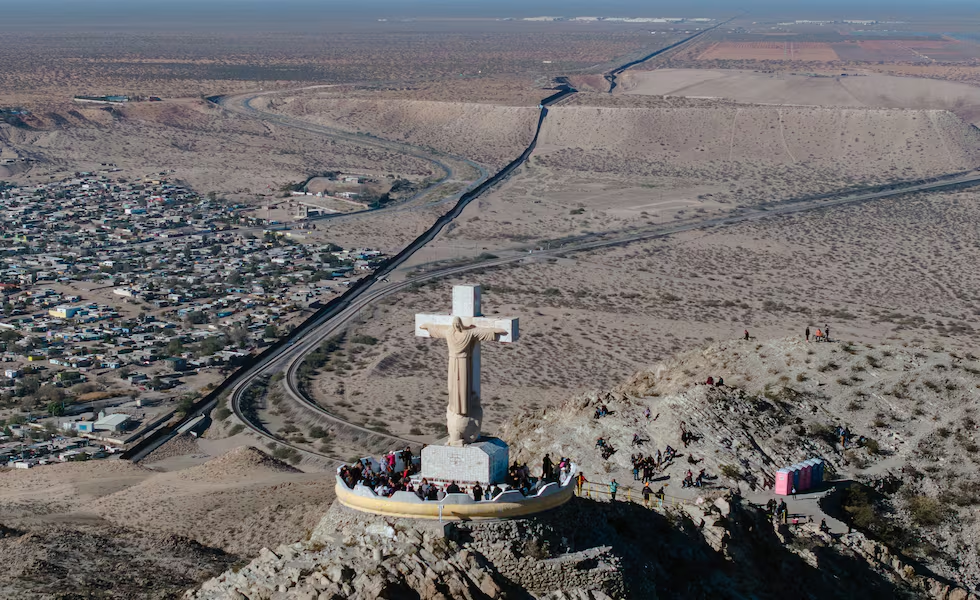
On a sun-drenched afternoon in August, five vultures circle Mount Cristo Rey. They soar above the 29-foot-tall statue of Christ on a cross at the top of the mountain, 4,600 feet above sea level. About a thousand feet below, white Border Patrol trucks circle the base and a dark steel scar in the earth stretches between Mexico and the United States for as far as the eye can see. Minus one spot.
At the base of Cristo Rey, meaning “Christ the King” in English, is the last major gap in the border wall that runs through the surrounding area. That gap stretches for a little more than a mile on land that’s owned by the Roman Catholic Diocese of Las Cruces in New Mexico, which safeguards the mountain as a sacred pilgrimage site. Every year, tens of thousands of people ascend up a jagged gravel trail on steep volcanic slopes to pray under the limestone statue at the summit.
As many as 40,000 pilgrims from around the world make the trek for religious holidays, like the Feast of Christ the King in the fall or Good Friday in the spring. Some climb the 4.7 mile, two-hour hike barefoot, or even on their knees, as a means of demonstrating devotion and sacrifice. It’s been this way for nearly 90 years. And in that time, Jesus’ likeness has stood at the nexus of two nations, with one hand pointing toward Ciudad Juárez in Mexico, and the other toward Sunland Park, New Mexico. A gesture the church fears could soon lose its meaning.
In May, the federal government filed an eminent domain lawsuit to seize possession of 14 acres surrounding Mount Cristo Rey and build a 30-foot-tall wall that would fill in the gap at the base of the mountain. The government offered the diocese more than $183,000 in exchange for the acreage, claiming that the opening serves as a hot spot for drug smuggling and human trafficking. The diocese pushed back. In its response, the church argued that the blasting and construction necessary to build the wall could threaten the structural integrity of the statue or otherwise desecrate the holy site. They also argued the placement of the wall would violate their religious freedom under the First Amendment since the barrier blocking immigrants’ entry into the U.S. is inconsistent with Catholic teachings.
“The statue is about unity, Christ’s arms outstretched,” says Deacon Jim Winder, chancellor of the Diocese of Las Cruces. “But when you get to the top and look immediately down to your right, that’s where the wall will be. That certainly has a spiritual, mental and visual impact.”
Now the church and state have reached a stalemate. In June, a federal judge allowed the government to deposit the cash in a court registry in exchange for the land’s title while both parties await motion hearings. Whether the District Court of New Mexico rules the condemnation is legal or not, the case could have far-reaching consequences as it pits the Constitution’s First Amendment protections of religious exercise against the government’s right to seize private land for a compelling public purpose under the Fifth Amendment.
Why the courts are siding with religious freedom
If the diocese wins, the court would determine that the government’s construction of a nearby border wall constitutes “substantially burdening” the church’s free exercise of religion, which is prohibited under the Religious Freedom Restoration Act (RFRA), unless the government has no other way to secure the border in the area. Religious institutions across the nation would thereafter gain substantial protections against government interference, regardless of eminent domain justifications or national security mandates. “Sometimes,” Deacon Winder says, “you don’t appreciate something until somebody tries to take it away.”
But if the government wins, eminent domain cases could become largely insulated from religious freedom challenges, and future land disputes between religious institutions and governments would face fewer legal obstacles.
“That would have pretty grave implications for religious liberty,” says Joshua McDaniel, a professor at Harvard Law School and faculty director of the school’s Religious Freedom Clinic. “(It) vastly expands concern of how the government could shut down religious sites, shut down churches, do all kinds of things that would raise really grave First Amendment and religious freedom concerns.”
A Department of Homeland Security spokesperson has dismissed those concerns, pointing out the barrier would run along the mountain’s southern base, while visitors approach the shrine from the north. The cross itself stands about a quarter-mile north of the border, the department said, asserting the wall wouldn’t impact the site at all.
If the government wins, eminent domain cases could become largely insulated from religious freedom challenges, and future land disputes between religious institutions and governments would face far fewer legal obstacles.
Meantime, hikers still venture to the top of Mount Cristo Rey, in search of direction or salvation, or even just perspective. Plants like Mormon tea shrubs and banana yucca cling to the beige rocky crags and sway in the occasional breeze. Baby pink rosaries dangle from altars dispersed along the trail, like one for San Antonio de Padua, a saint of lost things. New Mexico whiptail and Chihuahuan spotted whiptail lizards scamper out from beneath boulders to bask in the sun, unaware of any border or lack thereof.
A history of cooperation, then breakdown
In 1933, parish priest Lourdes Costa looked outside the back window of his home in Smeltertown, a bygone working-class community built around a copper smelter where El Paso, Texas, meets Sunland Park, New Mexico. His eyes met a lone rocky peak towering over the desert. He stared at the mountain until he had a vision of a giant cross at the summit, casting divine protection over the borderlands. He shared his vision with his congregation in late October, who all volunteered to come together and make it a reality.
Hundreds of volunteers, predominantly Mexican and Mexican American families, carved a serpentine trail with switchbacks winding more than 700 feet up the mountain and erected a temporary 12-foot wooden cross at the top in 1934. Congregants replaced the first monument with an iron cross crafted by students at the local Smelter Vocational School a few months later. Then three years after the iron cross was dedicated, Father Costa enlisted the help of Spanish sculptor Urbici Soler to begin designing the final monument — a much larger stone sculpture of Christ on a cross. It took 40 tons of limestone and more than six months to build the statue, not including the years of community labor that came before. By October 1940, the monument was christened with a ceremony attended by apostolic delegates, or official representatives of the pope, representing both the United States and Mexico.
Catholic nuns file lawsuit arguing medical aid in dying law threatens religious freedom
Binationality is baked into the history of Mount Cristo Rey, and remains a key point in the diocese’s legal argument. “The border wall is completely irreconcilable with Catholic teachings and values about openness to migrants,” says Jonathan Backer, senior counsel at Georgetown University’s Institute for Constitutional Advocacy and Protection and one of the attorneys representing the diocese. That inconsistency with Catholic values, the church believes, makes the matter an affront to religious liberty. “It’s because this is a sacred site, and the conduct here would jeopardize the religious practice that happens there.”
Part of the government’s argument in the Mount Cristo Rey case rests on the claim that neither the RFRA, which the diocese invokes in its defense, nor the First Amendment can be raised in any condemnation proceedings. “Eminent domain is an innate right of the sovereign, limited only by the Fifth Amendment requirement that just compensation be paid or as otherwise constricted by the legislature. … Neither the First Amendment nor RFRA supersede this inherent right,” the government stated in a motion. “Congress has the power to limit the sovereign right of eminent domain to protect individual rights, but it declined to do so when it passed RFRA. The United States is not aware of any case upholding a challenge to federal condemnation on RFRA grounds.”
The diocese cooperated with the federal government in 2021 to build an access road and install cameras and motion sensors on its land along the border. It renewed that agreement at no cost to the government just a few years ago in 2023. The wall, however, is the deal-breaker. They worry that building it could physically threaten the pilgrimage site. Leveling the steep grades enough to construct the wall would involve controlled explosions that could threaten the structural integrity of the statue. The diocese pointed to an incident in Arizona in April as evidence that damage can occur even when the government promises to proceed carefully. Contractors building a border wall bulldozed part of Las Playas Intaglio, a 1,000-year-old Native American geoglyph considered sacred by local tribes. The project was fast-tracked through the 2005 REAL ID Act, which allowed the government to bypass environmental, cultural and public health protections to build the wall. That would also apply for the project at Mount Cristo Rey.
Outside of the court case, Texas Democratic Rep. Veronica Escobar introduced the Mount Cristo Rey Protection Act in
Faith groups, states and Trump administration urge Supreme Court to overturn Colorado law
July with the hopes of preventing the federal government from exercising eminent domain and building on the diocese’s land. The act would recognize the monument as a holy site, prevent federal funds from paying for litigation against the diocese and prohibit the use of those funds to construct any border barrier on or near the site. “When you have the federal government coming in and saying we can do whatever we want in the name of border security, even if it means taking land away from the Catholic Church, even if it means going against a bipartisan group of community members and community leaders,” Escobar says, “that is a real issue when it comes to sovereignty.”
A dangerous crossing and a holy place
The January sky was nearly cloudless over a still desert. Border Patrol trucks and contractors gathered near a caution sign that read “BLAST ZONE AHEAD” in bold black letters. The base of Mount Cristo Rey stretches into Santa Teresa, six miles from its trailhead in Sunland Park, New Mexico. There, the men watched the sandy slope appear frozen in time as they waited.
Then suddenly, an explosion. Tall pillars of dust plumed skyward as the ground came undone. At 11 a.m., the blast woke up families across the border in the Puerto de Anapra neighborhood of Ciudad Juárez, Mexico. The earth rumbled as it quaked.
The government blasting marked the beginning of construction for the border wall. About a month after the initial explosion, the Border Patrol’s El Paso sector uploaded a video of the explosions to Facebook. “Border security is national security. Sections of Mount Cristo Rey in Santa Teresa will undergo a face lift to strengthen the border wall and secure a historically challenging terrain,” the post’s caption read. “El Paso Sector will soon be 100% under operational control.”
The gap in the border wall at Mount Cristo Rey has slowly grown into one of the busiest migrant smuggling corridors along the entire borderline with Mexico, as well as the single most deadly crossing. According to No More Deaths, a migrant aid group, there were at least 196 migrant deaths in the El Paso sector of the border — which includes New Mexico and Texas — in 2024. That number is likely a conservative estimate, since deaths can often go unreported, and far outweighs the number of migrant deaths in states like California and Arizona.
Assaults and robberies targeting Border Patrol agents and hikers have also been reported in the area. “They left it open, and what that created was a funnel of people coming through there — drug smugglers, human smugglers,” says Ruben Escandon, a founder of the Mount Cristo Rey Restoration Committee. He is a third-generation protector of the monument; his grandparents worked to build the limestone statue, and his parents maintained it afterward. He’s given tours of the pilgrimage site and seen vandals pockmark the statue’s face and feet by throwing rocks, threaten hikers at knifepoint, and break into cars parked at the trailhead. For that reason, he’s actually supportive of the government’s position and relieved at the prospect of the border wall. “My point has nothing to do with immigration. … It has to do with keeping the monument safe. This is our legacy, something our forefathers left to us to protect.”
Under RFRA, the government cannot substantially burden the free exercise of religion unless the action is considered the least restrictive means of fulfilling a valid government interest. In its court papers, the government states it needs the property to “construct, install, operate, and maintain roads, fencing, vehicle barriers, security lighting, cameras, sensors, and related structures designed to help secure the United States/Mexico border.” But a stakeholder feedback report by Customs and Border Protection acknowledges the religious and cultural significance of the sacred site, that it conducted biological and cultural surveys of the project area, and that the construction should have no adverse impact on any Mount Cristo Rey pilgrimages.
The border barrier construction will take place along the southern base of the mountain, whereas the trailhead begins on the northern base of the mountain. “Anyone who spent 30 seconds examining a map of Mount Cristo Rey and the southern border would realize how ludicrous these claims are,” a Department of Homeland Security spokesperson wrote in a statement to local station KVIA, an ABC affiliate serving El Paso, Las Cruces and Juárez. “The cross is located approximately A QUARTER MILE, 1,300 to 1,400 feet, north of the border ON TOP OF THE MOUNTAIN. Access to the shrine will not be affected, as all attendees enter from the U.S. side. The only individuals who could POSSIBLY be impacted by the border wall are illegal aliens attempting to illegally enter our country.”
Republicans press Supreme Court in case over religious gatherings at home
Nearly a century — 87 years — has passed since the shrine was dedicated. Mount Cristo Rey has stood still in that time, but the world around the sacred site has seen no shortage of change. Wars have come and gone, technology transformed society from analog to digital, populations have surged by the billions as life expectancies increased. Borders that were once lines in the sand have instead become enforced in steel.
“At the time I came here, it was almost one continuous community,” says Donna Vargas, archivist at the diocese in Las Cruces. The 82-year-old first moved to New Mexico in 1965, when movement back and forth across the border was less restricted. Residents of Ciudad Juárez traveled into Sunland Park and El Paso for work and Americans went into Mexico to eat or visit relatives without hassle. Vargas would cross the border with her husband to visit her mother-in-law every Sunday. “That feeling has definitely changed.”
At the mouth of the trailhead, a yellow metal archway greets hikers as they arrive and bids farewell to those leaving the way they came. It does so in two tongues: “WELCOME,” the arch reads on one side of a small white cross, followed by “BIENVENIDOS.” A few stone slabs adjacent to the entrance feature plaques dedicated to volunteers and families who contributed to the site’s founding.
They’re adorned with the names of veterans, priests, spouses and children that could have easily come from either side of the border. Etched into a boulder beside the names, to greet any seekers all the same, is a bolded message. “THE HUMBLE ARE EXALTED,” and beneath it, “FOR THE FAITHFUL FROM THE PAST, FOR THE PRESENT AND TO THE FUTURE.” Behind it, in the distance, a stone statue sprouts from a mountaintop, shielding the shared desert in its shadow.
This story appears in the November 2026 issue of Deseret Magazine under the headline “Seeing the future.” Learn more about how to subscribe.