A 28-year-old Republican outlines the GOP’s post-Trump future in a district Harris won by 24 points
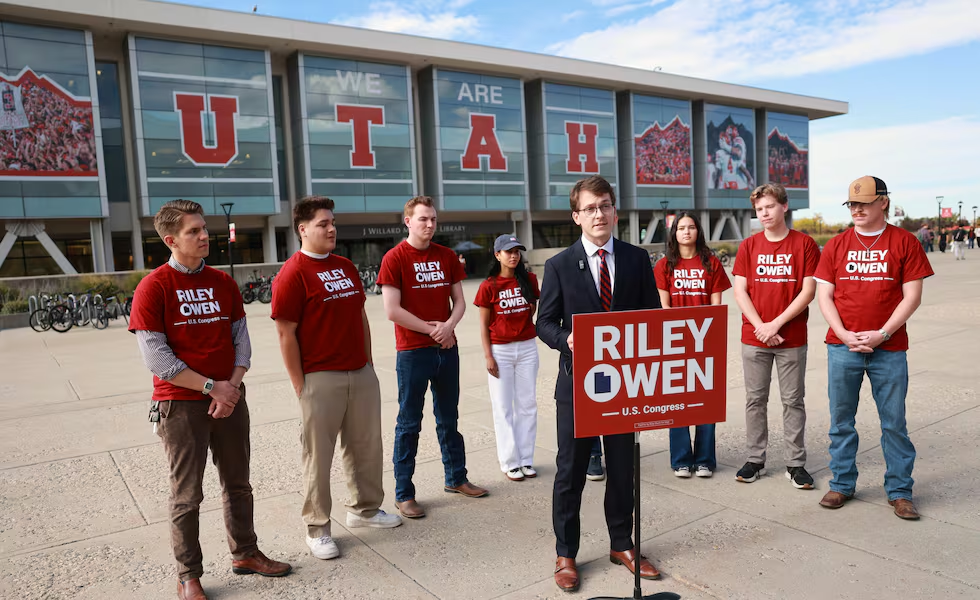
Utah’s 1st Congressional District, which favors Democrats by double digits, is an unlikely place to revamp the conservative movement. But that is exactly what Republican nominee Riley Owen set out to do on Wednesday.
Surrounded by a handful of college-age supporters, the 28-year-old Navy intelligence officer unveiled a framework for a GOP politics geared to the rising generation beset by high housing costs, political polarization and AI anxiety.
“In the months and years ahead, I believe we stand at the beginning of our next conservative chapter,” Owen said during prepared remarks at the University of Utah plaza. “So, in what direction will we walk with our conservative movement?”
The answer Owen gave centered on increasing affordability to stave off the turn to socialism among young people, ensuring accountability to return trust to government and encouraging innovation to spread the benefit of emerging technology.
His appeal to Salt Lake County voters comes less than two weeks before the midterm elections. Owen faces former Democratic Rep. Ben McAdams, who is expected to fill the seat where Kamala Harris won by 24 percentage points in 2024.
McAdams offers a check on Trump. Owen offers a new kind of Republican. Utah voters will decide
The message comes at a perilous moment for the GOP. As the party in power, it is anticipated to face significant losses in House seats, including some that President Donald Trump carried by more than 10 percentage points in the prior election cycle.
Trump’s approval rating hit an all-time low of 36% of likely voters last week, according to the latest New York Times poll published on Wednesday. The share who approve of how Trump is handling the job fell to just 16% for voters age 18-29.
It appears the party standard-bearer’s historic youth gains, shaving the Democratic margin among Gen Z from 25 points to 4, has all but disappeared, with Times polls finding a 30-point advantage for Democrats among voters under 30.
How the GOP can win Gen Z
Republicans can reclaim these voters, according to Owen, but it will take more than labeling the other side as socialists.
A perfect storm, Owen said, is turning Gen Z against the system: the share of Americans who are married and homeowners by 30 has plummeted from 52% in 1960 to 12%, even as birth rates hit a record low in 2025 of 53 births per 1,000 women.
Owen’s program to restore the American dream features proposals to provide tax credits for businesses with paid maternity leave and ban investors from buying up single-family homes so more Americans can replace rents with ownership.
“It’s no wonder socialism is surging in popularity amongst America’s young people,” Owen said. “If we don’t solve these problems fast, we will see rapidly shifting electoral outcomes that have already begun to show their face nationwide.”
Opinion: Utah’s hottest midterm races to watch — what you need to know
To shore up confidence in Washington, D.C., Owen called for prohibiting elected officials — and their staff — from trading stocks or betting on prediction markets. He also supports term limits and limiting corporate money in campaigns.
On Big Tech, an issue Owen says Gen Z is better positioned to understand than anyone, Owen demands data centers pay community dividends to offset costs, AI deepfakes be made illegal and social media be banned for minors under 16.
Attention to tangible outcomes is key to the conservatism of the future, Owen said. His wager is that Gen Z voters, enmeshed in a social media political environment, will vote for solutions over what he calls “rage-bait identity politics.”
Does Gen Z want identity politics?
But for many Gen Z voters, who entered adulthood after 2016, the Republican Party has come to mean just one thing: Trump
“Many of the youngest voters have no meaningful memories about politics before the Trump era,” said George Hawley, a political science professor at the University of Alabama. “As far as they know, conservatism and MAGA are interchangeable.”
Conservative organizations have “definitely moved to the right” under Trump as a new generation of activists follows the lead of “the online far-right,” Hawley said, with an emphasis on national identity, Israeli influence and mass immigration.
This could pose a problem for the Republican Party in the future because most of Gen Z has not made the same shift, despite the narrative that large swaths of Gen Z has become radicalized on issues like these, Hawley told the Deseret News.
“The right-wing voices that seem ascendant on social media are not a great barometer of the country’s direction,” he said.
While Trump has shown a historic ability to turnout unique coalitions to the polls, the MAGA movement is unlikely to find a charismatic leader to replace him anytime soon, according to Hawley, whose research focuses on the conservative movement.
Latter-day Saints at the center of Arizona’s contentious race for governor
If a post-Trump GOP wants to avoid the “political wilderness,” Hawley said they will need to relearn how to appeal to the moderate middle. The young staffing the institutions that are at the forefront of conservative movement might disagree.
Doug Blair, the spokesperson for Heritage Action, remembers how Trump’s explosion onto the political scene in 2016 appealed to him as a young man who had been told by “woke” liberals he was the “bad guy” because of his identity.
“When we talk with younger conservatives, they say sometimes it feels like the idea of America is under threat,” he told the Deseret News.
For those like him who felt like they had been turned into a “politically convenient punching bag,” Blair said Trump’s approach was a welcome change. The GOP’s recipe for future success, Blair said, looks a lot like the policies of “Trump 1 and Trump 2.”
Trump’s combination of economic strength, through deregulation, tax cuts and welfare reform; and his “America First” orientation — through deportations and decreased foreign aid — should continue to serve as a model, according to Blair.
A positive vision
Other Gen Z influencers are ready for the fresh start Owen is advocating for — one where the populism of the past decade is left there.
The Republican Party needs to return to an optimistic message that acknowledges the shortfalls of American institutions without attempting to tear them to the ground Gen Z talk show host Joshua Carr told the Deseret News.
Unfortunately, Gen Z conservatism is characterized by fragmentation, according to Carr, with a divide between “the builders” and “the destroyers.” Carr finds himself in the first camp, hearkening back to the traditions of faith, freedom and family.
Carr expects Vice President JD Vance to be anointed as the heir to the conservative movement as the Republican Party nominee in 2028. And Carr expects Vance to lose against whoever Democrats pick to define their party moving forward.
Romney invokes Churchill and George Washington in rare second rebuke of Trump’s Russia deal
What the GOP really needs is a wide-open primary process, like the one that allowed Trump to redefine the GOP in 2016, Carr said.
“And it’s going to be a great thing for the party,” Carr said. “There’s a weird fascination with populist politics right now from both sides. I think people think that they want populist politicians. But I think deep down they actually don’t.”
To Carr, the positive vision articulated by Owen on Wednesday was “insightful,” finding the right balance between conservative values on topics like family formation and forward-looking fixes on issues like adopting artificial intelligence.
While Owen’s long-shot bid for the U.S. House may go unnoticed by national parties, he is intent on spurring an inflection point for the GOP. The “fundamental focus” of conservatism, he said, must be “access to the American dream.”
It is yet to be seen whether Utah’s new, blue congressional seat is a viable launching pad for the next conservative revolution.