I tested Apple's $2,000 iPhone Duo. It's a fascinating experiment, but the price is hard to justify.
I've spent the past week trying to figure out whether Apple's $2,000 iPhone Duo is the future of smartphones or just an expensive way to do things I could already do on my regular iPhone.
- The answer, unsurprisingly, is a bit of both.
Why it matters: Apple wasn't first to the folding smartphone party. Samsung, Google and others began making them years ago. But Apple's arrival in a category has a way of reinventing it.
The big picture: The most exciting thing about Apple's first foldable iPhone isn't necessarily what it can do today but what it can become. Already, it's inspiring developers to explore possibilities that could reshape how we use our devices.
Old habits die hard
One of my first surprises was how little I initially used the Duo's biggest selling point: its folding screen.
- While other reviewers talked about endlessly opening and closing their devices, I found myself mostly using the smaller outside display. After years of conventional iPhones, it was a mix of instinct and muscle memory.
Zoom in: Over time, though, I found reasons to unfold it.
- Watching sports was one of the clearest advantages. I pulled out the Duo at Starbucks to watch the 49ers with my son and later followed a tied World Series game in a doctor's waiting room.
- At the WNBA Finals, having forgotten my laptop, I managed some quick edits to a story about Anthropic's IPO. I wouldn't want to write a full article that way, but it was reassuring to have the option.
- Playing the New York Times' Spelling Bee alongside its Spelling Bee Buddy helper was a small but delightful example of multitasking without constantly switching apps.
Between the lines: The Duo's advantages aren't always about more screen space. Sometimes they're about what you can physically do with a phone that bends.
- I tried watching Netflix with the phone unfolded, propped up like a tent and partially folded into a miniature laptop.
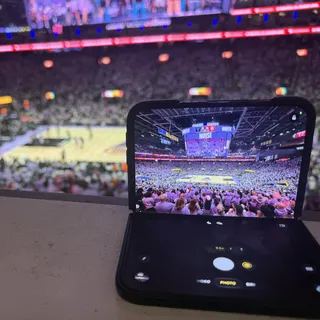
- I also used the Duo's ability to stand on its own to capture wide shots of the WNBA Finals from a press-box ledge without needing a tripod.
- Other experiences were less seamless, including getting the orientation right when trying FaceTime's option to use multiple camera views.
The developer wild card
Perhaps the biggest difference between the Duo and the Android foldables is the enthusiasm Apple's device has sparked among independent developers.
Zoom in: Some of the early experiments are more entertaining than useful, including apps that turn the Duo into a virtual cassette player or a grilled cheese toaster. My favorite was Tiny Computers, which let it simulate a semi-functional 1984 Mac, Windows 95 PC or candy-colored iMac.
- Nearly two decades after the App Store debuted, we aren't all using our iPhones as virtual cigarette lighters. And I doubt we'll all be making imaginary grilled cheese sandwiches on our phones 20 years from now.
Zoom out: But these early experiments offer glimpses of what might be possible when developers start thinking beyond a conventional rectangular screen.
- The question isn't whether today's novelties become hits. It's whether all this experimentation eventually produces genuinely new ways of using our phones — the kind of breakthroughs that make today's smartphones feel indispensable.
The $2,000 question
For all the fun I've had with the Duo, its price is an insurmountable obstacle. At $2,000, it's simply not a purchase I could justify for myself, much less recommend broadly.
The catch: There are other compromises. I missed Face ID, occasionally fumbling for the side-mounted Touch ID sensor until I started wearing an Apple Watch to make unlocking the phone easier. And when I needed to accomplish something quickly, I often instinctively reached for my familiar, traditional iPhone.
What I'm watching: On Friday, I tried putting the Duo away to see if I missed it. I didn't find myself longing for it the way I sometimes felt when I only had the Duo only and missed having a better camera.
The bottom line: The Duo is a fascinating glimpse of where smartphones could go next. But early buyers are paying a steep premium to participate in an experiment whose biggest rewards may still be years away.