Former senator embraces counsel from 2 Latter-day Saint presidents made decades apart
When former diplomat and U.S. senator Jeff Flake was growing up in Snowflake, Arizona, there was a Crisco-stained 3x5 index card attached to the fridge with this simple charge: “Assume the best. Look for the good.”
Those words became a Flake family maxim.
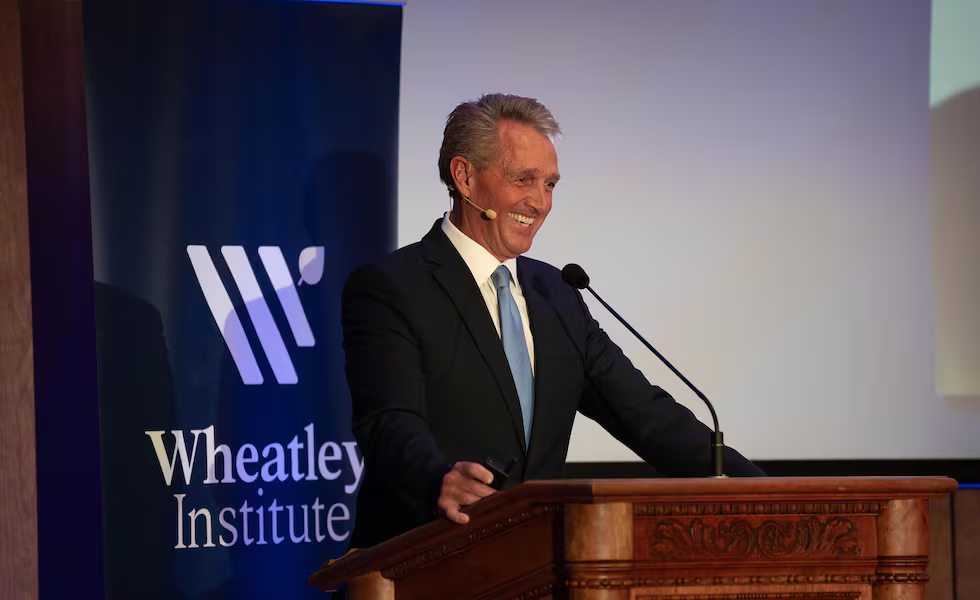
“That is not just a motto for home life, but a motto for politics as well,” said Flake during his civic duty-focused speech Wednesday at Brigham Young University’s Wheatley Institute.
“And I can tell you that the major issues of the day that we desperately need to deal with as a country, from the national debt to our foreign policy to AI policy … these are going to require a bipartisan solution.”
A veteran Republican lawmaker who was appointed by President Joe Biden, a Democrat, as the U.S. ambassador to Turkey, Flake’s remarks Wednesday doubled as a call to action for all Americans to be active, vocal participants in the defense of democracy.
And bipartisanship, he asserted, is essential to getting anything done.
Civic duty counsel Latter-day Saint leaders
Flake comes to civic service honestly. It’s a Flake family legacy, stretching back to his Latter-day Saint pioneer ancestors who settled his hometown of Snowflake and, in later generations, participated in the women’s suffrage movement and served in local and state elected positions.
The Flakes are a large clan, which he jokes has served him well at the ballot box.
“I had 10 brothers and sisters and 69 first cousins on my father’s side alone, that’s how I got elected,” he said. “John McCain used to complain bitterly whenever we’d campaign together. He’d say, ‘I have to fight for every vote I get, and you just have to call a family council’.”
Flake noted that he grew up in a Republican household. “But party didn’t mean as much as values and principles at that time. And I would argue it still shouldn’t.”
But what does it mean to be a good citizen in a representative democracy in 2026? Flake answered by repeating the words of Latter-day Saint leader President Dallin H. Oaks:
“We must insist on our constitutional right and duty to exercise our religion, to vote our consciences on public issues, and to participate in elections and debates in the public square and in the halls of justice.”
Those words, Flake added, “are a perfect summation of what our responsibility is.”
Two unlikely friends offer university students, faculty advice for fruitful conversations
Wednesday was Veterans Day, and Flake said the holiday marked an apt moment to consider the sacrifices that have been made to ensure the nation’s independence.
“The price of freedom has been too high — and the consequences of nonparticipation too great — for any of us to ignore our civic responsibility.”
When Flake considers the price that America’s veterans paid for freedom, “it certainly makes it easier to be involved where we need to be.”
Spend any time outside the United States, and one will likely return home with a deeper appreciation for the country’s freedom, he added.
Public service and civic engagement can take many forms, only one of which is running for office. But the duty to guide the nation remains with the people, said Flake.
He also warned against assumptions about a person’s virtue based on their political affiliation.
“I’ve been in Washington as a Republican for 18 years, and as an ambassador — a Republican appointed by a Democrat. Neither party has a corner on any virtue. You can find virtuous people supporting either party. I hope that we will always remember that.”
It remains wise, Flake added, to heed counsel that Latter-day Saint President Wilford Woodruff offered more than a century ago: “Don’t throw filth and dirt and nonsense at one another because of any differences on political matters.”
Steep challenges await the nation, he concluded.
“It’s going to take people on both sides of the aisle — and all sides of the aisle — to be involved and not see the other side as the enemy, but to work together on these issues.”
Activating social media for good
Following his prepared remarks, Flake spoke with moderator Hal Boyd about the lessons he learned growing up on a farm in rural Arizona and finding the courage in Washington, D.C., to foster bipartisan collaboration.
He again asserted that good people in the nation’s capital are trying to do the right thing — but that the incentives are bad.
“The incentives just drive everyone to the extremes. I’m hopeful that the election we had last week will point us toward better behavior on both sides, and I think it might.”
There’s great need, added Flake, for earnest people to work on campaigns and seek public office. But more importantly, Americans must use social media and other communication tools in a positive way.
“I do encourage students and others with access to social media to put something positive out there,” he said. “I can tell you as an elected official, if somebody writes something positive on social media, you’ll see it. Your staff will take it and say, ‘Hey, look what we got.’ It just doesn’t happen that often.”