‘Deseret Voices’ Episode 56: Trump can sign an order, but can he make it last?
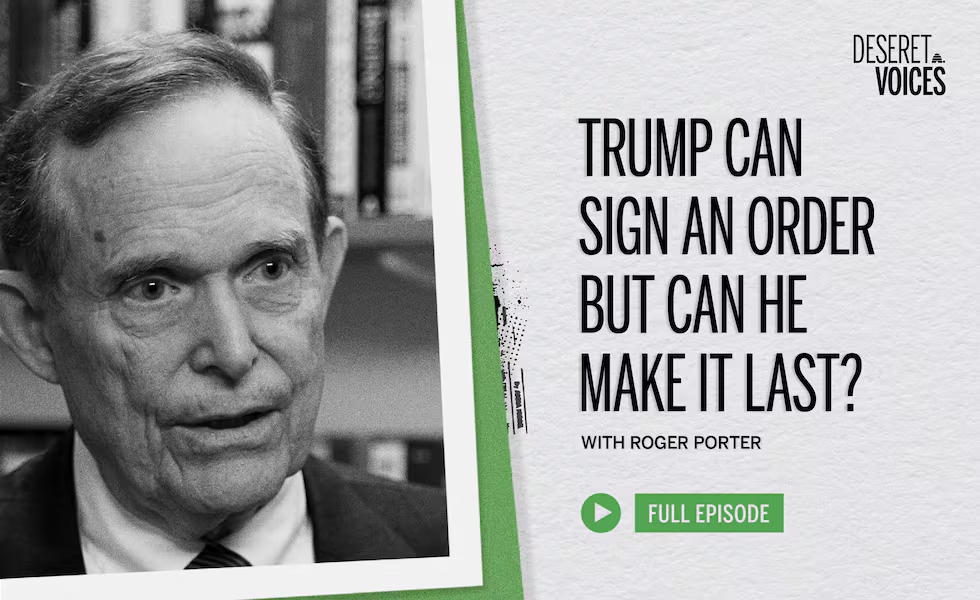
In just his second term in office, President Donald Trump has signed more than 280 executive orders. George W. Bush signed 291 and Barack Obama issued 277 during their administrations.
While these directives allow presidents to act quickly and bypass congressional logjams, without the hard work of legislation, the impact can be easily reversed by the next leader.
On this episode of “Deseret Voices,” Jane Clayson Johnson asks Harvard professor Roger Porter, who served under three U.S. presidents, if there is a danger as heads of state try to push their executive power a little further than their predecessors.
Subscribe to “Deseret Voices” on YouTube, Apple Podcasts or Spotify.
Note: Transcript edited by Steven Watkins.
Jane Clayson Johnson: When the framers drafted the U.S. Constitution, they envisioned a carefully restrained executive branch — where power was shared with the Congress. Two hundred and fifty years later, with legislative gridlock and a growing reliance on executive orders, has the balance shifted?
Today I’m joined by Harvard Kennedy School professor Roger Porter — who served in the White House under Presidents Gerald Ford, Ronald Reagan and George H.W. Bush. We explore the true limits of presidential power, the illusion of pen-stroke governance, how good presidents make difficult decisions and what history teaches us about real leadership.
That’s our conversation today on “Deseret Voices.”
It’s so great to have you, Roger. Thank you.
Roger Porter: It’s a real privilege to be with you.
JCJ: You have worked under three U.S. presidents. You have taught about and seen the power that a president has. How did the framers of the U.S. Constitution envision the role and the power of a U.S. president?
RP: The framers at the Constitutional Convention were very skeptical about the ability of people to exercise power wisely. They had not had a good experience under the British monarchs. And when they declared their independence, they formed their state constitutions and governments and had very weak executives. Most executives were elected by the legislature. Most of them were elected for one-year terms. And it didn’t work very well. And after a decade under the Articles of Confederation, things were not happening, and they decided that we need to create a new Constitution.
JCJ: So did they envision a powerful president or a restrained president?
RP: They envisioned that the Congress would establish the laws, and that the president would administer them. And they recognized that taking a piece of legislation and putting it into effect requires a whole bunch of implementing decisions. And they wanted to have somebody who they could trust and who they thought would do that. And they were very skeptical.
In the early drafts, Congress would appoint judges to the Supreme Court, Congress would do treaties, etc. And then they finally settled in this notion, “Well, we’re going to share it.” And we’ll have the president nominate judges, and the Senate will confirm them. We’ll have the president negotiate treaties, and the Senate ratify them. And they viewed very much this idea that we’ve got to have a set of arrangements in which power is shared as opposed to exercised what they were worried about as somebody who is doing it arbitrarily and capriciously.
‘Deseret Voices’ Episode 55: No country has ever saved a dying saline lake
JCJ: So then what protects a country from a president who wants to push the outer layers of power?
RP: Well, there are a number of things that do so. One is that the courts have served a useful purpose as a device in which to check presidents exceeding their constitutional powers. Donald Trump has issued large numbers of what are known as executive orders.
JCJ: So let me give the statistics because I looked this up. American presidents have issued executive orders, of course, since George Washington. President Trump issued a record 147 executive orders in the first 100 days of his second term. Has now signed more than 280 executive orders. What does that suggest to you about the reliance on executive orders to govern?
RP: Most executive orders are instructions to the executive branch as to how to do particular things that are within the president’s ambit. “I want you to focus on this; I want you to concentrate on that.”
He has veered over into issuing a lot of executive orders that try to establish policy that is contrary to law. If you look at most of the consequential executive orders, look what he tried to do on trade policy, which in the Constitution says that Congress shall have power to impose duties on imports. It also says Congress shall have no power to impose duties on exports. So when President Trump tried to impose duties using the International Emergency Economic Powers Act, the courts said, “This is not envisioned as part of that, and we’re reversing it.” And so all of these tariffs that he had put on, now you have to refund the literally tens of billions of dollars to the companies who paid them.
JCJ: Mail-in ballots. That was an executive order that was just overturned by the U.S. Supreme Court.
RP: That’s correct. And the reason that it was overturned is that elections are administered and run by the states. The president can’t command states to do things. That’s the reason the Supreme Court overturned it.
JCJ: So when does an executive order cross the line?
RP: Whether or not it crosses the line is determined by other parties — the courts, the Congress. Take an example: President Biden issued an executive order with respect to the repayment of student loans. This would have had the consequences of billions and billions of dollars. Who opposed this? Nancy Pelosi and the Congress says, “You don’t have the power to do that.” It was taken to the Supreme Court. The Supreme Court said, “You don’t have the power to do that.” So one effective check are the other players in the political system who stand up —
JCJ: Because some people suggest an executive order is like a magic wand.
RP: It’s not. It’s not. If you want to get things put in place that are going to last, executive orders is not the first tool in the tool chest that you pull out.
JCJ: Some of President Trump’s executive orders have been very consequential. Others seem to be more symbolic or relatively minor. I’m thinking about naming Lake Ontario “Lake America,” directing federal agencies toward using plastic straws, for example, changing federal showerhead regulations. What’s the purpose of executive actions in those cases?
RP: Well, those cases only apply — an executive order only applies to the executive branch. He can have the executive branch claim that we’re calling it Lake America. It has nothing whatsoever to do with other countries, non-executive branch things, the state of New York. Are you changing, or anybody else that I’ve met changing, the name of Lake Ontario to Lake America? No. So it’s more performative than anything else.
JCJ: Are you saying that’s what’s happening now during this presidency?
RP: I think all presidents engage in some of it, some more than others.
JCJ: It’s a larger political message: “I’m in charge, I do what I want.”
RP: And guess what? It will not stand.
JCJ: Is there a danger that every president pushes their executive power just a little further, and then every president becomes more powerful than the last?
RP: I don’t think that’s a likely thing. President Trump tried to do in his first term, he got turned back. President Biden trying to do it in his term, he got turned back. President Trump is trying to do it again in his second term, most of them got turned back. This is not a pattern that is likely to produce lasting success. Presidents who rely on executive orders to put a policy in place are making, in my view, a huge mistake by focusing attention on something that can be easily challenged in the courts, that can be easily challenged by Congress, and that can be reversed —
JCJ: By the next president.
RP: — by the next president, very easily. When President Trump came in, he reversed a whole bunch of executive orders of President Obama. When President Biden came in, he reversed a whole bunch of orders of President Trump. When President Trump came in, he reversed a whole bunch of orders of President — So why use the ability that you have to be a major player in doing things that can easily be reversed in a whole variety of ways?
JCJ: What’s the answer to the question?
RP: The answer to the question is if you do the hard work of building a foundation where you have support from both political parties, then that is likely to stay in place because it’s very hard to overturn a piece of legislation.
JCJ: That takes work, to enact legislation that goes through Congress, right? It’s very easy to sign an executive order.
‘Deseret Voices’ Episode 54: What sports betting does to your soul
RP: Very easy. And current president loves to do it. Some of them are merely pro forma, setting up a committee to do this or that, but the policy ones, the substantive ones, have been consistently challenged in the courts. In his first term, almost 80% of them were blocked or overturned by the courts. Presidents can order a lot of things. They can announce a lot of things, but that does not mean that those things are going to withstand the scrutiny of what has to happen following that in getting the rest of the government and the country to go along. You can sign a lot of things, but that doesn’t mean that they’re actually going to happen. And if you’re a president who is looking for a legacy that will last, you do not want to rely on executive orders as a principal tool by which you’re going to achieve those objectives.
JCJ: Do you think Congress has gradually ceded power to the executive branch?
RP: I don’t think there’s any question that Congress plays a much more reticent role than they did before.
JCJ: Not what the framers envisioned.
RP: Not what the framers envisioned. No.
JCJ: And what’s the danger in that?
RP: There is always a danger when people engage in making what I like to call uninformed decisions. When the decisions are not based on a full understanding of what it is that is at stake and what are the range of consequences that can follow. We have found in democracies that many voices are wiser than a single voice, and that having a process which engages large numbers of viewpoints before reaching a decision consistently tends to produce better and better decisions.
JCJ: You need to do the hard work of passing legislation.
RP: It is hard work. But in the process of doing it, it exposes a huge number of interests and considerations and evidence on one side or another. I’ve been involved in doing large numbers of negotiations where I say to myself, “We came out in the end with something which was better than what we had originally proposed because we had gone through a long process of making accommodations and judgments.” Other people have good ideas. Other people have interests that need to be represented and presented.
JCJ: Perhaps your most well-known book is entitled “Presidential Decision Making.” It examines not simply the decisions presidents make, but how they make them. What does good presidential decision-making look like in today’s political climate?
RP: The decisions that presidents have to make are incredibly large, and one of the most important decisions they make is what they’re going to take up. They cannot do everything. So having a process that helps you in establishing priorities and in determining what it is you’re going to spend your time working on is terribly important, and I think often underappreciated and underrated.
Once you have identified an issue that you want to work on, then the second step that is really important is that you gather information and analysis that enables you to make an informed decision. Because you’ve got the capacity to assemble lots of information analysis. If you are curious, the best position in the world is to be president of the United States because you’ve got all these resources that are available to you. I sort of say to myself, “Why don’t we just elect people who are really intellectually curious because they’ve got all this apparatus to do it?” So you can make an informed decision.
But the third step is equally important, and that is: That decision has to be implemented. It has to be implemented politically — “I’ve got to get support build up for it” — and it has to be implemented with respect to the way in which it’s going to be administered. I never once went into the Oval Office to discuss an issue with the president in which I had not had extensive conversations with people in departments and agencies, many of whom were career civil servants, saying, “If we go down this path, can it be implemented? Is there a better way of doing it?” The president was always saying, “OK, so can we implement this?”
JCJ: But you also want someone in that scenario that’s willing to say, “Mr. President, you’re wrong. That’s not the right path to take.”
RP: I never once said to a president, “You are wrong.” So I would always say, “If this is your objective, consider these possibilities of how you can do it. I’m not telling you what you think is — what you think you’re doing is wrong. I want you to consider, let’s look at it from your perspective and see what are the possibilities of getting this implemented.”
JCJ: But you want a president who surrounds himself with people who don’t always tell him what he wants to hear.
RP: I had a very interesting conversation with President Ford very early on after I worked for him. I was very young, in my 20s. And we ended up having a conversation after a meeting, an eight-hour long meeting during the course of the day, which had been really back-and-forth. People had strong — to put it mildly — strong disagreements about what we were going to do. So I turned to him and I said, “Mr. President, if you don’t mind my asking, what did you think of the meetings today?” And he smiled and he said, “Well, what do you mean?” And I said, “Do you find the kind of discussion that we had today helpful to you as a decision-maker?” And he smiled and he said, “It did get a little intense in there, didn’t it?” And I said, “I couldn’t believe it.”
Then he said something that I don’t think I’ll ever forget. He said, “I have discovered in this job that there are many people eager to tell you what they think you want to hear, and far fewer people who tell you what they think you need to know. And I heard from a lot of people today telling me what they think I want to know.”
I then said to him — you can only do this when you’re young and people recognize that you’re a little naive — I said, “Well, Mr. President, have you decided what you’re going to do tomorrow?” because we were going to go through a whole big series of decisions. And he smiled like, “I’m not going to tell you.” And he said, “No, no I haven’t. I want to think about it overnight. I want everyone else to think about it overnight, too. And I’m going to listen to all the arguments again tomorrow. But I know this: Whatever I decide, everyone will support it.”
I nearly dropped my utensils. I mean, this was a really intense meeting. I said, “Mr. President, how can you be so confident of that?” And he said a sentence that I will never forget. He said, “Because I’m giving them all the opportunity to take their best shot.”
And when I interviewed everyone for one of the chapters in the book that you referenced about this set of decisions, unprompted, all of them said, “I was willing to support this because I knew that he had heard my arguments, he had considered them, and I was willing to accept the outcome.”
You have to build a team. You can’t order people around. That doesn’t work well in life. You’ve got to have people not only have trust and confidence in you, but they need to feel like their views have been heard. They don’t — we don’t have to be — we don’t have to win all the time in the sense of winning; we don’t have to prevail on every point. But we do need to have an opportunity to have those views expressed if we’re going to keep it in place over the long term. Because if not, what will happen? The minute the next election comes around, people come in and try to reverse it.
‘Deseret Voices’ Episode 53: Pluralism is America’s superpower
JCJ: What have you learned from watching presidents make decisions under pressure that would apply to leadership outside of the White House?
RP: No one likes to make decisions under pressure. Most of us like to make sure that we are doing something that will last. But life doesn’t come in situations where you don’t often have to make decisions quickly. So in those instances, what I have seen presidents do is to ensure that they’re leaving some flexibility that if circumstances change, we can adjust and adapt.
President Bush had to react very quickly to the invasion of Saddam Hussein into Kuwait. I remember the day well — it was Aug. 4 — and he was going to be flying out to Vail, Colorado, and meeting with Margaret Thatcher among others at a conference. And he had to act and do something quickly. He was wise enough to know that this was both a threat and an opportunity, and if you respond only to the immediate threat, you often miss a very powerful opportunity.
So what he did was send Dick Cheney, who was secretary of defense; Bob Gates, who was then deputy national security adviser, over to the Middle East to talk with the Saudis and others because they took Kuwait. The next place he was probably going to go — Iraq had the fourth-largest army in the world at the time — and what are we going to do about this? And he said, “I want to build a coalition so that this is not perceived as a battle between Iraq and the United States; this is Iraq and the world. I’m going to do everything I can to try to settle this diplomatically, but if not, I am going to build a coalition that will enable us to succeed not just in the short run, but in the long run.”
So that was an example of how he took a situation in which he was under a lot of pressure, and instead of overreacting, said, “This is an opportunity to do something larger than simply deal with this immediate problem.”
JCJ: You were in the seat of power when that all unfolded. What do you make of what’s happening now, the situation in Iran, with the United States sort of going in unilaterally, no coalition? What’s the difference, and what’s the outcome?
RP: I can’t imagine that the pattern in the first six months has been what the president and those around him expected. I think that they probably believed this would be quick and fast, and we can have some regime change and go on our way. And that’s why you need a process for making a decision that examines all the things that could happen and what it would take to produce the outcome that we want. Now, some people say, “Well, that produces a very cautious, careful, patient, prudent style of leadership.” And my reaction to that is: exactly. That’s what I want. I want leadership that is going to produce a pattern of results that will last, not that will be quickly overturned, or will put yourself in a situation where now, the range of choices that you have is very different than what you were going to have. And when you ask yourself the question, “If I had known what I know now six months ago, would I have gone down this path?” And in this instance, I think it’s probably not. They don’t have a good array of options available to them at the moment.
JCJ: You talk about leadership; I’m curious about legacy. How have you advised presidents to think about their legacy once they leave the Oval Office?
RP: I had the opportunity to work for three presidents who I am persuaded did not spend a lot of time thinking about their legacy. In the sense of, “I want to do things that future historians are going to like.” I had a conversation with President Ford near the end of his term — I was fortunate to get one for about 15 minutes with him — and during the course of that I said, he had just lost a very close election, I said, “Mr. President, if you had to do this over, what if anything would you do differently?” And he smiled and he said, “I wouldn’t do anything differently. And I don’t mean by that that I exercised perfect judgment on everything. But this is the way I have lived my life. I surround myself with the best people I can find, I listen carefully to their advice, I weigh it, I decide and I move on. I don’t think about things that I cannot change.”
JCJ: Is that a good president who does that?
RP: I think that’s a great president. I had a very similar conversation with George H.W. Bush. I think he was one of the most effective presidents that we had, and was willing to sacrifice his political future to make a decision that caused him to have to reverse a promise that he had made during the campaign because —
JCJ: “Read my lips.”
RP: “Read my lips: no new taxes.” And the Budget Act of 1990, which to his credit, Bill Clinton kept in place, produced over the next decade what we were seeking all the way along, which was a balanced budget by the end of the decade. It never would have happened if the president had not been prepared to put it into place, and his successor, seeing the potential from it, managed to hold in place. He basically adopted the thing.
JCJ: There’s also a lot of courage in doing that. Do you see that sort of courage playing out today?
RP: I hope so. Yeah.
JCJ: Do you see it played out today?
RP: We will find out in the future elections what people are prepared to run for office. It’s a very challenging situation.
‘Deseret Voices’ Episode 52: AI is moving too fast — and the law can’t stop it
JCJ: Do you see it with this president?
RP: I don’t have any special insights on what he’s going to be doing over the next two years. He’s surprised many people many times, and I will be one of them.
JCJ: When you look at the trajectory of executive power over the last 50 years, and you see it moving forward from this point, what concerns you the most?
RP: Much of the power that has drifted from the Congress to the executive has been in the form of legislation that has involved emergencies, where the Congress has said, “We need to react to emergencies quickly, so we’re going to give the president emergency powers.”
Take one of the worst decisions that Richard Nixon made: imposing wage and price controls. He did that by executive order because the Congress had passed a bill, which he had signed, which saying, “We are not going to impose wage and price controls, but we are going to give the president authority to do so if he thinks it is necessary.” Now you can say that’s passing the buck, OK. He did; he went ahead. In this instance, he followed the advice of his treasury secretary, John Connally. All of his other economic advisers were opposed to it. And it led us into a pattern where it took us three years to get out of it, and we had rampant inflation once they came off, because it was a poor decision.
The wisest presidents, in my view, are the presidents who are patient, who are careful, who are wise, who are prudent, who surround themselves with people who are willing to tell them what they think they need to hear, not simply what they want to hear. They are still the ones making the decisions.
I talked to several people who were members of the Gang of Eight who advised President Bush on what to do with the Iraq War, and I asked them, I said, “Who spoke the most in these meetings? And who do you think had the most influence with president?” And they said, “It was very clear: The smartest person in the room, the wisest person in the room, was the president. We had a lot of differences of opinion people arguing about, but they had the respect for his wisdom that when he decided what he was going to do, they all supported it.”
And I think that’s what you need. You can’t do it all yourself. You’ve got to have people around you to provide advice and to go out and implement it. The best leaders of any organization, public or private, have put together teams that can do a great job of making patient, prudent, careful decisions that do, in fact, get implemented in a manner consistent with the intent of the decision-maker.
JCJ: Did seeing the presidency up close with three U.S. presidents make you more confident in the institution, or more wary of the enormous power that one person has?
RP: It made me way more confident that when we have good people in that office, they are wise in exercising the power that they have. When you’re there, the reality is that unless the country comes with you, unless the other institutions in society, both public and private, are willing to follow your leadership, then you can make a lot of speeches and issue a lot of orders, but that’s not actually going to have the impact —
JCJ: I think that’s a good place to end.
RP: Great.
JCJ: Thank you so much, Roger. Thank you so much. Really appreciate it.
RP: I’ve enjoyed it very much.