American ‘magic’ might be the solution to political polarization
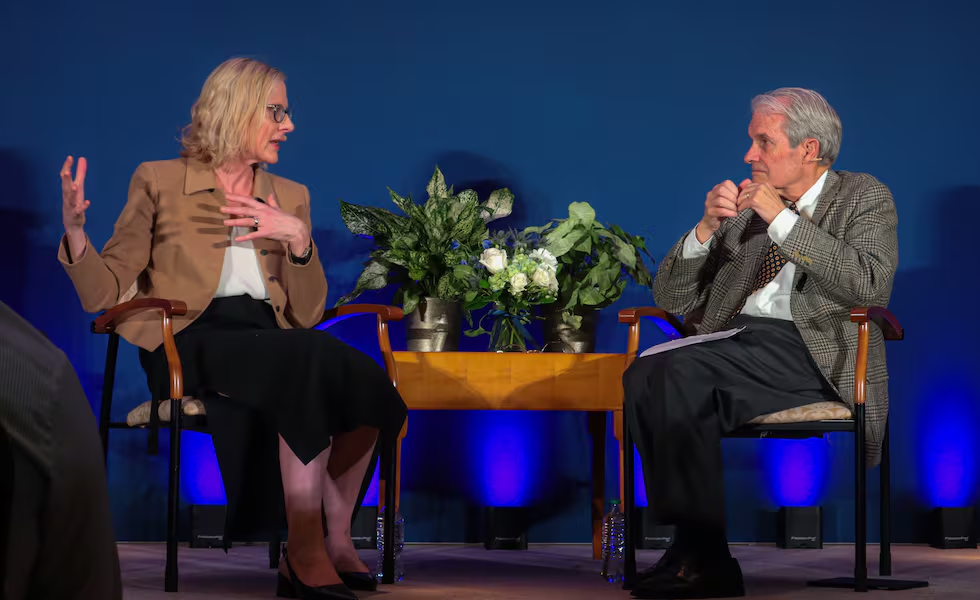
Heather Gerken, president of the Ford Foundation and a nationally recognized expert on democracy, federalism and elections, compared today’s political moment to that of a pivotal time in American history 80 years ago.
“This is a moment very much like the end of World War II,” Gerken said Tuesday while addressing a crowd at an event hosted by the Wheatley Institute at Brigham Young University alongside former U.S. Court of Appeals Judge Thomas B. Griffith.
“Fascism was on the rise,” Gerken said, describing the historic circumstances, “the global order had been upended, we just went through the Holocaust and people were trying to figure out ‘How do we pull it back?’”
At the time, Gerken explained, questions arose about how to bring back democracy, build a peaceful global order, restore economic equality and uphold respect for basic human rights.
“Those questions,” she said, “are with us today.” And, she added, they are accompanied by many more.
What is the contemporary crisis that Gerken compares to the global turmoil of the mid-1900s? The modern influence of political polarization.
When politics become part of a voter’s identity, policy falls to the wayside
“I’m worried about the push on both sides away from sort of finding a way of governing together,” Gerken said. “And it’s pronounced. I see it in progressive circles. I see it in conservative circles.”
The danger posed by polarization, Gerken continued, creates a “moral responsibility on all of us” to address the growing issue.
“We need to find a way to hold,” Gerken said. “We need to find a way to contain our community and our nation and move forward together, even if in the presence of intense disagreement.”
If not, she warned, polarization has the potential to “quickly infect everything.”
“I’ll just say,” she added, “I don’t want to be too sunny here — we have a lot of work to do.”
Gerken’s solution to polarization: ‘The magic of American democracy’
The solution to polarization, Gerken said, can be found in “the magic of American democracy,” which she defined as the diversity of perspectives found throughout the United States.
“The secret of the United States ... is the crazy quilt that we have of different communities,” Gerken said. “And it’s that quilt that allows us to move forward.”
“Federalism, democracy, the election system, it all depends on recognizing the decency of the other side and finding ways to work together,” Gerken said. “It is the magic of this place that we teach one another to win and to lose, to rule and to be ruled, to dissent and to do the work.”
This, she continued, is not possible if polarization creates extremes on either side of the spectrum.
“If we see one another as enemies, that will fail.”
Latter-day Saint leaders provide ‘remarkable’ example of peace-building, Gerken says
Prior to her address at Brigham Young University, Gerken met with leaders of The Church of Jesus Christ of Latter-day Saints to discuss modern democracy and the threats posed to it.
Gerken said the leaders of the Church provide a “remarkable” example of building peace across political divides.
“It’s been quite remarkable to see the leaders of the church really lead on this front and to show,” Gerken said. “Show(ing) the way forward about how to build peace … how to treat other people with dignity, how to welcome strangers into their lives.“
Gerken says participation in local government is necessary to combating polarization
In addition to church leaders, Gerken has found hope in the examples she has seen of people “standing up in their own communities” to advocate for their personal beliefs and values.
“I’ve witnessed so many people doing the quiet work of citizenship, sometimes at real risk to themselves,” Gerken said. “That gives me a lot of hope.”
The local level of government participation is where “the magic happens,” she said. This type of involvement provides avenues to “start to build the habits of trust” and is “something that everybody can do.”
In fact, Gerken said, local participation is not only helpful in the effort to combat political polarization, but it is necessary.
Opinion: Sustaining American unity and self-government
“If we don’t do that, if we don’t start to engage in our own communities, we’re not going to be able to build up the muscle that we need to engage the bigger community.”
“The most important thing that we can do at this moment is think about how we can get better.”