MMX mission to reveal the origins of the Martian moons
It was way back in the 1600s — immediately following the invention of the telescope — that moons around planets other than Earth were discovered. Jupiter’s four major moons were spotted by Galileo himself back in 1609 and 1610, leading his contemporary, Johannes Kepler, to hypothesize that the planet in between us and Jupiter — Mars — must have two moons of its own. Yet for centuries, no Martian moons were discovered. The first moons around Saturn were found later in the 17th century, and then Uranus and many of its moons were discovered in the 18th century. Even Neptune and its giant moon, Triton, were discovered back in 1846. Only in 1877 was Kepler’s hunch confirmed: when Asaph Hall spotted Mars’s two tiny satellites for the first time.
The larger and innermore of Mars’s two moons, Phobos, is only 22.2 kilometers across, while smaller, more remote Deimos is just 12.6 kilometers wide. Both are very close to the red planet: Phobos completing an orbit every 7.66 hours at a mean distance of 9377 km from Mars’s center, and Deimos completing one every 30.35 hours at a distance of 23,460 km from the center of Mars. Although they’ve been observed remotely many times, these moons have never had an in situ mission dedicated to studying them before, and despite a plethora of indirect evidence, their origins remain uncertain.
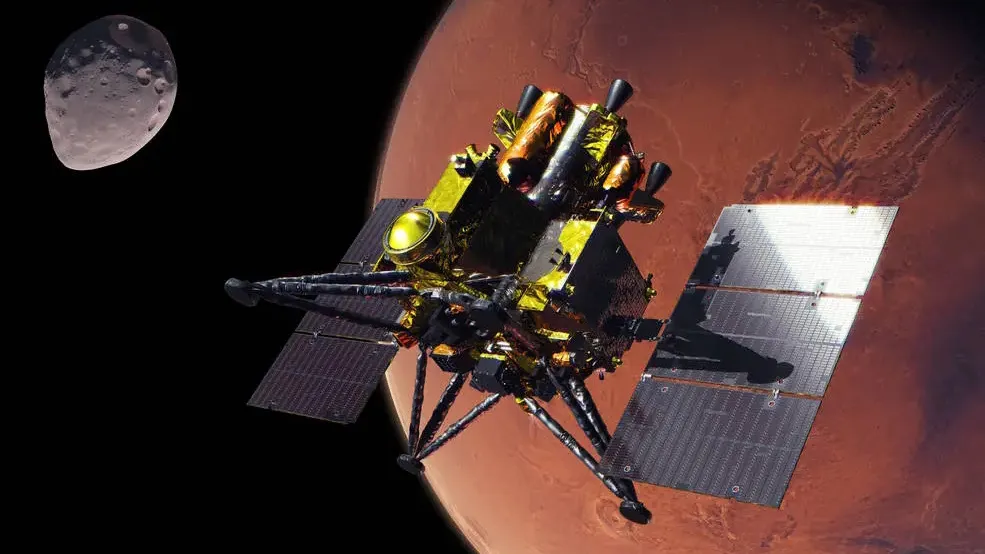
All of that is poised to change over the next few years, as JAXA’s MMX (Martian Moons eXplorer) mission now heads to Phobos and Deimos, where an orbiter, lander, rover, and sample return mission are all set to teach us more about these remote, tiny worlds than ever before. Here’s what lies in store.
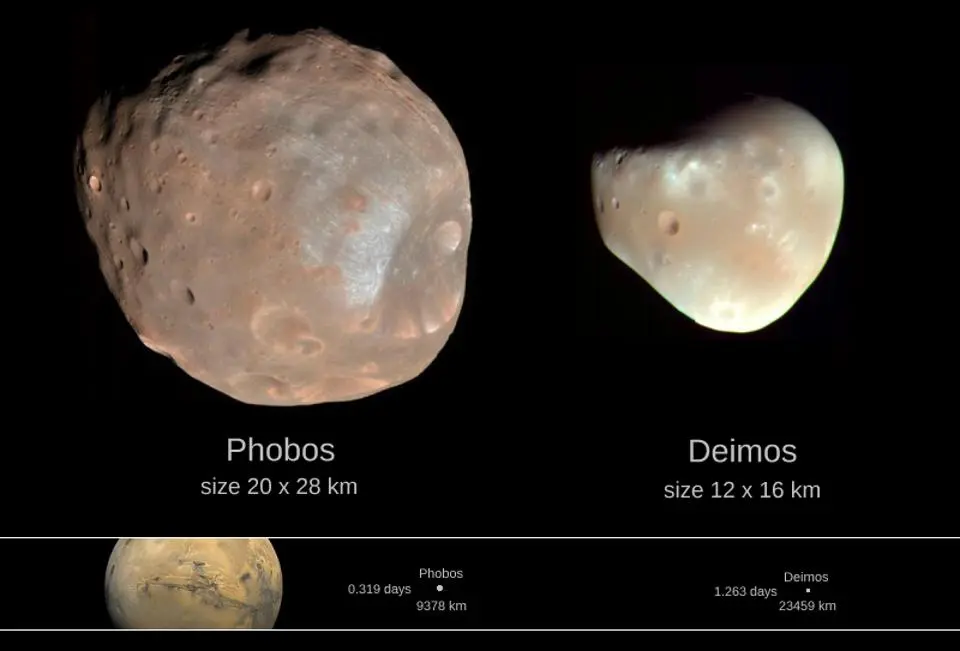 The relative sizes of the asteroid-like moons of Mars, Phobos and Deimos. Phobos is the innermost moon of Mars while the smaller Deimos is more than twice as far away. Despite their appearances as looking similar to asteroids, it’s thought that Phobos and Deimos were once joined by a larger, third, inner moon, which has since decayed and fallen back to Mars. All are thought to originate from a giant, ancient impact.
It might sound like a bit of hyperbole, but when it comes to Mars, understanding its moons is the key to understanding the entire history of the red planet. There are two main scenarios for how these moons came to be, and they would both lead to entirely different planetary histories for the Mars, and determining as much as we can about which scenario occurred, and in as much detail as possible, is the whole goal of the MMX mission.
- The first major scenario for the Martian moons was the one that came along earlier in a chronological sense, and was focused on the size and shape of those moons: that they were captured asteroids. These small, irregular bodies have been discovered to have cratered surfaces, irregular shapes, and low densities: of around 1.8-1.9 g/cm³ for Phobos and around 1.5-1.7 g/cm³ for Deimos, which is comparable to rubble-pile asteroids.
- The second scenario is more recent, and instead suggests that, much like Earth’s moon, they were formed in the aftermath of a giant impact event. Even though the moons are small, they both orbit in the same plane as the Martian equator, have hints of the reddish color that’s the hallmark of Mars and orbit extremely close in to the red planet, whereas nearly all known captured bodies orbit considerably far out around the worlds that captured them.
The possibility that these moons formed from a primordial circumplanetary disk around Mars has also been considered, but for such a small mass planet as Mars, isn’t a particularly viable scenario.
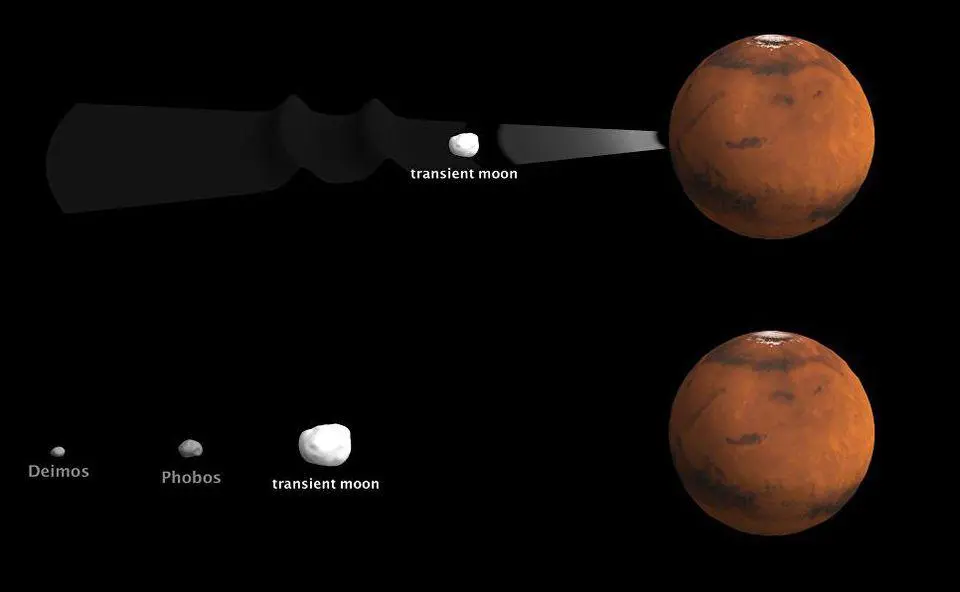 Rather than only the two Martian moons we see today, Phobos and Deimos, a collision followed by a circumplanetary disk may have given rise to three moons of Mars, where only two survive today. The idea is that Mars’s once-innermost moon was destroyed and fell back onto Mars long ago. This hypothetical transient moon of Mars, proposed in a 2016 paper, is now the leading idea in the formation of Mars’s moons, and helps explain the enormous differences in topography between Mars’s northern and southern hemispheres.
For a long time, there was a big problem with the second scenario: simulations of impacts would simply refuse to produce two small moons that were comparable to Phobos and Deimos. If you only produced small moons, they almost always wound up drifting farther away than even Deimos is located, while if you wanted to get multiple moons that were close in, they always wound up being larger. But then, in 2016, a remarkable new scenario was presented, which considered something novel: what if there was an ancient collision that created Phobos and Deimos, but also a third, much larger and more massive moon interior to them both, that has since been destroyed and fallen back onto Mars?
All of a sudden, a bunch of puzzle pieces appeared to line up. Mars is one of the most unusual worlds in the Solar System in terms of its geography, with an enormous basin covering approximately half of the planet (the northern hemisphere) and elevated highlands covering the other half (the southern hemisphere), with an elevation difference of about 5 kilometers between the two. There’s one and only one very deep depression in the southern hemisphere, like a large chunk of material caused an ancient impact crater, but it’s the deepest point on the Martian surface by far.
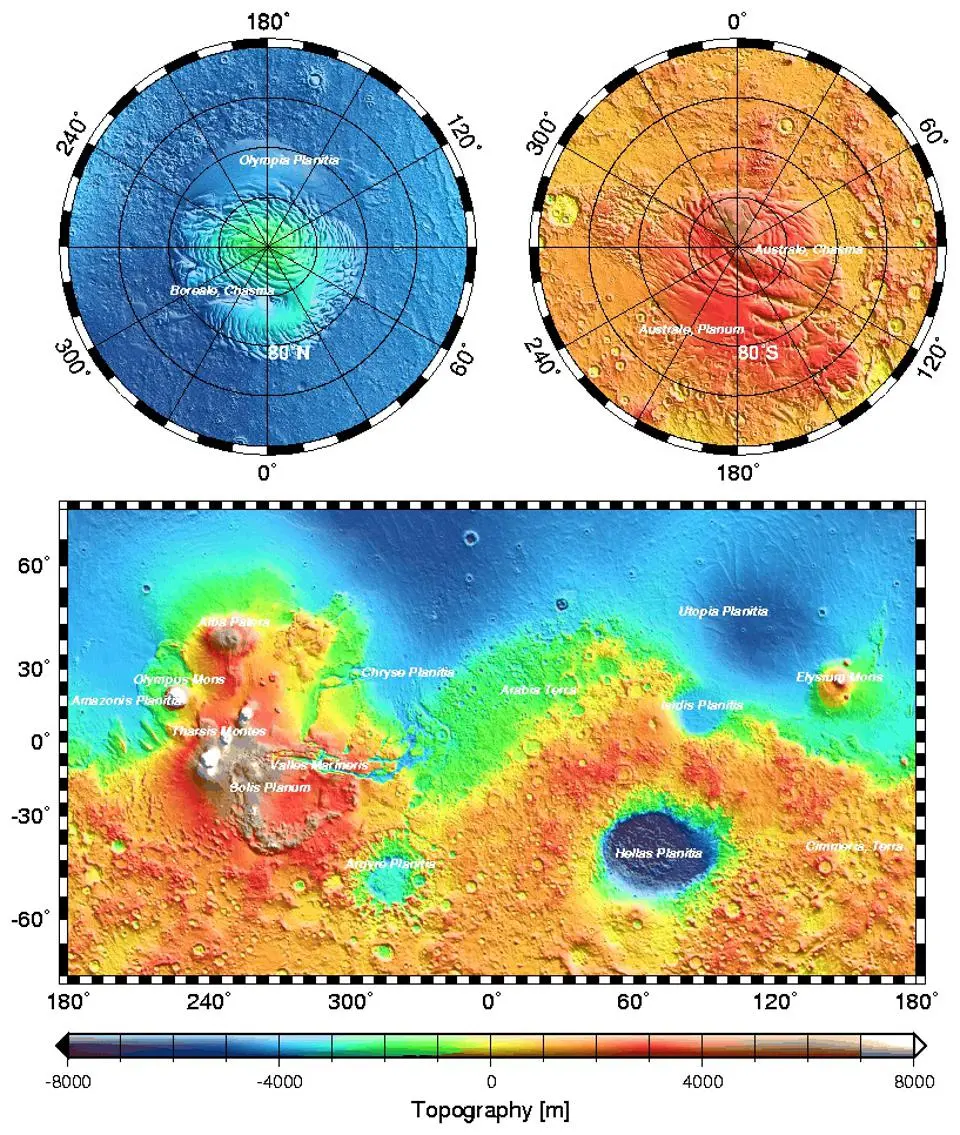 The Mars Orbiter Laser Altimeter (MOLA) instrument, part of Mars Global Surveyor, collected over 200 million laser altimeter measurements in constructing this topographic map of Mars. The Tharsis region (center-left) is the highest elevation region on the planet, while the lowlands appear in blue. Note the much lower elevation of the northern hemisphere compared to the southern, with a mean difference in elevation of around ~5 km, thought to arise from the fallback of a third, large, former Martian moon.
We have to keep in mind that the Solar System is old: between 4.5 and 4.6 billion years old, and that Mars has been this way for a very long time, for over 3 billion years at least. However, we are only seeing Mars as it is today; one of the difficulties we have with reconstructing the history of the Solar System is that we are only directly aware of the current survivors. We may have had more planets, moons, impacts, and rings around worlds in the distant past, but that evidence has largely been erased by the passage of time. Today, all that remains is the indirect evidence of their onetime presence, imprinted on whatever worlds, bodies, and features still persist.
But there is a surefire way to tell whether the surviving moons of Mars are of asteroidal origin or whether they were formed by an impact that struck Mars: we can determine it the same way we determined that the Moon was formed by a giant ancient impact with Earth, by going there, landing on it, examining what we find, and bringing samples of it back home to analyze and compare it in a laboratory setting. If the material of Phobos and Deimos are different from the material found on Mars, they probably are captured bodies. But if the material is largely identical to the material we find on Mars itself, they’re almost certainly the result of an ancient impact.
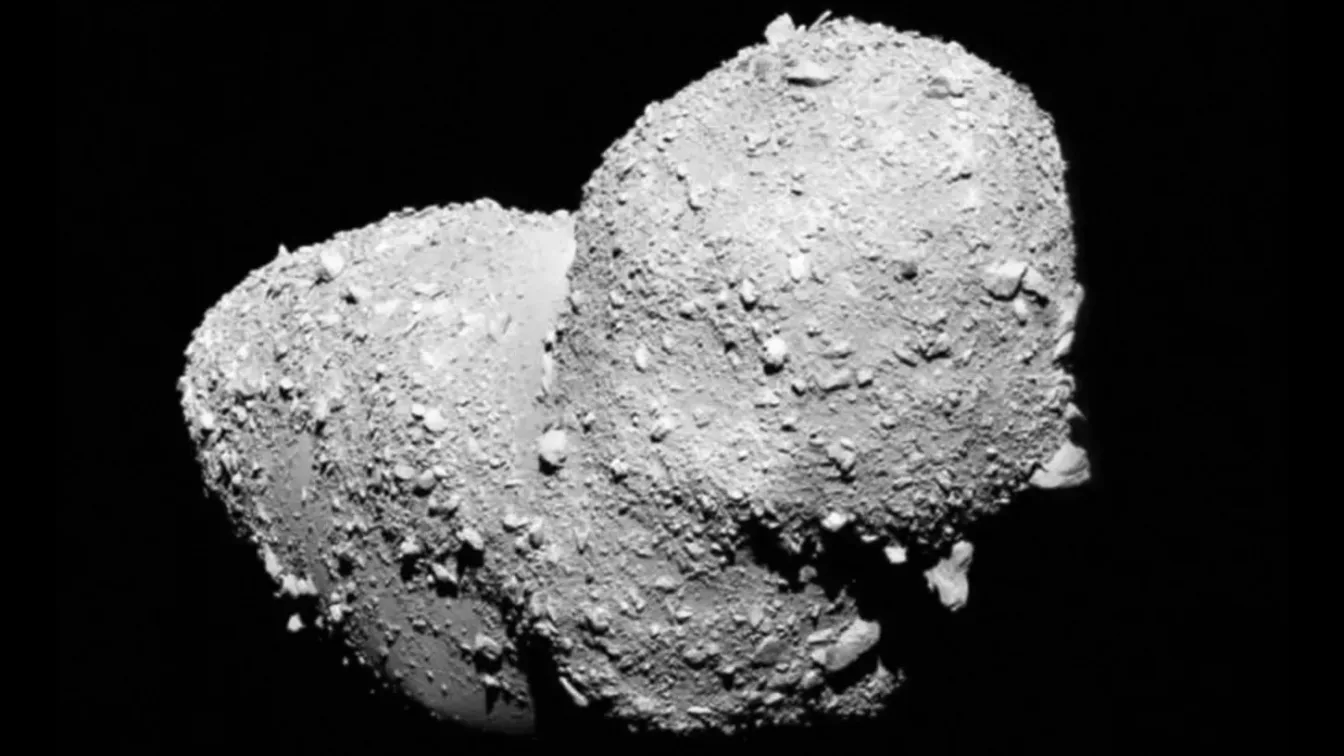 This close-up image of asteroid Itokawa was taken by the Hayabusa spacecraft in 2005 near its closest approach to the asteroid. Different parts of the asteroid have different densities, indicating that it formed as a contact binary from two predecessor “dirty snowball” asteroids, Itokawa likely has a history where several different smaller objects merged together to form what we see today: a common story among asteroid belt and Kuiper belt objects in our Solar System. Itokawa was the first object beyond Earth’s orbit to be successfully landed on, sampled, and to have its material returned to Earth.
The Martian Moons eXploration (MMX) mission should, if it succeeds in its ambitions, provide us with more than enough information to reveal the ultimate origins of Phobos and Deimos. The mission consists of an orbiter, a lander, a rover, and a sample return component. Because both Phobos and Deimos are so small and low in mass, their surface gravity is extraordinarily low: about 1/1700th of Earth’s gravity on the surface of Phobos and about half again as little on Deimos. If you weighed 220 pounds (had a mass of 100 kg) on Earth, you’d weigh the same on Phobos as if you were just 2.05 ounces (58 grams) on Earth.
This means it requires only a very small change in velocity, once you achieve orbit around Phobos or Deimos, to land on the surface and move across it. Because it’s expected to be a rubble-pile-like body, it should be extraordinarily easy to scoop up material for examination and for a sample return. And “taking off” from a moon such as Phobos or Deimos should require no more of an impulse than a human jumping generates. Because JAXA, the Japanese space agency that’s in charge of MMX, has so successfully returned samples from asteroids Ryugu (an extinct comet) and Itokawa (a rubble-pile asteroid) in the past, a sample return from a Martian moon should simply be a new application of already-established techniques and technologies.
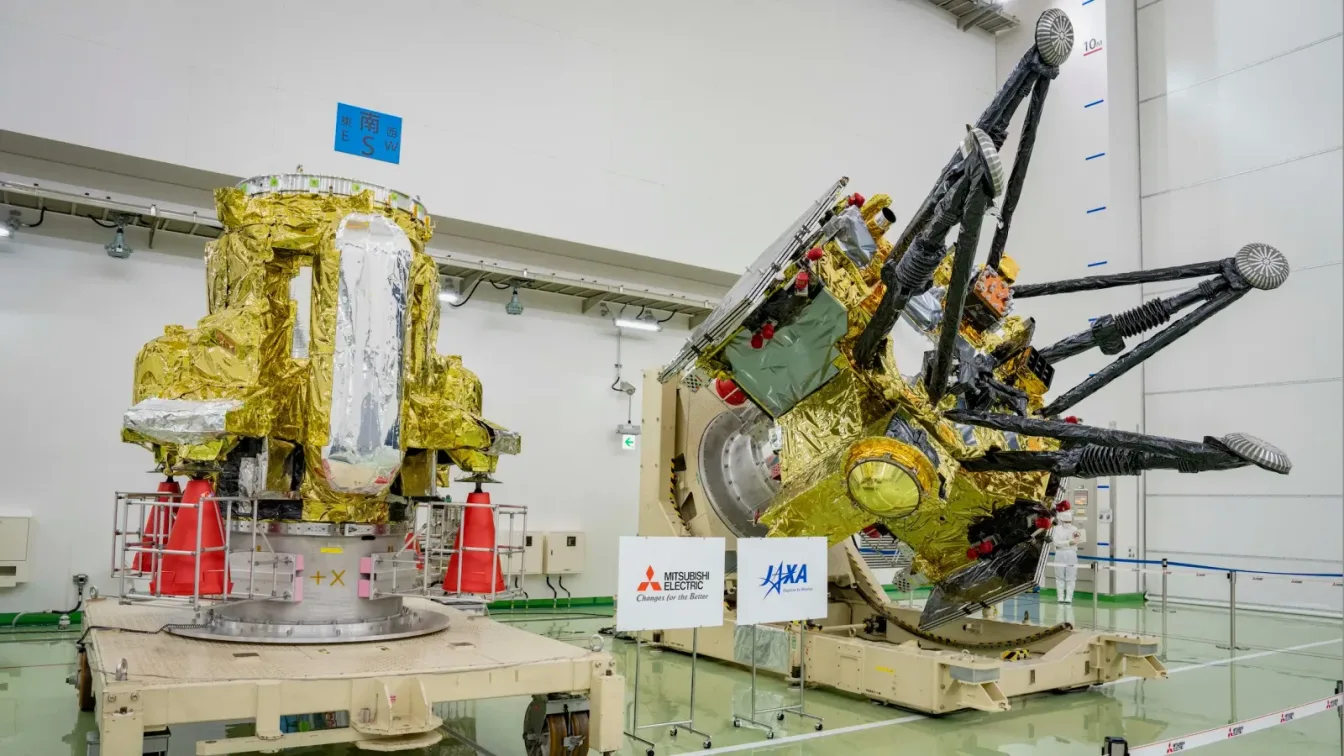 On the ground, in its terrestrial home at Tanegashima Space Center in Kagoshima, Japan, the two main modules of JAXA’s Martian Moons eXploration spacecraft are shown. At left, the propulsion module can be seen, while at right, the exploration and return modules can be seen, which make up the science instruments of the MMX mission.
The first task for the MMX mission is to survey Phobos and Deimos from orbit: using remote sensing to make the most comprehensive maps ever of both of these bodies. It is already known that Phobos, despite having a dark surface all over, has regions that are relatively “redder” and “bluer” across its surface. This strongly suggests that Phobos is composed of a diversity of material, and of a greater diversity of material than the more uniform Deimos displays.
Because Mars itself is a crater-rich world, having been impacted over and over again throughout the course of its planetary history, there’s an excellent chance that Phobos — just 7000 km away from the Martian surface — has accumulated a much greater amount of Martian material over its history than Deimos has: perhaps by a factor of 100. Whereas Mars has had a rich geologic history unfold across the billions of years it has evolved, Phobos and Deimos, with the exception of rare impacts and pollutive events from Mars itself, represent far more pristine environments that can provide a window into the early history of the Solar System.
By observing Deimos from orbit as well, major differences between Mars’s inner and outer moons will be highlighted, providing insight into whether Phobos and Deimos have a common origin, related origins, or completely disparate origins.
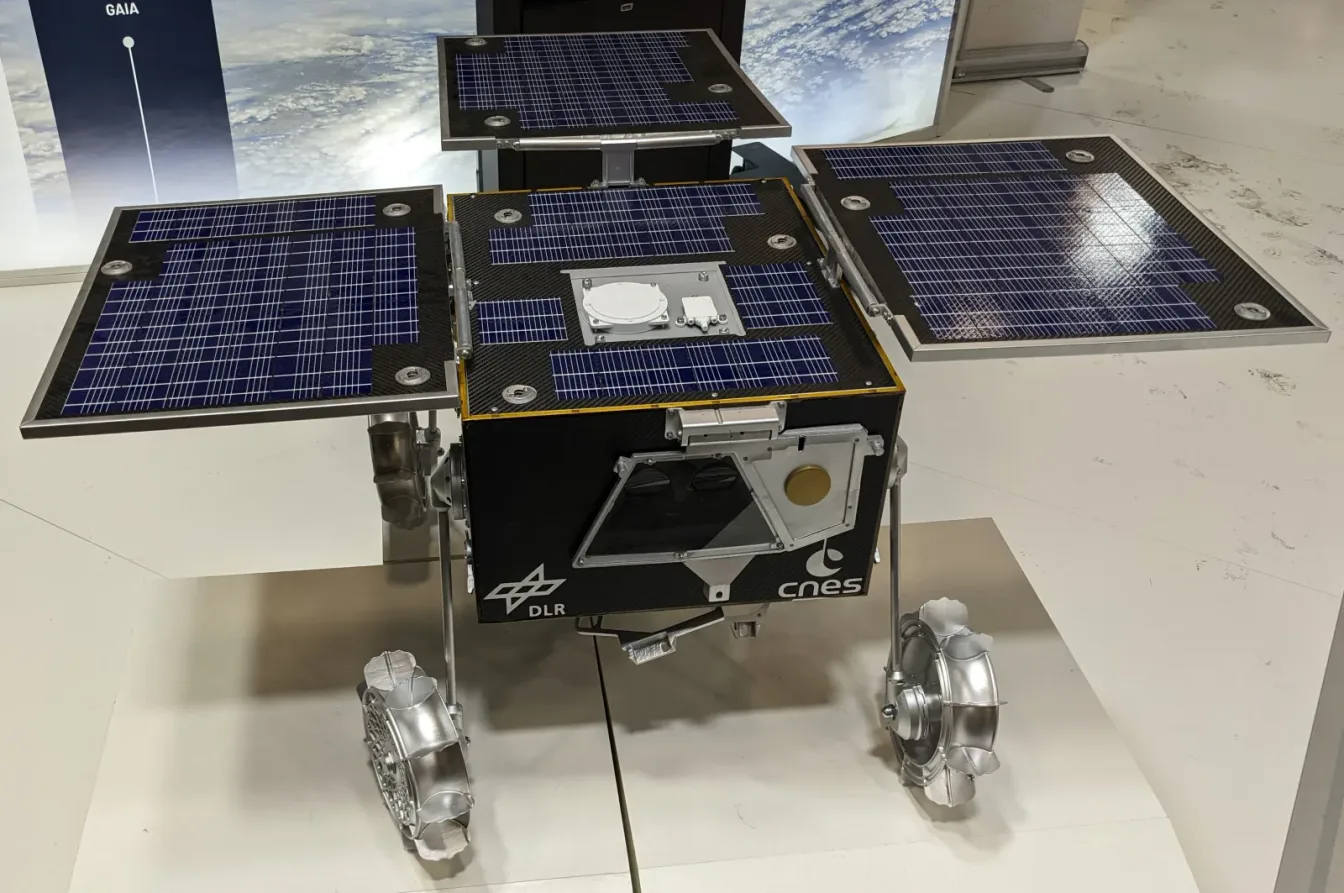 This cute little guy is a model of the IDEFIX rover: a tiny, 15 gram rover designed to be landed on Phobos in advance of the main sample collection and return lander. By characterizing the moon’s soil in advance and testing the ability to operate a wheeled vehicle on an ultra-low-density body, it will pave the way for the success of the sample return portion of the MMX mission.
However, orbiting is just the beginning. Shortly thereafter, there are plans to land on Phobos, deploy one of the smallest, lightest rovers ever (at just 15 grams) on it, and to collect a sample for return to Earth.
It doesn’t take a lot of material to make those determinations; the MMX sample return component plants to collect just over 10 grams of material. However, once that material makes it back to Earth, laboratory scientists will be able to determine:
- Where did that material originate in the Solar System?
- When did that material migrate onto its current location in orbit around Mars?
- And how much material, subsequently, of Mars origin was added to the surface of Phobos?
This will provide a window into not only answering the biggest question about the origins of Phobos and Deimos, but also of helping us understand how material gets transported within the Solar System over its history.
Because it orbits so close to Mars, Phobos is expected to be covered with a series of layers that represent the history of Martian ejecta kicked up by meteorites and other impacts, including the initial fallback of the original large, suspected moon that once orbited it. This could yield insights into the history of Mars that no observatory to date has been able to detect.
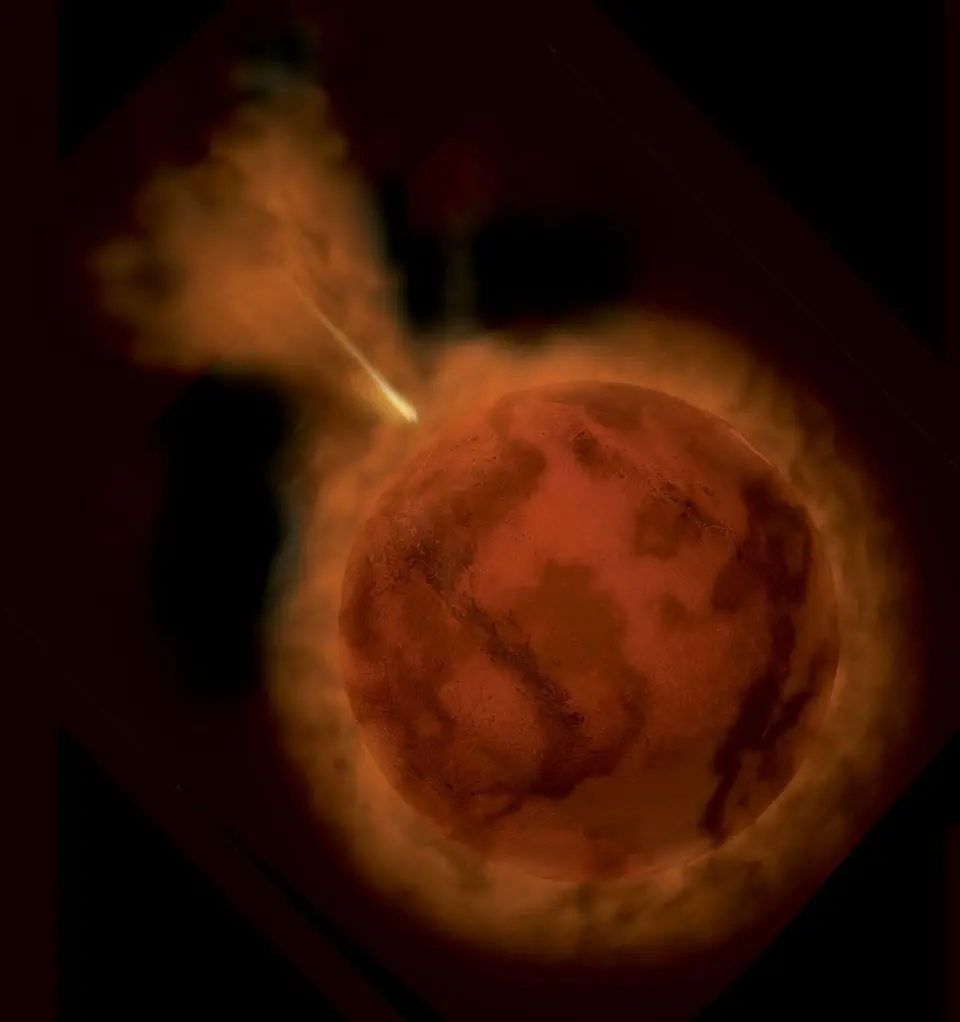 A large impact from an asteroid billions of years ago may have created the moons of Mars, including an inner, larger one that no longer exists today. Although this is not a likely explanation, on its own, for the formation of the Tharsis region and Valles Marineris, it may be primarily responsible for the northern/southern hemisphere dichotomy that plays a major evolutionary role in the red planet’s geological history. Subsequent, smaller impacts can kick up Martian debris that will often get deposited onto Phobos, being located just 7000 km away.
Credit: Medialab, ESA 2001
Just as Earth has layers of sedimentary rock on its surface that have built up over hundreds of millions of years due to the settling of deposits, Phobos — once formed — should accumulate layer after layer of what’s been deposited on it over the subsequent history of impact after impact on Mars. Although this will be disturbed by impacts that have subsequently occurred on Phobos, and the crater-rich nature of Phobos ensures that this effect will have indeed occurred, samples on Phobos can still provide an enormous amount of insight into how Mars has changed over the four billion years or so that have passed since the formation of Phobos itself.
Examples will include:
- When was there liquid water on Mars, and what material that has evidence of that past water on Mars will be deposited on Phobos and when?
- What are the chemical properties of that ancient material that’s been deposited on Phobos?
- Is there any organic matter on Phobos, and if so, what are its origins?
- Could there even be evidence of past life, or hints of it (what we might call biosignatures) that exist on Phobos, even today?
It’s important to recognize that, because there are now no plans for NASA to engage in the cancelled Mars Sample Return mission, the material brought back by MMX will be the closest thing we have to directly analyzing material brought back from Mars in a terrestrial laboratory setting.
Credit: NASA/Joel Kowsky
Remotely, several instruments will help map the properties of the Martian moons as never before.
- TENGOO is a high-resolution camera, resolving features as small as 40 centimeters (16 inches) on the surface, and can scout out a safe landing site.
- OROCHI is a multiwavelength and wide-angle imager, perfect for identifying organic matter and water-rich material.
- LIDAR is a laser altimeter that will measure altitude and reflectivity everywhere on the surface.
- MIRS is an infrared spectrometer that will map out the distribution of any water-related substance over the entire surface.
- MEGANE is a gamma-ray and neutron spectrometers that can map out the chemical elements composing the Martian moons.
- CMDM is a dust monitor that can detect any dust rings around Mars, down to a minimum size of as little as 10 microns.
- MSA is a mass spectrometer that will measure ions released by the moon itself, revealing the presence and cycles of ices.
And, in addition to all of those, IDEFIX is the small, mobile rover that will land on and explore the surface of Phobos before the main spacecraft lands to collect data and samples fit for the sample return component. There are three main drilling, sampling, collection, and return instruments:
- CSMP, which will excavate the surface of Phobos to a depth of 2 cm (just under 1 inch), filling a core soil tube for the sample return capsule.
- P-SMP, which will collect surface material pneumatically by injecting nitrogen gas on sub-second timescales.
- And SRC, which is the sample return capsule that will store the samples collected by CSMP and P-SMP and return them back to Earth’s surface.
The MMX mission is slated to arrive at Mars in 2027, and the samples it collects should return to Earth in 2031.
But perhaps the most important thing to remember is the reasons why we do this at all. Here on planet Earth, for as long as we remain here and confine our activities to what we can do and learn from being here, we will never know about the evolution or history of anyplace else, including for life, organics, and geochemical history. It’s only by looking out and going out into the Universe, including elsewhere in our own Solar System — the most accessible and close by place to explore alien worlds and look for alien life — that we can learn about where we, humans and planet Earth, fit in amidst the great seas of the cosmic ocean.
- Was Mars ever home to life?
- Was Phobos the result of a Martian impact or an asteroid capture event?
- When will deposited Martian material display signs of being hydrated versus anhydrous?
Going there, examining Phobos, and collecting and returning material from it is one way to help answer those questions and much more. All told, Phobos has a mass of about 10 trillion tonnes, or 10¹⁶ kg. About 1 million of those tonnes, or 10⁹ kg of that material, is expected to have been deposited from Mars subsequent to the formation of Phobos (but at 0.1% density, or greater, on Phobos’s outer surface), and so returning parts of its regolith will allow us to examine it in detail with all the modern laboratory equipment at our disposal. The MMX mission, now on its way, is helping us take our next giant leap towards understanding what steps towards alien life, or the lack thereof, actually took place elsewhere within our Solar System.
This article MMX mission to reveal the origins of the Martian moons is featured on Big Think.