Bob Woodward’s warning to Substackers
When Bob Woodward, the dean of American journalists, was 16, he worked as a janitor at his father’s law firm. He loved the job, he recalls in his new autobiography, Secrets: A Reporter’s Memoir, because it allowed him to snoop. It was in his father’s offices, after everyone had abandoned work, that Woodward discovered the “hard ugly controversies” of the lives of his neighbors in Wheaton, Illinois. Beneath the placid surface of middle-class Midwest life lay a troubling trove of “assaults, sexual assaults, divorces, police arrests, [and] secret business settlements”.
The anecdote may serve as a microcosm for Woodward’s relationship to America as a whole over the past half century, a country that has had to absorb the impacts of hidden corruptions, craven ambitions, and clandestine violence, as those in charge decry those whose job it is to shine a light. As Nixon said to his Secretary of State, Henry Kissinger, immortalized on tape: “The press is the enemy, the press is the enemy, the press is the enemy.”
Woodward presents himself as just the man to out the hidden undercurrents of his country’s social and political dysfunction, for he himself has been living with PTSD ever since he found his mother in the living room, kissing his father’s best friend. One result of that childhood shock is that America’s most renowned journalist repeatedly describes himself as consumed by anxieties — the constant fear that something, somewhere, is about to go horribly wrong. He concedes hosts of OCD-type behavior, reiterating his obsession with vacuuming and his compulsion to purchase fire extinguishers. And batteries. And paper towels. Such confessions land strangely, for they are tucked into a narrative otherwise lacking in emotional depth. “In my experience most people have warring parts of themselves,” he writes. And that’s about as profound as Woodward’s self-reflection gets.
This is Woodward’s 24th book but his first attempt at autobiography, and the result is a baggy monster of journalistic excursions interspersed with explanatory glosses, post-interview notes, verbatim transcripts, copies of the author’s memos-to-self, and direct cut-and-paste from his own articles for The Washington Post. Not to mention extended quotes from those 23 other books. No digression is too inconsequential for Woodward, no detail too small, including those peanuts caught in the dentures of CIA Director, William Casey. “A really messy sight.”
More from this authorThe orthodox Jews tripping on toad toxinsIf such worthless details anticipate the flat style of other post-traumatic narrators — Nathan Fielder and Errol Morris come to mind — they also demonstrate that a deficit of emotional intelligence may have been a prerequisite for the job Woodward chose for himself, and has pursued for more than 50 years with relentless ambition. If it takes a spectrum-y Midwesterner to get to the bottom of Watergate, Iran-Contra, and the inner workings of the Supreme Court, so be it.
Indeed, Woodward’s inability to differentiate the picayune from the significant has proven particularly effective for the interview process. “The process of questioning someone almost creates a spell,” he observes, while mistakenly believing that readers will be as fascinated by the particulars of each and every interview as he was. That said, no one has proven better than Woodward at working sources on deep background, and students of the dark art will find in Secrets a master class on discovering, developing, and handling such sources. The book catalogs a monomania of interrogative techniques that embrace everything from nudging to doggedness to chutzpah to silence to flattery — all for the sake of establishing a long-term professional rapport with the source, a relationship that will keep information flowing until death do they part.
His re-telling of the Watergate ordeal (for what must be the thousandth time) centers around a detailed history of his decades-long relationship with the renowned secret source known as Deep Throat, the FBI’s Associate Director, Mark Felt, after which Woodward spends a great majority of the rest of the book recounting decades-long bonds with other such sources, among them Paul Begala, James Carville, Richard Darman, Lawrence Eagleburger, Ari Fleischer, Leon Panetta, Alexander Haig, and Brent Scowcroft. The cast of characters is immense, as Woodward cultivated innumerable “gray men”, the “careful, shadowy figures at the center of things but not necessarily in the public eye. I’ve pursued them my entire reporting life.”
He appears no more than vaguely aware that many of these gray friends are themselves conniving, back-stabbing, lying, self-aggrandizing, and venal specimens — in short, a host of swampy sons of bitches. What Woodward misses is that the vast majority of these sources want to talk, either out of arrogance, pride, or vanity. Some hope to deliver their own spin, while others simply fear being left out of history.
More from this authorJaws spawned American carnageHe makes a point of enumerating the repetition-compulsions such work requires: more than 250 interviews for his book on Bill Clinton, The Agenda. His best-selling doorstop of a tome about the Supreme Court, The Brethren, required 200 distinct sources, including five justices, 170 clerks, and dozens of various and sundry Federal employees. VEIL: The Secret Wars of the CIA demanded more than 250 such dialogues, including numerous meetings with CIA Director William Casey (he of the dirty dentures), a series that infamously ended on Casey’s deathbed. “I knew I was being used sometimes, ” Woodward admits, “but that did not mean that the information I gleaned was not accurate.”
Indeed, Woodward’s gift is not so much the ability to see through the subterfuges of his sources but to not see them at all, or to only see his subjects as ciphers for his own use. While such obliviousness to the feelings of others may serve as a touchstone for aspiring journalists, the fact that no one appears in these pages as a fully formed human being explains why so much of the proceedings are excruciatingly dull.
Perhaps our expectations are too high. By now, we should be familiar with Woodward’s plodding prose, clunky anecdotes, and hoary abundance of cliché. The book is full of fingers in the pie, monkeys on peoples’ backs, deals with devils, politicians on sinking ships, and those fools who play with fire. That said, Woodward’s astonishingly successful career has had little to do with a luminous prose style. As his erstwhile partner Carl Bernstein noted long ago, this is a writer who cares little about sentences, a writer with a tin ear.
Nor is Woodward much of a media guru. The internet, he observes with unabashed conventionality, has accelerated the process of news gathering, creating a “culture of impatience and speed”. The omnipresent soundbite shortens, distorts and politicizes the long, hard work of reporting. “Flood the zone” strategies of controlling the day-to-day news ecosystem have proved effective because we have lost the requisite attention span to link much of anything from one day to the next. These observations are deeply shallow — but who in their right mind ever went to Woodward for philosophical insight?
“Woodward is a blank and will always remain a blank.”Instead, we go to Woodward for remembrance of journalism past — when hunting-and-pecking on manual typewriters was king, when newsroom editors wielded lethal red pens, when the hacks and scribes were mercilessly sent out of the office to pound the pavement in search of something once known as a fact. Of course, fact-gathering is hard work, which explains why the art has been lost in a news ecosystem mired with know-nothing shit-posters who feel no compunction about blasting their attention deficit idiocracies to the world at large. The podcasters, pundits, substackers, tweeters, and access journalists who pollute the waters of the disinformation age would not know how to go about such things. All would do well to take the counsel Katharine Graham, owner of the Post, gave to Woodward and Bernstein after the success of All the President’s Men: “Beware the demon pomposity.” Thus, Woodward’s practice of self-negation.
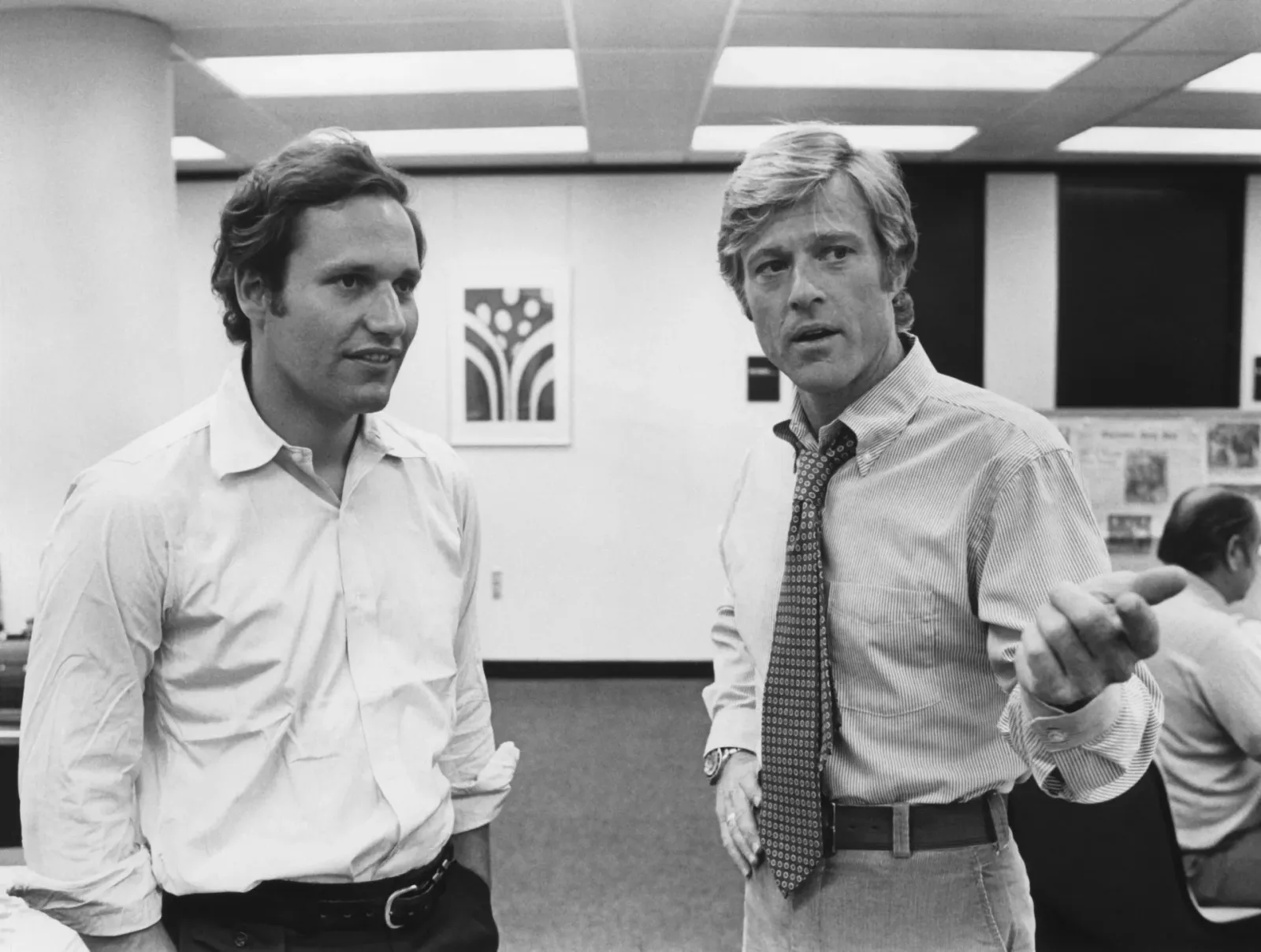
Blame it on trauma, his years in the Navy, his humble beginnings on the city desk, or a case of little-A autism, but Woodward is a blank and will always remain a blank. He knows it, because in sharp contrast to present trends in American journalism, being a blank is Woodward’s secret power. His own insistent inconspicuousness is demonstrated again and again by the actors who have struggled to represent this man without qualities: Robert Redford’s soft-spoken sexpot in 1976’s All the President’s Men has nothing in common with Will Ferrell’s portrayal of a dork who wears psychedelic ties to be cool in Dick. Mark Felt: The Man Who Brought Down the White House (2017), turned English actor Julian Morris into a shadow-stalking noirish mystery man, while the Gary Hart biopic, The Front Runner, featured Spencer Garrett (of Transformers and Star Trek fame), delivering a hail-fellow-well-met who gladhands his way around speakeasies and political backrooms. All of which are mutually exclusive.
After 500 pages of autobiography, the messenger remains a blank — but the message is clear. The best obtainable version of the truth matters, setting the record straight matters, history matters. Secrets is Woodward’s paean to his deep and abiding dedication to those eternal verities, a love that has guided him through 60 years of workaholic days and nights. It was this unflagging dedication to the craft that finally won me over.