After another weekend of protests, France faces a test of its promises
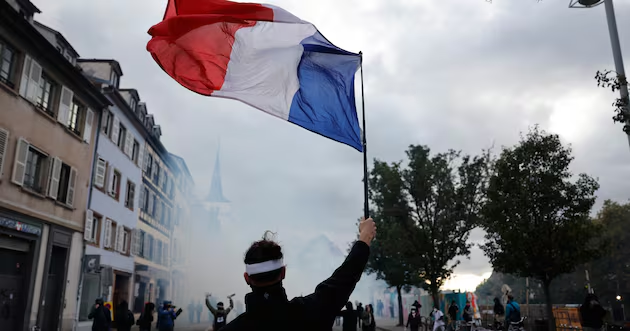
More than 400,000 people marched across France this weekend in a continuation of protests that have rocked the country since late September.
The Oct. 24 marches were largely peaceful, though authorities reported 1,435 arrests and clashes in several cities. Prior to the demonstrations, soldiers from Operation Sentinelle replaced police officers and gendarmes assigned to sensitive sites at public or state buildings. Their purpose was to make more police and gendarmes available for crowd control and responding to violence.
“The marches went well,” Interior Minister Laurent Nunez said during a public situation briefing Saturday, while also reporting clashes involving groups that authorities considered high-risk.
Two days later, officials unveiled education changes that protesters say are not enough. The government’s new plan includes smaller classes and a replacement for the university admissions platform, but student leaders are still calling for demonstrations on Oct. 31 and Nov. 5.
A second weekend in the streets
The protests began in late September, when students at a school outside Paris held a blockade over staff shortages and a lack of resources. The demonstrations soon grew beyond education, drawing unions and other groups with grievances over the cost of living and public services.
On Oct. 17, an estimated 550,000 people marched nationwide. The protests quickly gave way to widespread violence, with officials reporting nearly 2,400 arrests, almost 1,000 injured police and about 3,000 businesses damaged or looted.
A mass march, a burning city hall and a country on edge
One week later, hundreds of thousands of people returned to the streets with continued demands for government concessions. Authorities counted approximately 410,000 demonstrators, while the CGT union estimated closer to 800,000.
The main marches were described as generally calm, although clashes occurred toward the end of demonstrations in several cities, including Paris, Marseille, Lyon, Grenoble, Nantes, Angers, Lille and Strasbourg.
“Individuals from the ultra-left and radical far-left have once again sought to sow disorder, particularly during the dispersal of the processions,” Nunez posted Saturday. “These acts are unacceptable.”
Je veux saluer l’engagement exceptionnel et le professionnalisme de l’ensemble des préfets de zone, des préfets, des policiers, des gendarmes et des sapeurs pompiers mobilisés partout en France pour garantir la sécurité de nos concitoyens et permettre le bon déroulement des…
— Laurent Nuñez (@NunezLaurent) October 24, 2026
As of Sunday evening, Nunez reported 267 police officers and gendarmes injured, along with 150 demonstrators.
What the government is promising
The government announced concessions on Monday addressing several complaints raised by students. The package includes possible solutions for crowded classrooms, missing staff, stressful admissions procedures and deteriorating buildings.
“The success of our young people must not depend on their social background, their high school, or the area in which they grow up,” Prime Minister Sebastien Lecornu posted Monday. “The national consultation of high school students ... has made it possible to bring their concerns and proposals to light. We have listened to them. Their demands must now lead to concrete responses.”
La réussite de nos jeunes ne doit dépendre ni de leur origine sociale, ni de leur lycée, ni du territoire dans lequel ils grandissent.
— Sébastien Lecornu (@SebLecornu) October 26, 2026
Ces dernières semaines, les lycéens et les étudiants ont exprimé des attentes fortes. La consultation nationale des lycéens menée sur notre…
The largest headline concessions are the planned replacement of Parcoursup, the university admissions platform, by 2028. The government also announced capping high school classes at 28 students, opening 500 new teaching positions alongside 500 psychologist, nurse and social worker positions, adding 15,000 higher education places and offering 4 billion euros in loans for high school renovations.
The class-size cap would begin in the least-favored half of high schools in 2027, then expand to all high schools in 2028. This means students returning to schools now would not immediately receive the full benefits.
Why teachers and students say it’s not enough
Students and teachers are acknowledging concessions without accepting that the underlying problems have been solved. Their objections concern both the scale and the timing: the class-size cap is initially limited, the additional postsecondary places are still well below some organizations’ demands, and the teachers’ union wants a much larger staffing commitment.
How student protests grew into a nationwide crisis in France
The disagreement over Parcoursup is also significant, since changing the platform does not necessarily deliver the end of admissions selection that some protesters want.
“We are managing to achieve some gains through mobilization, but they are still crumbs,” Sabrine Karbach, Student Union spokesperson, told AFP.
Yet the movement is now about more than education. School grievances have become part of a wider coalition concerned about household budgets, inequality and public services. An education package alone may not settle the broader confrontation, since the coalition’s demands extend beyond schools and university admissions.
What’s on the horizon
The promises are possible to deliver, but they are not yet fully secured. France’s finance minister has put the package’s cost at about 5 billion euros and said it will be offset by cuts elsewhere, as the government tries to lower the deficit from 5.4% of GDP this year to 5% in 2027.
Some commitments are phased over several years, and the 4 billion euros toward school renovations is a loan program for local authorities rather than a direct grant. The measures still need to make it through a difficult 2027 budget process, so the key question is whether the government can fund them while meeting its deficit target and securing enough support in Parliament.
Amid France’s turmoil, the country’s faith leaders offer a different diagnosis
As for the protestors, the next two dates represent different forms of pressure. Oct. 31 is another Saturday street mobilization, with Yellow Vest organizers calling for protests, gatherings and sit-ins outside the National Assembly and town halls.
Nov. 5 includes a cross-sector strike over wages, wealth distribution, public services and the proposed budget. Student and teacher groups are maintaining their participation despite the government’s concessions, so the announcements have not yet brought the movement to an end.
President Emmanuel Macron called for upcoming demonstration routes to be kept outside city centers to prevent damage and looting. The organizers’ competing plans and emphasis on protest rights make route restrictions themselves another point of dispute.
“We will maintain the necessary security measures and work to establish permanent demonstration routes outside the city center, to reconcile the freedom to demonstrate, the safety of residents, and the resumption of economic activity,” Macron posted Monday. “Our priority: preserve calm, allow shops to reopen, and let life fully resume its course.”
Protests are flaring up in Spain, Portugal, Italy, Albania and Serbia over a variety of concerns, including housing, education and corruption.