Choose hope, family and friends over politicians, say leaders during Interfaith Forum at Salt Lake Tabernacle
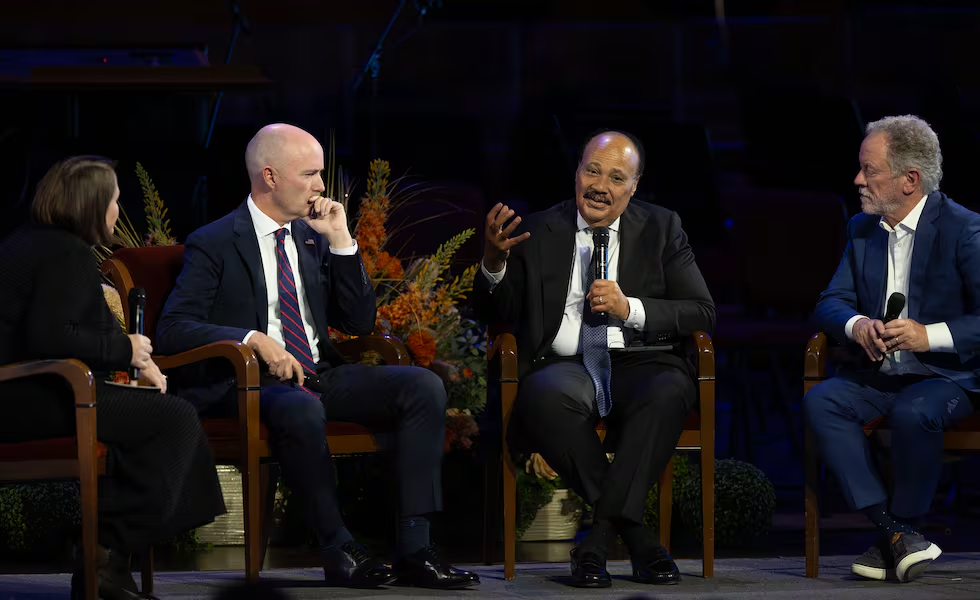
Martin Luther King Jr.’s final book asked whether America would choose chaos or community.
His son and two other leaders said Thursday in a powerhouse panel discussion at the Salt Lake Tabernacle that the solution to the nation’s current age of chaos is building belonging and connection at the hyperlocal level of families and neighborhoods.
“All of us must use our voices and our values to bring the nation together,” Martin Luther King III said during the first event of the annual international G20 Interfaith Forum, which is in Salt Lake City for the first time.
Algorithms and politicians feed fears about distant concerns the average person cannot change while the relationships in their homes and neighborhoods that once fueled American strength are fraying, he and the other two panelists said.
At 2021 G20 Interfaith Forum, Elder Rasband tells global faith leaders: ‘The world needs us’
“We’re all worried about things beyond our control,” Utah Gov. Spencer Cox said, “but we don’t know who are neighbor is, where we could make a difference.”
Surveys show that 30% of people have lost a relationship with a family member or friend over politics, he said.
“I’m here to tell you, politicians are not worth it,” the politician said. “We are not worth losing a single friendship or a single family member. We will let you down every time. Value those relationships over politicians.”
The third panelist called for a return to religious basics as they all sat on a podium in front of the Tabernacle’s towering organ pipes with the moderator, Deseret News editor Sarah Jane Weaver.
Martin Luther King III asks BYU students to rise up and create his father’s ‘beloved community’
“Love is the most powerful weapon on the planet,” said former South Carolina Gov. David Beasley, who led the World Food Programme to a Nobel Peace Prize in 2020. “It is the only thing that will carry us through this chaos.”
Weaver kicked off the discussion by asking the panelists about the cause of extremism and polarization.
“It’s deeper than that,” Cox said. “It’s a lack of belonging and connection that people are hungry for.”
All three panelists expressed faith that the Christian basics of hope, love and charity could rebuild the connection and belonging they said Americans have always craved.
Known as the “Disagree Better” governor, Cox welcomed the Interfaith Forum to Utah before the panel started.
“Utahns understand that our differences do not make us enemies, they make us a community,” he said.
Cox repeated the old saying that all politics is local and said that solutions for polarization should be local, too.
“Religion,” he said, “makes us local and tells us who are neighbor is and to help them.”
Beasley says the effort can begin over a meal.
He launched Breaking Bread Together two months ago. The idea is to start depolarizing Americans by getting them to sit down and eat together the way their parents and grandparents once did.
Latter-day Saint leaders give their largest donation ever to World Food Programme
“Go break bread with someone different than you,” he said. “If I could just get the church community, the churches across America, to go break bread with someone this week, it would change the country.”
Like the others, King III said it is hard for one person to change the whole world. Instead, his call to action was to get up each day and try to do something small.
“You can win a victory on your street,” he said. “You can win a victory in your school. You can win a victory in your places of worship ... but work until you’ve made something a little better than it was when you arrived.”
All three emphasized the teachings of Jesus Christ about the need for love, charity, peace and community.
“We need to get back to the fundamental basics taught to us several thousand years ago,” Beasley said. “I’m calling people back to the basics, back to the fundamentals. America can’t be great until it can be good. Once we get back to being good, then we’ll be great again.”
Cox agreed, adding, “I do know and testify here that Dr. King Jr. and Jesus were right, that it’s love that overcomes hate.”
The panel also said it just takes well-meaning people to try.
“If you want success, you have to work at it,” King III said. “If we want to create a better nation, a better world, a better community, we have to work at it. It doesn’t come by osmosis.
“The hope is we choose what is good, just and right, but it doesn’t happen on its own. It takes good women and men to do it.”
After all, faith is an active verb, Cox said.
“My friend Ben Sasse said if you want to be a good person, the best way is to pretend to be a good person,” Cox said. “Ask yourself, what would a good person do? Then you’ll become a good person.”