When and how did the BYU-Utah football rivalry game become must-see TV for entire nation?
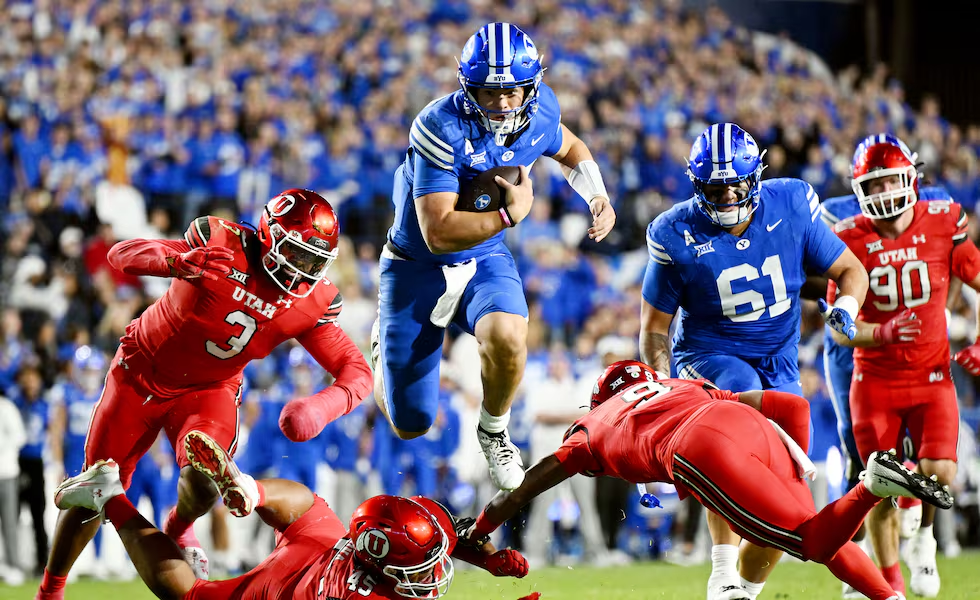
One of the most memorable games in the century-old BYU-Utah football rivalry — at least for BYU fans — was played 20 years ago this month.
After taking an early 14-0 lead, then falling behind 31-27 late in the fourth quarter at Rice-Eccles Stadium in Salt Lake City, the Cougars won 33-31 on a touchdown pass from John Beck to Jonny Harline with no time remaining on the clock.
As the Bronco Mendenhall-led Cougars raced onto the field to celebrate the finish that became known, simply, as “Beck to Harline,” the pro-Utah crowd sat in stunned silence. That BYU didn’t attempt to kick an extra point to make the final score 34-31 was somehow appropriate, because twice in the 1990s, the Utes had defeated the Cougars by that 34-31 score, prompting a series of television commercials featuring BYU coach LaVell Edwards and Ron McBride that added to the allure of the matchups.
Speaking of television, that instant classic in 2006 was not televised nationally on a major broadcast network. Instead, it was broadcast regionally via CSTV (College Sports Television) and shared regionally on The Mtn. (MountainWest Sports Network). Television ratings for the game were not known because The Mtn. did not subscribe to Nielsen Media Research tracking.
Flash-forward to Saturday morning at 10 a.m. at Rice-Eccles, when millions are expected to tune in to ABC for the first top-10 clash in rivalry history.
What was once an in-state and regional obsession, a grudge match that was one of the best-kept secrets in the Beehive State, has become must-see TV nationally. The rivalry began capturing more of the nation’s attention when Utah went to the Pac-12 in 2011 and BYU went independent and signed a deal to get its home games televised by ESPN, but Saturday’s game might never be matched in terms of national attention.
Although there are six other games pitting ranked teams on Saturday, No. 3 Utah hosting No. 9 BYU on a national television network feels like a seminal moment for the rivalry.
“I think any broad national appeal is contingent on either or both teams being ranked and/or in the College Football Playoff (CFP) conversation,” said Greg Wrubell of the BYU Sports Radio Network, the “Voice of the Cougars,” who has called every rivalry game since 1992. “BYU-Utah has long been a compelling regional rivalry, but the stakes have been raised for both teams as nationally relevant power-conference members.”
National sportswriter Stewart Mandel, editor-in-chief of college football coverage for The Athletic, told the Deseret News: “I think the rivalry got a big boost nationally when they both got in the Big 12, along with expansion to a 12-team CFP. When BYU was an independent it didn’t have quite those kind of stakes nationally.”
BYU's Keanu Tanuvasa reflects on being on both sides of BYU-Utah rivalry
What's RB LJ Martin's status ahead of rivalry football game?
Who will prevail in colossal Utah-BYU showdown? A few things to consider
Another national college football expert, Brett McMurphy of On3.com, said the rivalry “probably hasn’t gotten the love or attention it deserves nationally,” but that began changing when BYU joined the Big 12 in 2023 and ramped up when Utah moved from the Pac-12 to the Big 12 in 2024.
“Despite the incredible rivalry — and the cool part where both teams wear their colored jerseys — it may have been overlooked because it wasn’t two power conference teams,” McMurphy told the Deseret News. “That’s not necessarily fair, but reality. The only rivalry that gets prominent (coverage) nationally between two non-power schools is Army-Navy.
“That changed when BYU joined the Big 12 and the last two games have been insane,” he continued, referring to BYU’s 22-21 win in Salt Lake City in 2024 and 24-21 win last year in Provo. “It is unfortunate that it is one of six games involving ranked teams (on Saturday). It certainly won’t be overlooked, but it deserves a bigger showcase.”
Close games have defined and elevated the rivalry
From a national perspective, the stakes have never been higher in a rivalry game, with Utah (8-0) and BYU (7-1) heavily in the mix for a CFP berth, the Utes more so than the Cougars after BYU stumbled 39-31 in double overtime two weeks ago at UCF.
Can No. 3 Utah snap losing streak to No. 9 BYU in one of the most high-stakes rivalry games ever?
Another reason why the rivalry has risen in the nation’s eyes and become appointment viewing is that the games are almost always close, intense and settled in the fourth quarter. Since 1996, 20 of the 26 BYU-Utah games (76.9%) have been one-score games, which is to say the winning margin was 8 points or fewer.
That’s the most one-score games of any matchup in the country during that time. Second is USC-Arizona, teams that have played 17 one-score games out of their last 25 (68%), according to Cougarstats.com.
Even during Utah’s nine-game winning streak in the series that began, not coincidentally, when Utah announced it was joining a Power Five conference (Pac-12) and BYU announced it was going it alone (independent), most of the games were close.
Utah won 54-10 in Provo in 2011 and 30-12 in Provo in 2019; the other seven games in the streak were won by 8 points or fewer, and two were won by a single point.
“To me, it’s the endings of the games and the closeness of the games over the last 25 to 30 years,” said BYU defensive coordinator Kelly Poppinga, a former BYU linebacker. “How many times has it been decided by the last play of the game? I just think about the ones that I’ve been involved with. I think maybe all but two have come down to the last play of the game.
“So yeah, it’s a great game and you have to have the stomach for it, man, because it’s going to come down to the very end,” he continued. “There’s going to be a team that makes one more play than the other team and hopefully that’s us.”
Said BYU offensive coordinator Aaron Roderick, also a former BYU player, after being asked when the rivalry made the leap to the national radar: “That’s a really good question. I would say just recently both teams have been pretty good, so people are more aware of it nationally, just in the last eight to 10 years or something like that.”
Rivalry game deserved a better kickoff time, but it doesn’t diminish its enormity
Saturday’s game will mark the fifth time in rivalry history in which both teams are ranked.
Last year, No. 15 BYU beat No. 23 Utah 24-21 in Provo. In 2009, No. 18 BYU edged No. 22 Utah in overtime, 26-23, when Max Hall threw a touchdown pass to Andrew George.
In 2008, undefeated and eighth-ranked Utah pummeled No. 16 BYU 48-24 at Rice-Eccles to earn a berth into the BCS. In 1994, No. 21 Utah edged No. 20 BYU 34-31 in SLC in one of many classic McBride-Edwards matchups.
When the Utah-BYU football rivalry really began
BYU and Utah didn’t have much of a rivalry until the mid-1970s, as Utah dominated early and had won 38 of 49 games, with four ties, before Edwards came along.
Under Edwards, BYU won 18 of 20 meetings with Utah during one stretch, and many folks point to repeated drubbings of teams coached by Wayne Howard, Chuck Stobart and Jim Fassel as when the rivalry grew more heated, and oftentimes nasty.
McBride entered the picture in 1990, and started to turn the tide. Utah’s 1993 win in Provo marked the Utes’ first win there since 1971. From 1990 through 2003, each team won seven times. Nine of those contests weren’t decided until the fourth quarter.
“The rivalry began to gain traction in the 1990s, when McBride elevated Utah into a competitive program,” said Patrick Kinahan, a KSL “Sports Zone” talk show host and columnist. “Until then, any publicity the rivalry got was due to BYU’s dominance of the WAC and then recognition the program received through the 1984 national championship and the pipeline of quarterbacks going to the NFL.”
While McBride and Edwards brought some much-needed civility to the rivalry, that all ended when Urban Meyer arrived in Salt Lake City in 2002. His tactics were well documented, including referring to BYU as the “Team Down South” and installing urinal cakes with BYU logos on them in the school’s football facilities.
“By 2004, the rivalry had increased to a national level based on the number of incredible finishes and Utah’s breakthrough undefeated BCS-busting season that culminated in winning the Fiesta Bowl,” Kinahan said. “Two years later, the John Beck pass to Jonny Harline left no doubt that this game ranked with the country’s best rivalries.”
ESPN, vitriol helped put the rivalry on the map
In truth, 2004 was also a turning point in the rivalry’s journey toward national prominence, as ESPN’s “College GameDay” visited Utah’s campus in the week leading up to that game, an indication that the rivalry was now more than just a regional or in-state curiosity.
With Meyer not afraid to run up the score and rub it in a bit in Utah’s 52-21 victory at Rice-Eccles, which cemented its BCS berth en route to an undefeated season, the rivalry’s heat intensified.
Then there were the inflammatory comments from players on both sides in the 2000s that fueled the hatred even more. Hall, BYU receiver Austin Collie, former Utah quarterbacks Alex Smith and Tyler Huntley and even new Utah coach Morgan Scalley, when he was a player, made comments that enraged opposing fanbases.
Before the 2004 game, the normally reserved Smith called BYU fans “the most arrogant people” and brought up the religious aspects of the rivalry.
There were many others, dating way back to Lenny Gomes (now Lenny Gregory), saying the Utes would be “pumping my gas” and that they were “low-class losers” after Utah’s 1993 win.
“No other rivalry in the country has ever seen a fanbase storm the field three separate times in a single game the way Ute fans did at the bizarre conclusion of the 2012 game,” Kinahan said. “In addition, numerous quotes … on both sides brought attention to the rivalry that highlighted the game’s intensity by the two teams that share the same media market.”
Crediting the coaches that came before them
While pleading for civility to become a hallmark of the rivalry when they conducted their press briefings Monday, Utah’s Scalley and BYU’s Sitake praised the work of the coaches that came before them for making the rivalry what it is today.
“I think you have to give a lot of credit to those coaches that worked for it,” Sitake said. “It has kind of gradually evolved into what it is now, and I think when (Utah) went to the Pac-12, that got more eyes on it, being in a power conference, and then I think it’s just become even more elevated once we joined the Big 12.
“And now that Utah’s in the Big 12 with us, it’s even more elevated. It seems like we should have been in a power conference a long time ago,” Sitake continued. “But there’s a lot of recognition (now). … What a great time to be a fan of the University of Utah and a fan of BYU. So I’m using it to try to get our team to elevate our game. We see what Utah is capable of doing, and we are going to have to play at our best. And they’re a dangerous team, and they’re undefeated for a reason.”