A Brazilian Economic Canary in the Coal Mine
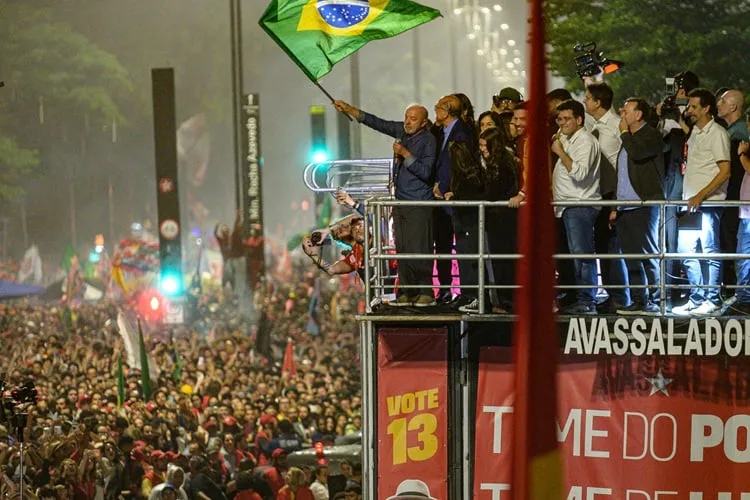
Brazil’s financial market developments bear watching for the light that they might shed on US and French financial market prospects. Like the US and France, Brazil is on an unsustainable public-debt path and has a government that has made lavish public-spending campaign promises. Following President Luiz Inácio Lula da Silva’s surprise electoral triumph in last weekend’s presidential election, Brazil now has a government that lacks a parliamentary majority to support much-needed measures to rein in its budget deficit. It also has a political base that expects public-spending increases.
Start with Brazil’s unsustainable public finances. Under Lula’s most recent term in office, Brazil’s ratio of public debt to GDP rose by 10 percentage points to its present level of 82 percent. While that might be below the corresponding US and French public-debt levels, it is high for an emerging market economy. Meanwhile, according to Brazil’s central bank, Brazil’s budget deficit is now running at around 9.5 percent of GDP, in large measure due to very large interest payments. According to the International Monetary Fund, Brazil will need to reduce its budget deficit by at least 3 percentage points of GDP if it hopes to start reducing its ratio of public debt to GDP.
The prospects for deficit reduction under another Lula term do not appear promising. Unlike Flávio Bolsonaro, Lula’s opponent who campaigned on a public-spending-reduction program, Lula made lavish public-spending promises. He championed a shorter working week without a cut in pay, an increase in the minimum wage, and debt relief for struggling households. He also floated free public transportation on weekends, seeking to reconnect with poorer voters who had long formed the backbone of his support.
Further clouding Brazil’s budget outlook is the fact that Lula’s party does not command a majority in congress, which has shifted to the right after the election. Indeed, he only has some 66 seats in a congress of 513. This means that any effort at deficit reduction will require Lula to not only walk back his electoral campaign promises but also build a coalition for deficit reduction with Bolsonaro’s Liberal Party.
The good news for Brazil is that most of its public debt is denominated in its own currency. This means that however bad the budget situation might be, we will not have a Brazilian foreign debt default as we might have had in earlier decades. Rather, the likely outcome would be central bank monetary financing of the budget deficit, which would cause a sharp fall in the exchange rate and a surge in inflation from its already high rate of 4.5 percent. Anticipating such an outcome, in the immediate aftermath of the election, Brazil experienced among its sharpest declines in both its exchange rate and its bond prices.
The drubbing that Brazil is currently receiving in the financial markets should be a wake-up call for both France and the US as to what might be in store for them should they not soon mend their public finances. Both France and the US, like Brazil, have unsustainable public finances, as reflected in high debt levels and gaping budget deficits. Both countries could be in situations where they do not have working majorities —in the US Congress after next week’s midterm election or the National Assembly after next April’s French election. It also does not help that President Trump is proposing large defense spending increases for the United States or that Marine Le Pen, the favorite to become the next French president, is proposing to reduce the pension age and cut the value-added tax on energy and food products.
James Carville, Bill Clinton’s political adviser, was fond of saying that if there were reincarnation, he would like to come back as the bond market, because then he could tell the government what to do. Carville’s comments are already having relevance in Brazil, France, and the United States, where bond yields have soared to multi-decade highs on budget deficit concerns. If these countries’ governments do not soon get a handle on their public finances, we could see further large increases in bond yields and a return to higher inflation.