The CEO, the Spy, and a Crisis for AI
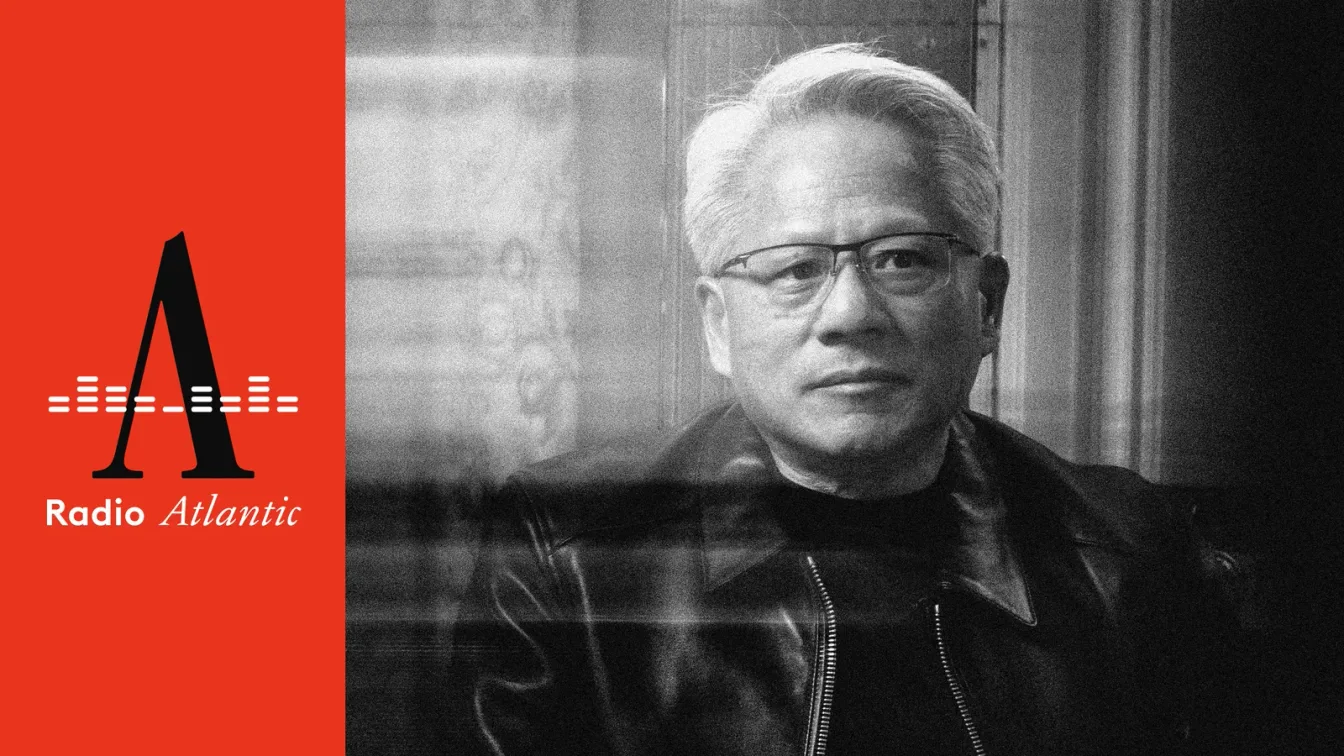
Subscribe here: Apple Podcasts | Spotify | YouTube | Overcast | Pocket Casts
Updated at 9:05 a.m. ET on November 12, 2026
Reports of a second compromising affair may be the undoing of Nvidia CEO Jensen Huang, even though the first affair was with an alleged Chinese spy. Earlier this week, tech titans were going out of their way to minimize the scandal at Nvidia. Huang had confessed to an affair with an alleged foreign agent, but he was “irreplaceable,” according to Elon Musk. Huang had potentially put trade secrets and national security at risk, but he was an “honorable guy,” said President Trump, and “he probably has an excuse for it.” The billionaire hedge-fund manager Bill Ackman posted on X, “Onward,” implying: Move along—nothing to see here.
Huang, it seemed, was too big to fail. Interested parties were more willing to ignore the obvious dangers than contemplate what it might mean to lose the man so singularly identified with the company at the center of the AI boom, the company so important that it might be currently propping up the U.S. economy.
That was true until yesterday, when news broke of a second affair Huang had, with an executive at Nvidia who reports directly to him. Nvidia’s board met to consider Huang’s future, a move that the Atlantic staff writer Charlie Warzel describes as “taking a Jenga block out” of the AI tower. Now Huang has resigned.
The staff writers Shane Harris, who covers intelligence agencies, and Warzel, who covers the tech industry, discuss on Radio Atlantic both the espionage and the business. Harris considers how China might have pulled this off, and what secrets they might have obtained. Warzel considers what the future of Nvidia, and the AI boom more broadly, might look like without its leader.
This episode of Radio Atlantic taped before Nvidia CEO Jensen Huang’s resignation. The following is a transcript of the episode:
Hanna Rosin: The tech news this week started out James Bond, but is now shaping up to be more like a season of HBO’s Succession. Over the weekend, news broke that Jensen Huang, the most important man at the center of the most important tech company in the world, admitted to having an affair with a woman who is a suspected Chinese spy.
Titans of Silicon Valley defended Huang, whose company, Nvidia, is the engine of the AI boom. President Trump called him an ”honorable guy,” essentially shrugging it off. Elon Musk called him “irreplaceable.” Billionaire hedge fund manager Bill Ackman wrote on X, “Onward,” as in: Nothing to see here—move along.
Earlier this week, the discussion was about whether all these VIPs were defending Huang because he was just too important, too central to the American economy, to contemplate losing. Too big to fail.
And then all of a sudden, he wasn’t.
I’m Hanna Rosin; this is Radio Atlantic.
On Wednesday, news of another affair broke. This one was not with a spy but with an Nvidia executive who reports to Huang. Great men can be messy, but apparently not so messy that they risk tanking their stock and potentially taking down the entire market with them.
The Nvidia board reportedly met to consider his future and, according to The Wall Street Journal, they are preparing to oust him.
To make sense of this story—the international espionage, the fallout for the tech economy, all of it—I called up two Atlantic staff writers: Shane Harris, who has written for years about spies and the intelligence world, and Charlie Warzel, who covers tech and hosts the Atlantic podcast Galaxy Brain.
Shane, welcome back to the show.
Shane Harris: Thank you, Hanna.
Rosin: Charlie, welcome back.
Charlie Warzel: Thank you very much.
Rosin: All right, Charlie, we’re gonna start with you. Jensen Huang is not exactly a household name yet. He and his leather jackets are not quite at the level of Steve Jobs and his black turtlenecks. And yet by some accounts, including yours, he seems to hold the fate of the universe, or at least this country, in his hands. Can you explain why that is and who he is?
Warzel: So Jensen Huang is the CEO and he’s also the co-founder of Nvidia. Nvidia makes processing units, GPUs, which is essentially the thing that allows the AI boom to happen. It helps power the data centers; it helps train the models. Without them, you don’t have generative AI, but you also don’t have things like computer graphics and graphics cards.
Huang is very good at seeing around corners, and is idolized for seeing the AI boom happening and reorienting the company around the idea of making better and better and more efficient chips and getting them to the right people. So he is the head of arguably the most important company in artificial intelligence, and that is because the U.S. economy hinges on the AI boom right now.
The Magnificent Seven, which is the seven massive technology companies, they are responsible for roughly a third of the S&P 500’s value at the moment. And Nvidia is the crucial node of all of that. So, according to The Economist, Nvidia’s stock produced 15 cents for every dollar that the American stock market has returned since ChatGPT came out.
They are one of the most valuable companies in the entire world because of this. And what they do—and this is why he’s so important—what Nvidia does is: It takes a lot of that money, and then it has become arguably the primary investor in the rest of the artificial-intelligence industry. As of July, they have had $99 billion worth of investments, and they invest in OpenAI; they invest in SpaceX, Anthropic; they invest in data-center providers.
They put all this money into an ecosystem so that those people can then purchase more Nvidia chips. And it’s part of what people who are concerned that there might be an artificial-intelligence bubble say is a “circular mode of financing.” And so the feeling about why Jensen is so important is he is the person who steered the company that, if it imploded, it would bring the entire economy down with it.
Rosin: So that brings us to the most recent news. Jensen Huang is critical to Nvidia. Nvidia is critical to the U.S. economy, and now the board is reportedly preparing to oust him. So what does that mean?
Warzel: It’s honestly unprecedented. I really don't know what to think about this, because this was never in the cards. Jensen Huang is Nvidia; Nvidia is Jensen Huang. You really can’t separate the two, and now the whole world and the stock market is being asked to separate the two. We’re in uncharted territory right now.
Rosin: Is there any precedent? Is there anything that we can look to, to try and understand this moment?
Warzel: Well, an interesting thing here, as we are talking in the middle of this chaos, is the fact that some of this happened a couple years ago with Sam Altman and OpenAI. Sam Altman was ousted by the board. They brought in the CEO of Twitch, the streaming company, or the former CEO.
It was this big debacle, and everyone was just absolutely flabbergasted that, Oh my gosh, Sam Altman has been ousted here. What’s gonna happen? And then you cut to a couple days later; he reversed it. He came back. This whole cycle was almost for naught, but then Sam had consolidated power at the end. And that is a hard thing for all of us to get out of our heads in this moment from tech observers.
Rosin: Right, because maybe this story’s not over yet.
Warzel: It seems plausible that it’s not over, and that’s because there’s so much baggage with Jensen in terms of all the deals that he’s involved in. He is the person who has brokered all of these investments across the AI industry, and the people who know him say he does this on a handshake. He is the central character of all of Nvidia’s success.
Rosin: Okay, so Jensen Huang is the central character in this story. Another character, of course, is Alice Huang, who is no relation. That’s the woman he had an affair with, who is described by U.S. officials as a “Chinese intelligence asset.” Shane, what does that mean exactly? How is that the same or different from being a spy?
Harris: It’s practically not all that different, right? So in this case, what it suggests is that she is somebody who is providing information to China’s Ministry of State Security. So that’s what an asset is. Whether or not she is actually an officer in Chinese state security—as in, employed by them directly—is unknown.
The allegation here is that her job was to provide information to Chinese intelligence officials about what she was learning from Jensen Huang in the course of their relationship together, which was described as being intimate. It’s not clear whether or not Alice Huang—who, by the way, is not related to Jensen Huang, we should say—was recruited as somebody to go out and target Jensen Huang and try to get close to him, or whether the Chinese intelligence agency knew that she was already close to Jensen Huang and went to her and then persuaded her to share information with them.
It is typical for the MSS, the Ministry of State Security—it’s China’s equivalent of the CIA—to find people like that, who have access to people who they wanna know about, and to coerce them into working for MSS. It’s not about going out and saying, Could you do a solid for the government of China? It’s more like, If you don’t cooperate, ugly things might happen to you.
Rosin: So on the one hand, you’re describing something that China does routinely. When you read about this, were you thinking, Oh, this is just a Tuesday in Chinese spying, or is this a big deal in some way?
Harris: Well, I would say that the tactics are pretty common, and China is extraordinarily aggressive and pervasive in their attempts to steal and obtain technology and intellectual property from U.S. companies.
They’ve been doing that for decades. They do a lot of it through hacking. Where this operation is extraordinary is in who the target is—arguably one of the most important CEOs in the world, who, as Charlie has said, is absolutely central to the biggest industry right now, the race that China is trying to win against the United States.
And not only that, he’s a personal friend of the president of the United States. He talks to him. He influences his thinking on AI. For any intelligence agency to place an asset in that situation with access to those kinds of people, that’s a home run in the spy game.
Rosin: So a big win for China, a huge revelation. Charlie, how does the tech world initially respond to this news?
Warzel: The entire conversation around artificial intelligence, and the fears that a lot of people who are building this technology have with what they are building, the concerns that it’s going to lead to job loss or AI-agent swarms that are going to be able to hack or develop bioweapons—all of these risks are justified by this industry because of the fact that we are in a geopolitical race against China.
Rosin: Yes! Yes.
Warzel: China should not develop this technology before us. And even if we incur some terrible, almost existential-level risks, the thinking goes, the logic goes, it’s better for us to be in charge of those than China to be in charge of those. And so now what you have is the man at the center of the AI boom, who, it turns out, has had a romantic relationship with a Chinese asset. And the initial impulse, especially this weekend in Silicon Valley amongst a lot of people—including Elon Musk, but some other venture capitalists—was to either joke about and make light of, or to suggest that this is not that big of a deal, or that really, this is being seen as some awful moral infraction.
But really, people: It’s not right, but people do cheat on their spouses. And in their justification, it was that Jensen is a great innovator and a good person who would not do anything to compromise national security, and therefore, I trust that this is all going to work out. Which is a very odd thing if your No. 1 concern in the industry is beating China. You’d think you’d be a lot more concerned about this than a lot of people in Silicon Valley have been.
Rosin: Yeah, you would think. I remember in the article you wrote earlier this week, you quoted billionaire hedge-fund manager Bill Ackman, who wrote on X, “Onward,” as in: Move along everyone—there’s nothing to see here. And then, of course, there’s Donald Trump, who just called Huang an “honorable guy,” as if to minimize the whole thing.
So obviously with news that the Nvidia board reportedly tried to oust him, people did not just easily move along. But I wonder if you can explain why people at first tried so hard to push this “onward” mentality. Because it was strange.
Warzel: I think the reason for this “onward” mentality, this let’s not look too hard at this at the moment mentality, is about Huang’s centrality to the global economy right now.
I think that there is a huge fear. I you just look politically at Donald Trump, first and foremost, you can make a very good case that the economy has not absolutely cratered in his second term because of the investment in artificial intelligence, that the entire stock market, one of the things that Donald Trump cares about the most, is hinging on this. And the idea of Jensen Huang having to step down because he has become this huge risk to the company reputationally, or that he has divulged something that is going to hurt the United States’ position, both in innovation and national-security-wise—all of that could lead to Nvidia’s stock plummeting, for them not to be able to invest as much money into this, for there to be a larger technology-stock sell-off.
And the position is so precarious that it is in Donald Trump’s best interest to not get out over his skis and call for his resignation or call for investigations to learn even more and more about this. And if you’re all of these folks in Silicon Valley whose portfolios are wrapped up in this, who are making a civilizationally historical bet financially on an industry, it’s also not in your best interest to have Jensen Huang, a person who doesn’t really have a clear successor, a person who is so fundamentally in control of that company—it doesn’t really make sense for them to have him step down or be pressured into this, or for more to come out about this that makes this look even worse.
Rosin: Alright, so that was the initial reaction at the beginning of the week. But, of course, more has come out. On Wednesday, there were reports of another affair—not with a spy, this one with an Nvidia executive that reports to Huang. And then later that day, the board reportedly met to consider his future and, according to The Wall Street Journal, they are preparing to oust him.
What do you make about how things developed? How something that people were trying to push away and deny for days and days and days, then suddenly actually happens.
Warzel: Well, I think what you can see from the reaction online from a lot of tech executives and tech people, there’s a lot of wanting the board to hold strong here.
Rosin: And what is “hold strong”? Do you mean hold strong in the way that confidence is important in the market? Like showing confidence, showing that there’s not chaos?
Warzel: There’s an idea, essentially, that shareholders here do not want Jensen removed. Shareholders don’t care about the morality of this thing. Maybe they don’t even care about the national-security implications of the whole spy part of this. But the idea that the second affair has shown up—the feeling from a lot of these investor types and Silicon Valley types is that what matters most is that we win the AI race.
What matters most is that Jensen is there. What matters most is that this person who has the favor of so many people in Silicon Valley and these relationships and is the deal maker when it comes to chips stays in place. Not only because of the market, but just because there’s so much uncertainty there.
And so there’s a lot of hope that—I saw online that—the board would hold strong. But I’ve seen Elon Musk joking about offering a job to Jensen. I’ve seen a lot of people basically saying, We have to pick this person up. We have to figure out something to do. Or that this would be some kind of coordinated attack either in the media, or from China, or somebody else.
The second revelation coming out has to be nefarious in some way in order to undermine the American position in A.I. So I don’t think, from that perspective, you’re seeing anything other than, again, still more circling of the wagons.
Rosin: Wait, so you’re saying they’re still supporting him? Even if the board tries to oust him, even if it becomes impossible not to oust him, the Silicon Valley mentality will still be, He’s the great man. We have to keep him alive.
Warzel: I think that there is a feeling that the ouster of Jensen Huang is a massive mistake. It’s people succumbing to a lot of pressure here, or a coordinated campaign in some way. I think that is really how a lot of people feel, or that there’s gonna have to be some place where he comes in and he settles, after the dust settles back in this ecosystem, because he’s such a crucial, important part of it.
But I think where it’s all coming from, very truly, is a place of fear, is a place of uncertainty, of what could happen if he is removed from this ecosystem where he is such a crucial node.
Rosin: It’s kind of incredible how Silicon Valley exalts and protects its geniuses, even when they behave like fools. It is incredible.
Warzel: Well, I think the thing here that I’m seeing from certain people—again, on X.com, but these are real people—who are saying things like, Morality is one thing, but this thing that we're building is another. This is an opportunity. This is a crucial moment. This is a national-security imperative—which is funny because of everything that happened with the Chinese spy. That, We mere mortals, our judgment doesn't matter here because it’s bigger than that. And I think we see this again, and again, and again in the industry—that these people are doing things that are so big that they are beyond reproach.
Rosin: Wow. I really like that answer, Charlie. I find that surprising, but not surprising.
Warzel: There are people, clearly—the board is making a decision, which stands for something. The pressure is clearly there. And I think what the Silicon Valley part of this discussion always misses, or is missing in this moment, at the very least, is the fact he has not disclosed another affair. Now it’s come out, and this is an affair with a major client and a direct report. And those things, just as a CEO and as somebody running an organization, are a very big deal outside of the whole A.I. supply chain and national security of it all.
Rosin: Okay, Shane, that’s the view in Silicon Valley. No matter how Jensen Huang’s story unfolds, the intelligence community will still want to know more. What are the big questions they continue to have?
Harris: The question is, what information did Alice Huang actually provide to the MSS? Did she find some compelling information about trade secrets, technology development, market strategy? Or was what she was providing really not all that interesting, and really not all that revealing?
Now, the president, according to news reports, was informed that Jensen Huang was close to Alice Huang, and that she was suspected of being a Chinese intelligence asset. In my experience, officials in the intelligence community would not brief the president on that kind of minutiae—granted, this is a VVIP we’re talking about here—unless they were pretty concerned about that relationship.
Now, we shouldn’t infer too much from that, but I would imagine that if they thought that this relationship was harmless and Alice Huang was passing back nothing of interest to the MSS, that they wouldn’t alert the president about it.
The second thing is that, as far as we know, no one in the U.S. government ever briefed him on the fact that his girlfriend was a Chinese asset. Now, usually when the FBI or another agency chooses not to give someone what’s called a “defensive briefing” (i.e., You should know that your girlfriend is not who she says she is; be careful), it’s because they’re worried about that disclosure cutting off their access to the intelligence that they’re getting.
So in this case, it looks like they developed intelligence that Alice Huang was spying for the MSS. They could have learned that by monitoring people she was talking to in the MSS, and they’re worried that if they tell Jensen Huang about her intelligence relationship, that blows up the entire channel of information.
It tips off the Chinese that they’re being spied on. All of this I mention to point out that I think that the intelligence community’s view on this was probably, This is serious, right? This is significant.
[Music]
Rosin: After the break, exactly what information could Alice Huang have gotten from him? And what’s the future of Nvidia?
[Break]
Rosin: This story of Jensen Huang and Alice Huang has a lot of unanswered questions: What is up with her former company, Megaspeed? How did she rise to power? How did they even meet?
But for Charlie, something he kept wondering about was the timing of it all.
Warzel: One thing that I will say about this story that, to me, is really wild, and I think opens up a bunch of questions, is that The New York Times, back last October 2025, essentially reported out this entire story. The romantic-relationship part of it was not disclosed. And Huang had not released a statement saying that he had been unfaithful to his wife and he’s sorry.
But this story was out there, and I’m covering this industry. It didn’t really percolate to the top of my radar. This did not break through in this way, and I think that that is very fascinating.
Right now we are in a really interesting position because we don’t yet know what we need to know about this company, Megaspeed, about Alice Huang’s actual influence. Frankly, the real issue here is in regards to: What did this relationship do in terms of what China had access to? And I think that we’re only in the first or second inning on all of that.
Harris: Another reason that’s so important is that Megaspeed is set up to take advantage essentially of a loophole in U.S. chip policy towards China, which is, Okay, we’re not gonna sell the most advanced chips to China, but we will sell them to a company that sets up in another country and operates a data center that then rents that capacity to China.
So she’s already kind of navigating in this vulnerable space that U.S. policy towards China doesn’t account for. And the fact that she then, or is already, a Chinese intelligence asset just adds to probably the concern that I could imagine U.S. officials would have had, because her company essentially exists to make money by circumventing the very policies the U.S. is trying to create to keep China from getting ahead in the AI race.
Rosin: What would China have demanded of Alice Huang? What would have been the list they gave to Alice Huang, like, We want X, Y, and Z?
Harris: You could imagine it would be pretty long, but maybe some that would be at the top: What’s the next-generation chip that’s coming, and how powerful is it? What are the conversations going on inside the Trump administration about where they might be amenable to loosening the restrictions on the sales of chips to us? Can you implant this idea in Jensen Huang’s head that he should go to the president and say X, Y, or Z?
It’s tempting to say, Tell us everything that you can, right? But if she’s an asset who’s being directed, there will be pretty specific things that China wants to know, and that list will be curated by all of the different people in that space in China who have an objective, which might be getting access to better chips or trying to understand what the next wave of technological development is so that they can get ahead of that.
Warzel: Well, I also think, too—we don’t know the exact relationship between Alice and Jensen: how often they met, and in which places they met, whether they were alone or not. Was she alone with his phone? There are things like that. He is call buddies with Donald Trump. What potentially does she have access to? Are the Nvidia IT and device policies as strict when he is in Singapore as they are when he is in the United States? There’s so many questions about that. There’s potential for things like data collection in there. He has god-tier access to his own company, presumably. I think everything is on the table, is essentially the point.
Rosin: Charlie, I’m curious what the fear of China getting ahead looks like from inside the tech industry. I understand why the U.S. government fears it. How do tech leaders talk about that?
Warzel: Well, I think one of the fears of China getting ahead is that China is also much more inclined to have these open-source models—these models that you don’t have to pay for in the same way that level the playing field, so to speak, between the OpenAIs and the Anthropics of the world, in which they are charging a pretty penny, especially for enterprise access.
When the Chinese model DeepSeek came onto the scene sort of unannounced, and showed that it was just as powerful, if not in some cases a little more powerful, than some of the, quote, unquote, “frontier models” from these American companies, it called briefly into question the entire economic model of all of these companies.
But I think the way that these AI companies—they call themselves “labs”—the way that they work is: They train, they build up these models, then they release them to the public. But the things that they are training tend to be a lot more powerful. And those models can be very dangerous if they’re released to different people, but also if they’re used in any kind of way.
And so the idea is: If China were to leapfrog the U.S. in the capability with the training and the things like this, they would be playing effectively a different game. And the capabilities can work in an exponential fashion. And so if you are six months ahead, that doesn’t sound like a lot to most people on the outside of this business, but it could mean living in a completely different paradigm of the technology.
Rosin: Shane, is there a worst-case scenario, like: We find out X happens, and everything falls apart? In this moment when all this information is emerging, what would be the “Oh my God” scenario?
Harris: One would be: The president was told Jensen Huang has relayed private discussions that the two of you had to this woman, and she has delivered it gift-wrapped to Chinese intelligence, and they know what our AI policy is gonna be next year. And the president said, Eh, whatever. And that he did nothing about it. The president’s lack of response to what he was told, reportedly, twice, begs the question of, Well, what exactly was he told? So that’s one.
Another worst-case scenario could be when Alice Huang is in a private room hanging out with Jensen Huang and he gets up to excuse himself for a few minutes and she puts a device on his computer, and the MSS is up entirely in the communications of the CEO of Nvidia for the past year and a half and sees everything that’s going across his email. The intelligence agency would be crazy not to at least contemplate trying to do that if they had an asset with intimate contact to someone like Jensen Huang.
So those would be worst-case scenarios. That essentially, China, either through direct access to his devices or because he is, in the course of pillow talk, talking about trade secrets or his conversations with White House officials, that that’s all going back to Beijing, and they’re basically just sitting there and reading it.
[Music]
Rosin: Charlie, and listeners, I’m going to do something a little unusual now. We actually taped another version of this conversation earlier on Tuesday, before the latest news broke. And I want to play you a bit of the audio from that taping.
So this is Charlie, on Charlie. Charlie, are we ready for Charlie?
Warzel: (Laughs.) Always. Always ready for myself.
Rosin: (Laughs.) Okay, go ahead.
Warzel: Well, it’s funny because when you were asking Shane that question of what’s the worst scenario, my version of it is that there’s no choice but for Huang to step down. I think that’s a nightmare scenario for the economy, also probably for Nvidia. I think it’s very important to think about Huang in the sense of this entire boom. And going back to what I said at the outset of this is that he is believed to be one of the visionaries who’s made this happen, whose decisions in changing Nvidia’s supply chain, but also in utilizing how these chips can power this artificial-intelligence investment and scale things up—he is credited with a lot of that. He is extremely well respected. And the confidence collapse that happens when you take that person out of it, I think it would at least cause some very, very serious turmoil.
And I think one way to look at all of this—especially if you’re a cynic about the AI build-out—is that it is, if not a house of cards, it is a Jenga pile, right? Or it is something in which there are so many load-bearing bricks, and if you take one of them out, the whole thing can come tumbling down. And I think it’s not a ridiculous thing to say that Nvidia is one of those load-bearing bricks.
[Music]
Rosin: Charlie, that nightmare scenario you describe might suddenly be happening now. So what do you think?
Warzel: I think that no one should have to listen to themselves from two days ago, frankly.
Rosin: (Laughs.)
Warzel: I think that this is a little bit of a scary moment. Maybe it’s scarier than we think. I wanna separate the morality of what he’s done here, and the recklessness of what he’s done, from just the meat and potatoes—like how the market and how this industry might react.
I’ve heard of Nvidia being referred to as the “bank of Nvidia,” recently, since this has come out—this idea that they put so much investment into this sector, and that so much of that investment in this sector is so closely tied to his ability, Jensen’s ability, to make these deals. But the fact that this industry is funded and supplied by this one guy in this one company, and the idea of him not being at the center of it is fully destabilizing, I think.
I really and truly believe that. This analyst, Dan Ives, said that Nvidia would be worth 25 percent to 30 percent less without Jensen Huang. This may be the craziest story in the AI era since ChatGPT launched, truly. What I sense and what I hear from people in the industry about all of this is that we have taken one of the Jenga blocks out, potentially, and does the tower hold up? Does it not? We’re gonna find out in the next weeks and months.
Rosin: Well, Charlie, Shane, thank you so much for joining me today.
Harris: Thank you.
Warzel: Thanks for having me.
Rosin: This episode of Radio Atlantic was produced by Rosie Hughes and Jinae West. It was edited by Kevin Townsend. Fact-checking by Sam Fentress. Rob Smierciak engineered and provided original music. We also had music from Breakmaster Cylinder. Claudine Ebeid is the executive producer of Atlantic audio, and Andrea Valdez is our managing editor.
Listeners, if you enjoy the show, you can support our work and the work of all Atlantic journalists when you subscribe to The Atlantic at TheAtlantic.com/Listener.
I’m Hanna Rosin. Thank you for listening.