Opinion: Better than a blue or red wave
As the noise of the midterm elections continues to settle, political analysts are dissecting the latest “blue wave.” Democrats and other liberal-leaning voters are celebrating victories, while Republicans and conservatives are licking their wounds, regrouping, and strategizing for the next election. Meanwhile, millions of Americans who identify with neither party are wondering whether they might help reds and blues find common ground.
Better than a blue or red wave
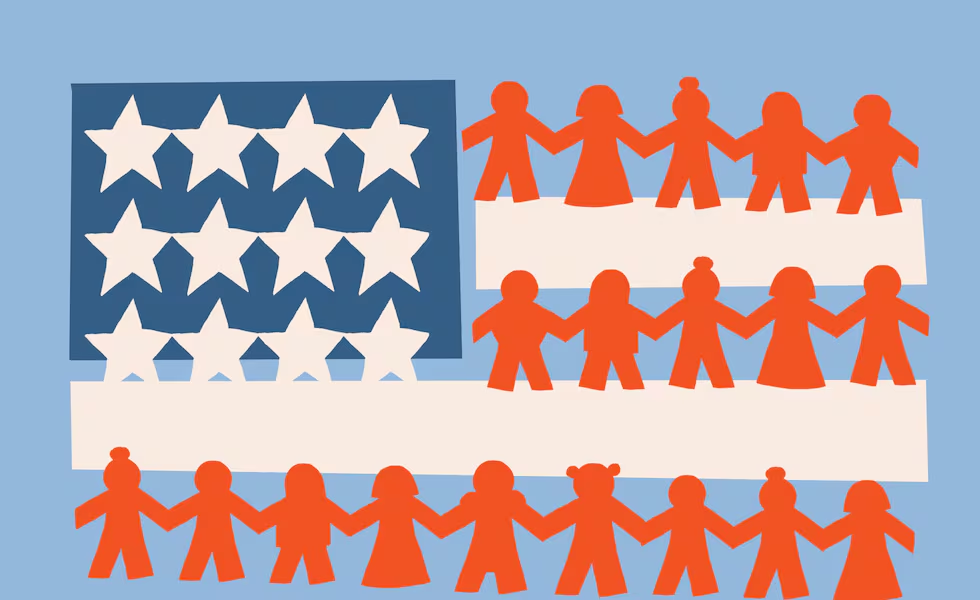
A larger, more urgent truth emerges above the partisan fray: What America needs most is not another blue or red wave battling for superiority and control. What our republic truly needs, and what our fragile democracy requires, is a wave — a three-color tide representing all the colors of our flag, red, white and blue
For decades, American political life has been defined by the tug-of-war between Republican red and Democratic blue. Interestingly, the color identifiers changed places over the years, with both parties avoiding the communist associations of red during the 1980s. It was the disputed 2000 Bush vs. Gore election, with its infamous “hanging chads,” that solidified our current color-coded political landscape.
Opinion: A divided Washington can still get things done — here’s where it should start
Everyone called it a blue wave. But were the midterms more about independents?
Since then, Americans have increasingly mapped the nation in partisan colors, dividing regions, states, neighborhoods and even families into opposing camps. For too many, political victory means total defeat for the other side. Governing consequently becomes a series of policy swings, depending on which party holds the gavel.
A more balanced red, white and blue tide, one that prizes cooperation over partisan warfare, might produce a more hopeful, coherent and unified government. It would encourage us to rediscover the common ground that anchors our self-governing republic and serves citizens of every political persuasion.
Colors in harmony
Many Americans now see political progress almost exclusively through the lens of their particular party. If we regarded the colors of our flag as complementary rather than conflicting, we might spare ourselves considerable division and grief.
Each color carries its own associations. Red can signify love, passion, courage and individual initiative, but also anger and danger. Blue can represent truth, loyalty, intelligence and fidelity, but also coldness and aloofness. Together, however, the colors suggest a larger vision of America — one in which different strengths and perspectives contribute to a common purpose.
Our political parties need each other
Political parties, like the colors of our flag, possess both strengths and weaknesses. When we see only the shortcomings of our opponents, we diminish the possibilities for cooperation and accomplishment. In a political sense:
Opinion: You want a village — but are you willing to be a villager?
- Red might represent the virtues of individual liberty and personal initiative: the freedom to pursue worthy enterprises, raise families, practice one’s faith and chart one’s destiny without unnecessary government interference.
- Blue might represent fidelity, unity and our collective responsibility to care for one another and the natural world. It affirms that we are all in this together and that a strong nation ensures every citizen a voice, equal protection under the law, and access to opportunity, regardless of political affiliation, background or ZIP code.
- The independent center might represent the democratic values that transcend party: integrity, fairness, openness, accountability and respect for the rule of law. It reminds us that our civic institutions belong to all Americans and that truth, trust and the integrity of our elections are essential to democracy’s survival.
Beyond temporary victories for Republicans, Democrats and independents lie the enduring principles that founded our republic and bind us together.
Together, these elements represent something greater than any political party. We pledge allegiance to a multicolored flag representing “one nation under God.” It is our shared commitment to the national motto, “e pluribus unum” — “out of many, one” — that should inspire our collective devotion to democracy.
Thinking in these terms could help us achieve greater political balance and more stable, enduring governance.
Restoring that balance requires looking beyond our respective parties and short-term electoral victories toward the longer and larger work of nation-building. It means rejecting the notion that compromise is betrayal and recognizing that principled compromise is an essential engine of democratic progress. It also requires elected officials to govern for all their constituents, not merely the partisan base that put them in office.
A wider and deeper citizen awakening
A Republican, independent and Democratic tide would also require an awakening among citizens, something that may already be happening. As Republicans and Democrats have hardened their political positions and widened the divide between them, the number of Americans who identify as politically independent has grown. According to a recent Gallup poll, 45% of Americans now identify as independents, with the remainder identifying equally as Republicans and Democrats, at 27% each.
Opinion: Three cheers for strong government
This growing independent constituency could become an important force for political renewal. Rather than simply occupying the space between two opposing parties, independents could help create a political culture that rewards cooperation, demands accountability and places the common good above partisan advantage.
Democracy is neither a spectator sport nor a blood sport. It is a shared commitment to living as one nation, bound by a higher moral obligation to justice, mercy and mutual respect.
Beyond the swinging pendulum
The midterms are over, although some ballots may remain to be counted. But the work of democracy never stops. As the political pendulum swings, we should consider not simply which party or group may benefit from its movement, but what kind of nation we hope to build regardless of which way the pendulum swings.
Beyond temporary victories for Republicans, Democrats and independents lie the enduring principles that founded our republic and bind us together. Let us build a wave that reaches every corner of this country, lifts our communities and renews our commitment to our founding ideals.
It is time to let all the colors of our flag wave together — not as competing political identities, but as symbols of a shared national promise.