Quo Vadis, Hispania? Part VI
Mass migration—largely from Africa, Asia, and the Middle East—is transforming the European continent today. Spain is at the forefront of this “demographic transition,” as previous installments in this series have detailed.
Migrants from outside the EU (and their descendants) make up a fifth of Spain’s population today. As recently as Spain’s 1991 census, that population basically did not exist. Most of these non-EU-origin migrants are from Latin America and Morocco.
This non-EU-origin population accounts for almost 30 percent of Spain’s youth under age 30. Yet it is curiously difficult to find out how well they are assimilating from official Spanish sources.
Nearly 90 percent of the non-EU second-generation (2-G) population under age 30 hold Spanish nationality—so Spain’s nationality-based statistics on (for example) employment, education, and public assistance can tell us nothing about them. Add in first-generation (1-G) citizens, and half of Spain’s non-EU-origin youth is “invisible” to nationality-based metrics.
Nevertheless, hints about youth assimilation show up in international student achievement tests and microdata from official surveys where parental country of origin is identified.
To begin: maternal education is quite limited in most of Spain’s non-EU homes. Take women 45–54 years of age—the likely mothers of most of Spain’s 16–29 youth cohort. Over half of those who were Spanish natives had higher education. Among Latin Americans, it was under a third, and less than a tenth for those from Morocco or the rest of Africa. Over half from Africa had only primary schooling or less. Although educational attainment is higher for younger women, big gaps between natives and non-EU migrants remain.
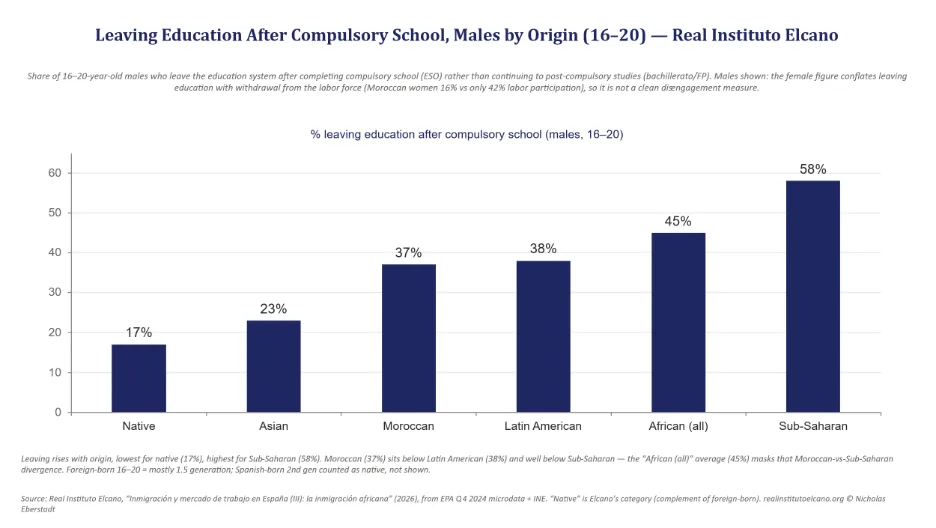
These are serious disadvantages for rising migrant youth to overcome—and many are not doing so. Spain’s Elcano think tank found that young non-EU-origin men were much less likely than native Spaniards to continue education after minimum compulsory schooling. Non-continuation was over twice as likely among Moroccans and Latin Americans, triple for sub-Saharans.
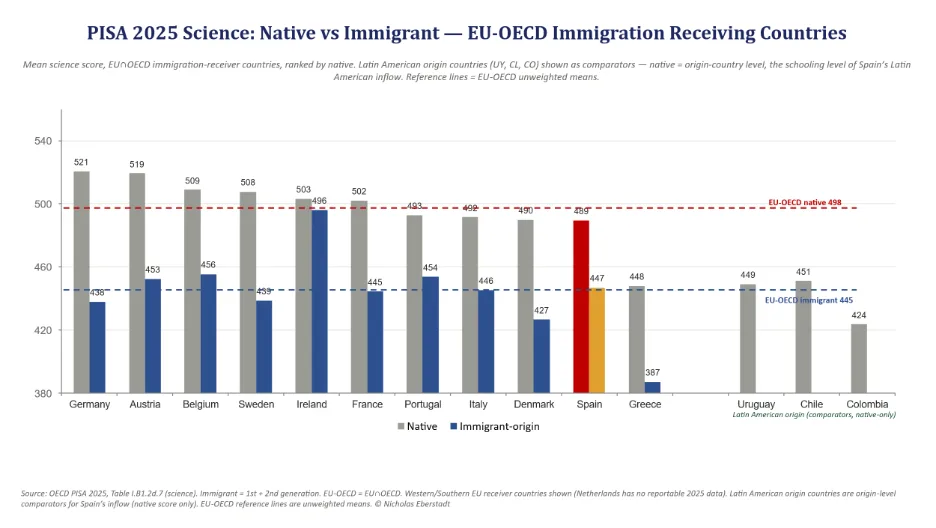
For those still in compulsory education, Spain’s 1-G and 2-G students perform more poorly than native Spaniards, according to the global Programme for International Student Assessment (PISA) findings. In 2025 the science gap in Spain between natives and immigrants was equivalent to about two full years of learning—and was only this small because Spain’s natives are relatively low achievers themselves. (Note that immigrant scores corresponded to national averages from Latin America.)
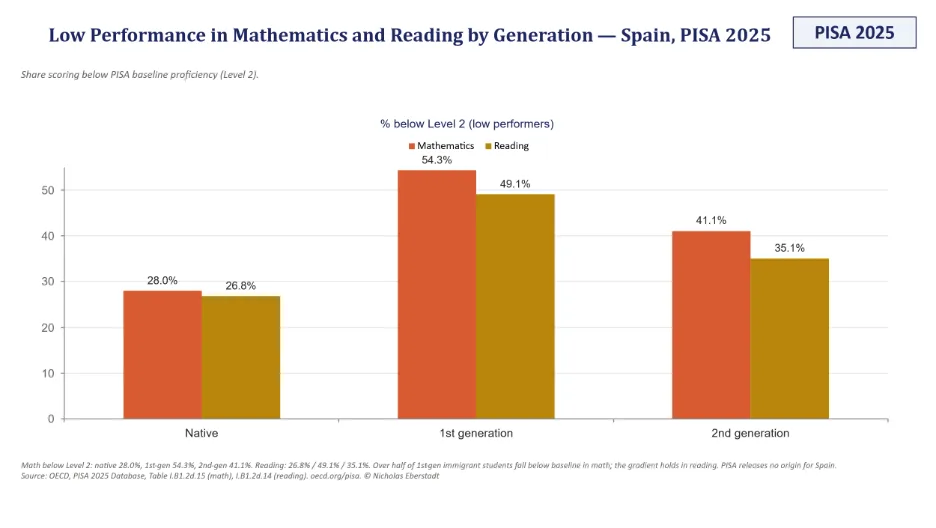
It is no better in math and reading—Spain’s immigrants score markedly worse than natives, though 2-Gs fare better than 1-Gs. (1-G reading comprehension is oddly weak, considering the high share of Latin Americans in Spain’s immigrant population.)
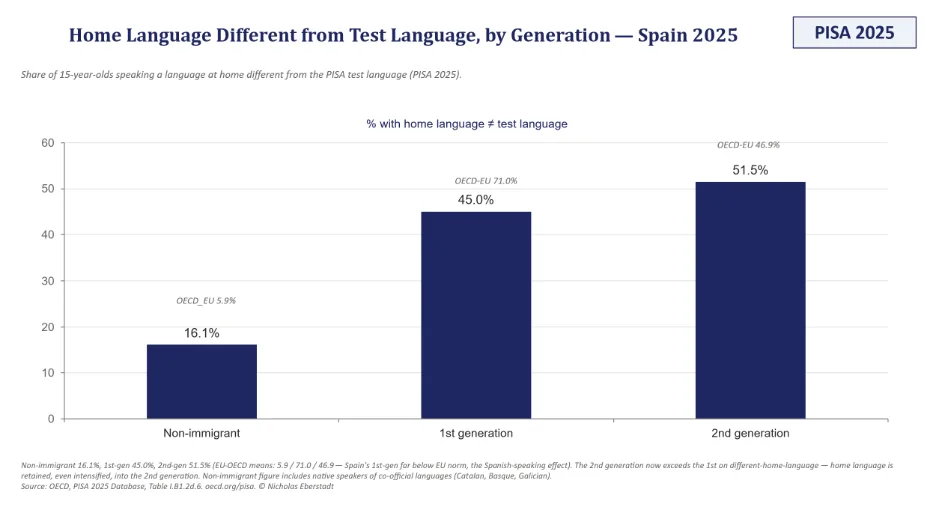
One measure of assimilation is whether immigrants speak the national language rather than their native tongue at home. PISA reports this is not happening in Spain—exactly the opposite, in fact.
And while Spain’s 1-Gs were much more likely than other EU-OECD immigrants to speak the national language at home (Latin American diaspora), Spain’s 2-Gs were less likely than their counterparts elsewhere in Europe.
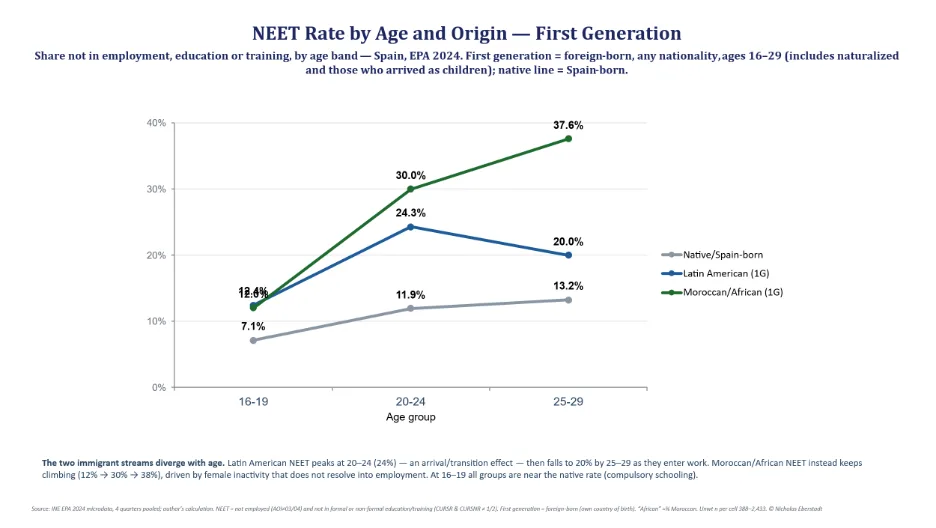
Poor achievement in school and lower educational attainment track with weaker workforce performance. “Neither in Education nor Training” (NEET) is a metric widely used to track dropout youths. Official microdata below contrast NEET rates in Spain for natives, 1-Gs from Latin America, and 1-Gs from Africa for age 16–29. Throughout, NEET rates are markedly higher for these immigrants than for natives. By age 25–29, NEET rates are approaching 40 percent for the African group—almost triple the Spain-born group.
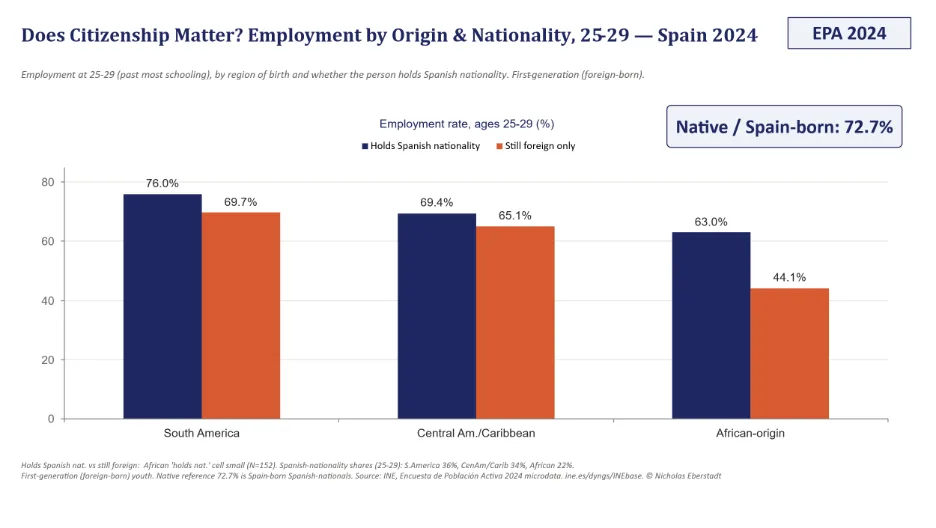
With youth employment for age 25–29, the good news about assimilation is that native Spanish levels are met and even exceeded by naturalized South Americans. The bad news is that almost everyone else from the non-EU diaspora does worse. Employment rates for people age 25–29 from Morocco and the rest of Africa are dismal—with noncitizens almost 30 points below Spanish natives.
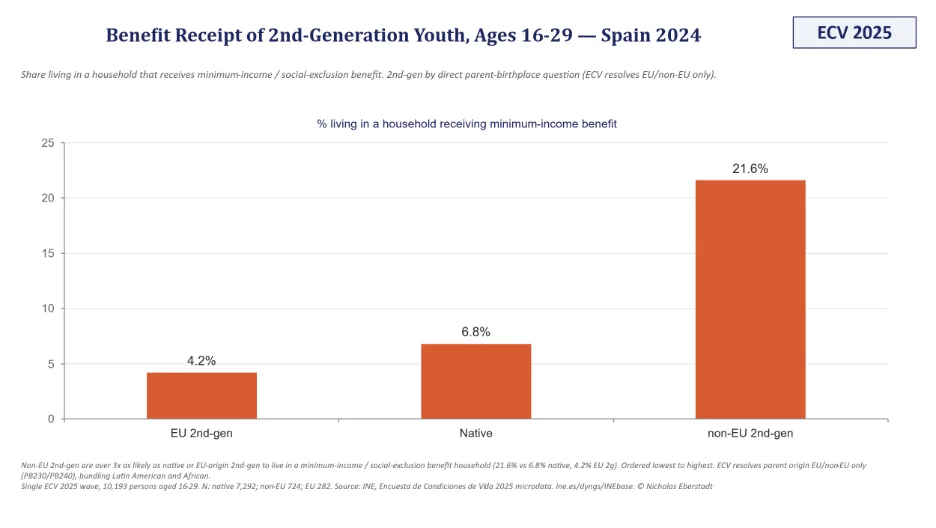
And 2-G non-EU youth age 16–29 are three times as likely to be in homes collecting social support as the “native” grouping (which still includes some “invisible” immigrants) and five times as likely as EU immigrant counterparts.
One last assimilation measure: marrying outside one’s origin group. Official microdata offer a glimpse into Spain’s 2-G homes.
By this measure, assimilation is starkly bifurcated—with parents from the EU, Mexico, Central America, and the Caribbean typically marrying outside their group, and everyone else tending to stay with their own. The endogamy rate exceeds 90 percent for African women.
Spain’s assimilation problem appears centered in this African diaspora—and that rapidly growing group accounts for as much as 45 percent of all 2-Gs in Spain today.
More on what this may mean for Spain’s future next time.