A Tale of Two Generals
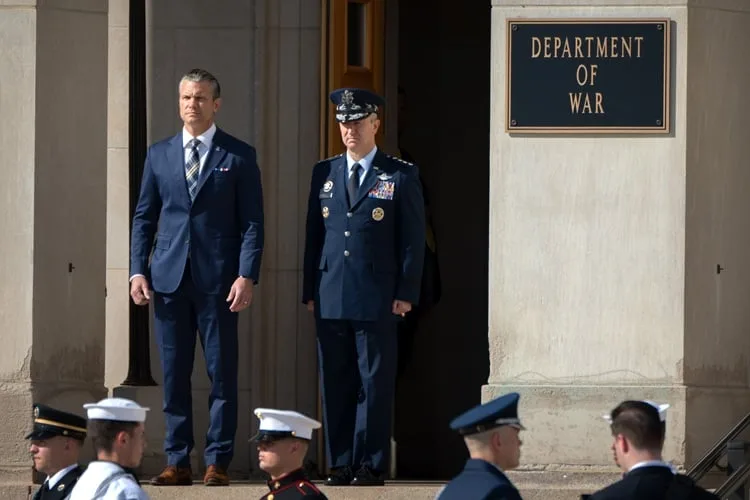
This is a tale of two generals—a general and admiral, to be specific. The general is Dan Caine, chairman of the Joint Chiefs of Staff, and the admiral is Brad Cooper, the commander of US Central Command. Both are officers with decades in the profession of arms: Caine has 36 years of service, Cooper has 37. Both earned the respect of their military superiors for conduct in combat. Both were promoted by their respective services and assigned into leading operational and advisory roles.
Neither can claim innocence of politics, because both have been military representatives in civilian environments at the highest policy levels. Caine worked in the White House and the Office of the Secretary of Defense. Cooper worked in the White House and the Office of the Secretary of Defense, and he was the Navy’s lead for legislative affairs. Neither can fail to understand how current choices in their highly visible and important jobs will be measured against the norms of their profession, making their respective and contrasting choices so illustrative of the state of US civil-military relations.
Beginning with his confirmation hearings, General Caine has navigated politics adroitly. President Trump claimed that when they met in 2018, Caine was wearing a MAGA hat and proclaimed, “I love you, sir. I think you’re great, sir. I’ll kill for you, sir.” When asked about this during the hearings, Caine denied the story but gave the president a face-saving excuse, saying, “I think the president was actually talking about somebody else. . . . I’ve never worn any political merchandise or said anything to that effect.”
He has chosen to speak little in public and confines his commentary at press conferences narrowly to the military elements of ongoing operations. During rarely held Pentagon press briefings, Secretary Hegseth prefers bombasts while General Caine doggedly sticks to the military objectives, diverting political questions by focusing on service members. He has kept silent on what advice he provides the president, even when he is grilled by Congress or reports of it become news.
Caine is criticized for failing to protect or publicly protest the firings of two dozen senior officers. However, the president and secretary of defense have that authority, and it is an important element of civilian control that they can fire any military officer, so publicly objecting to the firings would itself be a norm violation.
Reporting suggests Caine has provided sound military advice to the president, counseling that the US 2025 campaign against the Houthis would divert military resources from higher-priority objectives in the Pacific and cautioning about consequences of the Iran war.
He has also honored his obligation to the other source of civilian control over the military, testifying before Congress that he did not share the president’s judgment that the US was being invaded and therefore needed to deploy military forces into American cities.
When asked by Senator Elissa Slotkin about the use of the military during elections, General Caine definitively affirmed that
the Joint Force has acted, and will continue to act, in accordance with the Constitution and the law.
. . . The Joint Force has no plans to send Federal military personnel or Federalized members of the National Guard to polling places during the 2026 elections. Likewise, the Joint Force has no plans to use such personnel to seize ballots, voting machines, or other election material.
By contrast, Admiral Cooper has taken a much more active role in supporting administration claims. His military advice to the president on Iran evidently did not emphasize the risk of Iran closing the Strait of Hormuz, nor did he anticipate and prepare for Iranian attacks on US bases.
His March 3 claim to have eliminated the Iranian Navy was issued as a White House press statement. On March 11, he claimed, “We set out to dismantle the Iranian regime’s ability to project power beyond its own borders, and we clearly accomplished this task.” Even though attacks in shipping are at record levels, Cooper released a video of himself declaring that “the Strait of Hormuz is controlled by the United States and our partners, not Iran, and it remains open for business.”
Caine may be more conscious of the significance of his choices given he is in the highest military assignment as chairman, and he is the first chairman selected from the reserve component, the first to require a waiver for not meeting the job’s statutory requirements, and the second recalled into active duty from retirement. But Admiral Cooper cannot be unaware of how his decisions to hew to civilian leaders’ easily refuted fictions about the state of the war portray the military as a partisan force. By participating in the administration’s politics, Cooper is corroding military nonpartisanship and damaging the military as an institution.