Euclid’s newest release unveils a cosmic treasure trove
Back on July 1, 2023, ESA’s Euclid space telescope launched.
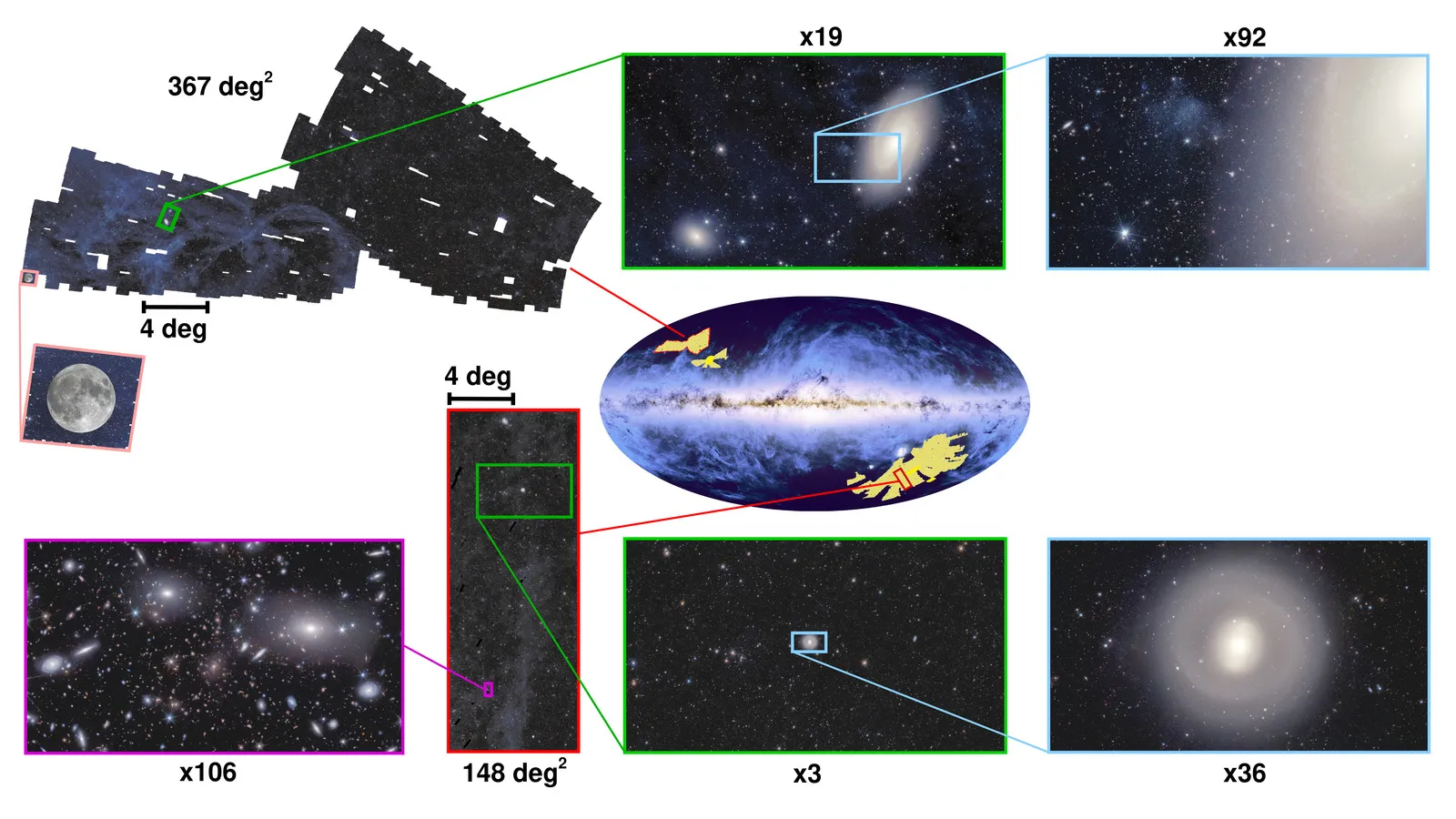
 This Falcon 9 rocket launch from July 1, 2023, carried the ESA’s Euclid mission into space. The Euclid space telescope, after deployment, commissioning, and calibration, has begun mapping out the Universe, and will cumulatively image 14,000 square degrees of sky: more than a third of the Universe. The imaging will be primarily out of the galactic plane, as the main science goals focus on extragalactic observations of cosmological importance.
This wide-field observatory is currently imaging and mapping out huge, 3D volumes of the Universe.
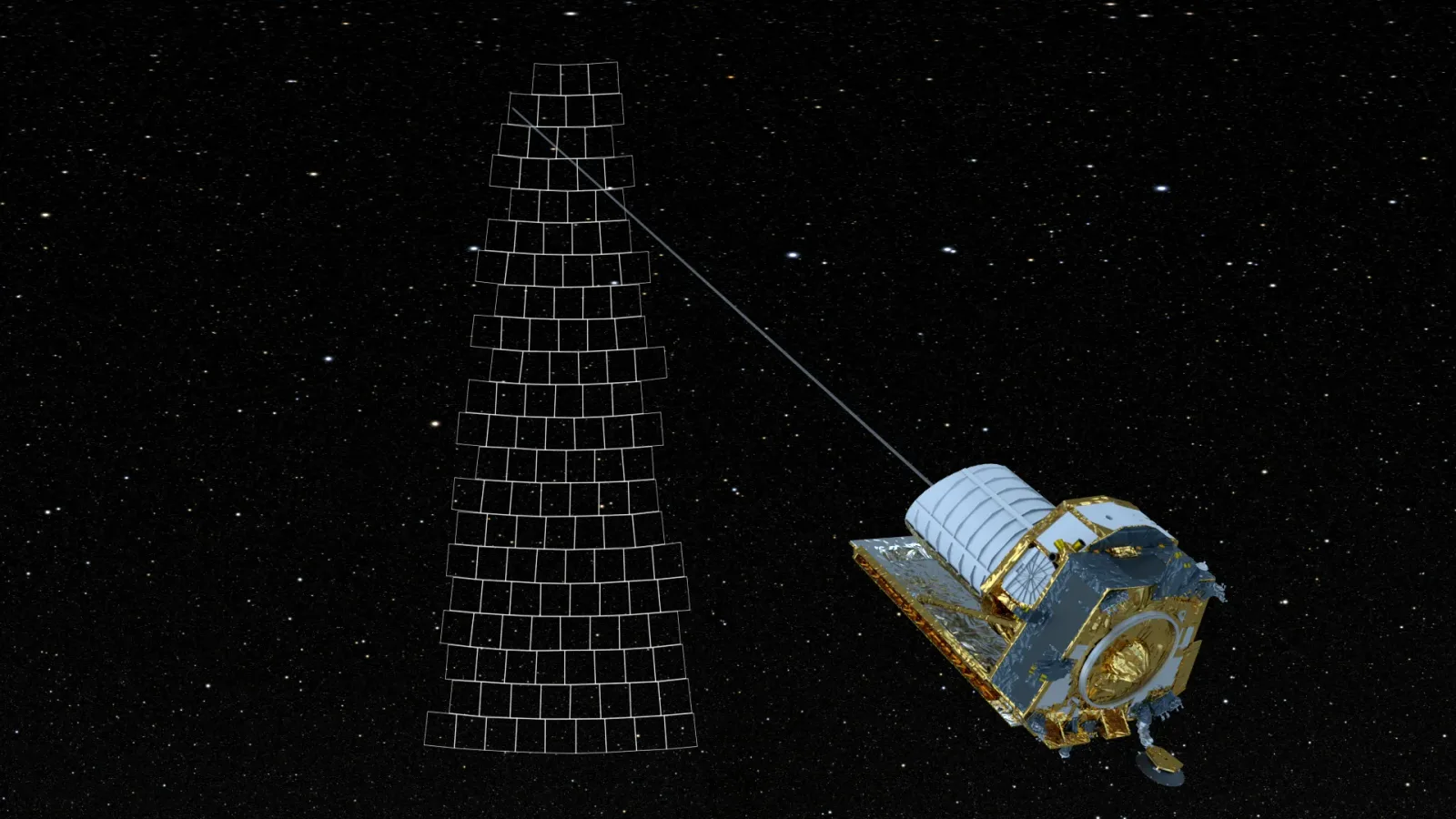 Each time the Euclid telescope points at a region of sky, its VIS and NISP instruments have access to the same half-a-square-degree (0.57 square degrees) so long as Euclid remains pointed there. Once observations are complete, Euclid then “steps” to point at the next, adjacent patch of sky. By performing tens of thousands of these steps, Euclid will build up the largest high-resolution extragalactic catalog in history.
Alongside SPHEREx, Roman, and the ground-based Vera Rubin observatory, Euclid heralds a cosmological revolution.
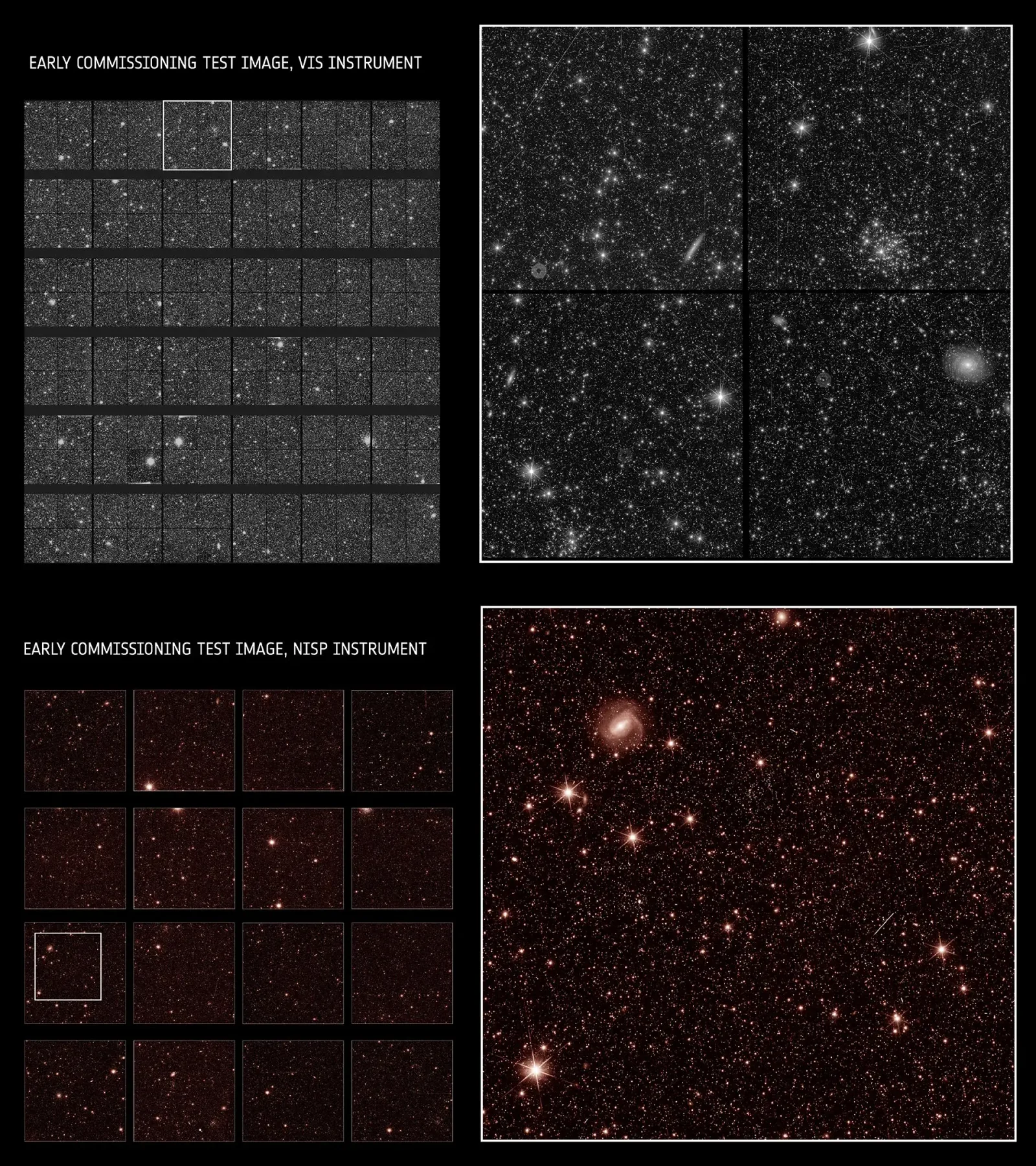 These two images, taken relatively early in the commissioning process of ESA’s Euclid telescope, shows a series of “steps” that the telescope stared at with both its monochrome VIS instrument as well as its near-infrared NISP instrument, which itself has three separate photometric filters. There will be tens of thousands of these “steps” all told, imaged and collected throughout Euclid’s nominal 6-year mission.
Its two main science goals are to probe dark energy’s and dark matter’s properties.
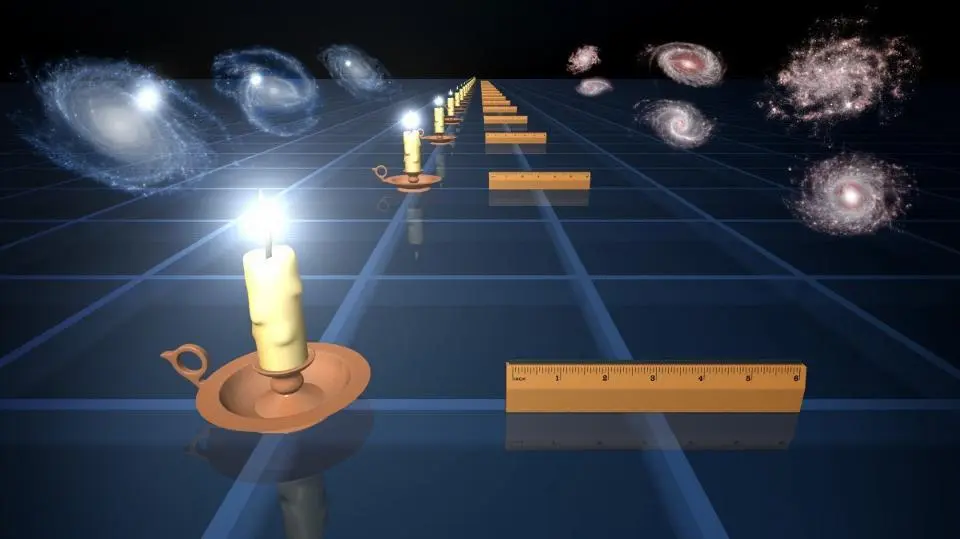 Standard candles (left) and standard rulers (right) are two different techniques astronomers used to measure the expansion of space at various times/distances in the past. Based on how quantities like luminosity or angular size/diameter change with distance, we can infer the expansion history of the Universe. Standard candles involve looking at objects whose intrinsic brightness is known at all cosmic distances, while standard rulers involve looking at features such as the physical size of a known object or the average separation distance between any two galaxies (imprinted from baryon acoustic oscillations during the early stages of the Big Bang) that evolve as the Universe expands.
It accomplishes this by mapping out enormous numbers of galaxies across 14,000 degrees of sky.
 By targeting the most dust-free regions of the sky, the ones least obscured by the foreground material present in the Milky Way, ESA’s Euclid mission seeks to map out an enormous portion of the sky at great depth and at very high resolutions. The science goals are to map out galaxy positions and the effects of mass throughout cosmic history, revealing new information about dark matter and dark energy.
Galaxy clustering information, in 3D space, reveals how likely galaxies are to be separated by specific distances.
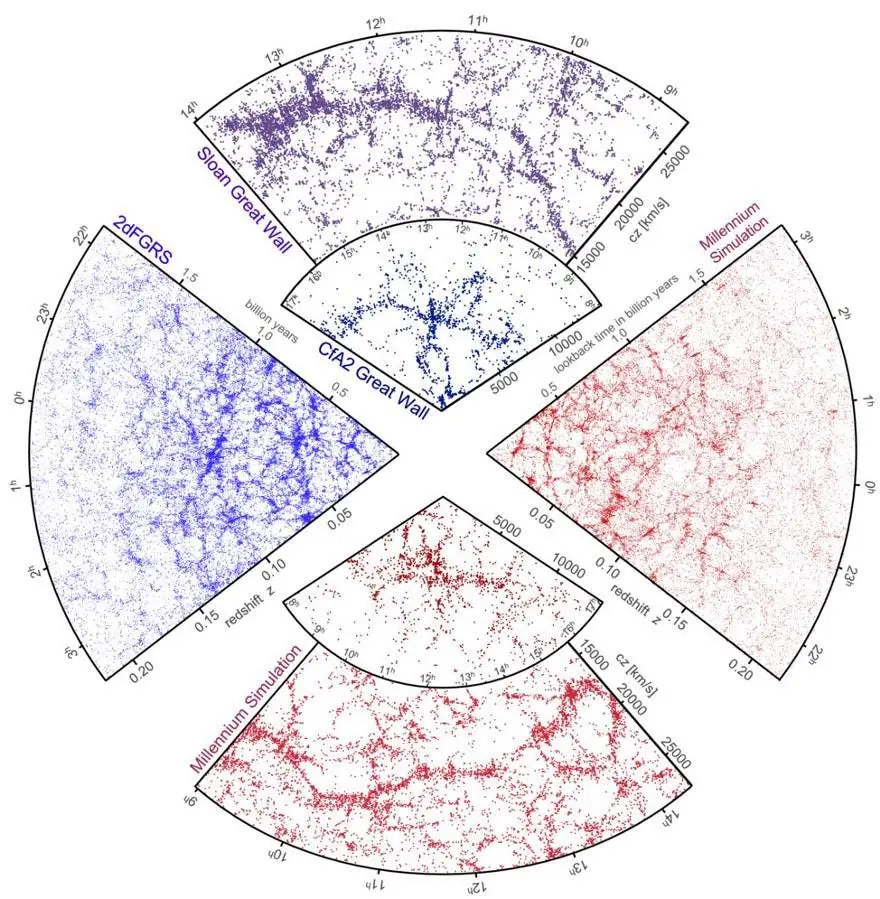 On the largest scales, the way galaxies cluster together observationally (blue and purple) cannot be matched by simulations (red) unless dark matter is included. Although there are ways to reproduce this type of structure without specifically including dark matter, such as by adding a specific type of field, those alternatives either look suspiciously indistinguishable from dark matter or fail to reproduce one of the many other observations in support of dark matter. Thus, measuring large-scale clustering provides a probe of dark matter.
Credit: 2dFGRS, SDSS, Millennium Simulation/MPA Garching, and Gerard Lemson & the Virgo Consortium
A key clustering distance scale — the acoustic scale — reveals dark matter’s properties.
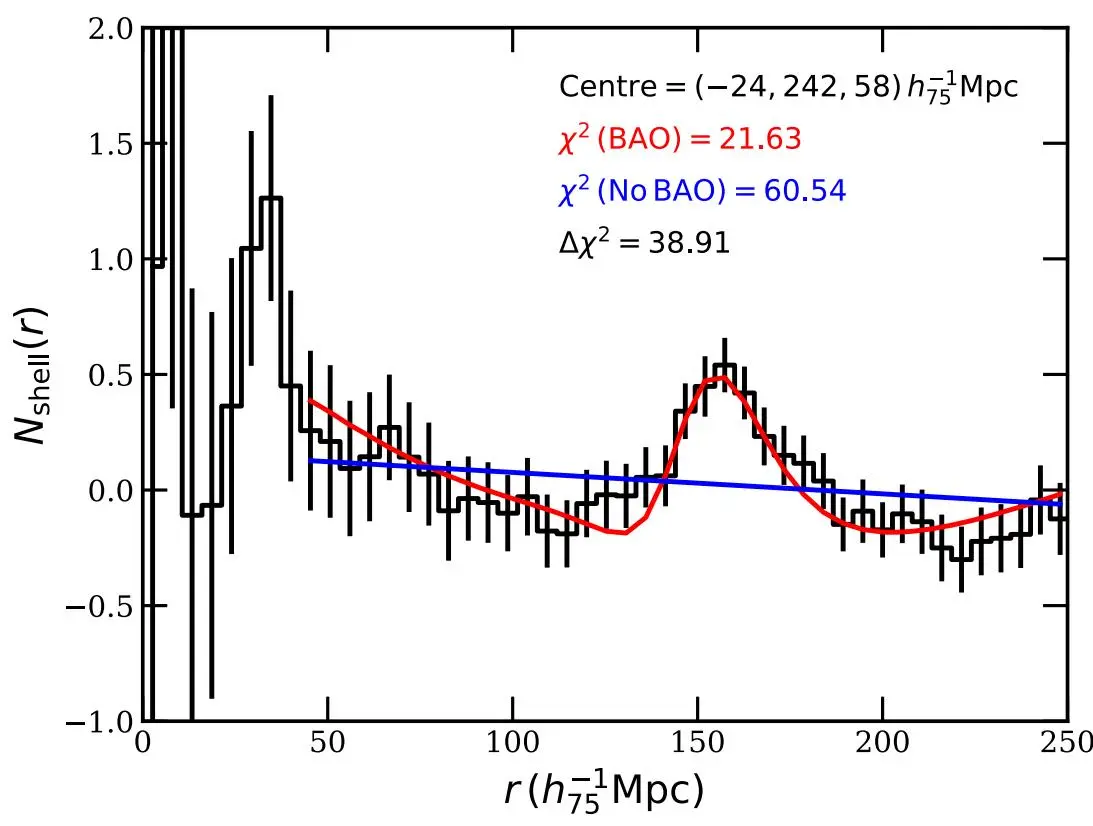 When the galaxies within the structure dubbed Ho`oleilana are analyzed statistically, it’s very clear that there is strong evidence for clustering-above-pure-randomness on scales of 155 Mpc or so: about 500 million light-years. This corresponds to the expected acoustic scale with an amplitude that matches the 5-to-1 dark matter-to-normal matter ratio expected from other lines of evidence, making this the first evidence for an individual baryon acoustic oscillation in the Universe. The acoustic scale expands as the Universe expands, giving 3D surveys, like those conducted by ESA’s Euclid, the opportunity to track this feature over cosmic time, providing a measurement of the expansion rate as a function of time.
Credit. R.B. Tully et al., ApJ, 2023
Complementarily, weak lensing — apparent shape distortion by foreground masses — reveals how cosmic structure grows.
Via the growth of this structure, we can probe dark energy’s nature.
Euclid, covering 14,000 square degrees cumulatively, also yields a broad range of astronomical phenomena.
Spectroscopic capabilities pin down the redshifts of distant galaxies.
Strong lenses magnify background objects, particularly within rich galaxy clusters.
Some 15,000 galaxy-galaxy strong lens candidates also appear.
Superclusters abound: containing dozens of individual galaxy clusters apiece.
Rare objects, like ring galaxies, abundantly appear.
Additionally, novel, rare, faint features appear even in well-studied galaxies.
An ongoing website, EPOD, highlights Euclid’s picture of the day.
Mostly Mute Monday tells an astronomical story in images, visuals, and no more than 200 words.
This article Euclid’s newest release unveils a cosmic treasure trove is featured on Big Think.