Perspective: Horror movies are more popular than ever. That can’t be a good thing, right?
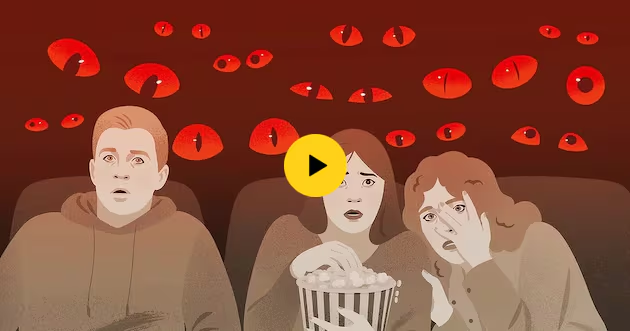
Every year around my October birthday growing up, we used to bundle up with teenage friends and head to one of Utah’s haunted houses, from the Haunted Forest to Rocky Point Haunted House.
Our excitement was always mixed with foreboding. I remember my friend crying in line as we heard the screams from the other side of the wall. But scary moments mostly added fun to life, from Lagoon’s Dracula’s Castle to scary stories around campfires to epic “Twilight Zone” and Alfred Hitchcock films.
That changed after serving a mission for The Church of Jesus Christ of Latter-day Saints in Brazil. Walking down the stairs from our apartment one morning, my companion and I saw our neighbors preparing a goat to be sacrificed in what I later learned was part of Candomblé — an Afro-Brazilian religion where participants actively seek out spirit possession.
When our mission president found out, he arranged for an immediate move. Haunted houses weren’t just make-believe anymore from then on. They were touching on something real, and I didn’t want anything to do with it.
The horror moment
Upon learning how much the horror movie genre has expanded recently, I was, admittedly, a little horrified.
What used to be a seasonal film genre has become a year-round theatrical juggernaut worth $14.5 billion globally and projected to double over the next decade. Horror’s share of the domestic box office has grown over the last 10 years from roughly 4.4% in 2015 to 15.5% today.
The most obvious driver here is financial: Even modest production budgets routinely generate outsized profit.
But why is there such growing interest in the first place?
I reached out to J Celene Anderson, a Utah filmmaker who produced a short horror film, “The Angel,” to ask what this all means.
Scary stories teaching a lesson
Anderson reminded me that scary stories are “ubiquitous” throughout human history — originally in folktales and religious messages to teach and warn.
Even the frightening underworld in “The Epic of Gilgamesh” over 4,000 years ago was intended to teach moral lessons, as was a first-century Roman magistrate’s story of an Athenian mansion terrorized by noisy phantom: “In the silence of the night … if you listened with closer attention, the rattle of chains was heard.”
The Brothers Grimm were forced in 1819 to defend frightening, cannibalistic tales like “Hansel and Gretel” — emphasizing to readers how their stories could teach children that while evil may threaten for a time, virtue can still prevail in the end.
Scary stories that just scare
But in 1764, English writer Horace Walpole broke from tradition by publishing “The Castle of Otranto,” prompted by his own nightmare. The story centered on a haunted ancestral castle, curses and moving paintings surrounding a protagonist who is “shocked” by the many “lamentable sounds.”
Although some tried reading messages into the story, Walpole himself — who turned his own London villa into an eccentric mock-Gothic castle — pushed back, explaining that “terror” was the story’s “principal engine” so that “the mind is kept up in a constant vicissitude of interesting passions.”
What made Walpole’s story significant, historian David Punter said in “The Literature of Terror,” was separating horror from any adjoining lesson. No demonic punishment of sin or terrifying the wicked to repent. Instead, fear was presented as a visceral thrill in its own right.
Over a century later in 1896 — one year after the first public motion picture — French filmmaker Georges Méliès’ four-minute silent film, “Le Manoir du Diable,” (The House of the Devil) became the world’s first horror movie — featuring a bat transforming into Satan, caldrons, phantoms, dancing skeletons and witches.
Since that time, an astounding 50,000 horror feature films have been cataloged — a number that doubles if we count short films, television specials and unreleased independent films.
Some argue that young people are most attracted to this genre due to their mounting cynicism about a society without “good guys.” Others argue these films further reinforce the darkening mood around us.
Scared of scary stories
I pressed Anderson: How many of these films truly have redeeming qualities outside of the thrill of being scared? Sensing my skepticism, she emphasized the lessons that could be gained. She quoted Brigham Young, who encouraged believers to embrace “every truth in heaven, in earth or in hell.”
Art helps us grapple with human experience, Anderson said, including fear. While we often dismiss distressing emotions as “bad,” uncomfortable feelings are crucial, she emphasized — including being warned of danger, called to repentance or stretched to grow.
She’s got a point. What would we miss by avoiding “The Passion of the Christ” or “Schindler’s List” because they were disturbing and sad, or “Les Misérables” because of unsettling scenes? Could we make space for a frightening saga like “A Quiet Place” to offer something meaningful?
A double elimination and the season’s first perfect score highlighted Horror Movie Night. | By @cakekeith123 pic.twitter.com/sZaRFNIPyv
— Deseret News (@Deseret) October 29, 2026
‘I can experience fear — and be OK’
People who have faced severe trauma in the past or who currently grapple with anxiety may naturally try to avoid scary media.
But similar to watching a hero fight their way through impossible odds in an action-adventure movie, Anderson suggests that watching a protagonist endure frightening scenarios can generate relief, fearlessness and an ability to “tolerate feeling the discomfort.”
Danish scholar Mathias Clasen suggests horror can act as an “anxiety gym.” The threat is over after 90 to 120 minutes — providing audiences with a sense of emotional mastery harder to find in modern life.
“Fairy tales do not tell children dragons exist,” G.K. Chesterton has been paraphrased as saying. “Children already know that dragons exist. Fairy tales tell children that dragons can be killed.”
Fear as teacher
In a discussion about horror movies on the Jeremy Boreing show, author Spencer Klavan pointed out that many of these films “take place in a universe where there’s Satan but no God, effectively.”
At the same time, horror films frequently delve into religious motifs in unsettling, twisted ways. As therapist Jill Manning told Deseret News, “when clergy are depicted in sinister ways, demons are shown as unstoppable, or pious women are demonically possessed despite their faith,” this can undermine in viewers their sense of “what humans can reliably count on.”
Nonetheless, filmmakers like Anderson still don’t want to give up on the positive potential of fearful accounts in our education. She noted that early miracles recounted in the New Testament were exorcisms. And in a founding story of her own faith, she pointed out, Joseph Smith was attacked by the adversary.
Famous fictional stories like “Dr. Jekyll and Mr. Hyde” and “The Wolf Man” also illustrate the consequences of letting darker, animalistic impulses overwhelm us.
Anderson has felt these lessons personally, describing herself as a “scaredy-cat” growing up — refusing to open her eyes on Lagoon’s Terror Ride or Dracula’s Castle.
While studying film at Brigham Young University, she was experiencing “a bit of a faith crisis” until her colleague pitched a horror story about a woman being deceived.
Anderson described seeing herself in that story and feeling freed to wonder, “Why aren’t I questioning myself?” That prompted her to open herself to new experiences with God.
Drawing sensible lines
There are sensible age limits, Anderson concedes. Although action films like “John Wick” have a higher overall body count, violence in horror films tends to be more graphic and detailed — using knives instead of firearms and focusing on fearful anticipation and physical suffering.
Yet rather than considering scary movies “innately good or bad,” Anderson suggests asking: “Does this media create hatred in your heart for yourself or God? Does it lead you to want to inflict violence? Are you learning anything?”
After 30 years of staying away from haunted houses, I took our family to a local spook alley this last weekend. My wife found it grotesque and questioned the point of it all. But after hearing all the nervous giggling and watching my boys hold on to each other the whole time, I came away feeling differently.
I’ll probably take them again next year.
Books by a horror author were used without permission to train AI models. What now?