Photo essay: Antelope Island Bison Roundup thrills first-timers, longtime riders
The sun hadn’t yet risen over the Great Salt Lake, and a chilly wind blew as 19-year-old Annie Watson secured the chaps of her mother, Kate, at the historic Fielding Garr Ranch on Utah’s Antelope Island State Park. The pair, who traveled with a posse from Walla Walla, Washington, were preparing for the 40th annual bison roundup.
For Annie, whose birthday it is, this was a once-in-a-lifetime experience. “I have been riding since I was a baby. I’ve known how to ride my entire life,” she said. She participated in 4H and the Future Farmers of America, and competed in barrel racing and pole bending. A lot of her friends in Washington have cattle ranches, she said, so she helps them move their herds in the mountains. “I’ve personally never been on anything as steep as the bison roundup, but I have ridden on some pretty crazy terrain before that.”
No bison were yet in view, however, as the sun finally peeked over the distant Wasatch Range, illuminating the Walla Walla group’s camp with golden light, as mother and daughter went about grooming and tacking up Tank and Lucky, their horses for the long day ahead.
Ervin Gross, whose own hair matches the mane of his black-and-white appaloosa, Jack, remarked that he just might be getting too old for such things after a decade on the roundup. “Jack,” he said, is short for a crass but affectionate nickname. “Sometimes I want an easier ride, but he just wants to go, go, go.”
He appreciates Jack, though, and brushed his white hair before fitting him with a red, white and blue blanket and beautifully embossed leather saddle.
There is a common thread among Gross and his family and friends, including Annie and Kate Watson: They all love the outdoors and the cowboy lifestyle. “Some of the riders are genuine cowboys and girls. Some, like myself, wish we were. I love the adrenaline rush less than I used to,” he said, but people and memories are the most important.
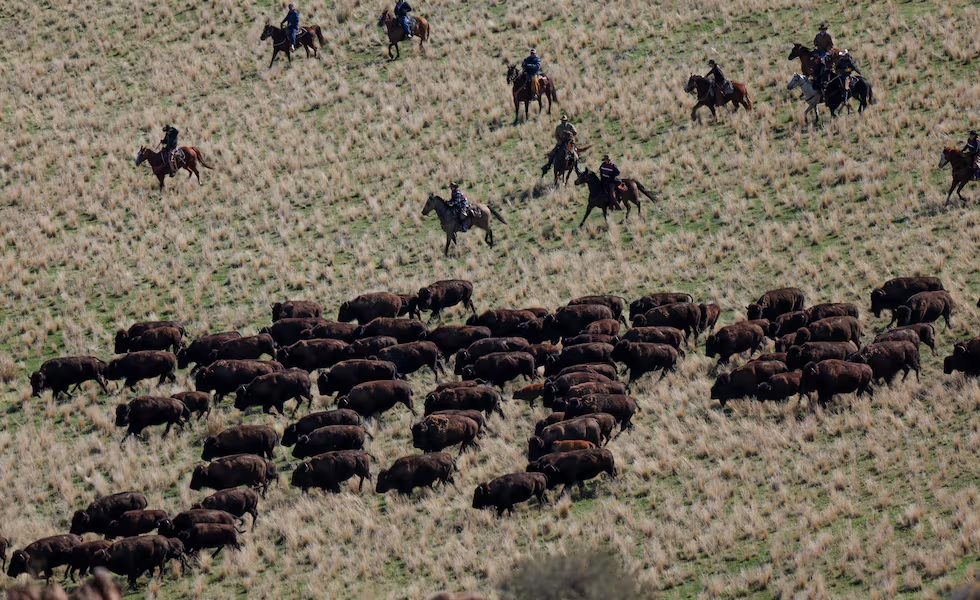
About 300 riders participated in the roundup this year, which is undertaken to check the health of each bison and maintain a sustainable herd size for the island, around 500-550 animals. In the days after the roundup, staff administer vaccinations, collect blood samples, weigh each bison, and perform an ultrasound check on cows and heifers for pregnancy. All bison have or will receive a computer-chipped tag that enables access to the animal’s history and helps ensure the overall health of one of the nation’s largest and oldest public herds.
Some of the animals will be sold at auction to reduce the size of the herd, as many calves are born each year and bison have no natural predators on Antelope Island. About 750 bison were rounded up this year, including more than 200 calves, according to park officials.
Kate Watson, who is a secretary and librarian back in Washington state but grew up riding horses, handed out sandwiches to her crew and braided her daughter’s hair before they joined the other riders for a safety briefing. Rios Pacheco, a member of Utah’s Northwestern Band of Shoshone, prayed over the group, wafting burning sage smoke with a bird’s wing.
William Glassman was responsible for bringing 12 bison to Utah in 1893, purchased from “Buffalo Jones” in Kansas, according to Ally O’Rullian, a public information officer for Utah State Parks. Glassman sold the small herd to John Dooly, who moved them to Antelope Island. Whether Dooly intended the bison for hunting, conservation, or otherwise is unclear, but as the herd grew over the years, those at Fielding Garr Ranch on the island had a tempestuous relationship with the animals.
“The ranchers had a mixed relationship with the bison. They’re not like cattle. They’re more difficult to handle,” said O’Rullian of Utah State Parks, who led a caravan of off-roading park vehicles during the roundup. Several large-scale hunts nearly wiped out the herd entirely. “By the time Antelope Island was bought as a state park, we bought the bison that came with it. And so, with that, we realized that there was a way that we needed to manage them and manage their health as well as the island’s health. And from there, the Bison Roundup was born.”
The bison have roamed freely throughout 28,000 acres of land since 1981.
The riders set out into the wilderness, soon coming upon a group of bison which they pushed over rocky hills between sagebrush and trees with fall-colored leaves. Members of the public watched from the road, sitting atop cars and peering through cameras and binoculars. The animals were slow-moving at first, but everyone knew they were highly unpredictable. Over the course of the day, clusters of bison, in varying levels of cooperation, were gathered by those on horseback. At one point, several bison made a break for the sand at White Rock Bay, evading the riders. Some remained elusive.
Many of the roundup volunteers were returning riders familiar with the roundup, like most of the Walla Walla posse, but for 19-year-old Annie, this was a first. There were some dicey moments.
“Up on top, which is where I was riding with the more difficult group, there was a trail, and you had to go down it and up the other side of the hill where the bison were. My horse was kind of slipping down the trail, and then we went up the other side, and he ended up going down to his knees at one point, ‘cause the trail was so steep, but he did really good,” she said. “Once we did get on top, the only sketchy part was kind of trying to direct the bison, ‘cause there were three of us, and we were trying to keep the bison from going over the wrong ridge.” They were handling about 50 bison at the time.
On the Monday after the roundup, when most of the bison were in corrals, park staff surveyed the island by helicopter for any remaining bison, said O’Rullian.
“It seems cliché to be like, ‘they’re wild animals, they do what they want,’ but really, it’s dependent on where they decide to be in their temperament. Some years, they don’t want to get pushed, so it takes a little bit longer to get them up and to get them moving. Other years, they’re in a great spot, and they’re ready to go,” she said. “Every year, staff are looking at ways to improve the experience for the riders as well as for the public, to ensure both a fun and safe event.”
For Annie Watson, the final push at the end, when riders drive the bison into the corrals in front of hundreds of onlookers, was the biggest thrill.
“I loved when we came down and brought that group of bison with us to the main group. I loved joining and seeing all of the other people riding, and I loved being part of the group that was actually pushing them, rather than behind,” she said. “I was up there in the grit of it all. And it was really fun bringing them in and seeing everybody cheer.”
Kate Watson said it was a joy to watch her daughter’s first roundup, and that she and Annie are somewhat opposite when it comes to horsemanship. Kate will jump a five-foot ditch with no second thoughts, while Annie is fearless on a horse in the arena.
“It was really fun to see her overcome her trepidation of the trails. You can still experience that same thrill that you get in the arena,” she said. “Running as fast as you can, scrambling up hills — it’s a major adrenaline rush. It’s every bit as fun and exciting as racing around those barrels. It was really fun to see her come out of her shell a little bit and experience both sides of the horse world.”